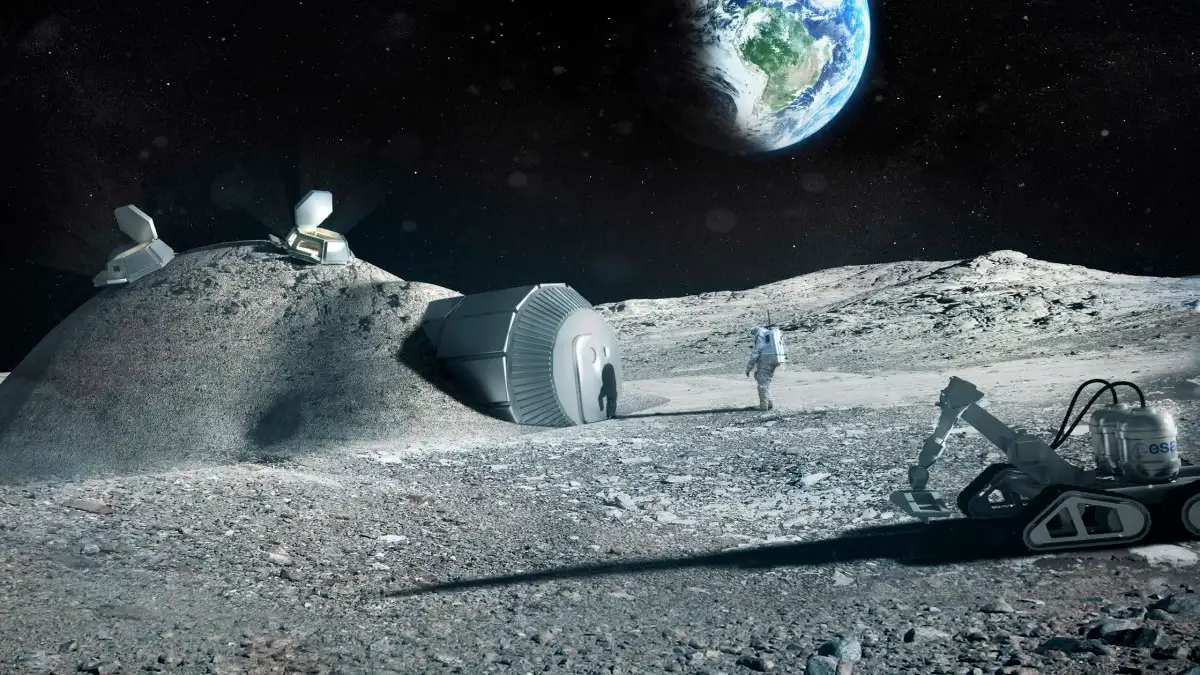
A future lunar base will not survive on rockets alone. Astronauts may reach the Moon with powerful launch vehicles, advanced spacecraft, and precision landing systems, but once they arrive, everything depends on energy.
A Moon base needs power for life support, communication, navigation, scientific instruments, rovers, lights, heaters, computers, air systems, water systems, construction tools, dust mitigation systems, and eventually resource processing. Without reliable energy, a lunar habitat becomes only a temporary shelter. With reliable energy, it becomes the foundation of long-term exploration.
This is why NASA lunar base power infrastructure is one of the most important parts of the Artemis future.
The Moon is a difficult place to build an energy system. It has long periods of darkness, extreme temperature changes, abrasive dust, rugged terrain, and no atmosphere like Earth’s. Some places near the lunar south pole receive more sunlight than others, but no location is simple. Power systems must survive cold, heat, dust, radiation, distance, and limited maintenance.
In 2026, NASA is not operating a completed permanent lunar base. That distinction matters. The accurate story is that NASA is developing the power technologies and surface infrastructure needed for future sustained lunar missions. These technologies include vertical solar arrays, energy storage, power management, distribution systems, fission surface power, cables, microgrids, thermal control, and robotic support systems.
In simple words, NASA is working on the energy backbone that future Moon missions will need.
Editorial Note
This article explains confirmed NASA lunar surface power work, current technology development, and future possibilities for Moon base energy systems. It does not claim that NASA already has a fully operating lunar base in 2026. NASA is developing lunar surface infrastructure through Artemis and related technology programs. Future deployment dates, mission schedules, and power system details should always be checked against official NASA updates.
Key Statistics and Facts
| Fact | Why It Matters |
|---|---|
| NASA’s Lunar Surface Innovation Initiative includes power and thermal management as a key technology area. | Power is one of the core systems needed for sustained lunar operations. |
| NASA is developing vertical solar array technologies for the lunar surface. | Tall solar arrays may help capture sunlight near the Moon’s south pole. |
| NASA and DOE are working on a 40-kilowatt-class fission surface power system. | Nuclear fission could provide continuous power when sunlight is unavailable. |
| NASA says fission surface power could operate regardless of environmental conditions on the Moon and Mars. | Reliable power is essential during darkness, dust, and extreme temperatures. |
| NASA’s Watts on the Moon Challenge focused on energy distribution, management, and storage. | A lunar base needs more than power generation; it also needs a working power grid. |
| NASA surface infrastructure includes habitats, life support, power generation and storage, communication, transportation, and resource utilization systems. | A future Moon base depends on many systems working together. |
These facts show why lunar energy is not a small technical detail. Power infrastructure is one of the hidden foundations of long-term Moon exploration.
What Is Lunar Base Power Infrastructure?
Lunar base power infrastructure means the complete energy system needed to support human and robotic activity on the Moon. It is not just one solar panel or one reactor. It includes everything required to generate, store, distribute, manage, and protect electrical power on the lunar surface.
A basic lunar power infrastructure may include:
Power generation systems.
Energy storage systems.
Power cables and distribution networks.
Power management electronics.
Thermal control systems.
Backup power systems.
Dust protection systems.
Robotic maintenance tools.
Habitat and rover power interfaces.
Communication links for monitoring the grid.
In simple words, lunar base power infrastructure is the Moon’s future electrical system.
On Earth, people rarely think about the power grid because electricity is usually available with the press of a switch. On the Moon, every watt must be planned. Power must be generated in a harsh environment, stored for periods of darkness, moved across difficult terrain, and delivered safely to systems that keep astronauts alive.
For more NASA mission explainers, visit our NASA category.
Why the Moon Needs a Special Energy System
The Moon is not like Earth. A power system designed for Earth cannot simply be placed on the lunar surface and expected to work.
The lunar environment creates several major challenges.
First, there is no breathable atmosphere. That means power systems must operate in vacuum and survive radiation exposure.
Second, temperatures can change dramatically between sunlight and darkness. Equipment must survive thermal extremes that can damage electronics, batteries, cables, and mechanical parts.
Third, lunar dust is abrasive and electrostatic. It can stick to solar panels, radiators, cables, seals, cameras, and moving parts. Dust can reduce power production and damage equipment.
Fourth, the Moon has long nights in many regions. A normal lunar day-night cycle lasts about 29.5 Earth days, meaning many areas experience roughly two weeks of sunlight followed by roughly two weeks of darkness.
Fifth, future lunar bases may be built near the south pole, where lighting conditions are complex. Some areas receive more sunlight, while permanently shadowed regions may contain water ice but remain extremely cold and dark.
This means NASA needs a mixed energy strategy. Solar power may work well in some places, but storage and backup power are essential. Fission power may provide steady electricity, but it requires advanced engineering and safety systems. Power distribution must connect everything into a reliable surface network.
Why Power Is the Heart of a Lunar Base
A lunar base cannot function without power. Energy supports almost every mission activity.
Astronaut habitats need electricity for oxygen systems, water recycling, temperature control, lighting, computers, sensors, communication, and medical equipment.
Rovers need energy to travel across the lunar surface, carry astronauts, transport tools, and support science operations.
Scientific instruments need stable power to collect data, study the Moon, monitor the environment, and communicate results.
Construction systems need power to build landing pads, roads, shelters, and other infrastructure.
In-situ resource utilization systems need power to process local materials, possibly including water ice, oxygen, or construction materials.
Communication systems need power to connect astronauts, robots, orbiters, Gateway, Earth, and mission control.
Power is not only one system among many. It is the system that allows all other systems to work.
For readers following NASA’s Moon missions, our article on the Artemis II lunar flyby mission explains how crewed lunar missions are helping prepare for future surface exploration.
Confirmed Facts vs Future Possibilities
It is important to separate confirmed NASA work from future lunar base possibilities.
| Topic | Status |
|---|---|
| NASA is developing lunar surface power technologies | Confirmed |
| NASA’s Lunar Surface Innovation Initiative includes power and thermal management | Confirmed |
| NASA is maturing vertical solar array technology | Confirmed |
| NASA and DOE are working on fission surface power | Confirmed |
| A permanent NASA lunar base is fully operating in 2026 | Not confirmed |
| A 40-kilowatt-class fission power system operating on the Moon by the early 2030s | NASA development target |
| Large lunar power grids serving multiple habitats and industries | Future possibility |
| Fully self-sufficient Moon city | Future possibility, not current reality |
This distinction protects credibility. NASA is building the technology path toward sustained lunar operations, but a complete Moon base power grid is not already operating in 2026.
Solar Power on the Moon
Solar power is one of the most important energy options for lunar missions. The Moon receives sunlight, and solar arrays are already widely used in space missions. Solar panels are mature, reliable, and do not require fuel once deployed.
However, lunar solar power is not simple.
In many lunar regions, darkness can last for long periods. A solar-powered system must either store enough energy to survive the night or operate in a location where sunlight is available more often.
This is one reason the lunar south pole is so important. Some high areas near the south pole may receive sunlight for long periods, while nearby shadowed craters may contain water ice. That makes the region attractive for future exploration.
NASA is supporting vertical solar array technologies because tall arrays may capture more sunlight near the lunar poles. These systems may be able to deploy vertically, rise above uneven terrain, and possibly be relocated when needed.
Vertical solar arrays could support habitats, rovers, science stations, communication systems, and other surface equipment.
Vertical Solar Array Technology
Vertical Solar Array Technology, often called VSAT, is one of NASA’s key lunar surface power development areas. The goal is to create tall, deployable solar arrays that can operate in the Moon’s harsh environment.
NASA has supported industry work on solar arrays that can autonomously deploy up to about 32 feet high and retract for relocation. This is useful because the lunar surface is rugged, and future missions may need power systems that can be moved as mission needs change.
A vertical solar array has several advantages.
It can raise panels above some surface obstacles.
It may improve sunlight access near the lunar poles.
It can support mobile or semi-permanent operations.
It may help power equipment without requiring a nuclear system for every mission.
But vertical solar arrays also face challenges. They must be lightweight, strong, stable, dust-resistant, and able to survive temperature extremes. They must deploy reliably and possibly work without frequent human repair.
In a future lunar base, solar arrays may form one part of a larger energy system that also includes batteries, cables, storage, and backup power.
The Problem of Lunar Night
Lunar night is one of the biggest energy challenges. In many places on the Moon, night can last about two Earth weeks. During that time, solar panels cannot generate power.
A base cannot simply shut down for two weeks. Life support must continue. Thermal control must continue. Communication must continue. Critical systems must stay alive.
This means a lunar base needs one or more solutions:
Large energy storage systems.
Fission surface power.
Fuel cells.
Power beaming.
Mobile power units.
Strategic location near high-illumination areas.
Thermal survival systems.
Reduced-power hibernation modes for some equipment.
Energy storage becomes especially important. Batteries can store power, but large batteries add mass. Fuel cells may help, but they require reactants and system complexity. Nuclear fission may offer continuous power, but it requires a more advanced system.
The lunar night problem is one reason NASA is studying multiple power approaches rather than relying on one technology.
Energy Storage for Lunar Surface Missions
Energy storage is essential for lunar operations. Even if solar arrays work well, power must be stored for darkness, emergencies, peak demand, and mobile missions.
A lunar base may need several kinds of storage.
Batteries could support rovers, tools, communication equipment, science instruments, and backup systems.
Regenerative fuel cells could store energy by using electricity to create chemical reactants, then later converting those reactants back into electricity.
Thermal storage could help manage heat and support survival during cold periods.
Mobile energy units could move power to different locations.
Energy storage must be safe, reliable, lightweight, and resistant to lunar temperatures. It must also work for many charge-discharge cycles.
NASA’s Watts on the Moon Challenge focused on energy distribution, management, and storage because future missions need practical solutions for getting power where it is needed, when it is needed.
Fission Surface Power
Fission surface power is one of the most important future energy options for the Moon. A fission power system would use nuclear fission to produce heat, then convert that heat into electricity.
NASA is working with the Department of Energy and industry to design, fabricate, and test a 40-kilowatt-class fission power system for use on the Moon by the early 2030s.
This system is important because fission power can operate regardless of sunlight. It could provide steady electricity during lunar night, in shadowed regions, or during poor solar conditions.
A fission power system could support:
Habitats.
Rovers.
Science experiments.
Communication systems.
Resource processing.
Backup grids.
Construction systems.
Future Mars missions.
NASA has described fission surface power as useful for both the Moon and Mars. It could be especially valuable where solar power is limited or where continuous power is required.
However, fission surface power must be handled carefully. It requires engineering, safety planning, launch approval, thermal control, deployment systems, and public trust. It is not simply a small generator placed on the Moon.
Solar Power vs Fission Power
Solar and fission power each have strengths and limitations. A future lunar base may use both.
| Feature | Solar Power | Fission Surface Power |
|---|---|---|
| Energy Source | Sunlight | Nuclear fission |
| Best Use | Sunlit regions, surface equipment, scalable arrays | Continuous power in darkness or harsh conditions |
| Main Strength | Mature, renewable, no fuel needed after deployment | Works regardless of sunlight |
| Main Challenge | Lunar night, dust, shadow, storage needs | Complexity, safety, heat rejection, deployment |
| Near-Term Role | Important for many lunar systems | Development target for future sustained missions |
| Long-Term Role | Part of lunar power network | Possible backbone for continuous base power |
This comparison shows why the future of lunar energy is likely hybrid. Solar arrays may provide large amounts of power when sunlight is available. Fission systems may provide steady baseline power when sunlight is not enough.
Power Distribution: The Moon’s Future Grid
Generating power is only one part of the problem. A lunar base also needs to move that power.
Power distribution means delivering electricity from where it is generated to where it is needed. On Earth, this is done by power grids. On the Moon, NASA will need smaller, rugged, mission-specific power networks.
A lunar power grid may include:
Cables.
Power converters.
Switching systems.
Smart controllers.
Energy storage nodes.
Connectors for habitats and rovers.
Fault detection systems.
Wireless or beamed power concepts.
Dust-resistant hardware.
Thermal protection.
Power distribution is difficult because lunar terrain is rough. Cables may need to cross uneven ground. Equipment must survive dust, temperature changes, radiation, and micrometeorite exposure.
A future lunar base may grow from small local power systems into a larger microgrid. At first, one habitat or lander may have its own power source. Later, multiple systems may connect together to share power.
What Is a Lunar Microgrid?
A microgrid is a small power network that can generate, store, and distribute electricity locally. A lunar microgrid would do this on the Moon.
A future lunar microgrid could connect solar arrays, batteries, fission power systems, habitats, rovers, communication towers, science stations, and resource processing equipment.
The microgrid would need to manage energy intelligently. It would decide where power should go, which systems are critical, when batteries should charge, when backup systems should activate, and how to respond to equipment failures.
A lunar microgrid may need to operate partly autonomously because communication delays, crew workload, and mission complexity make constant human control impractical.
This is where future artificial intelligence and automation could help. Smart power systems may monitor demand, predict storage needs, detect faults, and protect critical systems.
For broader future technology coverage, visit our Future & Technology section.
Why Thermal Control Is Part of Power Infrastructure
Power systems create heat, and lunar temperatures are extreme. That means thermal control is part of lunar power infrastructure.
Solar panels, batteries, reactors, electronics, cables, and power converters all have temperature limits. If equipment gets too hot or too cold, it may fail.
Thermal control systems may include radiators, insulation, heaters, heat pipes, phase-change materials, and careful placement of equipment.
Fission power systems especially need heat management. A reactor produces heat that must be converted into electricity and then safely rejected through radiators or other thermal systems.
Solar systems also need thermal protection. During sunlight, equipment can heat up. During darkness, equipment can become extremely cold.
A future lunar energy system must therefore manage both electricity and heat. Power and thermal systems are connected.
Lunar Dust and Power Systems
Lunar dust is one of the biggest threats to surface power infrastructure. Dust can stick to solar panels, reduce power output, coat radiators, damage joints, interfere with connectors, and affect cameras or sensors.
A solar array covered in dust produces less electricity. A radiator covered in dust may reject heat less effectively. A connector filled with dust may become unreliable.
This is why dust mitigation is closely connected to lunar power infrastructure. Power systems must be designed to resist, remove, or tolerate dust.
NASA’s Electrodynamic Dust Shield and other dust mitigation technologies may help protect solar panels, radiators, and other surfaces. Future power systems may need self-cleaning or dust-resistant designs.
For more detail, read our article on NASA lunar dust mitigation technology.
Power for Rovers and Mobility
Rovers will be essential for future lunar bases. They may transport astronauts, carry equipment, explore terrain, move samples, deploy instruments, and support construction.
Rovers need power for movement, communication, heating, navigation, sensors, lights, and life support if crewed. Some may recharge at base stations. Others may carry batteries, solar panels, or other energy systems.
A lunar power infrastructure may include rover charging stations or mobile power units. These could extend the range of robotic and crewed surface exploration.
Mobility creates a new energy challenge. A fixed habitat can connect to a local grid, but a rover travels away from the base. It needs reliable onboard energy and a plan for returning or recharging.
This makes power infrastructure part of exploration strategy. The farther astronauts want to travel, the stronger the mobility energy system must be.
Power for Communication and Navigation
A lunar base needs communication. Astronauts must communicate with each other, with rovers, with orbiters, with Gateway, and with Earth. Navigation systems also need power to help crews and robots know where they are.
Communication towers, relays, antennas, optical communication systems, and surface beacons all require energy.
As lunar activity grows, communication infrastructure may become more complex. Multiple landing sites, rovers, science stations, and habitats may need stable links.
Power systems must support this network. A communication relay that loses power could reduce mission safety.
Future lunar communication may also connect with high-speed data systems. You can read more about advanced space data links in our article on NASA deep space laser communication.
Power for In-Situ Resource Utilization
In-situ resource utilization, or ISRU, means using local resources instead of bringing everything from Earth. On the Moon, this could include processing regolith, extracting oxygen, studying water ice, or producing materials for construction.
ISRU systems need power.
Extracting oxygen from lunar soil, processing ice, heating materials, running drills, operating chemical systems, and manufacturing components all require energy. Some processes may require large amounts of electricity or heat.
This means a future lunar base that uses local resources will need more power than a short science mission. Energy demand will grow as missions become more ambitious.
At first, power may support basic operations. Later, it may support construction, resource processing, fuel production, and industrial-scale activity.
This is why lunar power infrastructure is directly connected to the long-term future of Moon exploration.
Building a Layered Lunar Energy System
A future lunar base will likely use a layered energy strategy rather than one single power source.
The first layer may be solar arrays for daytime or high-illumination power.
The second layer may be batteries or fuel cells for storage.
The third layer may be fission surface power for steady baseline electricity.
The fourth layer may be microgrids and cables for distribution.
The fifth layer may be backup systems for emergencies.
The sixth layer may be smart controls for energy management.
The seventh layer may be dust and thermal protection.
This layered approach is more realistic than relying on one system. The Moon is too harsh and mission needs are too complex for a single simple answer.
A strong lunar base will need redundancy. If one power source fails, critical systems must keep running.
Why 2026 Matters for Lunar Power Infrastructure
The year 2026 matters because lunar power is moving from broad concept to infrastructure planning. NASA is not simply studying the Moon as a destination. It is developing the systems needed for humans and robots to operate there for longer periods.
NASA’s surface infrastructure work includes power generation and storage, life support, habitats, transportation, communication, and resource utilization. These systems are not separate. They depend on one another.
Power is central because every other system needs energy.
In 2026, the correct way to describe the topic is this: NASA is developing and maturing lunar power infrastructure technologies that could support future Moon bases and Artemis surface missions. A complete permanent base is not already operating, but the foundation is being built through technology programs, industry partnerships, and mission planning.
Timeline: NASA Lunar Power Infrastructure Development
| Period | Development |
|---|---|
| Apollo era | Short lunar missions relied on limited surface power and battery-based systems |
| Space station era | NASA gained long-duration experience with solar power, batteries, and power management in orbit |
| Artemis planning era | NASA began focusing on sustained lunar presence and surface infrastructure |
| 2020–2024 | Watts on the Moon Challenge encouraged power distribution, storage, and management solutions |
| 2021–2024 | NASA supported vertical solar array technology development for lunar surface use |
| 2025 | NASA continued fission surface power and lunar infrastructure planning |
| 2026 | Lunar power infrastructure remains central to Artemis and Moon-to-Mars planning |
| Early 2030s target | NASA and DOE work toward a 40-kilowatt-class fission surface power system for the Moon |
| Future | Hybrid lunar microgrids may support habitats, rovers, science, and ISRU |
This timeline shows that lunar power infrastructure is developing step by step. It is not a single launch or one machine. It is a growing system of technologies.
Comparison: Lunar Power Options
| Power Option | Best Use | Main Strength | Main Challenge |
|---|---|---|---|
| Vertical solar arrays | Sunlit regions near lunar poles | Mature energy source with scalable design | Needs storage and dust control |
| Batteries | Backup power and mobile systems | Reliable and familiar | Heavy for long-duration storage |
| Fuel cells | Energy storage and backup | Can provide power during darkness | Requires reactants and system complexity |
| Fission surface power | Continuous base power | Works regardless of sunlight | Complex development and safety requirements |
| Power beaming | Moving energy across distance | Could reduce cables in some cases | Needs precise targeting and efficiency |
| Microgrids | Connecting multiple systems | Flexible and scalable | Requires smart control and fault protection |
This comparison shows why the future lunar base power system will likely combine multiple technologies.
What People Often Get Wrong About Lunar Base Power
Many people think a Moon base can run on a few solar panels. That is too simple. Solar panels are important, but long-term operations need storage, distribution, backup power, dust control, and thermal management.
Another mistake is thinking nuclear power automatically replaces solar power. It does not. Solar and fission power may work together. Solar can support many surface systems, while fission may provide steady baseline power.
Some people think NASA already has a fully operating Moon base in 2026. That is not accurate. NASA is developing the technologies and infrastructure that future lunar bases may need.
Another misunderstanding is thinking power generation is the only problem. A base also needs power distribution, storage, management, safety systems, and repair plans.
A final mistake is ignoring dust. Lunar dust can affect solar panels, radiators, cables, and connectors. Any realistic power infrastructure must include dust protection.
Why Lunar Power Matters for Mars
NASA’s Moon work is also connected to Mars. The Moon is a closer testing ground where power systems can be developed, demonstrated, and improved before humans travel farther.
Mars missions will also need reliable power. Solar power on Mars is affected by dust storms, distance from the Sun, and environmental conditions. Fission power may be important for Mars surface missions because it can provide electricity regardless of sunlight.
Lessons from lunar power infrastructure may help engineers design future Mars systems. Microgrids, fission power, storage, dust tolerance, thermal control, and autonomous maintenance could all matter on Mars.
This is why lunar energy is not only about the Moon. It is part of NASA’s broader Moon-to-Mars strategy.
How Lunar Energy Could Support Science
A strong lunar power system would allow better science. Scientific instruments need electricity to operate, collect data, stay warm, communicate, and survive harsh conditions.
With more reliable power, scientists could run long-duration instruments, monitor moonquakes, study radiation, observe Earth and space, analyze lunar geology, and operate experiments in permanently shadowed regions.
Power also supports mobility. Rovers can travel farther when they have reliable charging systems. Astronauts can spend more time exploring if habitats, suits, and tools are supported by strong energy infrastructure.
In short, better power means more science.
How Lunar Energy Could Support Construction
Future lunar construction may include landing pads, roads, berms, shelters, equipment platforms, and possibly habitats built with local materials. Construction systems need power.
Excavators, 3D printing systems, regolith processors, robots, cranes, sintering equipment, and material handling systems all require electricity.
At first, construction may be small and experimental. Later, it could become part of building long-term surface infrastructure.
Power determines how much construction can happen, how fast it can happen, and how reliable it will be.
This is why energy infrastructure must grow alongside construction technology.
Future Possibilities for NASA Lunar Base Energy
Future lunar energy systems may become more advanced than today’s early concepts.
A future base may use vertical solar arrays on ridges, fission reactors in safe locations, buried cables, wireless power links, smart microgrids, dust-cleaning surfaces, autonomous repair robots, and energy storage stations.
Rovers may recharge at surface power hubs. Science stations may connect to local grid nodes. ISRU plants may receive dedicated power. Habitats may have backup storage and storm survival modes.
Some parts of the system may be modular. New power units could be added as the base grows.
This is how a lunar outpost could gradually become a larger settlement: not by one giant leap, but by adding reliable infrastructure one system at a time.
Practical Reader Takeaway
The most important thing to understand is that a lunar base is not only a habitat. It is an infrastructure system. Power is the backbone of that system.
NASA’s lunar base power infrastructure work is about making future Moon operations practical. Solar arrays, fission systems, storage, cables, microgrids, thermal control, and dust protection are all part of the same challenge.
A rocket can take astronauts to the Moon, but power keeps them alive and working once they arrive.
Frequently Asked Questions
What is NASA lunar base power infrastructure?
NASA lunar base power infrastructure refers to the energy systems needed to support future Moon operations. It includes power generation, storage, distribution, management, backup systems, thermal control, and protection from lunar dust.
Does NASA already have a lunar base in 2026?
No. NASA does not have a fully operating permanent lunar base in 2026. NASA is developing surface infrastructure technologies that could support future sustained lunar missions.
Why does a Moon base need so much power?
A Moon base needs power for life support, communication, heating, cooling, lighting, rovers, science instruments, construction tools, water systems, and resource processing.
What power sources could NASA use on the Moon?
NASA may use a combination of solar arrays, batteries, fuel cells, fission surface power, microgrids, and backup systems.
What is fission surface power?
Fission surface power is a nuclear power system that uses fission to generate heat and convert it into electricity. NASA and DOE are working on a 40-kilowatt-class system for future lunar use.
Why is solar power difficult on the Moon?
Solar power is difficult because many lunar regions experience long periods of darkness. Dust, shadows, terrain, and temperature extremes also make solar power more challenging.
What are vertical solar arrays?
Vertical solar arrays are tall deployable solar power systems designed to capture sunlight on the lunar surface, especially near polar regions where lighting conditions may be favorable.
Why is energy storage important on the Moon?
Energy storage is needed because solar panels cannot generate power during darkness. Batteries, fuel cells, and other storage systems can help critical systems survive periods without sunlight.
What is a lunar microgrid?
A lunar microgrid is a local power network that connects power sources, storage systems, habitats, rovers, instruments, and other equipment on the Moon.
Why is lunar power important for Mars missions?
The Moon provides a testing ground for power systems that may later support Mars missions. Lessons from lunar solar, fission, storage, and microgrid systems could help future Mars exploration.
Conclusion
NASA lunar base power infrastructure is one of the most important parts of humanity’s future on the Moon. A lunar base cannot survive on ambition alone. It needs energy that is reliable, manageable, protected, and available when astronauts and machines need it.
In 2026, NASA is not operating a completed permanent lunar base. The more accurate and trustworthy story is that NASA is building the foundation for future lunar energy systems through Artemis, surface infrastructure planning, vertical solar array development, energy storage research, power distribution work, and fission surface power collaboration with the Department of Energy.
The future lunar energy system will likely be hybrid. Solar arrays may provide power in sunlit areas. Storage systems may support operations during darkness. Fission power may provide steady electricity regardless of sunlight. Microgrids may connect habitats, rovers, science stations, communication systems, and resource processing equipment.
The Moon’s biggest energy challenge is not only generating electricity. It is building a complete power ecosystem that can survive dust, cold, darkness, radiation, and distance from Earth.
The simplest way to understand the topic is this: rockets will bring astronauts to the Moon, but power infrastructure will decide how long they can stay, how much science they can do, and whether a true lunar base can become real.
Sources and Further Reading
NASA: NASA’s Fission Surface Power Project Energizes Lunar Exploration
NASA: NASA and Department of Energy to Develop Lunar Surface Reactor by 2030
NASA: Lunar Surface Innovation Initiative
NASA: Watts on the Moon Challenge
NASA: NASA Awards $1.5 Million at Watts on the Moon Challenge Finale
NASA: NASA, Industry to Mature Vertical Solar Array Technologies for Lunar Surface
NASA: Three Companies to Help NASA Advance Solar Array Technology for Moon