A powerful storm does not always begin on Earth. Sometimes, it begins on the Sun.
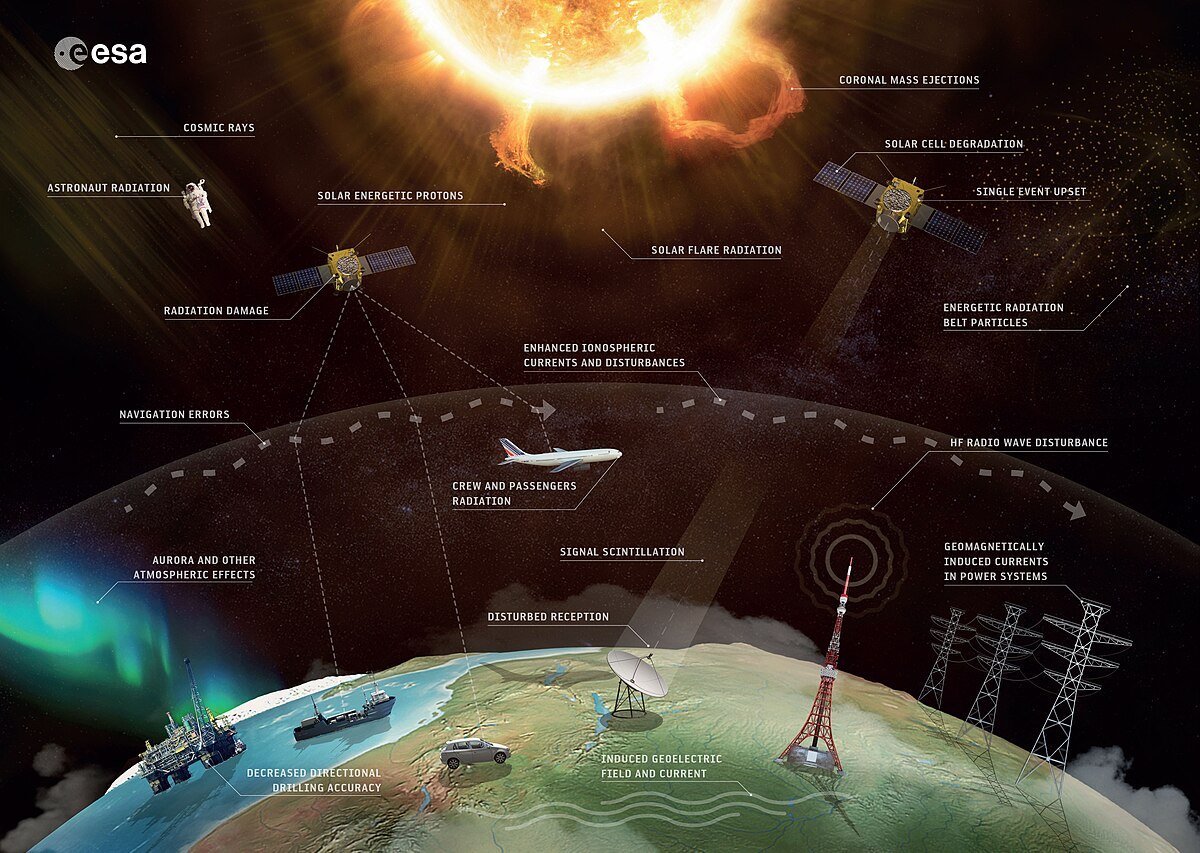
A sudden burst of solar energy can send radiation, charged particles, and magnetic material racing through space. If that storm reaches Earth, it can disturb satellites, GPS signals, radio communication, power grids, aviation systems, and even astronaut safety. Most people never see space weather directly, but modern life depends on technologies that can be affected by it.
This is why NASA space weather forecasting models are so important.
Space weather forecasting is the science of predicting how activity on the Sun may affect Earth, spacecraft, astronauts, and future missions across the solar system. It is not ordinary weather forecasting with clouds and rain. It deals with solar flares, coronal mass ejections, solar wind, radiation storms, geomagnetic storms, and the complex magnetic relationship between the Sun and Earth.
In simple words, NASA studies the Sun not only to understand a star, but also to protect the technology and people that depend on space-based systems.
As humanity moves deeper into the space age, space weather forecasting is becoming more important than ever. Satellites support communication, banking, internet timing, navigation, weather prediction, defense systems, aviation, agriculture, and emergency response. Future missions to the Moon and Mars will place astronauts farther from Earth’s protective atmosphere and magnetic field. A strong solar storm could become more than a scientific event. It could become a serious operational hazard.
NASA’s forecasting models, space weather research, artificial intelligence systems, and partnerships with NOAA and other agencies are helping build a future where solar storms can be better predicted, understood, and managed.
Editorial Note
This article explains confirmed NASA and NOAA space weather research, forecasting models, solar storm hazards, artificial intelligence tools, and future possibilities. It does not claim that NASA can perfectly predict every solar storm. Space weather forecasting is improving, but it remains scientifically difficult because the Sun is dynamic, magnetic, and complex. Official U.S. operational space weather alerts and warnings are issued by NOAA’s Space Weather Prediction Center, while NASA plays a major role in research, modeling, mission support, and technology development.
Key Statistics and Facts
| Fact | Why It Matters |
|---|---|
| NASA’s Space Weather Program supports research and applications to predict and track space weather across the solar system. | Space weather affects Earth, spacecraft, and future exploration missions. |
| NOAA’s Space Weather Prediction Center issues official U.S. alerts, watches, and warnings for space weather. | Public and industry users need reliable operational warnings. |
| The WSA-Enlil model is used to provide 1–4 day advance warning for solar wind structures and Earth-directed CMEs. | Forecast lead time helps satellite operators, grid managers, and communication systems prepare. |
| NASA’s DAGGER model was designed to forecast geomagnetic disturbances about 30 minutes before impact. | Short-term AI forecasting may help protect infrastructure during fast-developing events. |
| NASA and IBM released Surya, a heliophysics foundation model, in 2025. | AI is becoming part of next-generation solar activity prediction. |
| Space weather can affect satellites, GPS, radio communication, aviation, power grids, and astronaut safety. | Solar storms are not only space events; they can affect daily life on Earth. |
These facts show why space weather forecasting matters. A solar storm may begin millions of miles away, but its effects can reach technologies people use every day.
What Is Space Weather?
Space weather means the changing conditions in space caused mainly by the Sun. Just as Earth’s weather includes wind, rain, clouds, and storms, space weather includes solar wind, radiation, magnetic disturbances, solar flares, and coronal mass ejections.
The Sun constantly releases a stream of charged particles called the solar wind. Most of the time, this flow is manageable. Earth’s magnetic field helps shield the planet from much of it. But sometimes the Sun releases intense bursts of energy and material. These events can disturb Earth’s magnetic field and create geomagnetic storms.
The main types of space weather events include:
Solar flares, which are sudden bursts of electromagnetic radiation from the Sun.
Coronal mass ejections, or CMEs, which are huge eruptions of plasma and magnetic field from the Sun’s outer atmosphere.
Solar energetic particles, which are high-energy particles that can be dangerous to spacecraft and astronauts.
High-speed solar wind streams, which can interact with Earth’s magnetic field and trigger geomagnetic activity.
Geomagnetic storms, which happen when solar activity disturbs Earth’s magnetosphere.
Space weather is invisible to most people, but it can have real consequences. It can create beautiful auroras, but it can also disrupt technology.
For more space science explainers, visit our Space & Beyond section.
Why Space Weather Forecasting Matters
Space weather forecasting matters because modern society depends on technology that reaches into space. Satellites orbit above Earth. GPS signals travel from space to devices on the ground. Power grids can be affected by geomagnetic currents. Aircraft communication can be disrupted during solar storms. Astronauts can face radiation hazards beyond Earth’s atmosphere.
A strong solar storm can affect:
Satellite operations.
GPS accuracy.
Radio communication.
Electric power grids.
Aviation routes near polar regions.
Spacecraft electronics.
Astronaut safety.
Navigation systems.
Internet and timing infrastructure.
Scientific instruments in space.
The goal of forecasting is not to stop the Sun from producing storms. That is impossible. The goal is to give people and systems enough warning to reduce risk.
If a solar storm is expected, satellite operators may place spacecraft into safer modes. Airlines may adjust polar routes. Power grid operators may prepare for geomagnetic disturbances. Astronauts may move to more shielded areas. Mission controllers may delay sensitive operations.
This is why forecasting is a form of protection. Better predictions can help reduce damage, avoid disruption, and support safer space exploration.
What Are NASA Space Weather Forecasting Models?
NASA space weather forecasting models are scientific tools that help researchers understand and predict how solar activity moves through space and affects Earth or other planets. These models combine physics, observations, satellite data, solar imagery, magnetic field measurements, solar wind data, and increasingly artificial intelligence.
A forecasting model may try to answer questions such as:
Did the Sun release a coronal mass ejection?
Is that eruption heading toward Earth?
How fast is it moving?
When could it arrive?
How strong might the geomagnetic impact be?
Which technologies could be affected?
Could astronauts or spacecraft face increased radiation risk?
Different models focus on different parts of the problem. Some study the Sun itself. Some model how solar wind moves through the inner solar system. Some estimate how Earth’s magnetosphere may respond. Some use machine learning to predict geomagnetic disturbance patterns.
NASA’s role is especially important in research and model development. NOAA’s Space Weather Prediction Center provides official U.S. operational space weather forecasts, watches, warnings, and alerts. NASA research helps improve the science behind those forecasts.
For more NASA research and mission explainers, visit our NASA category.
The Sun: The Source of Space Weather
To understand space weather forecasting, readers first need to understand the Sun. The Sun is not a quiet ball of light. It is a magnetic, active star filled with plasma and powerful energy flows.
Solar activity is driven by magnetic fields. These fields can twist, stretch, reconnect, and release huge amounts of energy. When that happens, the Sun may produce flares, eruptions, or streams of fast-moving particles.
Sunspots are one visible sign of solar activity. They are darker regions on the Sun’s surface caused by intense magnetic activity. More sunspots often mean a more active Sun, although not every sunspot produces a major storm.
The Sun follows an approximately 11-year solar cycle, moving between periods of lower and higher activity. Near solar maximum, solar flares and CMEs become more common. This makes forecasting especially important during active solar periods.
Space weather prediction begins with watching the Sun carefully. NASA missions such as the Solar Dynamics Observatory, Parker Solar Probe, SOHO, STEREO, and other heliophysics missions provide data that helps scientists understand solar activity and improve forecasting models.
Solar Flares, CMEs, and Geomagnetic Storms
Solar flares and coronal mass ejections are often mentioned together, but they are not the same thing.
A solar flare is a sudden burst of radiation from the Sun. It can affect radio communication and increase radiation conditions in space. Flares travel at the speed of light, so their effects can reach Earth quickly.
A coronal mass ejection, or CME, is a massive eruption of plasma and magnetic field. A CME travels much slower than light, often taking many hours to several days to reach Earth if it is directed toward us.
A geomagnetic storm happens when solar material interacts strongly with Earth’s magnetic field. This can disturb currents and magnetic fields near Earth, affecting satellites, power grids, and communication systems.
This timeline is important:
Solar flare effects can arrive quickly because radiation travels at light speed.
Solar energetic particles may arrive later, depending on the event.
CMEs may take one to several days to reach Earth.
Geomagnetic storms occur when solar material interacts with Earth’s magnetic environment.
Forecasting models try to connect these stages. They help scientists move from observing an eruption on the Sun to estimating possible effects near Earth.
How NASA Predicts Solar Storms
NASA predicts solar storms by combining observations, physics-based models, simulations, and artificial intelligence.
The process usually begins with solar observation. Spacecraft monitor the Sun in different wavelengths of light. They observe sunspots, magnetic fields, flares, eruptions, coronal holes, and the solar atmosphere.
If a CME is detected, scientists estimate its speed, direction, size, and magnetic structure. Models then simulate how the eruption may travel through space. The model output can help estimate whether the CME may reach Earth and when it may arrive.
Near Earth, spacecraft measure solar wind speed, density, temperature, and magnetic field. These measurements help forecasters understand what is actually approaching Earth’s magnetic field.
Forecasting also uses ground-based magnetometers and ionospheric measurements to understand how Earth is responding.
The best forecasting systems do not depend on one data source. They combine many observations and models to build the most reliable picture possible.
This is similar to Earth weather forecasting. A weather forecast improves when satellites, radar, weather stations, computer models, and human experts work together.
WSA-Enlil: A Major Solar Wind Forecasting Model
One of the most important space weather models is WSA-Enlil. NOAA describes WSA-Enlil as a large-scale, physics-based model of the inner heliosphere used to provide 1–4 day advance warning of solar wind structures and Earth-directed CMEs.
This model helps estimate how solar wind and CMEs travel through space. It is especially useful because CMEs do not move through empty space in a simple straight line. They interact with the solar wind, magnetic fields, and other structures in the heliosphere.
The model can help forecasters estimate when a solar disturbance may arrive at Earth. That estimated arrival time is important for power grid operators, satellite teams, communication systems, and other users who may need to prepare.
WSA-Enlil does not make solar storm prediction perfect. No model does. But it provides valuable guidance for forecasters by simulating large-scale solar wind conditions and possible CME arrival.
NASA CCMC and Space Weather Modeling
NASA’s Community Coordinated Modeling Center, or CCMC, plays an important role in space weather modeling. It supports the space weather research and modeling community by providing access to models, simulations, tools, and research services.
CCMC helps connect scientific model development with forecasting needs. This matters because space weather prediction requires constant improvement. Scientists need to compare models, test predictions, evaluate performance, and move useful research toward operational use.
NASA’s CCMC also supports experimental tools such as CME scoreboards. These tools can help researchers compare CME arrival predictions and improve understanding of forecasting uncertainty.
This is important for accuracy. A space weather forecast is not simply one number. It often includes uncertainty. A CME may arrive earlier or later than expected. Its magnetic orientation may affect whether it causes a strong geomagnetic storm. Forecasting models help narrow the uncertainty, but they do not remove it completely.
Artificial Intelligence and Space Weather Forecasting
Artificial intelligence is becoming more important in space weather forecasting because the Sun produces massive amounts of data. Solar observatories capture images, magnetic field measurements, ultraviolet data, and other signals continuously. Human experts cannot manually inspect every detail at full scale.
AI can help by finding patterns in large datasets.
NASA has supported AI-related space weather research, including models designed to improve prediction of geomagnetic disturbances and solar activity. One example is DAGGER, a model designed to forecast geomagnetic disturbances about 30 minutes before impact. Another major development is Surya, a heliophysics foundation model developed by NASA, IBM, and partners to analyze solar data and improve understanding of solar eruptions and space weather effects.
AI does not replace physics. It supports it.
The strongest future forecasting systems may combine physics-based models with machine learning. Physics-based models explain how solar material moves and interacts. AI models may help detect patterns, improve speed, and identify early signs of solar activity.
This blended approach could make forecasting faster, more detailed, and more useful.
AI is changing many areas of future science and technology. You can also read our article on AI with Long-Term Memory and truly intelligent machines.
Surya: NASA and IBM’s AI Model for the Sun
Surya is a heliophysics foundation model developed by NASA, IBM, and partners. It uses solar data to help scientists better understand the Sun and predict solar activity.
Surya is important because foundation models can learn broad patterns from large datasets. In this case, the model was trained on solar observations and designed to help researchers analyze solar behavior.
NASA has described Surya as a model that can help scientists predict how the Sun’s ultraviolet output affects Earth’s upper atmosphere and provide early warnings to satellite operators.
This does not mean Surya makes space weather prediction perfect. It means AI is becoming a serious tool in heliophysics research. Models like Surya may help researchers process solar data faster, detect patterns earlier, and improve future forecasting methods.
For readers, the key point is simple: space weather prediction is moving beyond traditional modeling alone. It is entering an era where AI, physics, satellite data, and human expertise work together.
DAGGER and Short-Term Geomagnetic Forecasting
DAGGER stands for Deep Learning Geomagnetic Perturbation. It is an AI-powered model connected to NASA-supported research that was designed to predict geomagnetic disturbances around Earth.
NASA reported that DAGGER was tested against geomagnetic storms from August 2011 and March 2015. In those tests, the model was able to quickly forecast storm impacts around the world. The goal of such technology is to provide short-term warning before geomagnetic impacts become dangerous.
This kind of warning may be short, but it can still matter. Even 30 minutes can help operators take protective action if systems are ready.
For example, satellite operators could adjust spacecraft operations. Power grid operators could prepare for geomagnetic disturbances. Communication teams could anticipate possible problems.
DAGGER shows how AI can support fast, global forecasting. However, it should be described carefully. It is an important research model, not a guarantee that every solar storm can be predicted perfectly.
Official Forecasting: NASA and NOAA Work Together
A reliable article on this topic must explain the difference between NASA and NOAA.
NASA focuses heavily on space weather science, research, missions, modeling, and technology development. NOAA’s Space Weather Prediction Center provides official U.S. operational space weather forecasts, watches, warnings, and alerts.
This partnership matters because research and operations are different but connected.
NASA helps improve scientific understanding. NOAA provides operational forecasts used by the public, industry, emergency planners, airlines, satellite operators, and infrastructure teams.
NASA also supports research-to-operations efforts, helping useful scientific advances move toward practical forecasting. This is important because models developed in research settings need testing, validation, and operational readiness before becoming official forecast tools.
In simple words: NASA helps build the science; NOAA helps deliver official forecasts.
How Solar Storms Affect Satellites
Satellites are among the most vulnerable technologies during solar storms. They operate above much of Earth’s protective atmosphere and are exposed to radiation, charged particles, and changing space conditions.
Solar storms can affect satellites by:
Damaging electronics.
Increasing radiation exposure.
Causing charging effects on spacecraft surfaces.
Disturbing communication links.
Increasing atmospheric drag on low Earth orbit satellites.
Affecting navigation and orientation systems.
Reducing solar panel performance over time.
Satellite operators need space weather forecasts because they may need to delay maneuvers, protect sensitive systems, adjust operations, or interpret unusual spacecraft behavior.
As satellite constellations grow, this becomes even more important. Communication networks, Earth observation systems, internet satellites, navigation systems, and weather satellites all depend on reliable space operations.
How Solar Storms Affect GPS and Navigation
GPS depends on signals traveling from satellites to receivers on Earth. Space weather can disturb the ionosphere, the upper part of Earth’s atmosphere filled with charged particles. When the ionosphere becomes disturbed, GPS signals can be delayed, bent, or disrupted.
This can reduce accuracy.
Most people think of GPS as a tool for driving directions, but it is far more important than that. GPS supports aviation, shipping, agriculture, construction, emergency services, banking, telecommunications, and timing systems.
A space weather event that affects GPS can therefore create wider problems.
For example, farmers using precision agriculture may rely on accurate GPS for planting and equipment guidance. Aviation systems may depend on navigation reliability. Surveying and construction may require precise positioning.
Space weather forecasting helps users prepare for possible navigation problems during geomagnetic storms.
How Solar Storms Affect Power Grids
Power grids can be affected by geomagnetic storms because changing magnetic fields can induce electric currents in long conductors. These geomagnetically induced currents can affect transformers and grid operations.
This is one of the most serious concerns in space weather forecasting. A powerful geomagnetic storm could stress parts of the electric power system if operators are not prepared.
Forecasts help grid operators monitor risk and take precautions. Actions may include adjusting operations, monitoring transformer loading, preparing response teams, or changing system configurations.
Not every solar storm threatens power grids. Many are minor. But extreme events are taken seriously because modern society depends heavily on electricity.
This is why space weather is not only an astronomy topic. It is an infrastructure topic.
How Solar Storms Affect Astronauts
Astronauts can face radiation risk during space weather events. On Earth, the atmosphere and magnetic field provide protection. In space, especially beyond low Earth orbit, astronauts may be more exposed.
Future Moon and Mars missions make this concern more important. Astronauts traveling to or working on the Moon could face increased radiation during solar energetic particle events.
Space weather forecasts can help mission teams reduce risk. If a major event is expected, astronauts may move to more shielded areas, delay spacewalks, or change mission activities.
This matters for the Artemis program and future Mars exploration. Long-duration missions require better space weather awareness because crews will spend more time outside Earth’s protective environment.
For more Moon mission coverage, read our article on the Artemis II lunar flyby mission.
Why Space Weather Forecasting Matters for the Moon and Mars
Future exploration depends on space weather forecasting. The farther humans travel from Earth, the more important solar storm prediction becomes.
On the Moon, astronauts may work on the surface, drive rovers, set up instruments, build infrastructure, and conduct spacewalks. During a radiation event, mission teams need warning so crews can move to safer areas.
On Mars, the challenge is even greater. Mars is farther away, communication delays are longer, and astronauts would be far from immediate Earth-based support. Space weather forecasting for Mars missions must account for solar activity, interplanetary travel, and local planetary conditions.
NASA studies space weather not only for Earth but also for exploration across the solar system. This is one reason heliophysics is connected to human exploration.
Space weather models protect future missions by helping planners understand risk before it becomes an emergency.
Comparison: Traditional Models vs AI Forecasting
| Forecasting Approach | Strength | Limitation |
|---|---|---|
| Physics-based models | Built on scientific laws and solar wind behavior | Can require complex inputs and may have uncertainty |
| Observational forecasting | Uses real-time satellite and ground data | May provide limited warning for fast events |
| AI models | Can detect patterns in huge datasets quickly | Needs careful validation and trustworthy training data |
| Hybrid forecasting | Combines physics, observations, and AI | More complex to build and operate |
| Human expert analysis | Adds judgment and context | Depends on available data and model quality |
The future of space weather forecasting will likely combine all of these methods. The strongest systems will use physics, AI, satellite data, ground measurements, and expert interpretation together.
Timeline: Space Weather Forecasting Progress
| Period | Development |
|---|---|
| Early space age | Scientists began linking solar activity to radio and magnetic disturbances |
| Satellite era | Spacecraft allowed direct monitoring of the Sun and solar wind |
| Modern heliophysics | NASA missions improved understanding of solar flares, CMEs, and solar wind |
| Operational forecasting | NOAA SWPC expanded alerts, watches, warnings, and model products |
| AI era | Models like DAGGER and Surya showed how machine learning can support prediction |
| 2026 and beyond | Space weather forecasting becomes more important for satellites, Artemis, Mars planning, and infrastructure protection |
This timeline shows that space weather forecasting is not a single invention. It is a growing scientific system built from decades of solar observation, modeling, and technology development.
Why 2026 Matters for Space Weather Forecasting
The year 2026 matters because society is more dependent on space-based technology than ever. Satellites support communication, banking, navigation, forecasting, defense, agriculture, shipping, emergency response, and science.
At the same time, space exploration is expanding. NASA’s Artemis program is moving humans back toward the Moon. Commercial space activity is growing. Satellite constellations are increasing. AI models are becoming more capable. Space weather forecasting is becoming essential for both Earth-based infrastructure and future deep-space activity.
This does not mean 2026 is the year space weather becomes fully predictable. It means the need for better forecasting is becoming more urgent.
The future will likely require faster alerts, better models, more satellites, stronger AI tools, improved public communication, and closer coordination between agencies and industries.
What People Often Get Wrong About Space Weather
Many people think space weather only means auroras. Auroras are beautiful, but they are only one visible effect of solar activity.
Another misunderstanding is thinking solar storms are rare science-fiction disasters. Smaller space weather events happen regularly, while major storms are less common but important to prepare for.
Some people think NASA alone issues all space weather warnings. In the United States, NOAA’s Space Weather Prediction Center provides official operational alerts and warnings, while NASA supports research and model development.
Another mistake is thinking AI can now perfectly predict every solar storm. AI is improving forecasting, but the Sun remains complex. Forecasts still involve uncertainty.
A final mistake is thinking space weather only affects astronauts. It can also affect satellites, GPS, aviation, radio communication, power grids, and timing systems used on Earth.
How Space Weather Forecasting Protects the Future
Space weather forecasting protects the future by giving people time to respond. A good forecast can help reduce risk before a solar storm affects critical systems.
Satellite operators can protect spacecraft.
Grid operators can monitor electrical risk.
Aviation teams can adjust routes or communications.
Astronauts can move to shielded areas.
Mission controllers can delay sensitive operations.
Scientists can prepare instruments.
Emergency planners can monitor possible disruptions.
Forecasting is not about fear. It is about readiness.
As technology becomes more connected, the value of space weather forecasting grows. A society that depends on satellites and electricity needs to understand the Sun’s behavior.
Future Possibilities for NASA Space Weather Models
Future NASA space weather models may become faster, more accurate, and more connected.
They may use more solar observation data, better magnetic field measurements, improved CME tracking, AI-based pattern detection, and stronger simulations of the Sun-Earth system.
Future models may also support Moon and Mars missions more directly. Astronauts on the Moon may need local space weather alerts. Mars crews may need forecasts that account for solar storms during interplanetary travel and on the Martian surface.
AI may help identify early warning signs that humans could miss. Foundation models like Surya may help researchers analyze solar images and magnetic patterns faster than traditional methods alone.
However, future models must be carefully tested. Space weather forecasting affects real infrastructure and human safety. Any forecasting system must be accurate, transparent, validated, and integrated with operational agencies.
Frequently Asked Questions
What are NASA space weather forecasting models?
NASA space weather forecasting models are scientific tools that help researchers understand and predict solar activity, solar wind, CMEs, geomagnetic storms, and their effects on Earth, spacecraft, and future missions.
Does NASA issue official space weather warnings?
NASA supports space weather research and modeling. In the United States, official operational space weather alerts, watches, and warnings are issued by NOAA’s Space Weather Prediction Center.
What is a solar storm?
A solar storm is a burst of particles, radiation, magnetic field, or plasma from the Sun. It can include solar flares, coronal mass ejections, solar energetic particles, and geomagnetic disturbances.
What is a CME?
A coronal mass ejection, or CME, is a large eruption of plasma and magnetic field from the Sun’s corona. If directed toward Earth, it can trigger geomagnetic storms.
What is WSA-Enlil?
WSA-Enlil is a physics-based model used to predict solar wind structures and Earth-directed CMEs. NOAA uses it to support 1–4 day advance warning for possible space weather impacts.
What is NASA’s DAGGER model?
DAGGER is an AI-powered model designed to forecast geomagnetic disturbances around Earth. NASA reported that it was tested using past geomagnetic storms and could provide short-term warning of impacts.
What is Surya?
Surya is a NASA and IBM heliophysics foundation model designed to analyze solar data and help improve understanding and prediction of solar activity.
Can solar storms damage power grids?
Strong geomagnetic storms can affect power grid systems by inducing currents in long electrical conductors. Forecasting helps grid operators prepare for possible disturbances.
Can solar storms affect GPS?
Yes. Space weather can disturb the ionosphere, which can reduce GPS accuracy or disrupt signals during certain events.
Why is space weather forecasting important for astronauts?
Astronauts beyond Earth’s protective atmosphere may be exposed to increased radiation during solar storms. Forecasts help mission teams plan safer operations.
Conclusion
NASA space weather forecasting models are becoming essential for protecting the future. The Sun gives Earth light and energy, but it can also produce powerful storms that affect satellites, GPS, radio communication, aviation, power grids, spacecraft, and astronauts.
Space weather forecasting helps turn solar activity into actionable information. Scientists observe the Sun, model solar wind, track CMEs, measure near-Earth conditions, and use artificial intelligence to improve prediction. NASA’s research, NOAA’s operational forecasts, WSA-Enlil, CCMC tools, DAGGER, Surya, and other modeling efforts all contribute to a larger goal: understanding the Sun well enough to reduce risk.
The most important point is accuracy. Space weather prediction is improving, but it is not perfect. NASA does not control the Sun, and no model can guarantee flawless predictions. The value of forecasting is that it provides better warning, better preparation, and better protection.
As humanity moves deeper into space and becomes more dependent on technology, space weather forecasting will become even more important. Future Moon missions, Mars planning, satellite networks, power systems, and communication infrastructure will all depend on understanding solar storms.
The simplest way to explain it is this: the future of space exploration and modern technology depends not only on rockets and computers, but also on predicting the weather from our nearest star.
Sources and Further Reading
NOAA SWPC: WSA-Enlil Solar Wind Prediction
NOAA SWPC: Alerts, Watches and Warnings
NASA: Community Coordinated Modeling Center
NASA: NASA-Enabled AI Predictions May Give Time to Prepare for Solar Storms