Most of the universe is invisible.
That sounds like science fiction, but it is one of the most important facts in modern astronomy. The stars, planets, galaxies, nebulae, and glowing cosmic structures we can see make up only a small part of what exists. According to NASA, normal visible matter makes up about 5% of the universe, while dark matter makes up about 27% and dark energy makes up about 68%. That means the universe we see with ordinary light is only a small visible layer of a much larger cosmic reality.
Dark matter does not shine. It does not reflect light. It does not absorb light in the way ordinary matter does. Scientists cannot simply point a telescope at the sky and take a normal photograph of dark matter.
So how do we study something invisible?
NASA and its partners study dark matter by observing its effects. Dark matter has gravity. It pulls on galaxies. It bends light. It affects how galaxies rotate, how galaxy clusters hold together, and how the large-scale structure of the universe forms over billions of years.
This is where space telescopes and satellite observatories become important.
NASA dark matter detection satellites in 2026 should not be understood as satellites that directly “photograph” dark matter particles. The accurate explanation is that NASA and NASA-supported missions use powerful space observatories to detect the evidence of dark matter indirectly.
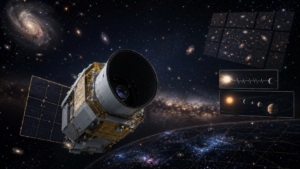
The most important examples include NASA’s upcoming Nancy Grace Roman Space Telescope, the ESA-led Euclid mission with NASA contributions, NASA’s Fermi Gamma-ray Space Telescope, the Hubble Space Telescope, the James Webb Space Telescope, and NASA’s SPHEREx mission.
Together, these missions are helping scientists hunt the invisible universe.
For related space technology coverage, readers can also explore our article on NASA Next Gen Space Telescopes Tech 2026 Unlocking the Universe, which connects future telescope technology with deeper cosmic discovery.
Editorial Note
This article uses careful wording for accuracy and Raptive/Mediavine/Journey/AdSense-safe publishing.
NASA does not currently describe a single operational 2026 spacecraft named “Dark Matter Detection Satellite.” Instead, dark matter research is supported by several space telescopes, observatories, and science missions that study dark matter indirectly.
These missions do not usually detect dark matter particles directly. They study dark matter through gravitational lensing, galaxy motion, cosmic structure, gamma-ray signals, galaxy clustering, and deep-sky mapping.
This article separates confirmed NASA missions from future possibilities and avoids misleading claims.
Key Facts About NASA Dark Matter Detection Satellites 2026
| Feature | Details |
|---|---|
| Main Topic | NASA dark matter detection satellites 2026 |
| Correct Status | No single confirmed NASA mission with this exact name |
| Accurate Meaning | NASA-supported space observatories studying dark matter indirectly |
| Main Detection Method | Observing gravity, galaxy structure, lensing, and possible particle signals |
| Key NASA Mission | Nancy Grace Roman Space Telescope |
| Roman Launch Status | Targeted as soon as early September 2026, ahead of required readiness by May 2027 |
| Active Partner Mission | ESA’s Euclid mission with NASA contributions |
| Gamma-Ray Search Mission | Fermi Gamma-ray Space Telescope |
| Other Important Observatories | Hubble, Webb, SPHEREx |
| Main Scientific Goal | Understand the invisible matter shaping galaxies and cosmic structure |
These facts are important because dark matter can easily be exaggerated online. The most trustworthy explanation is that NASA is not “catching” dark matter directly in 2026. Instead, NASA is helping map, measure, and test the invisible matter through its effects on the visible universe.
What Is Dark Matter?
Dark matter is an invisible form of matter that does not emit, absorb, or reflect light. Scientists call it “dark” because it cannot be seen directly with ordinary telescopes.
But dark matter is not imaginary.
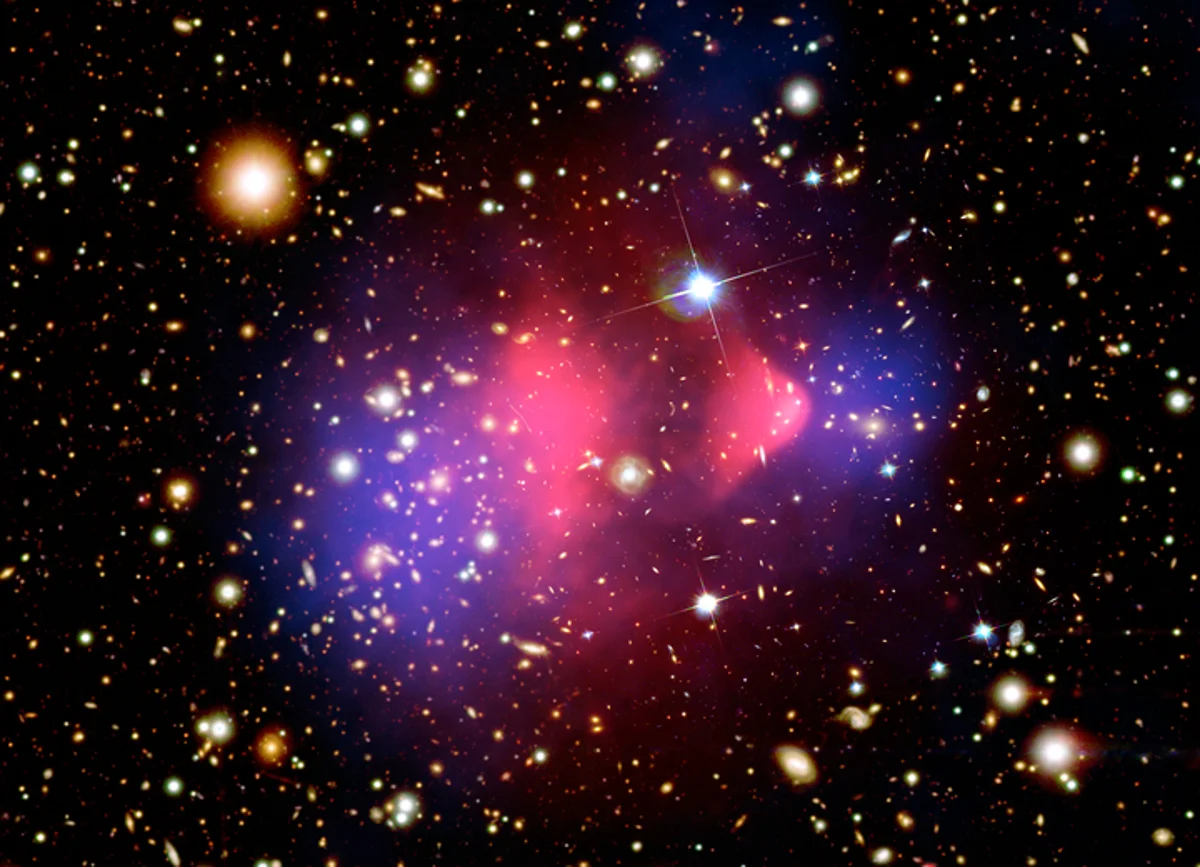
Scientists infer dark matter because of gravity. Galaxies rotate in ways that cannot be explained by visible stars and gas alone. Galaxy clusters hold together more strongly than visible matter can explain. Light from distant galaxies bends as it passes through massive clusters, revealing hidden gravitational mass.
NASA explains dark matter as a major invisible component of the universe, making up about 27% of the total universe. Normal matter makes up about 5%, while dark energy makes up about 68%. You can read NASA’s basic explanation here: NASA Dark Matter Overview.
In simple words, dark matter is like the hidden scaffolding of the universe. We cannot see it directly, but we can see how it shapes galaxies and cosmic structure.
Why NASA Uses Space Telescopes to Study Dark Matter
Earth-based telescopes are powerful, but space telescopes have major advantages.
They operate above Earth’s atmosphere. That means they can observe wavelengths of light that are blocked or distorted from the ground. They can also produce extremely stable images, which is important for measuring tiny distortions caused by gravity.
One of the most important dark matter tools is gravitational lensing.
Gravitational lensing happens when massive objects bend the path of light from background galaxies. If a galaxy cluster contains a lot of dark matter, its gravity can bend and distort light passing near it. By measuring those distortions, scientists can map where dark matter is located.
This is why missions like Roman and Euclid are so important. They are designed to survey huge areas of the sky and map the universe at large scales.
For readers interested in the future of mapping technologies beyond astronomy, our article on NASA Robotic Swarm for Planetary Mapping 2026 explains how mapping is also transforming planetary exploration.
Nancy Grace Roman Space Telescope: NASA’s Big 2026 Dark Matter Mission
The Nancy Grace Roman Space Telescope is one of the most important NASA missions connected to dark matter research in 2026.
NASA says Roman is targeted for launch as soon as early September 2026, ahead of the agency’s required launch readiness date of May 2027. Roman is designed to study dark energy, dark matter, exoplanets, and infrared astrophysics. Its wide-field view will allow it to survey large areas of the sky much faster than older observatories.
Roman will not scoop up dark matter particles. Instead, it will help map dark matter by studying how dark matter affects galaxies and bends light.
NASA explains that Roman will explore the structure and distribution of both normal matter and dark matter across space and time through its Roman dark matter science program.
Roman’s strength is scale. It can observe huge regions of the sky with high precision. That makes it useful for weak gravitational lensing, where tiny distortions in galaxy shapes reveal the hidden distribution of dark matter.
How Roman Will Map the Invisible Universe
Roman will help scientists study dark matter by looking at billions of galaxies across cosmic history.
The key idea is simple: dark matter leaves fingerprints.
It affects where galaxies form.
It affects how galaxies cluster.
It bends light through gravitational lensing.
It shapes the cosmic web, the huge network of galaxies and galaxy clusters stretching across the universe.
NASA has explained that Roman’s core survey will explore invisible dark matter through its gravitational effects and help study the nature of dark energy. You can read NASA’s Roman survey explanation here: Core Survey by NASA’s Roman Mission Will Unveil Universe’s Dark Side.
Example: imagine looking through a window made of uneven glass. Objects behind the glass look slightly stretched or distorted. Scientists use a similar idea in gravitational lensing. Distant galaxies may appear slightly distorted because dark matter between us and those galaxies bends their light. By measuring many tiny distortions, Roman can help build a map of invisible matter.
That is why Roman may become one of the most important dark matter observatories of the late 2020s.
Euclid: The Dark Universe Mission With NASA Contributions
Euclid is another major space telescope studying dark matter and dark energy.
Euclid is led by the European Space Agency, but NASA has contributed important hardware and science support. NASA describes Euclid as an active mission designed to explore the composition and evolution of the dark universe by making a 3D map of the universe. You can read NASA’s Euclid mission page here: NASA Euclid Mission.
Euclid launched on July 1, 2023, and is expected to observe more than 1.5 billion galaxies during its six-year prime mission. NASA reported that Euclid’s early deep-field data included 26 million galaxies, with the most distant more than 10.5 billion light-years away.
Euclid helps scientists study dark matter through weak lensing and galaxy clustering. Weak lensing measures how dark matter slightly distorts the shapes of distant galaxies. Galaxy clustering shows how matter is distributed across cosmic history.
Euclid and Roman are especially powerful together because both missions are designed to study the large-scale universe. Euclid provides a broad view of the dark universe, while Roman will add high-resolution wide-field infrared observations.
Roman vs Euclid: Two Powerful Dark-Universe Telescopes
| Feature | NASA Roman Space Telescope | ESA Euclid Mission With NASA Contributions |
|---|---|---|
| Main Agency | NASA | ESA, with NASA contributions |
| Status in 2026 | Targeted for launch as soon as September 2026 | Active mission |
| Main Science | Dark energy, dark matter, exoplanets, infrared astrophysics | Dark matter, dark energy, cosmic structure |
| Main Method | Wide-field infrared surveys, weak lensing, galaxy mapping | 3D cosmic mapping, weak lensing, galaxy clustering |
| Dark Matter Role | Map dark matter across space and time | Map the dark universe across large cosmic volumes |
| Best Strength | High-resolution wide-field infrared view | Massive 3D survey of galaxies |
Roman and Euclid do not compete in a simple way. They complement each other.
Both missions are part of a larger scientific effort to understand why the universe looks the way it does and how invisible matter shaped galaxies over billions of years.
Fermi Gamma-ray Space Telescope: Searching for Possible Particle Clues
NASA’s Fermi Gamma-ray Space Telescope studies the universe in gamma rays, the most energetic form of light.
Fermi is important for dark matter research because some dark matter theories predict that dark matter particles might produce gamma rays when they annihilate or decay. Scientists do not yet know if this happens, but gamma-ray observations can test possible signals.
NASA’s Fermi team explains that the Large Area Telescope provides a platform for indirect dark matter searches by surveying astrophysical sources that might reveal clues about dark matter. You can read more here: Fermi Searches for Dark Matter.
One important target is dwarf spheroidal galaxies. These are small satellite galaxies around the Milky Way. They are useful because they contain a lot of dark matter but relatively little ordinary astrophysical activity. That makes them cleaner places to search for faint gamma-ray signals.
This is a different approach from Roman and Euclid.
Roman and Euclid mainly map dark matter through gravity.
Fermi searches for possible high-energy signals related to dark matter particle behavior.
Both approaches are valuable because scientists still do not know what dark matter is made of.
Hubble and Webb: Seeing Dark Matter Through Galaxies
The Hubble Space Telescope has played a major role in dark matter research.
Hubble has helped scientists map dark matter in galaxy clusters through gravitational lensing. It has also studied unusual galaxies that appear to contain very little dark matter, which can test theories about galaxy formation.
NASA’s Hubble dark matter page explains that dark matter does not emit, absorb, or reflect light and may make up about 85% of the universe’s total mass. You can read NASA’s Hubble explanation here: Hubble Dark Matter.
The James Webb Space Telescope also supports dark matter research, though it was not designed as a dedicated dark matter detector. Webb observes extremely distant galaxies in infrared light. By studying the early universe, Webb helps scientists test how galaxies formed and whether dark matter models match real observations.
NASA recently described how Webb and Roman together could help study dark matter’s influence on the universe. You can read that NASA article here: NASA Reveals New Details About Dark Matter’s Influence on the Universe.
In simple words, Hubble and Webb help scientists study the visible structures that dark matter shapes.
SPHEREx: Mapping the Sky in Infrared Colors
SPHEREx is another NASA mission that helps scientists understand the large-scale universe.
SPHEREx is not a dedicated dark matter detector, but it creates a powerful all-sky infrared map. NASA JPL explains that SPHEREx surveys the entire sky in 102 infrared color bands. This kind of cosmic mapping helps scientists study galaxy formation, the history of the universe, and the distribution of cosmic structures. You can read the mission page here: NASA JPL SPHEREx.
NASA reported that SPHEREx is designed to map the distribution of more than 450 million galaxies. That kind of large-scale survey can support cosmology research by showing how galaxies are distributed across space.
Dark matter matters here because galaxy distribution is not random. Dark matter helps form the cosmic web. By mapping galaxies, scientists indirectly study the underlying invisible structure that helped guide galaxy formation.
For readers interested in deep-space data systems, our article on NASA Deep Space Laser Communication 2026 explains why future space missions need faster ways to send massive scientific datasets back to Earth.
How Dark Matter Detection Actually Works
Dark matter detection can be divided into three broad approaches.
First, there is gravitational detection. This is what Roman, Euclid, Hubble, and Webb mostly support. Scientists look at how dark matter affects galaxies, galaxy clusters, and light.
Second, there is indirect particle detection. This is where Fermi becomes important. Scientists search for radiation that might be produced if dark matter particles decay or collide.
Third, there is direct detection. This usually involves underground experiments on Earth trying to detect rare interactions between dark matter particles and normal matter. NASA satellites are not the main tool for this direct approach.
So when we say “NASA dark matter detection satellites,” the phrase should be understood carefully. NASA’s space telescopes detect dark matter evidence, not usually dark matter particles themselves.
That distinction is important for accuracy.
Example: How a Satellite Can “See” Invisible Dark Matter
Imagine a galaxy cluster sitting between Earth and a very distant galaxy.
The distant galaxy sends light toward Earth. As the light passes near the galaxy cluster, the cluster’s gravity bends the light. But visible stars and gas do not account for all the bending. There must be extra invisible mass.
That hidden mass is dark matter.
A space telescope like Hubble, Euclid, or Roman can measure the distortion in the distant galaxy’s image. Scientists then calculate how much invisible mass must be present to create that distortion.
The telescope is not seeing dark matter directly. It is seeing the effect of dark matter on light.
This is one of the most powerful methods for mapping the invisible universe.
Why Dark Matter Matters for Understanding the Universe
Dark matter is not just an astronomy mystery. It is one of the central problems in physics.
Without dark matter, scientists cannot fully explain how galaxies formed, why galaxy clusters behave as they do, or how the cosmic web developed.
Dark matter helps explain why galaxies rotate faster than expected.
It helps explain why galaxy clusters stay together.
It helps explain how structure formed after the Big Bang.
It helps connect small galaxies, giant clusters, and the large-scale structure of the universe.
If scientists discover what dark matter is made of, it could transform physics. It may reveal new particles, new forces, or new physics beyond the Standard Model.
That is why NASA and other space agencies continue investing in dark-universe research.
Confirmed Facts vs Future Possibilities
| Topic | Confirmed Fact | Future Possibility |
|---|---|---|
| Dark matter exists as an inferred gravitational component | Strong evidence from galaxies, clusters, lensing, and cosmic structure | Scientists may identify its particle nature |
| Roman Space Telescope | Targeted for launch as soon as September 2026 | Could produce major dark matter maps after science operations begin |
| Euclid | Active ESA mission with NASA contributions | Could refine understanding of dark matter and dark energy |
| Fermi | Active gamma-ray observatory used for indirect searches | Could help constrain or reveal possible particle signals |
| Hubble/Webb | Space telescopes studying galaxies and lensing | Could uncover new clues about dark matter’s role in early galaxy formation |
| Direct dark matter detection from satellites | Not confirmed as a routine NASA operational method | Future missions may test new detection concepts |
This table helps keep the article accurate. It is exciting to discuss dark matter, but trust depends on separating confirmed science from future possibilities.
Strengths of Space-Based Dark Matter Research
Space-based dark matter research has several strengths.
First, space telescopes can observe above Earth’s atmosphere, giving clearer views and access to infrared, gamma-ray, and other wavelengths.
Second, missions like Roman and Euclid can survey huge areas of the sky, which is essential for mapping cosmic structure.
Third, space telescopes can measure gravitational lensing with high precision.
Fourth, gamma-ray observatories like Fermi can test possible particle signatures.
Fifth, missions like Hubble and Webb can study distant galaxies and early cosmic structure.
Sixth, combining multiple missions gives scientists a stronger picture than any single telescope could provide.
This multi-mission approach is one of NASA’s biggest strengths.
Challenges and Limitations
Dark matter research is difficult because dark matter does not behave like ordinary matter.
It does not shine.
It does not form stars.
It does not interact strongly with light.
It may interact with normal matter very weakly, or almost not at all except through gravity.
That means scientists must rely on indirect evidence. These measurements are powerful, but they require careful analysis. Galaxy shapes, lensing maps, gamma-ray signals, and cosmic structure can be affected by many factors.
Another challenge is that dark matter may not be one simple thing. It could be a particle, multiple particle types, or something more surprising.
That is why responsible science writing should avoid claiming that NASA has already “found” dark matter particles unless an official scientific discovery confirms it.
What People Often Get Wrong About Dark Matter Detection Satellites
Many people think dark matter detection satellites take pictures of dark matter. That is not correct.
Dark matter does not emit light, so normal imaging does not show it directly.
Another mistake is thinking NASA has a single 2026 satellite officially called a dark matter detector. The accurate explanation is that several NASA and NASA-supported observatories contribute to dark matter research.
Some people confuse dark matter and dark energy. Dark matter acts like invisible mass that helps hold structures together. Dark energy is linked to the accelerating expansion of the universe.
Another misunderstanding is thinking that all dark matter research happens in space. Some direct detection experiments happen underground on Earth, while space telescopes mainly study cosmic effects.
A final mistake is assuming that dark matter has already been identified as a specific particle. Scientists have strong evidence that dark matter exists, but they have not yet confirmed what it is made of.
Timeline: Dark Matter Space Research and NASA-Linked Missions
| Period | Event |
|---|---|
| 1930s | Astronomers begin finding evidence for missing mass in galaxy clusters |
| 1970s | Galaxy rotation studies strengthen the case for dark matter |
| 1990s–2000s | Hubble helps map dark matter through gravitational lensing |
| 2008 | NASA’s Fermi Gamma-ray Space Telescope launches |
| 2021 | James Webb Space Telescope launches for infrared astronomy |
| 2023 | ESA’s Euclid mission launches with NASA contributions |
| 2025 | NASA’s SPHEREx launches and begins all-sky infrared mapping |
| 2026 | NASA targets Roman Space Telescope launch as soon as September 2026 |
| Late 2020s | Roman and Euclid are expected to deepen dark matter and dark energy studies |
This timeline shows that dark matter detection is not one mission. It is a long scientific effort built across many observatories and decades of research.
Practical Reader Takeaway
NASA dark matter detection satellites in 2026 are best understood as space observatories hunting dark matter indirectly.
The most important point is this:
NASA is not using a single confirmed 2026 satellite to directly capture dark matter particles. Instead, NASA and its partners use missions like Roman, Euclid, Fermi, Hubble, Webb, and SPHEREx to study the gravitational fingerprints and possible signals of dark matter.
Roman may become especially important after launch because it is designed to map huge areas of the sky and help reveal the distribution of dark matter across cosmic history.
Euclid is already active and mapping the dark universe.
Fermi continues to support indirect particle searches through gamma-ray observations.
Hubble and Webb help study lensing, galaxies, and early cosmic structure.
SPHEREx adds large-scale infrared mapping that supports cosmology.
Together, these missions are helping scientists investigate one of the biggest mysteries in the universe.
Frequently Asked Questions
What are NASA dark matter detection satellites in 2026?
NASA dark matter detection satellites in 2026 refers to NASA and NASA-supported space observatories that study dark matter indirectly through gravity, galaxy mapping, lensing, gamma rays, and cosmic structure.
Does NASA have a satellite named Dark Matter Detection Satellite?
No. NASA does not currently have a confirmed operational mission with that exact name. The phrase is best used as a general topic for space observatories involved in dark matter research.
Can satellites see dark matter directly?
No. Dark matter does not emit, absorb, or reflect light. Satellites study its effects on visible matter, light, galaxies, and cosmic structure.
Which NASA mission is most important for dark matter in 2026?
The Nancy Grace Roman Space Telescope is one of the most important NASA missions connected to dark matter research in 2026 because it is designed to map dark matter through large-scale surveys and gravitational lensing.
What is Roman’s role in dark matter research?
Roman will study how dark matter is distributed across space and time by observing galaxies, gravitational lensing, and cosmic structure.
What is Euclid’s role in dark matter research?
Euclid is an ESA mission with NASA contributions. It is designed to make a 3D map of the universe and study dark matter and dark energy.
How does Fermi search for dark matter?
Fermi searches indirectly by observing gamma rays from regions where dark matter may be concentrated, such as dwarf galaxies or the center of the Milky Way.
Is dark matter the same as dark energy?
No. Dark matter acts like invisible mass and helps shape galaxies. Dark energy is linked to the accelerating expansion of the universe.
Has NASA discovered what dark matter is made of?
No. Scientists have strong evidence that dark matter exists, but its exact particle nature remains unknown.
Why is dark matter important?
Dark matter is important because it shapes galaxies, galaxy clusters, and the large-scale structure of the universe. Understanding it could transform astronomy and physics.
Conclusion
NASA dark matter detection satellites 2026 is an exciting topic, but it must be explained accurately.
The real story is not that NASA has launched one special satellite that directly photographs dark matter. The real story is that NASA and its partners are using a powerful fleet of space observatories to hunt the invisible universe through evidence.
Roman will help map dark matter through wide-field surveys and gravitational lensing.
Euclid is already mapping the dark universe with NASA contributions.
Fermi searches for possible gamma-ray clues.
Hubble and Webb reveal how dark matter shapes galaxies and cosmic history.
SPHEREx adds large-scale infrared mapping that helps scientists understand cosmic structure.
Together, these missions show how modern astronomy studies what cannot be seen directly.
Dark matter remains invisible, but its influence is everywhere. It shapes galaxies, bends light, builds cosmic structure, and challenges our understanding of physics.
That is why NASA’s dark matter research matters in 2026. It is not only about finding something hidden. It is about understanding the true structure of the universe.
Sources and Further Reading
NASA: Dark Matter Overview
NASA Roman Space Telescope: Dark Matter Science
NASA: Roman Mission Core Survey and the Universe’s Dark Side
NASA: Roman Space Telescope Launch Target
NASA: Euclid Mission
NASA: ESA Previews Euclid Mission’s Deep View of the Dark Universe
NASA Fermi: Fermi Searches for Dark Matter
NASA Hubble: Hubble Dark Matter
NASA Webb: Dark Matter’s Influence on the Universe
NASA JPL: SPHEREx Mission