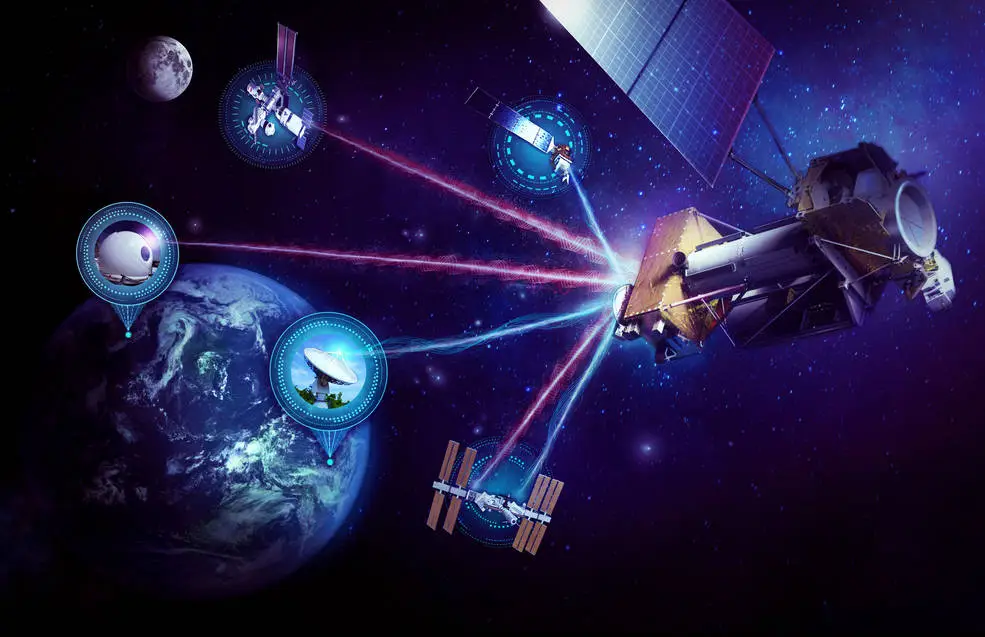
Space travel depends on navigation more than most people realize. A spacecraft may have powerful engines, advanced solar panels, scientific instruments, and communication antennas, but none of those systems are useful if the spacecraft cannot accurately know where it is, where it is going, and when it needs to adjust its path.
For decades, NASA has used radio tracking, ground stations, atomic clocks, spacecraft sensors, and mission-control calculations to guide missions across the solar system. These systems have helped spacecraft reach the Moon, Mars, Jupiter, Saturn, asteroids, comets, and even interstellar space.
But future space missions will be more demanding.
Astronauts may work around the Moon for longer periods. Robotic systems may explore shadowed lunar craters. Mars missions may need greater onboard autonomy. Deep-space probes may travel so far that real-time control from Earth becomes impossible.
This is where quantum navigation becomes important.
NASA quantum navigation in space 2026 does not mean NASA has already replaced traditional spacecraft tracking with a finished quantum navigation system. The correct explanation is that NASA is developing and testing quantum technologies that could support future navigation, gravity mapping, timing, and spacecraft autonomy.
NASA’s confirmed work includes quantum sensing, atom interferometry, atomic clocks, cold atom research, and gravity measurement technology. For example, NASA has demonstrated an ultracold quantum sensor in space through its Cold Atom Lab aboard the International Space Station. NASA and JPL are also developing a space-based quantum gravity sensor pathfinder that could improve how scientists measure Earth’s gravity field from orbit through the Quantum Gravity Gradiometer Pathfinder effort.
In simple words, quantum navigation could help future spacecraft measure motion, gravity, time, and position with extreme precision. It could make future missions safer, more autonomous, and less dependent on constant instructions from Earth.
For readers interested in related future space technologies, you can also explore our article on NASA Robotic Swarm for Planetary Mapping 2026, where autonomous robotic systems may also depend on advanced sensing and navigation.
Editorial Note
This article explains NASA quantum navigation in space as an emerging technology pathway. It does not claim that NASA has already deployed a fully operational quantum GPS system for spacecraft in 2026.
NASA’s confirmed work includes quantum sensing, atom interferometry, precision timing, cold atom physics, atomic clock demonstrations, and gravity measurement research. These technologies may support future spacecraft navigation, lunar exploration, Mars missions, planetary mapping, and deep-space autonomy.
This article uses careful wording to separate confirmed NASA research from future possibilities. That accuracy is important for reader trust, search quality, and Raptive/Mediavine/Journey/AdSense-safe publishing.
Key Facts About NASA Quantum Navigation in Space 2026
| Feature | Details |
|---|---|
| Main Topic | NASA quantum navigation in space 2026 |
| Current Status | Emerging technology pathway, not a fully operational navigation replacement |
| Confirmed NASA Work | Cold Atom Lab, atom interferometry, atomic clocks, quantum sensing, gravity measurement |
| Important Facility | Cold Atom Lab aboard the International Space Station |
| Important Method | Atom interferometry using ultracold atoms |
| Related Technology | Deep Space Atomic Clock and advanced timing systems |
| Future Use | Autonomous spacecraft navigation, lunar navigation, Mars travel, planetary mapping |
| Major Benefit | More precise measurement of motion, time, gravity, and position |
| Major Challenge | Quantum instruments must become compact, reliable, and mission-ready |
| Best Explanation | A future support technology, not science fiction and not a finished system yet |
These facts are important because quantum navigation can easily be misunderstood. It is not magic. It is not simply a quantum computer flying a spacecraft. It is a group of precision measurement technologies that may help spacecraft navigate more independently in the future.
What Is Quantum Navigation in Space?
Quantum navigation is a broad term for navigation methods that use quantum physics to measure motion, acceleration, rotation, gravity, or time with very high precision.
Traditional spacecraft navigation often depends on signals sent between Earth and a spacecraft. Engineers use timing, radio frequency changes, Doppler shifts, and tracking data to calculate the spacecraft’s position and speed. NASA’s Positioning, Navigation, and Timing program explains that accurate navigation allows spacecraft to know where they are, operate safely, and return more science data.
Quantum navigation could add another layer to this system.
Instead of depending only on external tracking from Earth, a spacecraft could use onboard quantum sensors to measure tiny changes in motion, gravity, and time. These measurements could help the spacecraft estimate its own position and movement more accurately.
One important technique is atom interferometry. NASA’s Cold Atom Lab has demonstrated that atom interferometry can be conducted in space, showing that ultracold atoms can be used for extremely precise quantum measurements in orbit. NASA Science describes this work in its explanation of quantum sensing via matter-wave interferometry aboard the International Space Station.
In simple words, quantum navigation could help a spacecraft “feel” tiny changes in motion and gravity more accurately than many traditional sensors.
Why Space Navigation Is Harder Than Navigation on Earth
On Earth, navigation feels easy because phones, cars, ships, and aircraft can use GPS. A GPS receiver reads timing signals from satellites and calculates its position.
Space navigation is very different.
A spacecraft traveling to Mars may be millions of miles from Earth. Signals take several minutes to travel one way. A spacecraft going farther into the solar system may face even longer communication delays. Mission control cannot always guide the spacecraft instantly.
NASA’s Deep Space Network and other tracking systems are extremely powerful, but future missions will need more onboard autonomy. This is especially important for spacecraft operating around the Moon, Mars, asteroids, or icy moons where fast decision-making may be required.
For example, a future Mars spacecraft may need to perform a course correction while communication with Earth is delayed. A lunar lander may need to adjust its descent path in real time. A robotic swarm exploring another world may need to coordinate movement without waiting for constant commands.
This connects directly with other future NASA technology areas, such as NASA AI Navigation System for Deep Space 2026, where artificial intelligence and advanced navigation could work together to support smarter spacecraft decisions.
NASA’s Cold Atom Lab: A Key Step Toward Quantum Space Sensors
NASA’s Cold Atom Lab is one of the most important confirmed foundations for future quantum navigation.
The Cold Atom Lab is a quantum science facility operating aboard the International Space Station. It creates extremely cold atom clouds, allowing scientists to study quantum behavior in microgravity. NASA explains that the facility helps researchers test quantum science in space and develop technologies that may support future missions through its Cold Atom Lab research program.
Why does this matter for navigation?
At extremely low temperatures, atoms behave in unusual quantum ways. They can act like waves. Scientists can split and recombine these atom waves, then study the resulting pattern. That pattern can reveal tiny changes in gravity, acceleration, rotation, or other forces.
This process is called atom interferometry.
NASA’s demonstration of atom interferometry in space matters because quantum instruments were once considered too delicate for extended space operation. Showing that these experiments can work remotely in orbit is an important step toward future space-based quantum sensors.
This does not mean the Cold Atom Lab is currently steering spacecraft. It means NASA has demonstrated a key technology that could support future quantum navigation and sensing systems.
How Atom Interferometry Could Help Spacecraft Navigate
Atom interferometry can sound difficult, but the basic idea is understandable.
Imagine two waves moving through water. When they meet, they create a pattern. Some parts of the waves become stronger, while others cancel out. Scientists can study that pattern to understand what happened to the waves.
Atom interferometry does something similar with atoms.
When atoms are cooled to extremely low temperatures, they can behave like waves. Scientists can split these atom waves, let them travel along different paths, and then recombine them. The final pattern reveals how gravity, acceleration, or rotation affected the atoms.
For a spacecraft, this could be useful because motion and gravity are directly related to navigation.
If a spacecraft accelerates slightly, a quantum sensor may detect that change.
If gravity changes slightly near a planet, moon, or asteroid, a quantum sensor may detect that change.
If the spacecraft rotates or changes direction, a quantum instrument may help measure that motion more precisely.
This could improve inertial navigation. Inertial navigation means estimating movement by measuring acceleration and rotation over time. Classical inertial sensors already exist, but quantum sensors may offer better long-term precision for some future missions.
Example: How Quantum Navigation Could Help a Mars Mission
Imagine a future spacecraft traveling from Earth to Mars.
During the journey, mission control tracks the spacecraft from Earth. Engineers calculate its path and send correction commands. But as the spacecraft moves farther away, communication delays become longer.
Now imagine that the spacecraft also carries quantum-assisted navigation instruments.
An advanced atomic clock helps the spacecraft keep extremely accurate time.
A quantum inertial sensor measures tiny accelerations and rotations.
A gravity sensor detects small changes in the gravitational environment.
Together, these systems help the spacecraft estimate its own motion between Earth-based tracking updates.
This would not remove NASA mission control. Instead, it would give the spacecraft better onboard awareness.
In practical terms, the spacecraft becomes more independent. It still receives instructions from Earth, but it can make more accurate calculations during periods when signals are delayed or unavailable.
This kind of autonomy could also support future reusable spacecraft concepts. Readers can explore that idea further in our related article on NASA Reusable Interplanetary Spacecraft 2026.
Atomic Clocks and the Role of Time in Navigation
Quantum navigation is not only about measuring motion. It is also about measuring time.
Accurate timekeeping is essential for navigation. GPS works because satellites carry very precise atomic clocks. If the timing is wrong, the position calculation becomes wrong.
The same principle matters in space.
NASA’s Deep Space Atomic Clock mission was a technology demonstration of a small, ultra-precise mercury-ion atomic clock launched into Earth orbit. JPL describes it as a tool designed to test next-generation spacecraft navigation, radio science, and positioning applications.
NASA also explains that the Deep Space Atomic Clock was a step toward enabling spacecraft to navigate more independently in deep space rather than waiting for directions from Earth through the DSAC mission overview.
This is important because deep-space navigation often depends on two-way communication. A signal may be sent from Earth to the spacecraft and then returned. Engineers measure the timing to determine distance and movement.
If a spacecraft carries a highly stable atomic clock, it may support one-way tracking and more autonomous navigation. That could reduce delays and improve mission flexibility.
In simple words, better clocks can help future spacecraft know where they are with less dependence on constant Earth-based timing.
Quantum Gravity Gradiometers and Space Mapping
Another important technology related to quantum navigation is the quantum gravity gradiometer.
A gravity gradiometer measures tiny differences in gravity from one place to another. These differences can reveal hidden changes in mass. On Earth, that may include water movement, ice loss, underground structures, or geological changes. Around other worlds, it may help map planetary interiors, buried features, or subsurface density changes.
NASA’s Earth Science Technology Office explains that NASA initiated work on a Quantum Gravity Gradiometer Pathfinder to develop a future space-based quantum gravity instrument for on-orbit testing no earlier than 2030.
JPL has also described NASA’s effort to fly the first quantum sensor for gravity measurements, noting that gravity maps are useful for science and could support better measurement of mass changes from space through the NASA/JPL quantum gravity sensor announcement.
This matters for navigation because gravity maps can help spacecraft and surface explorers understand where they are. A future mission might compare measured gravity data with known maps to improve position estimates.
This would not replace every navigation method. But it could add a powerful new layer of information.
Example: Quantum Gravity Mapping on the Moon
Imagine a future lunar rover exploring near the Moon’s south pole.
The terrain is rough. Some areas are permanently shadowed. Communication may be blocked by crater walls. GPS does not work on the Moon the way it works on Earth.
A future lunar navigation system may combine several tools: orbiters, surface beacons, optical navigation, inertial sensors, maps, atomic clocks, and possibly quantum sensors.
A quantum gravity sensor could help detect tiny variations in the Moon’s gravity field. If the rover compares those measurements with a high-resolution gravity map, it may improve its understanding of location and terrain.
This could also support resource exploration. Areas with unusual gravity patterns may reveal subsurface structures, lava tubes, buried mass changes, or other scientific clues.
This connects naturally with NASA’s broader lunar exploration work. For more context, see our article on NASA Lunar Gateway Habitat Systems 2026, which explains how future lunar infrastructure may support longer missions around the Moon.
Why Quantum Navigation Matters for Moon to Mars Exploration
NASA’s Moon to Mars vision requires better navigation than short-duration Apollo-style missions needed.
Future lunar missions may involve astronauts, rovers, orbiters, cargo landers, communication relays, science stations, and surface habitats. These systems will need reliable positioning and timing.
Mars missions will be even more demanding. Communication delays are longer, distances are greater, and spacecraft must handle more decisions independently.
Quantum navigation could support this future in several ways.
It could improve onboard motion sensing.
It could support more precise timing.
It could improve gravity maps of planets and moons.
It could help autonomous spacecraft operate between Earth updates.
It could support robotic swarms exploring difficult terrain.
It could make deep-space missions more resilient if communication is delayed or disrupted.
That is why quantum navigation matters in 2026. It is not only a laboratory topic. It is part of the long-term foundation for safer and more independent space travel.
What Makes Quantum Navigation Different From GPS?
GPS is an external signal-based system. A GPS receiver calculates position by receiving timing signals from multiple satellites.
Quantum-assisted navigation is different because it may use onboard sensors to measure motion, time, rotation, and gravity. It does not necessarily require a full GPS-like satellite constellation.
| Feature | GPS-Style Navigation | Quantum-Assisted Navigation |
|---|---|---|
| Main Input | Satellite timing signals | Internal motion, gravity, and timing measurements |
| Best Use | Earth and near-Earth environments | Future deep-space and signal-limited environments |
| Main Strength | Proven, fast, widely used | Potentially precise and autonomous |
| Main Weakness | Needs signal coverage | Complex and still developing |
| Space Role | Useful near Earth and possibly near the Moon with special systems | Could support future spacecraft autonomy |
| Current Status | Operational and mature | Emerging technology pathway |
The future will probably not be GPS versus quantum navigation. It will likely be GPS, radio tracking, optical navigation, atomic clocks, AI systems, and quantum sensors working together.
Space navigation is too important to depend on one system alone.
Strengths of NASA Quantum Navigation Technology
Quantum navigation technology has several major strengths.
First, it can be extremely precise. Quantum sensors may detect tiny changes in acceleration, rotation, time, and gravity.
Second, it can support spacecraft autonomy. A spacecraft with better onboard sensing can make more accurate calculations without waiting for constant Earth updates.
Third, it may help in places where GPS is unavailable.
Fourth, it can support both navigation and science. A gravity sensor can help map a planet while also helping a spacecraft understand its environment.
Five, it could support lunar and Mars exploration where many vehicles need to coordinate movement.
Sixth, it could improve mission safety by giving spacecraft another layer of navigation awareness.
These strengths explain why NASA is investing in quantum sensing, precision timing, and space-based quantum science.
Challenges and Limitations
Quantum navigation also has serious challenges.
Quantum instruments are sensitive and complex. They may require lasers, vacuum systems, atom cooling, stable electronics, and precise calibration.
Spacecraft have strict limits on mass, power, volume, and reliability. Every instrument must survive launch vibration, radiation, temperature changes, and years of operation.
A quantum sensor that works in a laboratory is not automatically ready for a spacecraft.
Another challenge is integration. Quantum navigation systems must work with existing spacecraft navigation methods. They must prove that they are reliable, useful, and worth the cost.
This is why the correct article framing matters. Quantum navigation is promising, but it is not an instant revolution already deployed across NASA missions.
What People Often Get Wrong About NASA Quantum Navigation
Many people think quantum navigation means NASA is already using a complete quantum GPS system in space. That is not correct.
Another mistake is thinking quantum navigation requires a quantum computer. In most cases, the topic is about quantum sensors, atom interferometers, atomic clocks, and precision measurement systems.
Some people think quantum navigation will immediately replace the Deep Space Network. That is also not accurate. NASA’s ground networks remain essential for tracking, communication, and mission operations.
Another misunderstanding is thinking GPS works normally everywhere in deep space. GPS was designed mainly for Earth, while deep-space missions require different navigation methods.
A final mistake is treating 2026 as a confirmed deployment year for operational quantum navigation. In this topic, 2026 should be understood as a current development period, not proof that the system is already fully operational.
Timeline: NASA Quantum Navigation and Related Technologies
| Period | Development |
|---|---|
| GPS Era | Atomic clocks become central to satellite navigation on Earth |
| 2018 | NASA’s Cold Atom Lab begins operating aboard the International Space Station |
| 2019 | NASA launches the Deep Space Atomic Clock technology demonstration |
| 2021 | Deep Space Atomic Clock completes its mission and supports future autonomous navigation research |
| 2024 | NASA reports demonstration of an ultracold quantum sensor in space |
| 2025 | NASA highlights space-based atom interferometry and quantum gravity sensing progress |
| 2025–2026 | NASA continues research in quantum sensing, gravity measurement, and precision timing |
| Future | Quantum sensors may support autonomous navigation, gravity mapping, and deep-space missions |
This timeline shows that quantum navigation is not a sudden trend. It is the result of years of progress in atomic clocks, cold atom physics, spacecraft tracking, and precision measurement.
Practical Reader Takeaway
NASA quantum navigation in space 2026 is best understood as a future-facing technology pathway.
The confirmed progress is real. NASA has demonstrated quantum sensing research in space through the Cold Atom Lab. JPL has tested atomic clock technology for future spacecraft navigation. NASA is also developing quantum gravity sensing technology for future orbital measurement.
The future possibility is exciting. Spacecraft may one day use quantum sensors and atomic clocks to navigate more independently, map gravity fields, and travel deeper into the solar system with less dependence on constant Earth-based instructions.
The safest conclusion is this:
Quantum navigation is not yet a finished NASA replacement for GPS or the Deep Space Network, but it could become one of the most important technologies supporting future autonomous space travel.
Frequently Asked Questions
What is NASA quantum navigation in space 2026?
NASA quantum navigation in space 2026 refers to NASA’s emerging research and technology development involving quantum sensors, atom interferometry, atomic clocks, and gravity measurement systems that could support future spacecraft navigation.
Is NASA already using quantum navigation for spacecraft?
Not as a fully operational replacement for traditional navigation. NASA is developing and demonstrating related technologies, but spacecraft still rely heavily on radio tracking, ground networks, mission control, timing systems, and onboard sensors.
What is atom interferometry?
Atom interferometry is a technique that uses the wave-like behavior of ultracold atoms to measure forces such as gravity, acceleration, and rotation with high precision.
Why are ultracold atoms useful in space?
Ultracold atoms can reveal tiny changes in motion and gravity. In microgravity, scientists can study quantum behavior in ways that may be difficult on Earth.
What is NASA’s Cold Atom Lab?
NASA’s Cold Atom Lab is a quantum science facility aboard the International Space Station. It allows scientists to study ultracold atoms and quantum behavior in microgravity.
How could quantum navigation help Mars missions?
It could help future spacecraft measure motion, time, and gravity more precisely onboard. This may reduce dependence on constant Earth-based navigation updates during long communication delays.
Does quantum navigation use quantum computers?
Not necessarily. Quantum navigation usually refers to quantum sensors, atom interferometers, atomic clocks, and precision measurement devices, not quantum computers.
Could quantum navigation replace GPS?
Not soon. It is more likely to complement GPS, radio tracking, optical navigation, atomic clocks, and other navigation systems.
Why is timing important in space navigation?
Accurate timing helps engineers calculate distance, velocity, and spacecraft position. Atomic clocks are important because even tiny timing errors can create large navigation errors over space distances.
Is quantum navigation science fiction?
No. The underlying science is real, and NASA has demonstrated important quantum sensing work in space. However, routine operational use for spacecraft navigation still requires more development.
Conclusion
NASA quantum navigation in space 2026 is one of the most promising areas in future space technology, but it must be explained accurately.
The real story is not that NASA has already replaced traditional navigation with a finished quantum system. The real story is that NASA is building the scientific and engineering foundation for future spacecraft that may navigate with greater precision and autonomy.
Cold atom research, atom interferometry, quantum gravity sensing, atomic clocks, and advanced timing systems all point toward the same goal: helping spacecraft understand motion, gravity, time, and position more accurately.
This could matter for Moon missions, Mars travel, deep-space probes, planetary mapping, robotic swarms, and future human exploration beyond low Earth orbit.
Quantum navigation is exciting because it could give spacecraft a deeper awareness of space itself. Not through hype, but through precision.
That is why NASA quantum navigation research could help transform future space travel.
Sources and Further Reading
NASA: Cold Atom Lab demonstrates ultracold quantum sensor in space
NASA Science: Quantum sensing via matter-wave interferometry aboard the International Space Station
NASA Science: NASA expands Cold Atom Lab for next-generation space missions
NASA: Positioning, Navigation, and Timing for space missions
JPL: Deep Space Atomic Clock mission overview
NASA: Deep Space Atomic Clock overview
JPL: NASA aims to fly first quantum sensor for gravity measurements
NASA ESTO: Quantum Technology for Earth Science