For more than fifty years, the Moon was a destination humans remembered more than visited. The Apollo missions had already proved that astronauts could travel to the lunar surface, walk on another world, and return safely to Earth. But after Apollo 17 in 1972, no human traveled around the Moon again for decades.
Artemis II changed that.
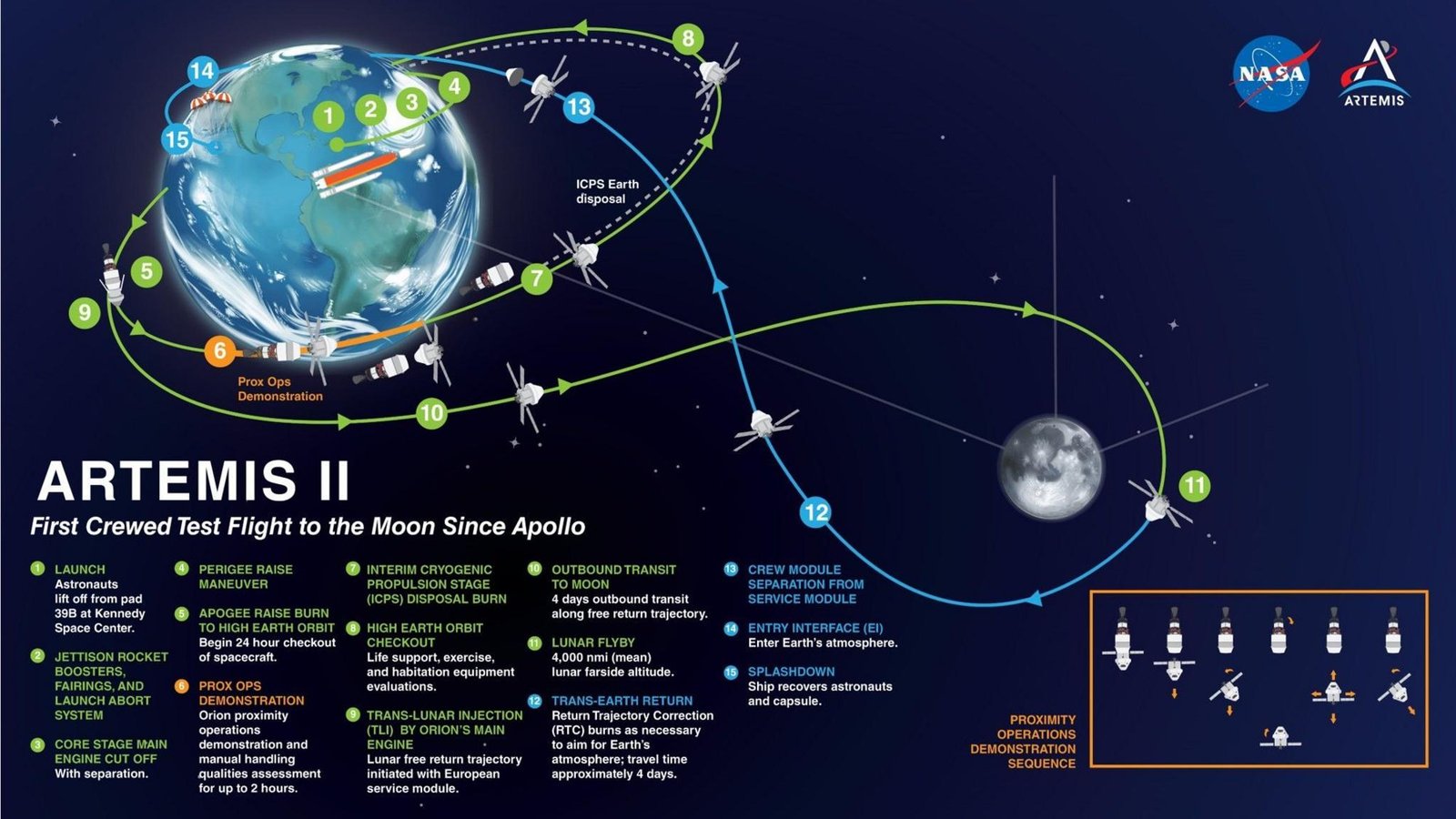
NASA’s Artemis II lunar flyby mission carried astronauts back to the Moon’s vicinity in 2026, marking one of the most important human spaceflight milestones of the modern era. It was not a Moon landing mission, and it should not be confused with future Artemis surface missions. Instead, Artemis II was a crewed test flight designed to prove that NASA’s modern deep space systems could carry humans beyond low Earth orbit, around the Moon, and safely back home.
The mission launched on April 1, 2026, using NASA’s Space Launch System rocket and Orion spacecraft. The crew included NASA astronauts Reid Wiseman, Victor Glover, Christina Koch, and Canadian Space Agency astronaut Jeremy Hansen. After a nearly ten-day journey around the Moon, Orion splashed down in the Pacific Ocean off the coast of San Diego on April 10, 2026.
In simple words, Artemis II was the mission that moved humanity from preparing to return to the Moon to actually sending people back around it.
Table of Contents
ToggleEditorial Note
This article is based on NASA’s official Artemis II mission information and post-mission updates. Artemis II was a crewed lunar flyby mission, not a lunar landing mission. It successfully tested NASA’s Orion spacecraft, Space Launch System rocket, crew operations, navigation, communication, reentry, and recovery procedures. Future Artemis missions may build on this success, but future mission schedules should always be checked against the latest NASA updates before publication.
Key Mission Facts
| Mission Detail | Information |
|---|---|
| Mission Name | Artemis II |
| Space Agency | NASA, with Canadian Space Agency participation |
| Mission Type | Crewed lunar flyby |
| Launch Date | April 1, 2026 |
| Splashdown Date | April 10, 2026 |
| Mission Duration | 9 days, 1 hour, 32 minutes |
| Rocket | Space Launch System |
| Spacecraft | Orion |
| Crew | Reid Wiseman, Victor Glover, Christina Koch, Jeremy Hansen |
| Main Purpose | Test crewed deep space systems around the Moon |
| Landing on Moon? | No |
| Historic Importance | First crewed journey around the Moon since Apollo |
These facts are important because Artemis II is sometimes misunderstood. It was not designed to land astronauts on the Moon. Its purpose was to test the spacecraft, rocket, crew systems, and deep space operations needed before more complex lunar missions.
What Was the Artemis II Lunar Flyby Mission?
Artemis II was the first crewed flight of NASA’s Artemis program. Its main goal was to test whether Orion, the Space Launch System rocket, ground systems, and mission teams could safely support astronauts on a deep space journey around the Moon.
A lunar flyby means the spacecraft travels near or around the Moon without landing on the surface. This type of mission allows engineers and scientists to test deep space navigation, communication, life support, crew operations, and return-to-Earth systems before attempting more complex missions.
Artemis II followed Artemis I, which was an uncrewed mission around the Moon. Artemis I tested the rocket and spacecraft without astronauts onboard. Artemis II took the next step by adding a crew.
That made the mission much more significant. A spacecraft carrying humans must do more than survive space. It must keep astronauts alive, protect them from dangerous conditions, allow them to work, communicate with Earth, and return safely through Earth’s atmosphere.
For more NASA mission explainers, visit our NASA category.
Why Artemis II Mattered
Artemis II mattered because it tested the human side of NASA’s return to the Moon. Robotic and uncrewed missions are essential, but crewed missions bring a different level of complexity. When astronauts are onboard, every system must work with much greater reliability.
The mission tested life support, navigation, communication, spacecraft control, mission operations, reentry protection, and recovery procedures. It also helped NASA understand how Orion performs with a crew inside during a real deep space mission.
Artemis II also mattered because it restored human lunar travel. Since 1972, astronauts had lived and worked mainly in low Earth orbit. The International Space Station became a major laboratory, but it remained close to Earth compared with the Moon. Artemis II sent humans beyond that familiar region again.
This made Artemis II both a technical mission and a historic mission. It connected the legacy of Apollo with the future of Artemis.
The Artemis II Crew
The Artemis II crew included four astronauts.
| Astronaut | Role | Agency |
|---|---|---|
| Reid Wiseman | Commander | NASA |
| Victor Glover | Pilot | NASA |
| Christina Koch | Mission Specialist | NASA |
| Jeremy Hansen | Mission Specialist | Canadian Space Agency |
Each crew member played an important role in testing Orion and supporting mission operations. They were not simply passengers. They monitored systems, followed mission procedures, supported spacecraft checks, communicated with mission control, and helped NASA evaluate how Orion performed during crewed deep space flight.
The crew also represented a broader future for lunar exploration. Artemis is not only a NASA program in isolation. It includes international partnerships, commercial contributions, and long-term plans for more sustained exploration.
Jeremy Hansen’s role as a Canadian Space Agency astronaut showed how modern lunar exploration is becoming more international than the Apollo era. Future missions to the Moon will likely depend on cooperation between space agencies, companies, engineers, scientists, and astronauts from different countries.
Orion: The Spacecraft That Carried the Crew
The Orion spacecraft was the crew vehicle for Artemis II. Orion is designed for deep space missions beyond low Earth orbit. It includes a crew module, service module, heat shield, navigation systems, communication systems, power systems, and life support equipment.
During Artemis II, Orion had to support the astronauts during launch, Earth orbit operations, the journey toward the Moon, the lunar flyby, the return trip, atmospheric reentry, and splashdown.
One of Orion’s most important jobs was keeping the crew safe during reentry. Returning from the Moon is much more demanding than returning from low Earth orbit because the spacecraft enters Earth’s atmosphere at very high speed. This creates extreme heat around the capsule. Orion’s heat shield had to protect the astronauts during one of the most dangerous parts of the mission.
The mission gave NASA valuable performance data. Engineers can use this data to improve future missions, understand system behavior, and prepare for more complex Artemis flights.
The Space Launch System Rocket
The Space Launch System, also called SLS, launched Artemis II from Earth. SLS is NASA’s powerful deep space rocket designed to send Orion and astronauts toward the Moon.
A lunar mission requires enormous energy. The rocket must lift the spacecraft, crew, service module, fuel, and mission systems out of Earth’s gravity and place Orion on a path toward deep space.
SLS is important because human lunar missions need heavy-lift capability. A rocket for a Moon mission must do much more than send a satellite into orbit. It must provide enough power to begin a journey far beyond Earth.
During Artemis II, SLS helped prove that NASA’s launch system could support a crewed deep space mission. This was a key part of the Artemis program because future Moon missions depend on reliable launch capability.
Timeline of the Artemis II Mission
Artemis II followed a carefully planned mission timeline. Each phase tested important systems and procedures.
| Mission Phase | What Happened |
|---|---|
| Launch preparation | NASA completed final checks on SLS, Orion, crew systems, and ground operations |
| Launch | Artemis II launched on April 1, 2026 |
| Earth orbit operations | Orion and the crew completed early system checks |
| Journey toward the Moon | Orion traveled away from Earth toward lunar flyby |
| Lunar flyby | The crew flew around the Moon and captured views of the lunar surface |
| Return journey | Orion headed back toward Earth |
| Reentry | Orion entered Earth’s atmosphere at high speed |
| Splashdown | Orion splashed down off the coast of San Diego on April 10, 2026 |
| Recovery | NASA and U.S. Navy recovery teams retrieved the crew and spacecraft |
| Post-mission analysis | Engineers began reviewing spacecraft performance and mission data |
This timeline shows that Artemis II was not just a dramatic flight around the Moon. It was a complete deep space mission cycle from launch to recovery.
What Happened During the Lunar Flyby?
The lunar flyby was the most visually powerful part of Artemis II. Orion traveled around the Moon, allowing the astronauts to see lunar regions directly and capture images of the Moon’s far side.
NASA released images from the flyby showing lunar terrain and views connected to humanity’s return to the Moon’s vicinity. These images mattered because they reminded people that the Moon is not only a symbol in the night sky. It is a real world with craters, mountains, plains, and scientific history.
The flyby also tested important technical systems. Orion had to navigate accurately, maintain communication, manage power, support the crew, and remain on a safe trajectory back to Earth.
For future Artemis missions, these tests matter. A landing mission requires even more complex operations, including lunar orbit activities, docking, lander coordination, surface descent, ascent, and return to Earth. Artemis II helped build confidence in the systems that future astronauts will depend on.
Confirmed Facts vs Future Artemis Possibilities
It is important to separate confirmed facts from future plans.
| Topic | Status |
|---|---|
| Artemis II launched in 2026 | Confirmed |
| Artemis II completed a crewed lunar flyby | Confirmed |
| Artemis II splashed down safely | Confirmed |
| Artemis II landed astronauts on the Moon | False |
| Future Artemis lunar landings | Future program objective |
| Long-term human presence near the Moon | Future Artemis goal |
| Mars missions using Artemis experience | Long-term future possibility |
This distinction protects the accuracy of the article. Artemis II should be described as a completed crewed lunar flyby mission, not as a Moon landing.
Future Artemis missions may aim for lunar surface operations, longer-duration missions, and eventual Mars preparation. However, future schedules can change, so they should be described carefully as planned, expected, proposed, or future objectives unless NASA confirms specific details.
How Artemis II Prepared for Future Moon Landings
Artemis II prepared for future Moon landings by testing the transportation and crew systems that future missions will need.
A Moon landing mission is not only about reaching the lunar surface. It requires a safe launch from Earth, a reliable crew spacecraft, accurate navigation, stable communication, life support, docking capability, lander coordination, surface operations, return from the Moon, reentry, and recovery.
Artemis II tested several of these core systems with humans onboard.
Future landing missions will be more complex because astronauts will need to travel to the Moon, transfer between spacecraft or systems, descend to the surface, conduct scientific work, leave the surface, reconnect with Orion or another spacecraft, and return safely to Earth.
Before those steps can happen, NASA needs confidence in the basic crewed deep space transportation system. Artemis II helped provide that confidence.
Why the Moon Still Matters
The Moon remains one of the most important destinations in space exploration. Some people think the Moon is only important because of the Apollo missions, but its value goes far beyond history.
Scientifically, the Moon preserves clues about the early solar system. Its surface has recorded billions of years of impacts. Unlike Earth, the Moon has no oceans, active weather, or plate tectonics that erase much of its ancient surface history.
The Moon is also a nearby testing ground for future exploration. Technologies needed for Mars missions can be tested closer to Earth on or near the Moon. These include habitats, spacesuits, power systems, communication networks, navigation methods, surface mobility, and life support systems.
The Moon may also contain water ice in permanently shadowed regions near its poles. Water ice is important because it can support science and may one day help future exploration if it can be accessed and used responsibly.
The Moon also connects with wider space science topics, including planetary formation and orbital systems. You can explore related ideas in our guide on why planets have rings.
Artemis II and the Return of Human Deep Space Exploration
For decades after Apollo, human spaceflight stayed mostly close to Earth. Astronauts flew aboard space shuttles and lived on space stations, but they did not travel around the Moon.
Artemis II changed that pattern. It sent astronauts beyond low Earth orbit and helped restart human deep space travel.
This matters because exploration capability takes time to rebuild. A space agency must test spacecraft, rockets, operations, recovery systems, communication networks, crew training, and emergency planning. Artemis II gave NASA and its partners real crewed deep space experience in the modern era.
The mission also inspired public interest because human spaceflight has emotional power. Robotic missions are extremely valuable, but seeing humans travel around the Moon again connects science, history, risk, and imagination in a unique way.
For more space exploration topics, visit our Space & Beyond section.
Artemis II Compared with Apollo 8
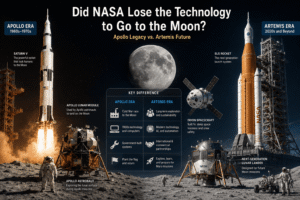
Artemis II is often compared with Apollo 8 because both missions sent humans around the Moon without landing. Apollo 8 flew in 1968 and became the first crewed mission to orbit the Moon. Artemis II, more than five decades later, became the first crewed lunar flight of the Artemis generation.
| Feature | Apollo 8 | Artemis II |
|---|---|---|
| Program | Apollo | Artemis |
| Era | 1960s | 2020s |
| Mission Type | Crewed lunar orbit mission | Crewed lunar flyby test mission |
| Moon Landing? | No | No |
| Crew Size | 3 astronauts | 4 astronauts |
| Spacecraft | Apollo command/service module | Orion spacecraft |
| Historic Role | Opened the path to Apollo Moon landings | Tested modern crewed deep space systems |
| Long-Term Goal | First human Moon landing | Sustained lunar exploration and Mars preparation |
This comparison shows how Artemis II connected past and future. Apollo 8 helped prepare for Apollo 11. Artemis II helped prepare for future Artemis missions.
What Artemis II Tested
Artemis II tested many systems that future astronauts will depend on.
The first major test was crew safety. Orion had to support human life during deep space travel.
The second test was navigation. Orion had to follow the correct path around the Moon and return to Earth.
The third test was communication. NASA had to stay connected with the crew across deep space distances.
The fourth test was spacecraft control. The mission helped evaluate how Orion behaved with astronauts onboard.
The fifth test was reentry. Orion had to survive high-speed return through Earth’s atmosphere.
The sixth test was recovery. NASA and its partners had to locate, secure, and recover the crew and spacecraft after splashdown.
These tests may sound technical, but they are the foundation of safe human exploration. Before astronauts can live and work on or near the Moon for longer periods, the transportation system must prove itself.
What People Often Get Wrong About Artemis II
Many people misunderstand Artemis II.
The first mistake is thinking Artemis II landed on the Moon. It did not. Artemis II was a lunar flyby mission.
The second mistake is thinking the mission was only symbolic. It was historic, but it was also highly technical. It tested systems that future lunar missions will need.
The third mistake is thinking Artemis is simply a repeat of Apollo. Apollo focused on reaching the Moon during the space race. Artemis is designed around a longer-term return to the Moon, international partnerships, modern technology, and preparation for future Mars missions.
The fourth mistake is assuming future Artemis dates are guaranteed. Space mission schedules can change because of safety reviews, engineering issues, funding, hardware readiness, and mission planning. Future Artemis dates should always be described carefully unless officially confirmed.
The fifth mistake is thinking the Moon no longer matters. The Moon remains scientifically valuable and strategically important for testing exploration systems.
Why Artemis II Matters for Science
Artemis II was mainly a test flight, but it still mattered for science. The mission gave astronauts a chance to observe the Moon directly and capture images during the flyby. It also tested the human and technical systems that future science missions will need.
Future Artemis missions may study lunar geology, collect samples, deploy instruments, investigate water ice, examine the lunar environment, and support long-term science operations near the Moon.
Artemis II helped prepare the transportation and crew systems needed for those future scientific goals.
Human explorers can also make real-time observations. They can notice unexpected features, adjust priorities, describe what they see, and support scientific decision-making in ways that are different from robotic missions.
NASA uses advanced mapping and imaging methods across many worlds, including Mars. You can read more in our article on how NASA maps the surface of Mars.
Artemis II and the Future of Mars Exploration
NASA often connects Moon exploration with future Mars exploration. The reason is practical: Mars is much farther away and much harder to reach than the Moon.
Before humans travel to Mars, they need experience living and working beyond Earth for longer periods. The Moon provides a closer place to test technologies and procedures.
Systems that may matter for Mars include life support, radiation protection, navigation, surface habitats, power systems, communication delays, emergency planning, and long-duration crew health.
Artemis II did not go to Mars, but it contributed to that long-term path. It tested crewed deep space flight and helped NASA learn how Orion performs with astronauts onboard.
In this sense, Artemis II was not only about the Moon. It was also about preparing humanity for deeper space exploration.
International Partnership in Artemis II
Artemis II showed that the future of lunar exploration is international. Jeremy Hansen of the Canadian Space Agency joined the NASA crew, making the mission an important example of cooperation beyond one country.
Modern space exploration is different from the Apollo era. Today, major missions often involve international partners, commercial companies, scientific institutions, and industrial teams.
This type of cooperation matters because sustained lunar exploration is complex. It requires spacecraft, launch systems, landers, communication networks, spacesuits, scientific instruments, surface systems, and long-term planning.
Artemis II demonstrated that the return to the Moon is not only a national achievement. It is part of a wider effort to build a long-term human presence beyond Earth.
Reader-Friendly Artemis II Timeline
| Date or Phase | Event |
|---|---|
| Before launch | Crew training, spacecraft preparation, rocket readiness, and mission planning |
| April 1, 2026 | Artemis II launched aboard SLS with Orion |
| Early mission phase | The crew checked Orion systems after launch |
| Translunar journey | Orion traveled from Earth toward the Moon |
| Lunar flyby | The crew observed the Moon and tested deep space operations |
| Return journey | Orion traveled back toward Earth |
| April 10, 2026 | Orion splashed down off the coast of San Diego |
| Recovery phase | NASA and U.S. Navy teams recovered the crew and spacecraft |
| Post-mission phase | Engineers began studying Orion’s performance and mission data |
This timeline helps show the mission as a complete journey: launch, travel, lunar flyby, return, splashdown, recovery, and analysis.
Artemis I, Artemis II, and Future Artemis Missions
| Mission | Crew Status | Main Purpose | Moon Landing? |
|---|---|---|---|
| Artemis I | Uncrewed | Test SLS and Orion around the Moon | No |
| Artemis II | Crewed | Test Orion, SLS, and crew systems during a lunar flyby | No |
| Future Artemis missions | Crewed and more complex | Lunar orbit, landing, surface operations, and long-term exploration | Planned for future missions |
This comparison makes the Artemis program easier to understand. Artemis II was not the final destination. It was a necessary step between uncrewed testing and future human surface exploration.
How Artemis II Captured Public Imagination
Artemis II mattered not only to engineers and scientists but also to the public. Human spaceflight has a special emotional impact because people can imagine the courage, risk, and wonder of the journey.
Seeing astronauts travel around the Moon again reminded the world that lunar exploration is not only part of the past. It is part of the present and future.
For students, Artemis II may become a mission that inspires interest in science, engineering, astronomy, robotics, and space exploration. For researchers, it provides new mission data. For the public, it renews the sense that humans can still attempt difficult and meaningful journeys.
This kind of inspiration is important because space exploration depends on future generations. The students who watched Artemis II may become the engineers, scientists, astronauts, and mission planners of future exploration programs.
What Comes After Artemis II?
After Artemis II, NASA and its partners must study the mission data carefully. Engineers need to review Orion’s performance, crew systems, heat shield behavior, communication, navigation, recovery procedures, and any issues that appeared during the mission.
This post-mission analysis is essential because future missions will be more complex. A lunar landing mission requires more hardware, more coordination, and more risk management than a flyby.
Artemis II provided real flight experience. That experience helps mission planners improve future systems and reduce risk.
The most important result of Artemis II may be this: humanity has taken a crewed step back toward the Moon. Future missions will build from what Artemis II proved and what engineers learn from its data.
The Artemis program also connects with broader future technology trends, from advanced spacecraft systems to robotics and human exploration planning. For more future-focused science topics, explore our Future & Technology section.
Frequently Asked Questions
What was Artemis II?
Artemis II was NASA’s first crewed lunar flyby mission under the Artemis program. It carried four astronauts around the Moon and returned them safely to Earth.
Did Artemis II land on the Moon?
No. Artemis II did not land on the Moon. It was a lunar flyby mission designed to test Orion, SLS, crew systems, and deep space operations.
When did Artemis II launch?
Artemis II launched on April 1, 2026.
When did Artemis II return to Earth?
Artemis II splashed down in the Pacific Ocean off the coast of San Diego on April 10, 2026.
Who were the Artemis II astronauts?
The Artemis II crew included NASA astronauts Reid Wiseman, Victor Glover, Christina Koch, and Canadian Space Agency astronaut Jeremy Hansen.
Why was Artemis II important?
Artemis II was important because it was the first crewed lunar journey of the Artemis program and the first human journey around the Moon since the Apollo era. It tested the systems needed for future lunar missions.
What spacecraft did Artemis II use?
Artemis II used NASA’s Orion spacecraft, launched by the Space Launch System rocket.
How long did Artemis II last?
NASA lists the Artemis II mission duration as 9 days, 1 hour, and 32 minutes.
How did Artemis II help future Moon missions?
Artemis II tested the spacecraft, rocket, crew procedures, communication, navigation, reentry, and recovery systems needed before more complex lunar missions.
Was Artemis II part of the Apollo program?
No. Artemis II was part of NASA’s Artemis program. Apollo was the earlier Moon program from the 1960s and 1970s.
Conclusion
Artemis II was one of the most important human spaceflight missions of the modern era. It carried astronauts around the Moon for the first time in the Artemis program and helped prove that NASA’s Orion spacecraft, Space Launch System rocket, and deep space operations could support a crewed lunar journey.
The mission did not land on the Moon, and that distinction matters. Artemis II was a crewed lunar flyby designed to test and prepare. Its success helped build confidence for future Artemis missions that may involve lunar orbit operations, surface exploration, scientific investigations, and longer-term human activity near the Moon.
For humanity, Artemis II was a bridge between memory and momentum. Apollo showed what was possible in the past. Artemis II showed that human lunar exploration is moving forward again.
The simplest way to understand Artemis II is this: it was humanity’s next major step back toward the Moon. It proved that people can once again travel beyond low Earth orbit, fly around the Moon, and return home safely using a new generation of space technology.
Sources and Further Reading
NASA: Artemis II Splashdown and Recovery
NASA: Artemis II Mission Milestones
NASA: Artemis II Lunar Flyby Gallery
About the Author
Shahzaib Ali
Shahzaib Ali is the founder and editor of Sanceen, a science, space, NASA, and future technology educational website. He writes beginner-friendly articles about space missions, astronomy, scientific discoveries, and emerging technology.