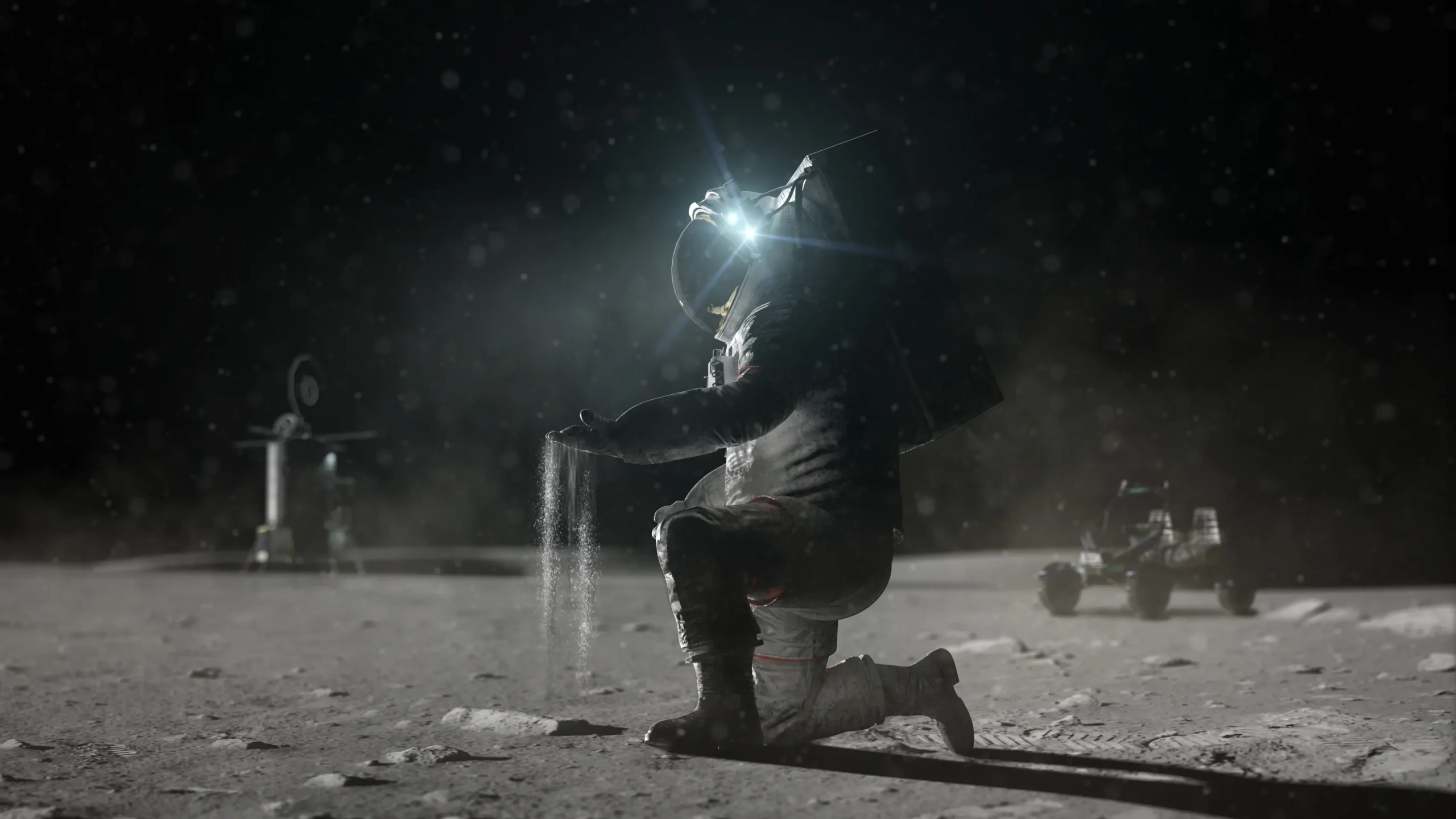
The Moon may look calm, silent, and beautiful from Earth, but its surface hides one of the hardest problems future astronauts will face: dust.
Lunar dust is not like the soft dust found inside a house. It is sharp, abrasive, clingy, electrostatic, and difficult to remove. It can stick to spacesuits, scratch visors, cover solar panels, block camera lenses, enter seals, damage hardware, and create health concerns if carried into crew habitats. During the Apollo missions, astronauts quickly learned that Moon dust was not a small inconvenience. It was a serious operational problem.
Now, as NASA prepares for longer Artemis missions and future lunar surface operations, dust mitigation has become one of the most important technology challenges. Future astronauts may spend more time walking, driving, building, testing equipment, and working near the lunar surface. That means they will face more dust exposure than Apollo crews did.
This is why NASA lunar dust mitigation technology matters in 2026. If humans want to work safely on the Moon for longer periods, they need ways to keep dust away from spacesuits, machines, habitats, solar panels, radiators, windows, cameras, tools, and air systems.
NASA is not treating lunar dust as a simple cleaning problem. It is a major engineering challenge that affects astronaut safety, mission reliability, surface power, thermal control, visibility, mobility, and long-term exploration.
In simple words, solving Moon dust is not optional. It is one of the keys to making future lunar exploration sustainable.
Editorial Note
This article explains confirmed NASA lunar dust mitigation research, demonstrated technologies, current challenges, and future possibilities. It does not claim that one single technology has completely solved the lunar dust problem. NASA has demonstrated progress with technologies such as the Electrodynamic Dust Shield, but long-term Moon missions will likely require multiple dust mitigation methods working together. Future Artemis mission schedules and technology deployments should always be checked against official NASA updates.
Key Statistics and Facts
| Fact | Why It Matters |
|---|---|
| Lunar dust is abrasive, electrostatic, and can cling to charged surfaces. | This makes it difficult to remove from spacesuits, tools, and hardware. |
| NASA says lunar dust can scratch spacesuits, affect human lungs, reduce solar panel power, coat radiators, and obscure cameras or visors. | Dust can affect both astronaut safety and mission equipment. |
| NASA’s Electrodynamic Dust Shield uses electric fields to lift and remove dust from surfaces. | This gives NASA an active method for removing lunar dust without simple brushing. |
| EDS has been tested in low Earth orbit and on the Moon. | The technology has moved beyond lab-only testing. |
| NASA reported that EDS removed dust from glass and thermal radiator surfaces during Firefly Aerospace’s Blue Ghost Mission 1. | This was a major real-world lunar demonstration. |
| NASA’s Lunar Surface Innovation Initiative includes dust mitigation as one of its key technology development areas. | Dust control is part of NASA’s wider plan for long-duration lunar missions. |
These facts show why lunar dust mitigation is not a minor technical detail. It is directly connected to whether astronauts and machines can work safely on the Moon for more than short visits.
What Is Lunar Dust?
Lunar dust is the fine powdery material found on the Moon’s surface. It is part of lunar regolith, which includes dust, soil, broken rock, and small particles created by billions of years of impacts from micrometeorites.
On Earth, wind, water, and weather slowly smooth many particles over time. The Moon does not have the same weathering processes. Because of this, lunar dust grains can remain sharp, jagged, and abrasive. NASA has described lunar dust as sharp and abrasive, similar to tiny shards of glass.
That shape makes lunar dust especially dangerous for equipment. When dust rubs against spacesuits, seals, glass, tools, or moving parts, it can scratch and wear them down. Simple brushing may not solve the problem because the dust is also electrostatically charged and highly insulating.
Lunar dust is also very fine. Some particles are smaller than the human eye can easily see. This means a surface may appear clean while still holding dust that can damage systems or enter sensitive areas.
For more NASA mission and technology explainers, visit our NASA category.
Why Lunar Dust Is One of the Moon’s Biggest Challenges
The Moon’s dust problem is serious because it affects almost every part of a surface mission. A rover, habitat, spacesuit, camera, solar panel, radiator, hatch, seal, and scientific instrument can all be affected by dust.
Dust can damage spacesuits by grinding into fabric and joints. It can scratch helmet visors and reduce visibility. It can cover solar panels and reduce available power. It can coat thermal radiators and make it harder for equipment to control temperature. It can enter seals and hatches, making it harder to keep pressurized spaces safe.
Dust may also create health concerns. If astronauts carry dust into habitats after moonwalks, fine particles could become airborne inside the living area. NASA has studied lunar regolith hazards because future Artemis astronauts may need to stay healthy during longer missions.
This is why lunar dust is not just a surface cleanliness issue. It affects mission safety, power, thermal control, crew health, hardware lifetime, and scientific productivity.
The Artemis program aims to build a path toward more sustained lunar exploration. That goal cannot be achieved unless dust is controlled more effectively than it was during Apollo.
What Makes Moon Dust Different from Earth Dust?
Moon dust behaves differently from Earth dust because the Moon has a very different environment.
The Moon has almost no atmosphere. It has no rain, rivers, wind, or oxygen-rich weathering like Earth. As a result, dust grains are not smoothed in the same way. They can remain sharp and abrasive.
Moon dust can also become electrostatically charged. Solar ultraviolet radiation, plasma interactions, and surface charging can make dust cling to surfaces. Spacecraft landing plumes can also loft dust and blow it across the surface.
On Earth, a person might clean dust with water, air, cloth, or a brush. On the Moon, those methods are more difficult. Water is precious. Air is limited to pressurized areas. Brushing can make abrasion worse. Some dust may cling even after visible cleaning.
This is why NASA needs specialized lunar dust mitigation technologies. The Moon requires solutions designed for vacuum, low gravity, radiation, electrostatic charging, and abrasive regolith.
NASA’s Electrodynamic Dust Shield Technology
One of NASA’s most important lunar dust mitigation technologies is the Electrodynamic Dust Shield, also called EDS.
EDS uses transparent electrodes and electric fields to lift and remove dust from surfaces. Instead of simply wiping or brushing dust away, EDS applies electrical forces that move charged dust particles off protected surfaces.
NASA says EDS technology can be used for many space applications, including thermal radiators, solar panels, camera lenses, spacesuits, boots, and helmet visors. This is important because different parts of a lunar mission face dust in different ways.
A solar panel needs to stay clear to produce power. A camera lens needs to stay clean for visibility and navigation. A radiator needs to release heat. A spacesuit visor needs to protect astronaut vision. A seal needs to remain reliable.
EDS is valuable because it can potentially protect many of these surfaces.
NASA’s Kennedy Space Center has worked on EDS for years. The technology is based on an “Electric Curtain” concept developed by NASA in 1967, with later development for modern lunar and space applications.
EDS Successfully Demonstrated on the Moon
A major milestone came when NASA’s Electrodynamic Dust Shield demonstrated its ability to remove lunar regolith during Firefly Aerospace’s Blue Ghost Mission 1. NASA reported that the mission concluded on March 16, 2025, and that EDS removed dust from glass and thermal radiator surfaces.
This was important because it moved dust mitigation from laboratory testing into a real lunar environment. Testing on Earth is useful, but the Moon has special conditions that are difficult to fully reproduce. A successful lunar demonstration gives engineers better evidence about how the system performs outside a lab.
NASA described the demonstration as a significant step toward reducing dust-related hazards for surfaces such as thermal radiators, solar panels, camera lenses, spacesuits, boots, and helmet visors.
This does not mean the entire lunar dust problem is solved. It means one important technology has shown real promise on the Moon.
That distinction matters. A trustworthy space article should not claim “NASA has completely solved Moon dust.” The accurate statement is that NASA has demonstrated progress with dust mitigation systems, especially EDS, while broader dust-control strategies are still needed for long-duration missions.
Confirmed Facts vs Future Possibilities
| Topic | Status |
|---|---|
| Lunar dust is abrasive and electrostatic | Confirmed |
| Lunar dust can affect spacesuits, lungs, solar panels, radiators, cameras, and visors | Confirmed by NASA |
| NASA developed Electrodynamic Dust Shield technology | Confirmed |
| EDS has been tested in low Earth orbit | Confirmed |
| EDS demonstrated lunar dust removal on Blue Ghost Mission 1 | Confirmed |
| One dust technology has completely solved all lunar dust problems | Not confirmed |
| Future Artemis missions using multiple dust mitigation systems | Likely future direction |
| Dust-proof lunar bases with perfect protection | Future possibility, not current reality |
This table is important because lunar dust mitigation is an active area of technology development. NASA has made real progress, but long-term lunar surface operations will likely require a combination of solutions.
Why Brushing Moon Dust Is Not Enough
A simple brush may seem like an obvious cleaning tool, but lunar dust is too difficult for ordinary cleaning methods.
Because the particles are sharp, brushing can push dust across a surface and cause scratching. Because dust is electrostatically charged, it can cling tightly. Because particles are tiny, visible cleaning may not remove everything.
Spacesuits are especially vulnerable. Dust can enter fabric layers, joints, zippers, seals, and bearings. Over time, this could weaken the suit or make movement harder. Tools and rover parts can suffer similar problems if dust gets into moving mechanisms.
For habitats, dust control becomes even more important. Astronauts may return from moonwalks covered in dust. If that dust enters a pressurized living area, it could affect filters, air quality, equipment, and health.
This is why NASA needs active and passive dust control strategies, not only cleaning brushes.
Different Types of Lunar Dust Mitigation Technology
NASA and its partners are exploring several approaches to lunar dust mitigation. No single method is likely to solve every dust problem. Different surfaces and mission systems may require different solutions.
| Technology Type | How It Helps |
|---|---|
| Electrodynamic Dust Shield | Uses electric fields to lift and remove dust from surfaces |
| Surface stabilization | Helps reduce dust movement from landing, driving, or walking |
| Filtration systems | Helps protect habitats and life support systems from fine particles |
| Dust-tolerant fabrics | Helps spacesuits resist dust damage and intrusion |
| Protective coatings | Helps reduce dust sticking to surfaces |
| Electron-beam dust mitigation | Uses charged particles to remove dust from surfaces |
| Robotics and cleaning tools | Helps remove dust without exposing astronauts directly |
| Operational planning | Reduces dust exposure through smarter landing, walking, and equipment procedures |
A strong lunar dust strategy will likely combine engineering, materials science, robotics, surface operations, and astronaut procedures.
Electron Beam Dust Mitigation
Another promising idea is Electron Beam Dust Mitigation, or EBDM. NASA’s Space Technology Payload Challenge highlighted an EBDM technology developed by Space Dust Research & Technologies. According to NASA’s challenge page, the technology uses an electron beam to charge particles and mitigate dust hazards on airless bodies like the Moon. It demonstrated cleaning efficacy up to 92% for several surfaces, including spacesuits, solar panels, optical lenses, and thermal blankets.
This technology is different from EDS, but it shares the same broad goal: removing or controlling lunar dust without relying on simple mechanical cleaning.
EBDM remains a technology direction rather than a universal solution. Future testing, mission integration, and real lunar demonstrations would determine how useful it becomes for Artemis and other lunar operations.
Still, it shows that lunar dust mitigation is not limited to one idea. NASA and the wider space technology community are exploring multiple methods because the problem is complex.
Dust Mitigation and Artemis Missions
The Artemis program aims to return humans to the Moon and build toward longer-duration lunar exploration. Dust mitigation is essential for that goal.
Short missions can tolerate more inconvenience. Long missions cannot. If astronauts stay on or near the Moon for longer periods, dust exposure becomes repeated and cumulative. Every moonwalk, rover drive, landing, construction task, and equipment deployment can create more dust problems.
Dust may affect:
Spacesuit mobility.
Helmet visibility.
Solar power generation.
Thermal control systems.
Air filters.
Habitat cleanliness.
Rover mechanisms.
Scientific instruments.
Communication equipment.
Seals, hatches, and joints.
Future Artemis missions will need better ways to prevent dust from entering habitats, damaging suits, reducing power, or shortening equipment life.
For readers following NASA’s return to the Moon, you can also read our article on the Artemis II lunar flyby mission.
Dust and Lunar Power Systems
Power is one of the most important requirements for a lunar mission. Astronauts and robots need electricity for life support, communication, science instruments, rovers, lights, heaters, navigation, and computing.
Solar panels are one major power option on the Moon, but dust can reduce their performance. If dust accumulates on solar panels, less sunlight reaches the surface of the panel. That can reduce the amount of electricity produced.
NASA has noted that dust accumulation on solar panels can reduce available power. This matters because power shortages can affect mission safety and scientific productivity.
Dust mitigation technologies such as EDS could help protect solar panels by removing dust buildup. Other strategies may include panel placement, surface operations planning, cleaning tools, coatings, and robotic maintenance.
In a long-duration lunar mission, keeping power systems clean is not just helpful. It may be mission-critical.
Dust and Thermal Control
Thermal control is another major reason dust matters. Spacecraft, habitats, rovers, and instruments must manage heat carefully. If equipment becomes too hot or too cold, it can fail.
Thermal radiators help release heat. But if dust covers a radiator, it can reduce the radiator’s ability to control temperature. NASA has identified dust buildup on thermal radiators as a problem because it can increase equipment temperatures.
This is why EDS testing on thermal radiator surfaces is important. If dust can be removed from radiators, equipment may survive longer and perform more reliably.
Thermal control is especially important on the Moon because temperatures can be extreme. Lunar day and night conditions create major engineering challenges. Dust makes those challenges harder.
Dust and Astronaut Health
Lunar dust is also a health concern. Fine particles could be carried into habitats on spacesuits, tools, or equipment. If dust becomes airborne inside a pressurized area, astronauts may inhale it.
NASA has studied lunar regolith hazards because future Artemis moonwalkers will need protection from dust exposure. Dust particles can be tiny, sharp, and chemically reactive compared with many Earth dusts.
This does not mean every dust exposure will automatically cause severe illness. It means NASA must understand and reduce the risk before longer missions.
Possible protections include:
Better suit materials.
Suitports or dust-isolating entry systems.
Air filtration.
Cleaning procedures.
Dust-resistant fabrics.
Monitoring systems.
Habitat design that separates dusty and clean areas.
Astronaut health is one reason dust mitigation is not only an engineering topic. It is also a human safety topic.
Dust and Spacesuit Design
Spacesuits are among the most important systems affected by lunar dust. A spacesuit is not just clothing. It is a small human spacecraft. It provides pressure, oxygen, temperature control, mobility, communication, protection, and safety.
Dust can affect spacesuits in several ways. It can scratch visors, cling to fabric, enter joints, damage seals, reduce flexibility, and make suit maintenance harder.
Apollo astronauts experienced dust problems after moonwalks. Future Artemis astronauts may spend more time on the lunar surface, so the challenge becomes larger.
Dust-tolerant fabrics, improved seals, suit cleaning systems, and operational procedures will all be important. EDS-like technologies may also be useful for selected suit surfaces such as visors, boots, and other exposed areas.
A future lunar spacesuit must not only protect astronauts from vacuum and temperature. It must also survive repeated contact with regolith.
Dust and Lunar Habitats
Habitats will need strong dust-control systems. If astronauts live on the Moon for longer periods, they cannot allow large amounts of dust to enter living areas every time someone returns from a moonwalk.
A lunar habitat may need zones that separate dusty equipment from clean living spaces. It may need filtration systems, suit storage areas, dust-removal chambers, cleaning tools, and careful airflow design.
Dust can also affect habitat seals, hatches, windows, solar arrays, radiators, and external systems. If dust enters mechanical parts, it may cause wear or failure over time.
This is why dust mitigation must be designed into the architecture of lunar missions. It cannot be treated as an afterthought.
NASA’s Lunar Surface Innovation Initiative includes dust mitigation as one of the key technology development areas for successful lunar surface missions. This shows that NASA sees dust control as part of the larger lunar infrastructure challenge.
Dust and Lunar Construction
Future lunar exploration may involve construction, excavation, landing pads, roads, surface power systems, and resource processing. All of these activities can disturb regolith.
When machines dig, drive, land, or build, they can create dust clouds or spread dust across equipment. Lunar construction may therefore increase dust exposure.
This makes surface stabilization important. If parts of the lunar surface can be stabilized, missions may reduce dust movement around habitats, roads, landing zones, and work areas.
Robotic systems may also help. Robots could clean equipment, prepare surfaces, move regolith, and reduce how often astronauts must interact directly with dusty areas.
Lunar dust mitigation is therefore connected to construction, infrastructure, robotics, and in-situ resource utilization. It is not just about wiping dust from a visor.
For more future-focused space technology topics, visit our Future & Technology section.
How NASA Tests Lunar Dust Technologies
Testing lunar dust technology is difficult because the Moon’s environment is hard to reproduce on Earth.
NASA and researchers use vacuum chambers, lunar dust simulants, Apollo regolith samples, low-gravity flight tests, space station experiments, suborbital flights, and lunar payload demonstrations.
Each type of test has strengths and limits.
Earth-based simulants allow engineers to test designs repeatedly, but they are not exactly the same as real lunar dust. Vacuum chambers can simulate some space conditions, but not every aspect of the lunar environment. Low-gravity tests can help study dust motion, but they are brief. Lunar demonstrations provide the most realistic data, but they are expensive and difficult.
This is why the Blue Ghost EDS demonstration mattered. A real lunar surface test gives engineers information that cannot be fully replaced by laboratory results.
Why 2026 Matters for Lunar Dust Mitigation
The year 2026 matters because lunar exploration is moving from short visits toward more serious planning for sustained operations. Technologies that once seemed like side projects are becoming mission-critical.
Dust mitigation is one of those technologies.
As NASA and its partners develop Artemis systems, commercial lunar payload missions, lunar infrastructure ideas, surface power systems, mobility systems, and habitat concepts, dust control must be built into the design.
The success of EDS on the Moon in 2025 gave NASA important evidence that active dust removal can work on real lunar surfaces. In 2026, the focus is not only proving that dust is a problem. The focus is developing, improving, and integrating solutions.
This is why lunar dust mitigation belongs in discussions about the future of Moon exploration.
Comparison: Active vs Passive Dust Mitigation
| Approach | How It Works | Strength | Limitation |
|---|---|---|---|
| Active systems | Use energy, electric fields, beams, or mechanical action to remove dust | Can remove dust after it accumulates | Requires power and system complexity |
| Passive coatings | Reduce dust sticking to surfaces | Can work without power | May not remove all dust in all conditions |
| Filtration | Captures dust inside habitats or equipment systems | Protects air quality and internal systems | Does not prevent external dust buildup |
| Surface stabilization | Reduces dust movement from regolith | Useful near landing pads and habitats | Requires surface preparation |
| Operational procedures | Reduces dust exposure through mission planning | Low-cost and practical | Depends on crew behavior and mission design |
This comparison shows why NASA likely needs a layered approach. The best dust mitigation strategy may combine active removal, passive materials, filtration, surface design, and careful operations.
Timeline: NASA Lunar Dust Mitigation Progress
| Period | Development |
|---|---|
| Apollo era | Astronauts experienced major dust problems on suits, equipment, and inside spacecraft |
| 1967 | NASA developed the Electric Curtain concept, an early foundation for electrodynamic dust removal |
| 2004 onward | NASA Kennedy Space Center continued development of EDS technology for space applications |
| 2019 | EDS was tested in low Earth orbit on the International Space Station |
| 2024 | NASA highlighted EDS as a leading dust removal technology for Artemis and CLPS applications |
| 2025 | EDS demonstrated dust removal on the Moon during Firefly Aerospace’s Blue Ghost Mission 1 |
| 2026 | Dust mitigation remains a key technology area for sustained lunar surface missions |
| Future | Multiple dust-control systems may support habitats, suits, rovers, power systems, and lunar infrastructure |
This timeline shows that lunar dust mitigation is not a sudden idea. It is a long-running challenge that has become more urgent as NASA prepares for longer Moon missions.
What People Often Get Wrong About Lunar Dust
Many people think lunar dust is just ordinary dirt. It is not. Lunar dust is sharper, more abrasive, and more difficult to manage than common Earth dust.
Another mistake is thinking astronauts can simply brush it away. Brushing can make the problem worse because abrasive particles may scratch surfaces.
Some people think dust only affects spacesuits. In reality, dust can affect solar panels, radiators, camera lenses, seals, hatches, tools, rovers, habitats, and human health.
Another misunderstanding is thinking one technology will solve everything. Lunar dust is too complex for one universal fix. Different surfaces and systems need different solutions.
A final mistake is thinking dust is a small issue compared with rockets and landers. Rockets may get astronauts to the Moon, but dust affects whether they can work safely once they arrive.
Why Lunar Dust Mitigation Matters for Long-Term Moon Exploration
Long-term lunar exploration requires reliability. A mission cannot depend on fragile systems that fail after repeated dust exposure.
If astronauts are going to live and work on the Moon for longer periods, their equipment must survive the environment. Dust mitigation helps protect that equipment.
It can help extend the life of solar panels, keep cameras useful, reduce suit wear, protect radiators, support habitat cleanliness, and reduce crew health risks.
It also supports science. Scientific instruments must stay clean enough to collect accurate data. Cameras must see clearly. Drills, rovers, and sample tools must work reliably.
Lunar dust mitigation is therefore not only about comfort. It affects the entire mission architecture.
How Lunar Dust Mitigation Connects to Future Mars Missions
NASA’s Moon work is often connected to future Mars exploration. The Moon is closer than Mars, making it a practical place to test systems before sending humans farther into space.
Mars also has dust problems. Martian dust is different from lunar dust because Mars has an atmosphere and weather, but dust still affects solar panels, machinery, optics, and mission operations.
By learning how to design dust-resistant systems on the Moon, engineers may gain valuable experience for future planetary missions.
NASA uses advanced mapping, imaging, and surface analysis across different worlds. You can read more about that in our article on how NASA maps the surface of Mars.
Future Possibilities for Lunar Dust Control
Future lunar dust mitigation may include many technologies working together.
Spacesuits could use dust-resistant fabrics and surfaces that are easier to clean. Helmets could include dust-repellent visors. Rovers could use protected joints and self-cleaning sensors. Habitats could include suitports, airlocks, filtration, and dust-control zones.
Solar panels and radiators may use EDS or coatings to reduce dust buildup. Landing zones may be stabilized to reduce dust blown by rocket plumes. Robots may clean surfaces or inspect equipment before astronauts use it.
Future lunar bases may be designed with dust control from the beginning. That means layout, materials, traffic routes, entry systems, maintenance routines, and robotics could all be planned around dust.
The strongest future approach will likely be layered. Prevent dust where possible, remove dust when needed, isolate dust from clean areas, and design equipment to survive dust exposure.
Frequently Asked Questions
What is NASA lunar dust mitigation technology?
NASA lunar dust mitigation technology refers to systems and methods designed to reduce, remove, or control lunar dust on spacesuits, spacecraft, habitats, solar panels, radiators, cameras, tools, and other mission hardware.
Why is lunar dust dangerous?
Lunar dust is dangerous because it is sharp, abrasive, electrostatic, and difficult to remove. It can damage spacesuits, scratch surfaces, reduce solar panel power, coat radiators, obscure visors and cameras, enter seals, and create health concerns.
What is the Electrodynamic Dust Shield?
The Electrodynamic Dust Shield, or EDS, is a NASA technology that uses electric fields to lift and remove dust from surfaces. It can potentially protect solar panels, camera lenses, radiators, spacesuits, visors, boots, and other surfaces.
Has NASA tested dust mitigation technology on the Moon?
Yes. NASA reported that its Electrodynamic Dust Shield removed lunar regolith from glass and thermal radiator surfaces during Firefly Aerospace’s Blue Ghost Mission 1, which concluded in March 2025.
Is the lunar dust problem completely solved?
No. NASA has made important progress, but the lunar dust problem is not completely solved. Long-term Moon missions will likely need multiple dust mitigation technologies and operational strategies.
Why is lunar dust worse than Earth dust?
Lunar dust is worse than many types of Earth dust because it is not smoothed by wind, water, or weather. Its particles can be sharp, jagged, abrasive, and electrostatically charged.
Can astronauts just brush Moon dust away?
Brushing may not be enough and can sometimes make the problem worse by scratching surfaces. Specialized cleaning and dust-control technologies are needed.
How does lunar dust affect solar panels?
Dust can cover solar panels and reduce the amount of sunlight reaching them. This can lower power generation, which is a serious problem for lunar missions.
How does lunar dust affect spacesuits?
Dust can cling to spacesuit fabric, enter joints and seals, scratch visors, reduce mobility, and increase wear over time. Future suits need better dust resistance.
Why is dust mitigation important for Artemis?
Artemis aims to support longer and more complex lunar missions. Longer missions mean repeated dust exposure, so NASA needs better ways to protect astronauts, equipment, habitats, power systems, and science instruments.
Conclusion
NASA’s lunar dust mitigation technology is one of the most important parts of future Moon exploration. The Moon’s surface may look quiet from Earth, but its dust is sharp, abrasive, electrostatic, and difficult to control. It can affect spacesuits, solar panels, radiators, cameras, habitats, tools, rovers, seals, and astronaut health.
NASA has made real progress. The Electrodynamic Dust Shield has demonstrated dust removal on the Moon, and other approaches such as filtration, surface stabilization, dust-tolerant fabrics, coatings, robotics, and electron-beam dust mitigation are part of the wider technology landscape.
But the most accurate conclusion is this: lunar dust is not solved by one invention. It requires a complete strategy.
Future lunar missions will need to prevent dust movement, remove dust from key surfaces, protect sensitive equipment, keep habitats clean, and design systems that can survive repeated exposure. Dust mitigation is not just about keeping things tidy. It is about making long-term lunar exploration possible.
The simplest way to understand the challenge is this: rockets can take astronauts to the Moon, but dust control will help determine how safely and effectively they can work there. In 2026 and beyond, NASA’s lunar dust mitigation technology may become one of the hidden foundations of humanity’s return to the Moon.
Sources and Further Reading
NASA: NASA Technologies Aim to Solve Housekeeping’s Biggest Issue — Dust
NASA: NASA Technology Helps Guard Against Lunar Dust
NASA: NASA’s Dust Shield Successfully Repels Lunar Regolith on Moon
NASA Science: What Hazards Are Caused by Lunar Regolith?
NASA: Lunar Surface Innovation Initiative
NASA: Space Technology Payload Challenge — Electron Beam Dust Mitigation