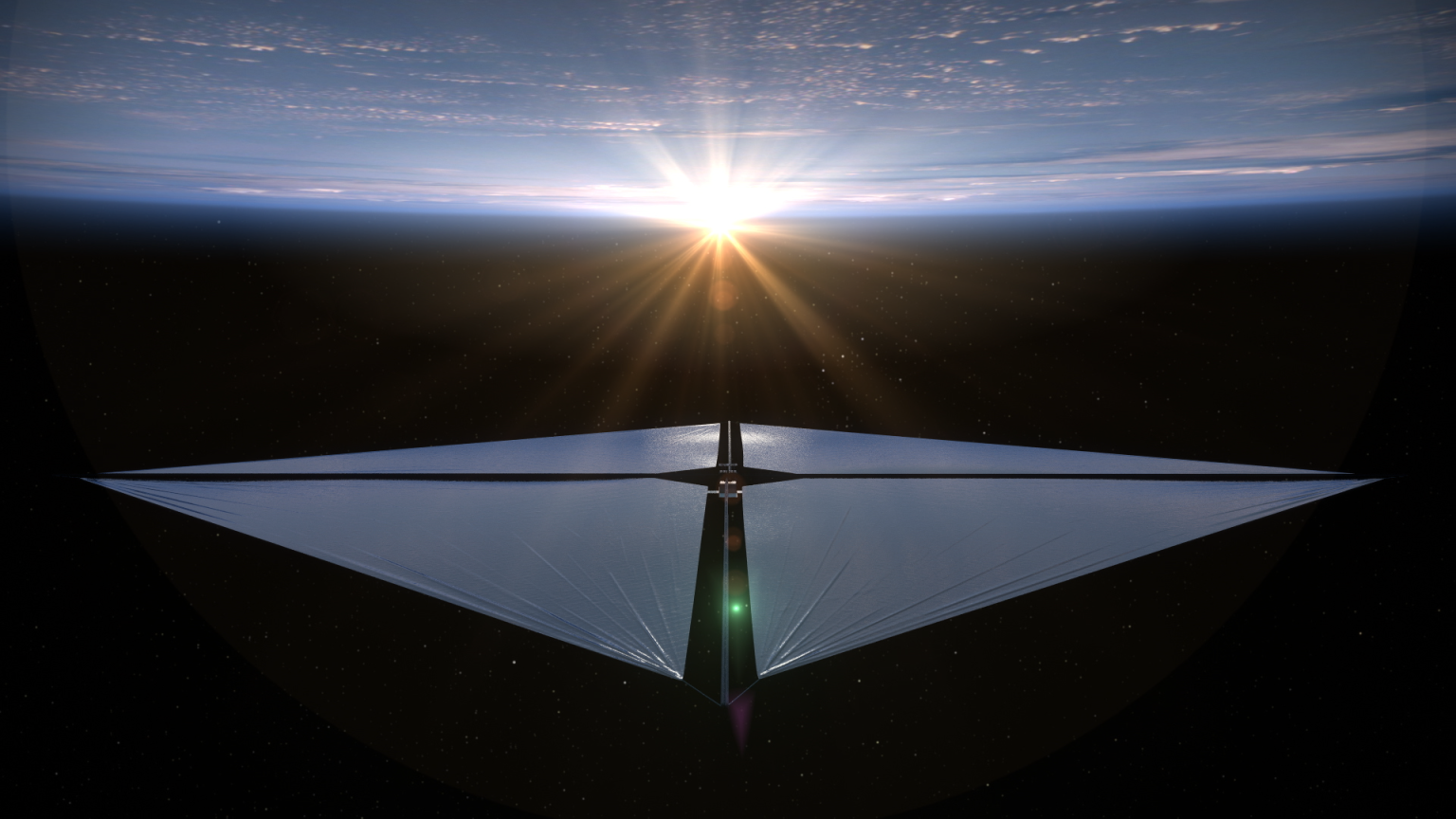
NASA solar sail propulsion projects are among the most fascinating ideas in modern space technology. Most people imagine spacecraft moving through space by burning fuel. Rockets use chemical engines, electric thrusters use electrical power and propellant, and large launch vehicles depend on enormous energy to escape Earth. Solar sail propulsion works in a very different way.
A solar sail uses sunlight itself.
Instead of burning fuel, a solar sail reflects photons from the Sun. Photons have no rest mass, but they carry momentum. When sunlight strikes a large reflective sail and bounces away, it gives the sail a tiny push. That push is extremely small at first, but it can continue for days, weeks, months, or even years. Over time, continuous sunlight pressure can gradually change a spacecraft’s speed and trajectory.
NASA explains the concept simply: just as a sailboat is powered by wind in a sail, solar sails use the pressure of sunlight for propulsion, eliminating the need for conventional rocket propellant. NASA’s Advanced Composite Solar Sail System, or ACS3, is designed to test deployable structures and materials for future low-cost deep space missions.
Editorial Note
This article uses careful wording for accuracy. NASA solar sail propulsion projects do not mean that all future spacecraft will stop using rockets in 2026. Rockets are still required for launch, and many missions still need chemical or electric propulsion.
The more accurate explanation is that NASA is developing and testing solar sail technologies that may support selected future missions, especially missions that benefit from lightweight propulsion, long-duration acceleration, unusual orbits, heliophysics observations, asteroid reconnaissance, and low-cost small spacecraft operations.
Confirmed examples include NASA’s Advanced Composite Solar Sail System, Solar Cruiser concept studies, NEA Scout mission planning, and long-running research into solar-sail structures and trajectory design. Future possibilities include space weather early warning platforms, asteroid reconnaissance missions, communication relays, and deep-space science missions that use sunlight as a continuous source of propulsion.
Key Facts About NASA Solar Sail Propulsion Projects
| Key Point | Simple Explanation |
|---|---|
| Solar sails use sunlight | They are pushed by the pressure of photons from the Sun. |
| They do not need onboard propellant for sail thrust | The sail uses sunlight instead of burning fuel for continuous acceleration. |
| Rockets are still needed for launch | Solar sails cannot lift spacecraft from Earth’s surface. |
| NASA’s ACS3 is a major solar sail demonstration | It tests lightweight composite booms and sail deployment technology. |
| ACS3 uses an 80-square-meter sail | NASA and related mission materials describe ACS3 as using a sail of about 80 square meters. |
| Solar Cruiser explored larger solar-sail mission concepts | It studied how solar sails could support heliophysics observations from difficult-to-maintain vantage points. |
| NEA Scout was designed as a solar-sail CubeSat | It launched on Artemis I but the team was not able to communicate with the spacecraft after launch. |
| 2026 is a development stage | NASA is advancing solar sail technology, not replacing all propulsion systems with solar sails. |
What Is Solar Sail Propulsion?
Solar sail propulsion is a method of spacecraft movement that uses radiation pressure from sunlight. The sail is usually made from very thin, lightweight, reflective material. When sunlight hits the sail, photons transfer momentum to the spacecraft.
The force is tiny compared with a rocket engine, but it does not require propellant. That makes solar sails useful for certain types of long-duration missions. A spacecraft with a solar sail can keep receiving a small push as long as sunlight reaches the sail and the spacecraft can control its orientation.
NASA describes solar sails as systems that employ sunlight pressure for propulsion and eliminate the need for conventional rocket propellant.
A simple example is pushing a shopping cart. One strong push moves it quickly for a short time. That is more like a rocket burn. But if someone gives the cart a very tiny push again and again for a long time, the cart can still build up motion. Solar sails work more like continuous tiny pushes from sunlight.
Why Solar Sail Propulsion Matters
Solar sail propulsion matters because propellant is one of the biggest limitations in spaceflight. A spacecraft can only carry a limited amount of fuel. Once fuel is gone, the spacecraft may lose the ability to maneuver, maintain its orbit, or continue its mission.
A solar sail changes the equation for certain missions. It does not remove the need for launch rockets, but it can reduce or eliminate the need for onboard propellant during the sail-driven part of the mission.
This matters for small spacecraft, long-duration science missions, asteroid reconnaissance, heliophysics observations, and missions that need to maintain unusual positions in space.
For comparison, NASA cryogenic propulsion advancement focuses on powerful high-performance rocket propulsion. Solar sail propulsion focuses on gentle, continuous acceleration from sunlight. Both are important, but they solve different problems.
How a Solar Sail Actually Moves
A solar sail moves by controlling the angle between the sail and incoming sunlight. If the sail faces the Sun directly, sunlight pressure pushes it mostly away from the Sun. If the sail is tilted, the direction of the reflected light changes, and the spacecraft can gradually change its path.
This means solar sailing is not simply “being blown away” from the Sun. With careful attitude control and trajectory planning, a solar sail can raise or lower orbits, change inclination, and reach mission paths that may be difficult with ordinary propulsion.
The spacecraft must control its sail orientation carefully. If the sail tumbles, wrinkles, fails to deploy properly, or cannot point accurately, propulsion performance may suffer.
This is one reason NASA’s solar sail work focuses so much on deployable structures, lightweight booms, materials, and attitude control.
NASA’s Advanced Composite Solar Sail System
NASA’s Advanced Composite Solar Sail System, or ACS3, is one of the most important current solar sail technology demonstrations.
NASA says ACS3 is developing new deployable structures and materials technologies for solar sail propulsion systems intended for future low-cost deep space missions. The mission focuses especially on composite booms, which support and deploy the sail.
The boom technology matters because a solar sail must be large but also lightweight and compact. It must fit inside a small spacecraft during launch, deploy reliably in space, and remain stable after deployment. If the booms are too heavy, the spacecraft becomes less efficient. If they are too weak, the sail may not hold its shape.
ACS3 is important because it does not only test a sail. It tests the structure that makes future solar sails practical.
What Makes ACS3 Different?
ACS3 uses lightweight composite booms made from flexible polymer and carbon fiber materials. These booms are designed to be stronger and lighter than earlier metallic boom designs. NASA’s ACS3 materials explain that the mission is meant to demonstrate new boom materials and deployable structures for future solar-sail spacecraft.
This matters because future solar sails may need to be much larger than small demonstrations. Larger sails need structures that are strong, lightweight, compact, and reliable.
A useful comparison is an umbrella. The fabric is important, but the ribs and frame are what allow it to open and hold its shape. A solar sail also needs a reliable frame. ACS3 is helping NASA test that frame technology in orbit.
ACS3 Deployment and 2024–2025 Mission Status
NASA reported in October 2024 that ACS3 had successfully deployed its booms and solar sail, and that mission operators were continuing to analyze spacecraft data and characterize the composite boom performance. NASA also noted that the spacecraft was slowly tumbling in orbit because the attitude control system had not yet been reengaged at that time.
This detail is important because it keeps the topic realistic. Solar sail missions are not easy. Deploying a large, lightweight sail from a small spacecraft is difficult. Controlling the spacecraft after deployment is also difficult.
The key point is that ACS3 is a technology demonstration. It gives NASA engineering data about deployment, structures, materials, and control challenges that can guide future solar sail missions.
Why Composite Booms Matter
Composite booms are central to NASA solar sail propulsion projects because they determine how well a sail can deploy and remain stable.
A solar sail must be folded or rolled tightly during launch. After reaching orbit, it must unfold without tearing, tangling, or losing shape. The booms must extend properly and hold the sail in the correct geometry.
Good booms need to be:
Lightweight
Strong
Compact before deployment
Stable after deployment
Resistant to space conditions
Compatible with thin sail material
Reliable after launch vibration
Useful for future larger sails
NASA’s ACS3 mission is designed to test exactly these kinds of deployable structure technologies.
Solar Cruiser: A Larger Solar Sail Vision
Solar Cruiser is another important NASA solar sail concept. NASA’s heliophysics materials describe Solar Cruiser as a mission concept that would demonstrate how solar sail propulsion can allow spacecraft to collect observations from novel vantage points that are difficult to reach and sustain.
This matters because solar sails can potentially support “non-traditional” orbits and observation points. A spacecraft may be able to remain in places where ordinary spacecraft would require too much fuel to maintain position.
For heliophysics, this is especially useful. Scientists want to observe the Sun, solar wind, coronal mass ejections, and space weather from better angles. A solar sail could help a spacecraft hold a useful viewing location for longer periods.
This connects with NASA deep space laser communication because future solar sail missions may need reliable long-distance communication to return science data from unusual locations.
Solar Sails and Space Weather Early Warning
One future use of solar sail propulsion is space weather early warning. Space weather events from the Sun can affect satellites, communications, power grids, navigation systems, and astronauts.
A solar sail spacecraft may be able to stay at a better vantage point for observing the Sun and solar wind. If positioned well, it could provide earlier warning of solar storms heading toward Earth.
NASA’s ACS3 educational materials note that data from the mission may guide the design of future larger composite solar sail systems that could be used for space weather early warning satellites, near-Earth asteroid reconnaissance missions, or communications relays for crewed missions.
This is a strong example of why solar sails are not only a futuristic travel idea. They can support practical science and monitoring missions.
NEA Scout: A Solar Sail CubeSat Example
NEA Scout, or Near-Earth Asteroid Scout, was a NASA CubeSat mission launched as a secondary payload on Artemis I. NASA describes NEA Scout as roughly the size of a large shoebox, designed to be propelled by a solar sail and take pictures of a near-Earth asteroid. After launch, the project team was not able to communicate with the spacecraft.
NEA Scout is important because it shows both the promise and difficulty of small solar sail missions.
The promise is clear: a very small spacecraft could use a solar sail to travel toward an asteroid without carrying a large propulsion system. The difficulty is also clear: deep-space small spacecraft must survive launch, deploy systems, communicate, orient themselves, and operate reliably.
Including NEA Scout makes the article more accurate because it does not only describe success stories. It also shows that solar sail technology is challenging.
Solar Sails vs Electric Propulsion
Solar sails and electric propulsion are both useful for long-duration missions, but they work differently.
| Feature | Solar Sail Propulsion | Electric Propulsion |
|---|---|---|
| Main energy source | Sunlight pressure | Electrical power |
| Propellant needed | No propellant for sail thrust | Requires propellant such as xenon or other gases |
| Thrust level | Very low but continuous | Low but usually stronger than solar-sail pressure |
| Best mission type | Long-duration, lightweight, sunlight-accessible missions | Orbit raising, station keeping, deep-space missions |
| Main challenge | Large deployable sail and precise attitude control | Power supply, thruster life, propellant supply |
| Strength | No onboard propellant for propulsion | More controllable thrust with established flight history |
Solar sails are not automatically better than electric propulsion. They are better for certain mission profiles where continuous sunlight-driven acceleration is useful.
Solar Sails vs Chemical Propulsion
Chemical propulsion provides high thrust quickly. Solar sails provide tiny thrust continuously.
| Feature | Chemical Propulsion | Solar Sail Propulsion |
|---|---|---|
| Thrust | High | Very low |
| Fuel use | Burns propellant | Uses sunlight pressure |
| Launch from Earth | Required | Cannot launch from Earth by itself |
| Best use | Launch, rapid maneuvers, landing, major burns | Long-duration cruise and special trajectories |
| Main limitation | Limited fuel | Needs large sail, sunlight, and precise control |
| Future role | Still essential | Useful for selected deep-space and science missions |
This is why solar sails will not replace rockets. They may complement rockets. A rocket launches the spacecraft into space, and then a solar sail can help it travel or maneuver without using onboard propellant.
Practical Example: A Solar Sail Space Weather Mission
Imagine a spacecraft designed to monitor solar storms. It needs to stay in a location that gives scientists a better view of the Sun and solar wind.
A traditional spacecraft may need regular fuel-consuming maneuvers to hold that position. A solar sail could use sunlight pressure to help maintain a special vantage point for a longer period.
This could improve early warning of space weather events. Better warning could help protect satellites, power systems, aviation communication, GPS services, and astronauts.
Practical Example: A Small Asteroid Reconnaissance Mission
Imagine a small CubeSat launched as a secondary payload. It does not have room for large fuel tanks or a major engine. A solar sail gives it a way to maneuver after launch using sunlight.
Over time, the sail changes the spacecraft’s trajectory and helps it approach a small asteroid. The spacecraft takes images and returns data to Earth.
That was the kind of mission NEA Scout was designed to attempt. NASA says NEA Scout was intended to use a solar sail and take pictures of a near-Earth asteroid, although communication with the spacecraft was not established after launch.
Practical Example: Long-Duration Deep Space Travel
A solar sail spacecraft may not accelerate quickly, but it can keep accelerating as long as sunlight provides useful pressure. For some mission designs, that long-duration acceleration can become valuable.
A spacecraft might use a solar sail to gradually change orbit, reach an observation point, or support science operations without carrying a large amount of propellant.
This makes solar sails especially interesting for lightweight spacecraft and missions where time is less critical than fuel efficiency.
Confirmed Facts vs Future Possibilities
| Confirmed Fact | Future Possibility |
|---|---|
| NASA has developed the Advanced Composite Solar Sail System. | Larger solar sails may support future deep-space and heliophysics missions. |
| ACS3 tests deployable composite booms and sail materials. | Future sails may use improved lightweight structures for larger spacecraft. |
| ACS3 successfully deployed its booms and sail, with operators analyzing performance data. | Future missions may use lessons from ACS3 for better attitude control and sail steering. |
| Solar Cruiser studied how solar sails could enable observations from difficult vantage points. | Future solar sail missions may provide better space weather monitoring. |
| NEA Scout was designed as a solar-sail CubeSat for asteroid reconnaissance. | Future small spacecraft may use solar sails for low-cost asteroid missions. |
| Solar sails use sunlight pressure rather than onboard propellant for sail thrust. | Solar sails may support communication relays, asteroid scouts, or long-duration science platforms. |
What People Often Get Wrong
One common misunderstanding is that solar sails are pushed by solar wind. That is not the main idea. Solar sails are primarily pushed by sunlight pressure from photons, not by the stream of charged particles known as the solar wind.
Another misunderstanding is that solar sails can launch from Earth. They cannot. A rocket still has to carry the spacecraft into space.
A third misunderstanding is that solar sails are fast immediately. They are not. Their thrust is very small, but it can build up over time.
A fourth misunderstanding is that solar sails will replace all rocket engines. They will not. Solar sails are useful for selected missions, while rockets, chemical propulsion, electric propulsion, and other systems remain important.
A fifth misunderstanding is that solar sail deployment is easy. Large thin sails are difficult to package, deploy, control, and keep stable in space.
Benefits for the Reader
Understanding NASA solar sail propulsion projects helps readers understand a different kind of space travel.
First, it explains how sunlight can move a spacecraft without traditional propellant.
Second, it shows why lightweight structures and deployable materials are essential.
Third, it helps readers understand why solar sails are useful for long-duration missions, not launch from Earth.
Fourth, it explains how projects like ACS3, Solar Cruiser, and NEA Scout fit into NASA’s broader technology development.
Fifth, it gives a realistic view of 2026 progress by separating current demonstrations from future mission possibilities.
Why Solar Sail Propulsion Could Shape the Future
Solar sail propulsion could shape the future because it offers a way to move spacecraft without using onboard propellant for thrust. That could make some missions lighter, longer-lasting, and more flexible.
The biggest advantage is endurance. A solar sail does not run out of sunlight the way a spacecraft runs out of fuel. As long as the spacecraft remains in a useful sunlight environment and the sail can be controlled, it can continue receiving thrust.
This makes solar sails attractive for missions that need patience, precision, and long-term operation.
For deep space missions, this could support new types of science. For heliophysics, it could support better solar observations. For asteroid reconnaissance, it could support small spacecraft missions. For future communication systems, it could help position relay spacecraft in useful locations.
Challenges NASA Must Still Solve
NASA solar sail propulsion projects still face major challenges.
The first challenge is deployment. A large sail must be folded into a small spacecraft and deployed reliably in space.
The second challenge is attitude control. The spacecraft must point the sail accurately to control thrust.
The third challenge is structural stability. Lightweight booms must hold the sail in shape without adding too much mass.
The fourth challenge is materials durability. The sail must survive sunlight, temperature changes, radiation, micrometeoroids, and space conditions.
The fifth challenge is mission design. Solar sail trajectories require careful planning because thrust is low and continuous.
The sixth challenge is operations. Mission teams must understand how the sail behaves after deployment and how to steer it over time.
These challenges explain why NASA’s ACS3 mission is valuable. It provides real flight data about structures, deployment, and control.
Future Outlook: Fuel-Free Movement Through Space
The future of solar sail propulsion will likely be selective, not universal. Solar sails will not replace launch vehicles, landers, or high-thrust engines. But they may become extremely useful for missions where low thrust and long duration are acceptable.
Future solar sail spacecraft may monitor the Sun, scout asteroids, act as communication relays, test new trajectories, or support low-cost science missions. Larger sails may open new mission options that are hard to sustain with fuel-limited spacecraft.
NASA solar sail propulsion projects in 2026 are best understood as part of a long-term technology path. ACS3 provides engineering data. Solar Cruiser studies show mission possibilities. NEA Scout provides lessons from a small solar-sail mission attempt. Together, they show how sunlight-powered propulsion could become a practical tool for future space travel.
Frequently Asked Questions
What are NASA solar sail propulsion projects?
NASA solar sail propulsion projects are missions, demonstrations, and studies that test how spacecraft can use sunlight pressure on large reflective sails to move through space without conventional propellant for sail thrust.
How does a solar sail work?
A solar sail works when photons from the Sun strike a reflective sail and transfer momentum. The push is tiny, but it can continue over long periods.
Does a solar sail use solar wind?
Solar sails mainly use the pressure of sunlight from photons, not solar wind. Solar wind is a stream of charged particles from the Sun, but photon pressure is the main propulsion source for solar sails.
Can a solar sail launch from Earth?
No. A solar sail cannot launch from Earth’s surface. A rocket is still needed to carry the spacecraft into space.
What is NASA’s ACS3 mission?
ACS3 stands for Advanced Composite Solar Sail System. It is a NASA technology demonstration designed to test lightweight composite booms and solar sail deployment for future low-cost deep space missions.
Did ACS3 deploy its sail?
Yes. NASA reported that ACS3 successfully deployed its booms and solar sail, while operators continued analyzing data and characterizing composite boom performance.
What was Solar Cruiser?
Solar Cruiser was a NASA heliophysics concept studying how a solar sail could enable observations from novel vantage points that are difficult to reach and maintain.
What was NEA Scout?
NEA Scout was a CubeSat launched on Artemis I that was designed to use a solar sail to travel toward and photograph a near-Earth asteroid. NASA says the team was not able to communicate with the spacecraft after launch.
Are solar sails faster than rockets?
Not at first. Rockets produce much higher thrust. Solar sails produce tiny thrust, but they can keep accelerating over long periods without using propellant.
Will solar sails replace rockets?
No. Rockets are still needed for launch and high-thrust maneuvers. Solar sails may complement rockets for selected long-duration space missions.
Conclusion
NASA solar sail propulsion projects show a very different vision of space travel. Instead of relying only on stored propellant, a solar sail can use sunlight itself to create continuous, gentle thrust. The force is small, but the long-term potential is powerful.
NASA’s Advanced Composite Solar Sail System is helping test the deployable structures and lightweight boom technology needed for future solar sails. Solar Cruiser studies show how larger solar sails could support heliophysics observations from difficult vantage points. NEA Scout shows both the promise and difficulty of using small solar-sail spacecraft for asteroid reconnaissance.
In 2026, solar sail propulsion is not a replacement for rockets. It is a specialized technology that may support future deep space missions, space weather monitoring, asteroid exploration, and long-duration science platforms. The real promise is not instant speed, but endurance. A spacecraft that can keep using sunlight for propulsion may operate in ways that fuel-limited spacecraft cannot.
For readers, the lesson is simple: the future of space travel may not depend on one propulsion method. Rockets, cryogenic engines, electric propulsion, and solar sails may all play different roles. NASA solar sail propulsion projects are helping prove that sunlight itself can become part of humanity’s toolkit for exploring space.
Sources and Further Reading
NASA Advanced Composite Solar Sail System
NASA: What Is the Advanced Composite Solar Sail System?
NASA Update on Advanced Composite Solar Sail System
NASA Science: Solar Cruiser
NASA Science: NEA Scout
NASA HEAT Solar Sails Investigation
NASA NTRS: Advanced Composite Solar Sail System Overview
NASA NTRS: Solar Cruiser Technology Maturation Plans