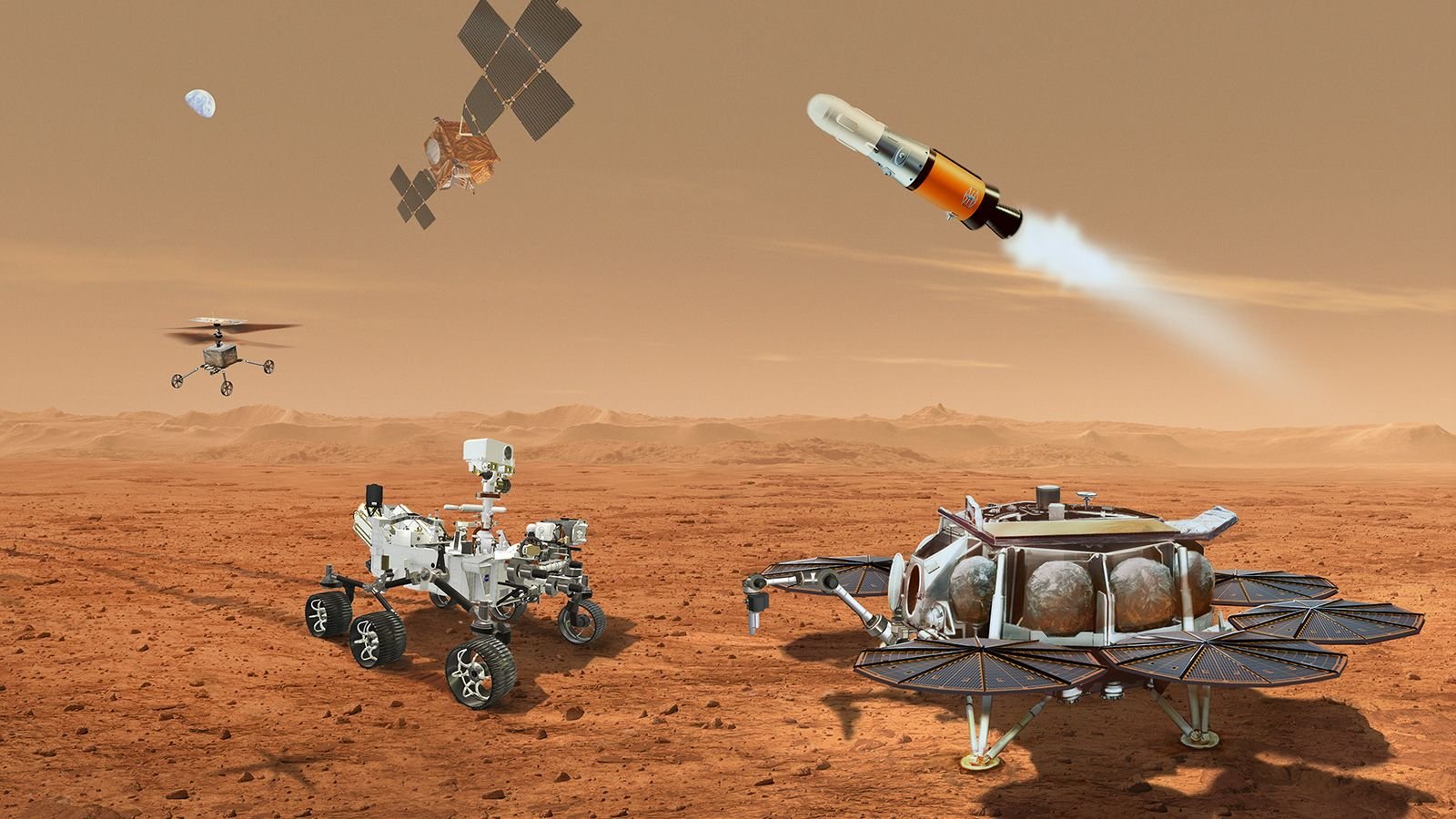
NASA Mars atmospheric entry technologies are among the most important systems for future Mars exploration. Sending a spacecraft to Mars is difficult, but landing it safely is even harder. A mission can travel millions of miles across space and still fail in the final minutes if its entry, descent, and landing systems do not work exactly as planned.
Mars landing is challenging because the planet has a thin atmosphere. It is thick enough to create dangerous heating during entry, but too thin to slow a spacecraft as easily as Earth’s atmosphere. That means engineers must use a carefully timed combination of heat shields, parachutes, sensors, guidance, radar, powered descent, and landing systems to bring a spacecraft safely to the surface.
In 2026, the most accurate way to understand NASA Mars atmospheric entry technologies is that NASA is improving the tools needed for safer robotic and future human landings. These include better heat shields, inflatable and deployable decelerators, supersonic parachute testing, landing sensors, atmospheric data collection, and advanced modeling. NASA’s Entry, Descent, and Landing work includes advanced hypersonic and supersonic entry systems, terminal descent, landing systems, aerobraking, and aerocapture for future exploration and science missions.
Editorial Note
This article uses careful wording for accuracy. NASA Mars atmospheric entry technologies do not mean NASA has already solved every challenge of landing humans on Mars in 2026. The more accurate explanation is that NASA has successfully landed robotic missions and continues developing larger, safer, and more capable entry, descent, and landing technologies for future payloads and crewed exploration.
Confirmed examples include Perseverance’s Mars 2020 landing system, MEDLI2 flight data, ASPIRE parachute testing, LOFTID inflatable heat shield testing, ADEPT deployable heat shield concepts, and NASA’s broader EDL technology development. Future possibilities include heavier Mars payload delivery, improved landing precision, larger heat shields, safer descent systems, and landing technologies for human-scale missions.
Key Facts About NASA Mars Atmospheric Entry Technologies
| Key Point | Simple Explanation |
|---|---|
| Mars landing is difficult | Mars has enough atmosphere to heat a spacecraft, but not enough to slow it easily. |
| EDL means entry, descent, and landing | It covers the entire process from atmospheric entry to touchdown. |
| Heat shields protect spacecraft | They absorb and manage extreme heating during atmospheric entry. |
| Supersonic parachutes slow spacecraft | They deploy while the vehicle is still traveling faster than the speed of sound. |
| Powered descent helps final landing | Rockets or descent engines can slow the spacecraft near the surface. |
| MEDLI2 collected Mars 2020 entry data | It measured heating and pressure to improve future entry system designs. |
| LOFTID tested inflatable heat shield technology | It demonstrated a large inflatable aeroshell that could help land heavier payloads. |
| ADEPT studies deployable heat shields | It uses a mechanically deployable heat shield concept that opens like an umbrella. |
| 2026 is still a development stage | NASA is advancing safer Mars landing technologies, not claiming every human Mars landing challenge is solved. |
What Is Mars Atmospheric Entry?
Mars atmospheric entry is the moment when a spacecraft first enters the Martian atmosphere at very high speed. At this stage, the spacecraft is moving so fast that air in front of it compresses and heats dramatically. Without protection, the spacecraft would burn, break apart, or lose control.
The spacecraft uses an aeroshell and heat shield to survive this phase. The heat shield faces the flow of hot atmospheric gases and protects the payload inside. The backshell protects the upper part of the vehicle and helps maintain aerodynamic shape and stability.
NASA’s Mars 2020 MEDLI2 page explains that the Perseverance spacecraft entered Mars’ atmosphere traveling about 12,500 miles per hour and that MEDLI2 collected data during the final seven minutes leading up to landing.
A simple way to understand atmospheric entry is to imagine slamming into air so fast that the air itself becomes a wall of heat. The spacecraft must use the atmosphere to slow down, but it must also survive the heat and forces created by that slowing process.
What Is Entry, Descent, and Landing?
Entry, descent, and landing is often shortened to EDL. It is the complete process of entering a planet’s atmosphere, slowing down, descending, and touching the surface safely.
EDL usually includes several phases:
Atmospheric entry
Peak heating
Guided entry
Parachute deployment
Heat shield separation
Radar or sensor acquisition
Powered descent
Touchdown
Landing system separation or shutdown
NASA describes EDL as the work of developing advanced technologies for future human and robotic exploration, including advanced hypersonic and supersonic entry systems, terminal descent, and landing systems.
For Mars missions, EDL is often called “seven minutes of terror” because the spacecraft must complete the landing sequence automatically. Mars is far enough away that engineers on Earth cannot control the spacecraft in real time during the final descent.
Why Mars Landings Are So Hard
Mars is difficult because its atmosphere is thin but not harmless. The atmosphere is thick enough to create major heating and aerodynamic forces, but too thin to slow a large spacecraft enough with drag alone.
This creates a problem. A spacecraft arriving at Mars must slow from thousands of miles per hour to a safe landing speed in only minutes. It must do this without real-time joystick control from Earth. It must survive heat, deploy a parachute at supersonic speed, separate hardware at the right times, detect the surface, and use powered descent if needed.
A small spacecraft can be landed with simpler systems. A rover the size of Perseverance requires much more complex EDL. A future human Mars lander would be far heavier, making the problem even harder.
This is why NASA studies multiple technologies instead of relying on only one solution.
Heat Shields: The First Line of Protection
The heat shield is one of the most important Mars atmospheric entry technologies. Its job is to protect the spacecraft from extreme heat during entry.
During atmospheric entry, the heat shield absorbs, reflects, or sheds heat while the spacecraft slows down. Traditional Mars missions have used rigid aeroshells and thermal protection systems. These systems must be strong enough to survive launch and cruise, and they must perform correctly during entry.
NASA’s MEDLI2 instrumentation was embedded in the heat shield and backshell thermal protection systems of the Mars 2020 entry vehicle to gather aerodynamic, aerothermal, and TPS performance data during EDL.
This data helps engineers understand how heat shields actually perform at Mars, rather than relying only on simulations and Earth-based testing.
MEDLI2: Measuring the Heat of Mars Entry
MEDLI2 stands for Mars Entry, Descent, and Landing Instrumentation 2. It flew with the Mars 2020 Perseverance mission and collected data during entry through the Martian atmosphere.
NASA says MEDLI2 collected data during the Perseverance rover’s entry to enable improved designs of future entry systems for robotic and crewed missions. It measured conditions during the final minutes before landing.
MEDLI2 is important because every Mars landing teaches engineers something. A spacecraft can be designed with models, simulations, and wind-tunnel testing, but flight data is the most valuable proof.
The data can help answer questions such as:
How hot did the heat shield get?
How did pressure change during entry?
How did the backshell perform?
How accurate were the models?
Where can future designs be improved?
How much margin is needed for heavier payloads?
For future Mars missions, this kind of data can make landing systems safer and more efficient.
Supersonic Parachutes: Slowing Down in Thin Air
After surviving the hottest part of entry, a Mars spacecraft still needs to slow down. Supersonic parachutes are one of the key technologies used for this phase.
A supersonic parachute deploys while the spacecraft is still traveling faster than the speed of sound. This is extremely difficult because the parachute must inflate quickly without tearing apart under violent aerodynamic loads.
NASA’s ASPIRE testing helped validate the parachute used for the Mars 2020 Perseverance mission. NASA reported that during a test, the parachute deployed at Mars-relevant conditions and inflated from a compact cylinder to a fully inflated parachute in four-tenths of a second.
This is not ordinary parachute behavior. A Mars landing parachute must work in a thin atmosphere, at high speed, and with extreme forces.
ASPIRE: Testing Mars Parachutes Before They Fly
ASPIRE stands for Advanced Supersonic Parachute Inflation Research Experiment. It was designed to test supersonic parachutes under conditions relevant to Mars missions.
NASA and JPL reported that the strengthened parachute tested through ASPIRE was approved for the Mars 2020 mission after successful testing. The testing helped reduce risk before Perseverance landed on Mars.
This is a good example of how Mars landing technology is developed. Engineers do not simply design a parachute and hope it works. They test it under extreme conditions, measure loads, study inflation, compare results with simulations, and improve the design before the mission.
For readers, the important idea is simple: a parachute on Mars is not just a cloth canopy. It is a high-speed engineering system.
Powered Descent and the Sky Crane System
Parachutes cannot slow a heavy Mars rover all the way to a gentle touchdown. For larger robotic missions like Curiosity and Perseverance, NASA used a powered descent system and sky crane.
The sky crane system lowers the rover on cables while a rocket-powered descent stage hovers above the surface. Once the rover touches down, the cables are cut and the descent stage flies away to crash at a safe distance.
NASA’s Mars 2020 Perseverance mission captured actual footage from cameras on the spacecraft’s entry, descent, and landing suite as it approached the Martian surface and landed in Jezero Crater on Feb. 18, 2021.
The sky crane may sound unusual, but it solved a real problem. A large rover cannot simply land on airbags like smaller earlier rovers. It also cannot sit on top of a large landing platform without creating mobility problems. The sky crane places the rover directly on its wheels.
Terrain Relative Navigation: Landing More Precisely
A safer Mars landing also depends on knowing where the spacecraft is relative to the ground. Terrain Relative Navigation helped Perseverance compare images of the surface with onboard maps to choose a safer landing location.
This matters because Mars landing zones are not always flat and hazard-free. The most scientifically interesting places may include rocks, cliffs, slopes, craters, or ancient river delta terrain.
Better navigation allows missions to target more challenging but scientifically valuable areas. It also reduces the chance of landing on dangerous ground.
This connects with NASA AI navigation system for deep space, because future landers may need smarter onboard systems that can interpret terrain, update descent decisions, and support safer landings.
LOFTID: Inflatable Heat Shields for Heavier Payloads
LOFTID stands for Low-Earth Orbit Flight Test of an Inflatable Decelerator. It is one of NASA’s most important demonstrations for future atmospheric entry systems.
NASA says LOFTID demonstrated a cross-cutting aeroshell, a type of heat shield, for atmospheric re-entry. The mission launched and landed on Nov. 10, 2022.
The reason LOFTID matters for Mars is simple: future missions may need to land heavier payloads than current rigid heat shields can easily support. A larger heat shield provides more drag and helps slow a spacecraft higher in the atmosphere. But a rigid heat shield must fit inside a launch vehicle fairing. Inflatable heat shields can be packed compactly for launch and expanded before entry.
NASA reported that the LOFTID inflatable heat shield test was successful and that the technology could be key to landing humans on Mars.
HIAD: Hypersonic Inflatable Aerodynamic Decelerator
LOFTID is part of a broader technology area called Hypersonic Inflatable Aerodynamic Decelerator, or HIAD.
A HIAD system uses an inflatable structure with thermal protection to create a large aeroshell. This increases drag, helping a spacecraft slow down during atmospheric entry.
NASA later reported that the LOFTID mission proved the HIAD design functioned successfully at appropriate scale and in a relevant environment.
HIAD-type technology could be especially useful for future Mars missions because large payloads need large decelerators. A human Mars lander would likely be much heavier than a robotic rover, so NASA needs new ways to slow larger vehicles safely.
ADEPT: An Umbrella-Like Heat Shield Concept
ADEPT stands for Adaptable Deployable Entry and Placement Technology. It is another approach to deployable entry systems.
NASA describes ADEPT as a mechanically deployable heat shield concept that uses carbon fabric and opens like an umbrella. The flexible carbon fabric acts as both a heat shield and aerodynamic surface.
NASA’s ADEPT project aims to develop a semi-rigid low-ballistic-coefficient aeroshell entry system concept for planetary missions. Such a system could help safely deliver scientific payloads or support future exploration needs.
The key difference between LOFTID and ADEPT is that LOFTID is inflatable, while ADEPT is mechanically deployable. Both concepts are designed to create larger entry systems that can fit within launch vehicle constraints before deployment.
Why Deployable Decelerators Matter for Human Mars Missions
Human Mars missions will need to land much heavier payloads than robotic missions. A crewed lander, habitat, ascent vehicle, power system, or cargo module may be far larger than Perseverance.
Traditional rigid aeroshells have limits because they must fit inside launch vehicle fairings. Deployable systems can pack into a smaller space and expand before entry. That allows a larger drag surface without needing an enormous launch fairing.
For future human exploration, this matters because heavier payloads need more drag, better thermal protection, better control, and safer descent systems.
This is why NASA continues studying technologies like LOFTID, HIAD, and ADEPT.
Aerobraking and Aerocapture
NASA’s EDL work also includes aerobraking and aerocapture. These technologies use a planet’s atmosphere to change a spacecraft’s orbit.
Aerobraking uses repeated passes through the upper atmosphere to gradually slow a spacecraft and reduce orbit size. Aerocapture is more aggressive: it uses one atmospheric pass to capture a spacecraft into orbit around a planet.
NASA’s EDL work includes aerobraking and aerocapture alongside hypersonic and supersonic entry systems.
These methods can save propellant, but they require excellent knowledge of atmospheric behavior, heat loads, guidance, and vehicle control.
For future Mars missions, atmospheric flight may not only be about landing. It may also help spacecraft enter orbit more efficiently.
Thermal Protection Systems
Thermal protection systems, often called TPS, are the materials and structures that protect a spacecraft from heat during entry.
TPS must handle extreme heating while staying lightweight and reliable. It may include ablative materials, insulating layers, reinforced carbon fabric, tiles, or flexible thermal protection depending on the mission design.
MEDLI2 measured thermal protection system performance during Mars 2020. NASA’s MEDLI2 materials explain that the system collected aerodynamics, aerothermodynamics, and thermal protection performance data during entry.
This matters because future missions need better models. Engineers want to avoid overbuilding heavy heat shields, but they also cannot risk underprotecting the spacecraft. Data helps them design with the right safety margin.
Sensors and Flight Data
Sensors are a major part of modern Mars entry technology. A spacecraft entering Mars’ atmosphere can collect valuable data about pressure, temperature, heating, acceleration, and vehicle behavior.
MEDLI2 is a strong example because it measured the actual conditions experienced by Perseverance’s entry vehicle. NASA noted that MEDLI2 was designed to help improve future entry systems for robotic and crewed missions.
Future landers may carry even more sensors to improve models, verify designs, and adjust landing systems.
This kind of data matters because Mars’ atmosphere changes with season, altitude, dust, temperature, and weather. The more NASA learns from real entries, the better future landing predictions can become.
Computer Modeling and Simulation
Mars atmospheric entry technologies are not only physical hardware. They also include computer modeling and simulation.
NASA uses high-performance computing to model aerodynamics, heating, parachute inflation, structural loads, and landing behavior. For example, NASA’s Advanced Supercomputing Division describes work on simulating supersonic parachute inflation for Mars entry, descent, and landing. The team developed computational fluid dynamics methods to simulate complex aerodynamics during supersonic parachute inflation.
This is important because flight tests are expensive and limited. Simulations allow engineers to test many conditions before a mission flies.
Better simulations can improve confidence, reduce risk, and help engineers understand conditions that are hard to reproduce on Earth.
Why Human Mars Landings Are Much Harder
Landing humans on Mars is much harder than landing robotic rovers. A human Mars mission may need to land large habitats, ascent vehicles, supplies, power systems, rovers, and crewed landers.
These payloads are much heavier than previous Mars landers. Heavier payloads require larger decelerators, more precise guidance, stronger heat shields, more powerful descent systems, and safer landing methods.
Human missions also have stricter safety needs. A robotic mission can accept more risk than a crewed mission. Human landings must protect lives, not only hardware.
This is why NASA’s Mars atmospheric entry research remains important even after successful robotic landings. Perseverance was a major success, but human-scale Mars landing is a larger challenge.
Practical Example: Perseverance’s Landing Sequence
Perseverance’s Mars 2020 landing is one of the best practical examples of NASA Mars atmospheric entry technologies.
The spacecraft entered the Martian atmosphere at high speed. Its heat shield protected the rover from extreme heating. A supersonic parachute deployed to slow the vehicle. The heat shield separated. The spacecraft used sensors and terrain relative navigation. Then a powered descent stage lowered the rover using the sky crane system.
Finally, Perseverance touched down safely in Jezero Crater.
This sequence shows that Mars landing is not one technology. It is a chain of technologies that must work together.
Practical Example: Landing a Future Mars Habitat
Now imagine a future Mars habitat. It would be much heavier than Perseverance. It may need to land near other mission systems with high precision. It may need to carry life support, supplies, power equipment, and crew living space.
A traditional rover landing system may not be enough. NASA may need larger heat shields, inflatable decelerators, better guidance, stronger descent engines, and more accurate landing systems.
This is why LOFTID, ADEPT, MEDLI2, and EDL simulation work matter. They are not only engineering experiments. They are steps toward landing the larger systems needed for future human exploration.
Practical Example: Mars Cargo Delivery
Future Mars missions may send cargo before astronauts arrive. That cargo could include food, oxygen systems, habitats, power units, vehicles, spare parts, and science tools.
Cargo landers must be reliable because a crewed mission may depend on those supplies already being in place. If a cargo lander crashes or lands far from the planned location, the human mission could be delayed or become unsafe.
Better Mars atmospheric entry technologies can improve cargo delivery by increasing payload mass, landing precision, and mission confidence.
This connects with NASA space habitat technology, because future habitats must be delivered safely before astronauts can live inside them.
Confirmed Facts vs Future Possibilities
| Confirmed Fact | Future Possibility |
|---|---|
| NASA has landed multiple robotic missions on Mars. | Future missions may land much heavier payloads for human exploration. |
| Mars 2020 used a heat shield, supersonic parachute, powered descent, and sky crane. | Future landers may use larger heat shields, stronger descent engines, and improved terrain navigation. |
| MEDLI2 collected Mars 2020 entry data. | MEDLI2 data may improve future robotic and crewed entry system designs. |
| ASPIRE tested supersonic parachutes for Mars 2020. | Future parachute tests may support heavier robotic and sample-return payloads. |
| LOFTID successfully demonstrated inflatable heat shield technology. | HIAD-like systems may help land heavier cargo or human-scale payloads on Mars. |
| ADEPT is a deployable heat shield concept. | Deployable heat shields may expand what can be landed on Mars, Venus, Titan, and other bodies with atmospheres. |
| NASA continues EDL research and testing. | Future Mars landings may become safer, more precise, and capable of delivering larger systems. |
What People Often Get Wrong
One common misunderstanding is that landing on Mars is easy because NASA has done it before. In reality, each Mars landing is extremely difficult, and heavier future payloads make the challenge much harder.
Another misunderstanding is that Mars’ thin atmosphere makes entry simple. The thin atmosphere is exactly what makes Mars difficult: it creates heat but does not provide enough drag to slow heavy spacecraft easily.
A third misunderstanding is that parachutes alone can land large Mars payloads. Parachutes help, but large rovers and future human-scale payloads need additional systems such as powered descent or deployable decelerators.
A fourth misunderstanding is that one successful rover landing solves human Mars landing. Robotic rover landings provide valuable experience, but human missions require much larger and safer systems.
Benefits for the Reader
Understanding NASA Mars atmospheric entry technologies helps readers understand the real challenge of Mars exploration.
First, it explains why the final minutes before landing are so dangerous.
Second, it shows why heat shields, parachutes, sensors, and powered descent must work together.
Third, it helps readers understand why future human Mars missions need larger and safer landing systems.
Fourth, it explains how technologies like LOFTID, ADEPT, ASPIRE, and MEDLI2 support safer landings.
Fifth, it gives a realistic view of 2026 progress by separating successful robotic landing systems from future human-scale landing challenges.
Challenges NASA Must Still Solve
NASA Mars atmospheric entry technologies still face major challenges.
The first challenge is payload mass. Human missions need to land far heavier systems than previous robotic missions.
The second challenge is heat protection. Larger vehicles need thermal protection that is strong, lightweight, and reliable.
The third challenge is deceleration. Mars’ thin atmosphere makes it hard to slow heavy vehicles.
The fourth challenge is landing precision. Future missions may need to land near pre-positioned cargo, habitats, or resource sites.
The fifth challenge is safety. Human missions require stricter reliability than robotic missions.
The sixth challenge is testing. It is difficult to fully recreate Mars entry conditions on Earth, so engineers must combine simulations, flight tests, and Mars mission data.
These challenges explain why EDL remains one of the most important technology areas for future Mars exploration.
Future Outlook: Safer and Heavier Mars Landings
The future of Mars landing will likely combine multiple technologies. Future missions may use improved heat shields, inflatable decelerators, deployable aeroshells, supersonic parachutes, terrain navigation, powered descent, precision landing software, and advanced sensors.
For robotic missions, these technologies can improve science return and landing access to more interesting locations. For human missions, they are essential for delivering the large payloads needed to live and work on Mars.
The long-term goal is not only to land safely. It is to land safely, accurately, and with enough mass to support real exploration.
NASA Mars atmospheric entry technologies are helping move Mars exploration from one-vehicle robotic landings toward future systems capable of delivering habitats, supplies, ascent vehicles, science equipment, and eventually humans.
Frequently Asked Questions
What are NASA Mars atmospheric entry technologies?
NASA Mars atmospheric entry technologies are systems that help spacecraft survive entry into Mars’ atmosphere and land safely. They include heat shields, aeroshells, parachutes, sensors, guidance, powered descent, landing systems, and advanced decelerators.
Why is landing on Mars difficult?
Mars has a thin atmosphere. It is thick enough to create heating during entry but too thin to slow heavy spacecraft easily. This makes landing dangerous and technically complex.
What does EDL mean?
EDL stands for entry, descent, and landing. It describes the full process of entering a planet’s atmosphere, slowing down, descending, and touching down safely.
What is MEDLI2?
MEDLI2 stands for Mars Entry, Descent, and Landing Instrumentation 2. It collected heating and pressure data during the Mars 2020 Perseverance entry to improve future entry system designs.
What is LOFTID?
LOFTID stands for Low-Earth Orbit Flight Test of an Inflatable Decelerator. It demonstrated inflatable heat shield technology that could help land heavier payloads on Mars and other worlds with atmospheres.
What is ADEPT?
ADEPT stands for Adaptable Deployable Entry and Placement Technology. It is a mechanically deployable heat shield concept using flexible carbon fabric that opens like an umbrella.
What is ASPIRE?
ASPIRE stands for Advanced Supersonic Parachute Inflation Research Experiment. It tested supersonic parachutes under Mars-relevant conditions and helped validate the Mars 2020 parachute design.
Why do future Mars missions need bigger heat shields?
Future missions may need to land heavier payloads, including habitats, cargo, and crewed landers. Larger heat shields or deployable decelerators can create more drag and help slow heavy spacecraft.
Can NASA already land humans on Mars in 2026?
No. NASA has successfully landed robotic missions, but human-scale Mars landing remains a major technology challenge.
Why is powered descent needed?
Parachutes alone cannot safely land heavy Mars payloads. Powered descent uses engines to slow and control the spacecraft near the surface.
Conclusion
NASA Mars atmospheric entry technologies are paving the way for safer Mars landings by improving how spacecraft survive heat, slow down, navigate, and touch the surface. Mars landing is difficult because the atmosphere is thin, the speeds are high, and every part of the landing sequence must happen automatically.
Past robotic missions have already proven many important technologies. Perseverance used a heat shield, parachute, terrain relative navigation, powered descent, and sky crane system to land safely in Jezero Crater. MEDLI2 collected valuable flight data to improve future designs. ASPIRE tested supersonic parachutes. LOFTID demonstrated inflatable heat shield technology. ADEPT explores deployable heat shield concepts.
In 2026, NASA is still developing the next generation of Mars landing systems. The goal is not only to land small robotic spacecraft. The future challenge is landing heavier payloads, cargo, habitats, ascent vehicles, and eventually humans.
For readers, the key lesson is simple: reaching Mars is only half the journey. Surviving the final minutes and landing safely is one of the greatest engineering challenges in space exploration.
Sources and Further Reading
NASA Entry, Descent, and Landing
NASA MEDLI2
NASA Mars 2020 Perseverance Mission
NASA LOFTID Mission
NASA LOFTID Inflatable Heat Shield Test
NASA LOFTID Heat Shield Demo Results
NASA ADEPT
NASA ADEPT Heat Shield Testing
NASA ASPIRE Mars 2020 Parachute Test
NASA Supersonic Parachute Simulation