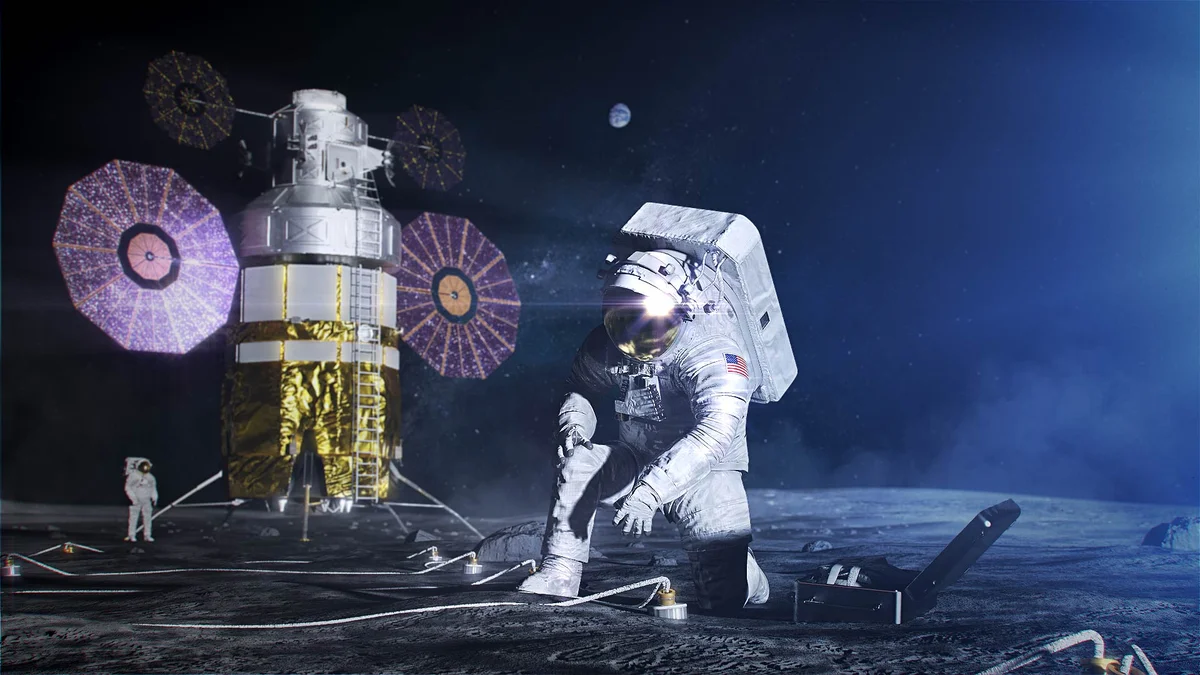
NASA lunar dust mitigation tech is becoming one of the most important technologies for future Moon missions. Rockets can carry astronauts to space, landers can bring them to the lunar surface, and rovers can help them travel farther. But once astronauts and machines touch the Moon, they face one of the most stubborn problems in lunar exploration: dust.
Moon dust is not like ordinary dust on Earth. It is sharp, abrasive, sticky, electrostatically charged, and difficult to remove. It can cling to spacesuits, scratch visors, damage seals, reduce solar panel efficiency, cover camera lenses, affect radiators, and enter mechanical joints. During the Apollo missions, astronauts quickly learned that lunar dust was more than an inconvenience. It was a real engineering and safety problem.
In 2026, NASA lunar dust mitigation tech should be understood as a developing family of solutions, not one single finished invention. NASA has tested and demonstrated technologies such as the Electrodynamic Dust Shield, studied dust-resistant materials, explored surface infrastructure solutions, and included dust mitigation as a key part of lunar surface innovation. NASA says dust mitigation is one of the technology development areas under its Lunar Surface Innovation Initiative, alongside power, thermal management, excavation, construction, and autonomous robotics.
Editorial Note
This article uses careful wording for accuracy. NASA has not permanently solved the lunar dust problem in 2026. The more accurate explanation is that NASA and its partners are developing, testing, and demonstrating technologies that can reduce dust-related risks for future Artemis missions.
Confirmed examples include NASA’s Electrodynamic Dust Shield, lunar surface testing through Commercial Lunar Payload Services missions, spacesuit and textile dust-mitigation work, lunar terrain studies, dust-resistant materials, and research into how lunar regolith affects surface operations. Future possibilities include dust-resistant habitats, cleaner rover sensors, protected solar panels, safer airlocks, better spacesuits, and long-term lunar infrastructure designed to handle regolith from the beginning.
Key Facts About NASA Lunar Dust Mitigation Tech
| Key Point | Simple Explanation |
|---|---|
| Lunar dust is highly abrasive | It can scratch surfaces, damage seals, and wear down moving parts. |
| Lunar dust is electrostatically sticky | It can cling to spacesuits, solar panels, cameras, and equipment. |
| Apollo astronauts faced serious dust issues | Dust entered equipment, coated suits, and affected mission operations. |
| NASA’s Electrodynamic Dust Shield is a major technology | It uses electric fields to lift and remove dust from surfaces. |
| EDS was tested on the Moon | NASA reported that the Electrodynamic Dust Shield successfully repelled lunar regolith during Firefly Aerospace’s Blue Ghost Mission 1. |
| Dust mitigation supports Artemis | Future Moon missions need cleaner spacesuits, rovers, habitats, sensors, and solar systems. |
| Dust protection is not one solution | NASA needs active, passive, material-based, operational, and infrastructure-based approaches. |
| 2026 is a development stage | NASA is advancing dust mitigation, not claiming the Moon dust problem is fully solved. |
Why Lunar Dust Is So Dangerous
Lunar dust is dangerous because it is formed in a very different environment from Earth dust. On Earth, weather, water, wind, and atmosphere gradually smooth particles. On the Moon, there is no air, rain, or normal weathering process. Micrometeorite impacts break lunar rock into tiny, sharp fragments over long periods of time.
That means lunar dust can be jagged and abrasive. NASA’s textile work for Artemis describes lunar regolith as highly abrasive because, without an atmosphere, lunar soil remains razor sharp. It also notes that electrostatic charging makes dust cling to surfaces and that micron-sized particles can penetrate fabrics, damaging zippers, joints, seals, and long-term system reliability.
This is why lunar dust can become a mission risk. It can damage equipment slowly, reduce visibility, interfere with seals, and make spacesuit maintenance harder.
A simple example is sandpaper. If a small amount of sandpaper rubs against a surface again and again, it slowly damages that surface. Lunar dust can act in a similar way on spacesuits, rover joints, seals, and mechanical parts.
What Apollo Taught NASA About Moon Dust
Apollo astronauts experienced the lunar dust problem directly. Dust stuck to suits, boots, tools, equipment, and spacecraft surfaces. It was difficult to brush off, and it followed astronauts back into the lunar module.
The problem became clear because Apollo missions were short. If lunar dust caused that much trouble during short stays, it could become a much larger challenge for longer Artemis missions, lunar habitats, surface rovers, and future base operations.
The lesson is simple: future Moon missions cannot treat dust as a small cleaning problem. Dust mitigation must be built into the design of spacesuits, habitats, airlocks, rovers, solar panels, cameras, and instruments.
This topic connects directly with NASA space habitat technology, because long-duration lunar habitats must prevent dust from entering living areas and damaging life-support systems.
What Is NASA Lunar Dust Mitigation Tech?
NASA lunar dust mitigation tech refers to the tools, materials, coatings, electrical systems, cleaning methods, operational designs, and infrastructure that help prevent or remove lunar dust contamination.
These technologies may protect:
Spacesuits
Boots and gloves
Helmet visors
Solar panels
Radiators
Camera lenses
Rover wheels
Mechanical joints
Airlocks
Habitat seals
Thermal systems
Scientific instruments
Communication hardware
Landing pads and surface infrastructure
Dust mitigation can be active or passive. Active systems use energy, such as electric fields or mechanical cleaning, to remove dust. Passive systems use materials, coatings, textures, seals, barriers, and design choices to reduce dust attachment or damage.
The best future solution will likely be a combination of both.
Electrodynamic Dust Shield: NASA’s Major Dust-Fighting Technology
One of NASA’s most important lunar dust technologies is the Electrodynamic Dust Shield, or EDS.
NASA explains that EDS uses transparent electrodes and electric fields to electrically lift and remove dust from different surfaces. NASA says the technology can be used for thermal radiators, solar panels, camera lenses, spacesuits, boots, and helmet visors.
This is important because EDS does not work like a normal brush. Instead of scraping dust away, it uses electrical forces to move dust particles off a surface. That matters because brushing can sometimes scratch surfaces or push dust deeper into seams and joints.
A simple way to understand EDS is to imagine an invisible electric “wave” moving dust across a surface until it leaves the protected area. The system uses electrical fields to move particles that are already charged or can respond to the field.
For lunar missions, this could be a major improvement because many surfaces cannot be cleaned easily by hand.
EDS Successfully Repelled Lunar Dust on the Moon
One of the strongest recent developments is NASA’s 2025 lunar test result. NASA reported that its Electrodynamic Dust Shield successfully demonstrated its ability to remove regolith from various surfaces on the Moon during Firefly Aerospace’s Blue Ghost Mission 1, which concluded on March 16, 2025.
This is important because technologies often work well in laboratories but face new problems in real lunar conditions. A successful lunar surface demonstration gives scientists and engineers more confidence that EDS can be useful for future missions.
NASA also describes lunar dust as extremely abrasive and electrostatic, meaning it clings to anything that carries a charge. That is exactly why dust removal systems are needed for future surface equipment.
The key point for readers is this: NASA has not merely imagined dust mitigation. It has tested real technology on the Moon.
Why 2026 Is Important for Dust Mitigation
The year 2026 is important because Artemis planning, lunar payload development, commercial lunar deliveries, spacesuit development, and surface technology research are all increasing the need for dust solutions.
NASA continues selecting payloads and technologies to study lunar terrain, surface properties, and exploration risks. In January 2026, NASA announced new Artemis payloads to study the Moon’s terrain, radiation, and history. One payload, EMILIA-3D, is designed to create three-dimensional thermal models of lunar terrain using a thermal imager and visible-light cameras, improving understanding of dusty lunar soil and what temperature measurements reveal about the lunar surface.
This matters because dust mitigation is not only about cleaning. It is also about understanding how regolith behaves, how terrain changes with temperature, and how surface conditions affect rovers, landers, and crew activities.
A safe way to explain 2026 is this: lunar dust mitigation is becoming more important as NASA prepares for more complex lunar operations, but it remains an active technology development area.
Why Moon Dust Sticks to Everything
Moon dust sticks to surfaces because it can become electrostatically charged. The Moon has no thick atmosphere like Earth, and the surface is exposed to solar radiation, ultraviolet light, and charged particles from space.
When dust becomes charged, it can cling to spacesuits, tools, lenses, solar panels, and vehicle surfaces. This is different from ordinary dirt that falls away easily under gravity or can be washed off with water.
On the Moon, there is no rain and no easy outdoor washing system. Dust that sticks may remain stuck unless a technology actively removes it or prevents attachment.
This is why electrical dust mitigation is so promising. If dust behaves electrically, then electric-field-based cleaning can directly target one of the main reasons dust clings to surfaces.
Spacesuits and Dust Protection
Spacesuits are among the most vulnerable systems on the lunar surface. A spacesuit must protect astronauts from vacuum, temperature extremes, radiation, micrometeorites, and dust. It must also allow movement, communication, cooling, breathing, and tool use.
Dust can damage suit joints, seals, zippers, bearings, gloves, boots, and outer materials. If dust enters mechanical parts, it can increase wear. If it enters airlocks or habitats, it can create contamination problems.
NASA’s Artemis textile work identifies dust mitigation as a key challenge. It notes that lunar regolith can penetrate fabrics and damage zippers, joints, and seals, reducing long-term reliability.
This is why future spacesuits need better materials, better seals, better dust barriers, and better cleaning systems.
A simple example is a boot sole. On Earth, dust on a boot can be wiped or washed off. On the Moon, dust may cling electrostatically and grind against surfaces with every step. That makes boot design and dust cleaning much more important.
Helmet Visors, Cameras, and Optical Surfaces
Dust on optical surfaces is a major problem. Astronauts need clear helmet visors to see. Rovers need clean camera lenses to navigate. Scientific instruments need clean optics to take accurate measurements. Solar sensors and star trackers may also need clear surfaces.
If lunar dust coats a lens, it can reduce image quality. If it scratches a visor, it can reduce visibility. If it covers a sensor, it can affect data quality.
NASA says EDS can be used on camera lenses and helmet visors, which makes it especially useful for optical surfaces that cannot be cleaned roughly.
This connects with NASA AI navigation system for deep space because future autonomous rovers and robots depend on clean cameras and sensors. A rover cannot navigate safely if its vision systems are covered in dust.
Solar Panels and Power Systems
Solar panels are another major dust concern. Lunar missions depend heavily on power. Rovers, landers, habitats, communication systems, instruments, and life-support equipment all need electricity.
If dust covers a solar panel, it can reduce the amount of sunlight reaching the cells. That can reduce power production. On long missions, dust accumulation could become a serious problem.
NASA identifies solar panels as one of the possible surfaces where EDS technology can remove dust.
This is important because a future lunar base may need reliable power for days, weeks, or months. Dust-covered panels could reduce system performance, so dust mitigation directly supports mission survival.
Radiators and Thermal Control
Radiators help spacecraft and habitats control temperature. In space, heat management is critical because systems cannot simply release heat into air the way buildings do on Earth.
If dust coats a radiator, it can change how effectively the surface emits heat. That can affect thermal control. NASA includes thermal radiators among the surfaces where EDS technology may be useful.
This means dust mitigation is not only about cleanliness. It is also about temperature control, power efficiency, and equipment reliability.
For future lunar habitats, dust protection will need to work alongside insulation, cooling, heating, and power systems. That is why dust mitigation belongs inside the larger engineering plan for long-duration Moon missions.
Rovers and Moving Parts
Lunar rovers face constant dust exposure. Their wheels roll through regolith, their joints move near the surface, and their cameras, sensors, and radiators may collect dust over time.
Dust can wear down mechanical parts. It can enter joints and bearings. It can coat sensors. It can reduce traction predictability. It can make maintenance difficult.
This connects strongly with NASA lunar surface mobility systems. Future lunar transportation will need dust-resistant wheels, protected motors, sealed joints, clean sensors, and reliable power systems.
A rover that works well on Earth can still struggle on the Moon if dust is not considered from the beginning. Lunar mobility and dust mitigation must be designed together.
Habitats, Airlocks, and Dust Control
A lunar habitat must keep dust outside as much as possible. If astronauts bring dust inside on suits, boots, tools, or sample containers, it can contaminate living spaces and equipment.
Dust inside a habitat could affect filters, seals, electronics, air circulation, and crew health. Because lunar dust particles can be very small and abrasive, removing them from a closed environment may be difficult.
Future habitats may use dust-control zones, suitports, external suit storage, dedicated airlocks, brushes, electrostatic removal systems, filters, and special materials.
This is why dust mitigation is a habitat problem, not only a rover problem. Any long-term lunar home must have a dust strategy.
For more background on future living systems, see NASA space habitat technology.
Landing Pads and Surface Infrastructure
Dust is also a problem during landing and takeoff. Rocket exhaust can blast regolith into the surrounding area. This can damage equipment, cover surfaces, and create hazards for nearby hardware.
Future Moon missions may need landing pads, berms, roads, or prepared surfaces to reduce dust and debris movement. NASA’s Lunar Surface Innovation Initiative includes excavation and construction alongside dust mitigation because surface infrastructure can help make lunar operations safer and more sustainable.
This is important for future Moon bases. If landers repeatedly arrive near habitats, power systems, or rovers, controlling dust and plume effects becomes essential.
A simple example is a helicopter landing in loose sand on Earth. The rotor blast throws dust everywhere. A lunar lander’s exhaust can create a similar but more extreme surface contamination problem because the Moon has low gravity and no atmosphere to slow dust the same way.
Passive Dust Mitigation Materials
Not every dust solution needs electricity. Passive dust mitigation uses material choices, coatings, textures, geometry, seals, and design strategies to reduce dust attachment or damage.
Passive systems may include:
Dust-resistant coatings
Low-adhesion materials
Abrasion-resistant fabrics
Protected seals
Smooth surfaces
Replaceable outer layers
Dust barriers
Textured surfaces that reduce contact
Better suit and rover material design
A 2026 review of passive lunar dust mitigation and anticontamination materials highlights the continuing importance of material and structure design for space and extreme environment applications.
Passive systems are important because they can work without power. A future Moon mission will likely need both active and passive dust protection.
Electron Beam Dust Removal Research
Another interesting approach is dust removal using electron beams. In April 2026, the Laboratory for Atmospheric and Space Physics at the University of Colorado Boulder noted that lunar dust becomes charged because the Moon lacks a global magnetic field and has a very thin atmosphere. LASP scientists have developed electron-beam methods that can quickly and safely remove lunar dust from materials.
This is not the same as saying every NASA mission will use electron beams immediately. It is better understood as one of several active research directions that could help future lunar exploration.
The important idea is that lunar dust has electrical behavior. That opens the door to electrical cleaning methods that may work better than simple mechanical brushing.
Practical Example: Cleaning a Rover Camera
Imagine a lunar rover exploring near the Moon’s south pole. The rover uses cameras to avoid rocks and plan safe routes. After several drives, dust begins to coat one of its lenses.
If the camera becomes too dusty, navigation images become unclear. The rover may need to slow down, stop, or wait for human instructions.
A dust mitigation system like EDS could help by using electric fields to remove dust from the lens without scraping it. This protects the optical surface and helps the rover keep working.
That is why dust mitigation matters for robotics and AI navigation. Clean sensors allow smarter systems to operate safely.
Practical Example: Protecting Solar Panels
Now imagine a small lunar lander powered by solar panels. It lands successfully, but dust kicked up during landing settles on nearby surfaces. Over time, more dust collects on the solar panel.
Less sunlight reaches the panel, so power output drops. If power drops too far, instruments may shut down early.
A dust mitigation system could help clear the panel and keep power production more stable. For long missions, this could be the difference between a short experiment and a longer successful operation.
Practical Example: Keeping Dust Out of a Habitat
Imagine astronauts returning from a lunar walk. Their suits are covered in fine regolith. If they enter the habitat directly, dust can come inside with them.
A better system might keep dusty suits outside, use a suitport, clean boots and gloves before entry, use filters, and remove dust from tools before they enter the living area.
This example shows why dust mitigation is not just one device. It is a full mission procedure involving suits, airlocks, tools, filters, surfaces, and crew habits.
Confirmed Facts vs Future Possibilities
| Confirmed Fact | Future Possibility |
|---|---|
| NASA has identified dust mitigation as a key lunar surface technology area. | Future Moon bases may use multiple dust-control systems across habitats, rovers, and landing zones. |
| NASA’s Electrodynamic Dust Shield uses electric fields to lift and remove dust. | EDS-like systems may be integrated into future spacesuits, solar panels, and rover sensors. |
| EDS successfully demonstrated dust removal on the Moon during Blue Ghost Mission 1. | Later missions may use improved versions on larger surfaces and more mission hardware. |
| Lunar regolith is abrasive and electrostatically sticky. | Advanced materials may reduce dust adhesion and wear over long missions. |
| NASA studies dusty lunar terrain through new Artemis payloads. | Better terrain and dust data may improve rover routes, landing zones, and habitat placement. |
| Dust can affect suits, seals, joints, solar panels, cameras, and radiators. | Future lunar infrastructure may include landing pads, dust barriers, and dedicated cleaning zones. |
What People Often Get Wrong
One common misunderstanding is that Moon dust is just like beach sand. It is not. Lunar dust is sharper, more abrasive, and more difficult to remove because the Moon has no weathering like Earth.
Another misunderstanding is that astronauts can simply brush dust away. Brushing may help in some cases, but it can also scratch surfaces or push dust into seams and joints.
A third misunderstanding is that dust only affects spacesuits. In reality, it can affect rovers, solar panels, radiators, cameras, seals, airlocks, habitats, and scientific instruments.
A fourth misunderstanding is that NASA has already fully solved the lunar dust problem. NASA has demonstrated promising technology, but dust mitigation remains an active development area.
Benefits for the Reader
Understanding NASA lunar dust mitigation tech helps readers understand the real engineering challenges of living and working on the Moon.
First, it explains why Moon dust is more dangerous than ordinary dust.
Second, it shows why future Artemis missions need better spacesuits, rovers, airlocks, habitats, and surface infrastructure.
Third, it helps readers understand how technologies like the Electrodynamic Dust Shield can remove dust without rough mechanical cleaning.
Fourth, it connects lunar dust with power, navigation, safety, communication, and long-term mission success.
Fifth, it gives a realistic view of 2026 progress by explaining what has been demonstrated and what still needs further testing.
Why Lunar Dust Mitigation Could Be a Game Changer
NASA lunar dust mitigation tech could become a game changer because dust affects almost every surface operation. It is not limited to one piece of equipment. It touches nearly every part of lunar exploration.
If dust mitigation improves, astronauts may spend less time cleaning equipment. Rovers may operate longer. Solar panels may produce more reliable power. Cameras may remain clearer. Spacesuits may last longer. Habitats may stay cleaner. Scientific instruments may produce better data.
This is why dust mitigation is not a small side technology. It is a foundation technology for sustained lunar exploration.
Challenges NASA Must Still Solve
NASA and its partners still face several challenges.
Dust mitigation systems must work in vacuum, low gravity, temperature extremes, radiation, darkness, sunlight, and harsh terrain. They must also be lightweight, reliable, energy-efficient, and compatible with mission hardware.
An EDS system on a small test surface is different from a full dust-control system on a habitat, rover, or spacesuit. Engineers must scale technologies, test them over time, and make sure they do not create new problems.
Materials must survive abrasion. Seals must stay clean. Spacesuit joints must remain flexible. Solar panels must keep working. Cameras must stay clear. Airlocks must control dust entry. Landing zones must reduce dust blast.
These challenges explain why lunar dust mitigation is a long-term engineering priority.
Future Outlook: Cleaner Moon Missions
The future of Moon exploration will likely use many dust-control methods together. There may not be one perfect solution.
Future systems may include electrodynamic cleaning surfaces, dust-resistant coatings, improved spacesuit fabrics, protected rover joints, external suit storage, airlock cleaning systems, landing pads, regolith barriers, robotic maintenance, and better surface maps.
As NASA and commercial partners build more lunar systems, dust mitigation will become part of the design from the beginning. Rovers, habitats, power systems, landers, and instruments will need dust protection built into their hardware and operations.
For future exploration, the goal is not to make the Moon dust-free. That is impossible. The goal is to design systems that can survive and function in a dusty lunar environment.
Frequently Asked Questions
What is NASA lunar dust mitigation tech?
NASA lunar dust mitigation tech includes technologies, materials, systems, and mission procedures designed to prevent, remove, or reduce the harmful effects of lunar dust on spacesuits, rovers, solar panels, habitats, cameras, and instruments.
Why is lunar dust dangerous?
Lunar dust is dangerous because it is sharp, abrasive, electrostatically sticky, and difficult to remove. It can damage seals, joints, optics, fabrics, mechanical parts, and power systems.
What is NASA’s Electrodynamic Dust Shield?
NASA’s Electrodynamic Dust Shield is a technology that uses electric fields to lift and remove dust from surfaces such as solar panels, camera lenses, radiators, spacesuits, boots, and helmet visors.
Has NASA tested dust mitigation technology on the Moon?
Yes. NASA reported that its Electrodynamic Dust Shield successfully demonstrated dust removal from surfaces on the Moon during Firefly Aerospace’s Blue Ghost Mission 1.
Why does Moon dust stick to surfaces?
Moon dust can become electrostatically charged because the Moon lacks a thick atmosphere and is exposed to solar radiation and charged particles. This makes dust cling to many surfaces.
Can lunar dust damage spacesuits?
Yes. Lunar dust can damage suit materials, seals, joints, zippers, boots, gloves, and other parts. NASA textile research identifies dust mitigation as a key challenge for Artemis materials.
Can dust reduce solar panel power?
Yes. Dust on solar panels can block sunlight and reduce power production. This is why solar panels are one of the surfaces NASA has considered for EDS protection.
Is lunar dust mitigation fully solved in 2026?
No. NASA has demonstrated promising technologies, but lunar dust mitigation remains an active research and development area.
Why is dust mitigation important for Artemis?
Artemis missions aim to explore the Moon more deeply than Apollo. Longer missions, more equipment, rovers, habitats, and surface infrastructure all require better dust protection.
Could dust mitigation help future Mars missions?
Some ideas may help Mars missions too, but lunar dust and Martian dust are different. Technologies must be tested for each environment.
Conclusion
NASA lunar dust mitigation tech is one of the most important hidden technologies behind future Moon exploration. Lunar dust may look simple, but it can damage equipment, reduce visibility, block solar panels, scratch surfaces, contaminate habitats, and make spacesuit operations harder.
The Electrodynamic Dust Shield is one of NASA’s most promising solutions because it uses electric fields to remove dust without rough brushing. Its successful lunar demonstration during Firefly Aerospace’s Blue Ghost Mission 1 shows that active dust removal can work in real lunar conditions. NASA is also studying dusty terrain, advanced textiles, passive materials, dust-resistant surfaces, and surface infrastructure that could reduce regolith risks.
For future Artemis missions, dust mitigation could become a game changer because it protects the systems astronauts need most: suits, rovers, habitats, sensors, solar panels, radiators, and scientific instruments.
The Moon will always be dusty. The real challenge is building technology that can survive there anyway. NASA’s dust mitigation work is a major step toward safer, cleaner, and longer-lasting lunar missions.
Sources and Further Reading
NASA Electrodynamic Dust Shield Successfully Repels Lunar Regolith on the Moon
NASA Technology Helps Guard Against Lunar Dust
NASA Electrodynamic Dust Shield Heading to Moon on Firefly Lander
NASA Lunar Surface Innovation Initiative
NASA New Artemis Payloads to Study Moon Terrain and Radiation
NASA Engineering Textiles for Artemis
LASP Lunar Science and Dust Mitigation Research
Current Lunar Dust Mitigation Techniques and Future Directions