Space is beautiful, silent, and full of possibility. But for astronauts, it is also dangerous. Beyond Earth’s atmosphere and magnetic field, human explorers face invisible radiation that can pass through spacecraft walls, damage cells, increase cancer risk, affect the nervous system, and threaten long-duration missions to the Moon, Mars, and beyond.
On Earth, we are protected by the planet’s atmosphere and magnetic field. These natural shields reduce the impact of many harmful particles from the Sun and deep space. Astronauts traveling beyond low Earth orbit do not have the same level of protection. Once they leave Earth’s magnetic shield, they enter an environment where solar storms and galactic cosmic rays become serious mission risks.
This is why NASA magnetic shielding for astronauts is such an important future concept.
Magnetic shielding is an advanced form of active radiation protection. Instead of only using thick walls, water, plastics, or other materials to absorb radiation, magnetic shielding would use powerful magnetic fields to deflect charged particles away from astronauts and spacecraft. In simple words, it tries to create a kind of artificial protective field around a crewed vehicle.
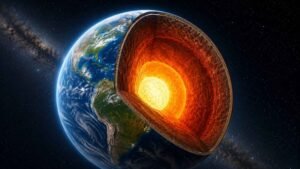
The idea is inspired by Earth itself. Earth’s magnetic field helps protect life from charged particles in space. Future spacecraft may one day use a much smaller artificial version of that idea to protect astronauts during deep space travel.
But this technology must be explained carefully. NASA has studied active magnetic shielding concepts, but astronauts are not currently protected by a fully operational magnetic shield in space. Today, NASA relies on spacecraft design, material shielding, storm shelters, radiation monitoring, space weather forecasting, mission planning, and biological research. Magnetic shielding remains a future possibility, not a finished solution.
Editorial Note
This article explains NASA-related research, technical concepts, current radiation protection methods, and future possibilities for astronaut shielding. It does not claim that NASA has already deployed an operational magnetic radiation shield for crewed missions. Magnetic shielding is a promising but technically difficult concept. Current astronaut radiation protection uses spacecraft structure, material shielding, radiation monitoring, storm shelters, space weather forecasting, mission planning, and health research. Future active magnetic shielding may support deep space missions if engineering challenges can be solved.
Key Statistics and Facts
| Fact | Why It Matters |
|---|---|
| NASA says astronauts traveling beyond Earth’s protective atmosphere and magnetic field face space radiation hazards. | Deep space missions expose crews to higher radiation risk than missions close to Earth. |
| NASA’s Space Radiation Element studies health outcomes linked to space radiation exposure. | Human health protection is a core part of NASA’s exploration planning. |
| Orion radiation measurements from Artemis I helped validate crew protection strategies for lunar missions. | NASA uses real flight data to improve astronaut safety. |
| Active magnetic shielding concepts use magnetic fields to deflect charged particles. | This could reduce reliance on heavy passive shielding if made practical. |
| NASA technical studies have examined superconducting magnet architectures for active radiation shielding. | Magnetic shielding has been studied seriously, but remains technically challenging. |
| Galactic cosmic rays are difficult to block with ordinary material shielding alone. | Future Mars missions may need layered protection strategies. |
These facts show why space radiation protection is one of the biggest challenges for human exploration. Rockets can carry astronauts into deep space, but protection systems must help keep them alive and healthy once they get there.
What Is Space Radiation?
Space radiation is high-energy radiation found beyond Earth’s protective atmosphere and magnetic field. It comes mainly from two sources: the Sun and deep space.
The first source is solar particle events. These are bursts of energetic particles from the Sun, often associated with solar flares and coronal mass ejections. Solar particle events can be dangerous because they may arrive with limited warning and expose astronauts to increased radiation.
The second source is galactic cosmic rays. These are high-energy particles that come from outside the solar system. They are extremely difficult to shield against because they can travel at very high speeds and penetrate materials deeply.
Space radiation is different from many radiation sources on Earth. It can include protons, heavy ions, and high-energy particles that interact with spacecraft materials and human tissue. When these particles strike shielding material, they can sometimes produce secondary particles, which also need to be considered.
This makes space radiation protection complex. A thick wall is not always the best answer because adding more material can increase spacecraft mass and sometimes create secondary radiation effects.
Why Astronauts Need Better Radiation Protection
Astronauts need better radiation protection because future missions will last longer and travel farther. A short mission in low Earth orbit is very different from a mission around the Moon, on the lunar surface, or to Mars.
Low Earth orbit still receives some protection from Earth’s magnetic field. The Moon does not have the same protective global magnetic field and atmosphere. Mars has a thin atmosphere and no strong global magnetic shield like Earth. Deep space travel between Earth and Mars would expose astronauts to radiation for months.
Radiation can affect astronauts in different ways.
Short-term exposure to high radiation levels can cause acute health problems. Long-term exposure can increase cancer risk. Radiation may also affect the central nervous system, cardiovascular system, immune system, and other biological processes. NASA studies these risks carefully because astronaut health is essential for mission success.
Radiation also affects electronics. Spacecraft systems, sensors, computers, and instruments must be protected from radiation damage or errors.
For future Moon and Mars missions, radiation protection is not optional. It is one of the foundations of safe human exploration.
For more space exploration topics, visit our Space & Beyond section.
What Is Magnetic Shielding for Astronauts?
Magnetic shielding for astronauts is a proposed active radiation protection method that uses magnetic fields to deflect charged particles away from a spacecraft or habitat.
The basic idea is similar to how Earth’s magnetic field helps guide charged particles away from the planet. Earth’s magnetosphere does not block everything, but it provides important protection. A spacecraft magnetic shield would try to create a smaller artificial protective field around astronauts.
This is different from passive shielding.
Passive shielding uses materials such as aluminum, polyethylene, water, hydrogen-rich materials, or spacecraft supplies to absorb or reduce radiation. Active shielding uses energy and fields to change the path of incoming charged particles.
In theory, magnetic shielding could reduce astronaut exposure without requiring extremely heavy physical walls. That is why it is attractive for deep space missions, especially long missions to Mars.
However, building such a system is difficult. It may require powerful superconducting magnets, cryogenic cooling, strong structural support, careful field design, radiation modeling, and protection from magnetic effects on spacecraft systems and humans.
Active Shielding vs Passive Shielding
Astronaut radiation protection can be divided into passive and active methods.
| Shielding Type | How It Works | Strength | Challenge |
|---|---|---|---|
| Passive shielding | Uses physical materials to absorb or slow radiation | Proven and already used | Adds mass and may not fully stop galactic cosmic rays |
| Active magnetic shielding | Uses magnetic fields to deflect charged particles | Could reduce exposure without extremely thick walls | Requires powerful magnets, energy, cooling, and complex engineering |
| Active electrostatic shielding | Uses electric fields to influence charged particles | Potential active approach | High voltage and spacecraft integration challenges |
| Storm shelters | Uses concentrated shielding in a small safe area | Practical for solar particle events | Not a full-time whole-spacecraft solution |
| Operational protection | Uses forecasting, mission timing, and procedures | Reduces risk through planning | Cannot remove radiation from the environment |
A future spacecraft may not depend on one method alone. The most realistic approach is layered protection: passive materials, storm shelters, monitoring, forecasting, mission planning, and possibly active magnetic shielding if the technology becomes practical.
Why Magnetic Shielding Is So Attractive
Magnetic shielding is attractive because mass is one of the biggest limits in spaceflight. Every kilogram launched into space costs energy, money, and design complexity. If a spacecraft needs very thick physical shielding, the mission becomes heavier and harder to launch.
A magnetic shield could, in theory, reduce some radiation exposure without adding as much passive material. It could bend the paths of charged particles so fewer reach the crew compartment.
This idea is especially interesting for Mars missions. A round trip to Mars could expose astronauts to months of deep space radiation. A magnetic shielding system could potentially reduce risk during the cruise phase between planets.
Magnetic shielding also fits into a larger vision of future spacecraft that are more advanced, reusable, and designed for long-duration human presence beyond Earth.
However, “attractive” does not mean “easy.” Magnetic shielding must overcome major technical barriers before it can become part of real crewed missions.
Confirmed Facts vs Future Possibilities
| Topic | Status |
|---|---|
| Space radiation is a serious risk for astronauts beyond Earth’s magnetic field | Confirmed |
| NASA studies space radiation health risks through its Human Research Program | Confirmed |
| Orion and Artemis missions use radiation monitoring and shielding strategies | Confirmed |
| NASA technical studies have examined active magnetic shielding concepts | Confirmed |
| Magnetic shielding is currently protecting astronauts on operational NASA missions | Not confirmed |
| Magnetic shielding may support future Mars missions | Future possibility |
| A perfect artificial magnetosphere around a spacecraft | Future possibility, not current reality |
| Complete elimination of radiation risk | Not realistic with current technology |
This distinction matters for credibility. Magnetic shielding is a serious research concept, but it should not be presented as a finished NASA system already protecting astronauts in space.
How NASA Protects Astronauts Today
NASA protects astronauts today through a combination of spacecraft design, monitoring, operational planning, and medical research.
Spacecraft structure provides some shielding. The materials in the spacecraft walls, equipment, supplies, water, and storage areas can reduce radiation exposure. NASA can also identify areas inside a spacecraft that provide better shielding during radiation events.
During Artemis I, radiation measurements inside Orion helped researchers validate the spacecraft’s protection strategies. NASA reported that Orion’s design can protect crew from potentially hazardous radiation levels during lunar missions, though exposure varies depending on spacecraft orientation and environment.
NASA also uses radiation sensors and dosimeters. These devices help track how much radiation astronauts are receiving. Monitoring is essential because crews and mission controllers need accurate information during missions.
Space weather forecasting is another layer. If the Sun produces a dangerous event, mission teams can adjust operations, delay spacewalks, or move astronauts into better-shielded areas.
For a deeper explanation, read our article on NASA space weather forecasting models.
The Role of Storm Shelters
A storm shelter is a protected area inside a spacecraft or habitat where astronauts can go during a solar particle event. It is not necessarily a separate room with thick walls. It can be an area where supplies, equipment, water, and spacecraft structure provide extra protection.
This approach is practical because solar particle events can be intense but temporary. Instead of making the entire spacecraft extremely heavy, engineers can create a smaller area with more concentrated shielding.
Storm shelters are especially useful for solar particle events, but they are not a complete solution for galactic cosmic rays. Galactic cosmic rays are more constant and harder to block.
This is why future missions may need both short-term protection from solar storms and long-term strategies for chronic radiation exposure.
Why Galactic Cosmic Rays Are So Difficult
Galactic cosmic rays, often called GCRs, are one of the hardest radiation problems in human space exploration. They are high-energy particles that come from outside the solar system and can penetrate deeply into spacecraft materials.
Some GCR particles are heavy ions. These can cause complex biological damage because they deposit energy densely along their paths through tissue.
Passive shielding can help, but it has limits. Adding more material can reduce some radiation, but it can also produce secondary particles when cosmic rays strike the shielding. Engineers must carefully model these interactions.
Magnetic shielding is interesting because charged particles can be deflected by magnetic fields. If a magnetic field is strong and shaped properly, it may reduce the number of dangerous particles reaching the crew.
But high-energy galactic cosmic rays are difficult to deflect. They may require large magnetic field strength, large shield geometry, and advanced superconducting systems. That is why GCR protection remains one of the hardest challenges for future Mars missions.
Magnetic Shielding and Superconducting Magnets
Most serious magnetic shielding concepts involve superconducting magnets. Superconductors can carry electrical current with very low resistance when kept at extremely cold temperatures. This makes them useful for creating strong magnetic fields.
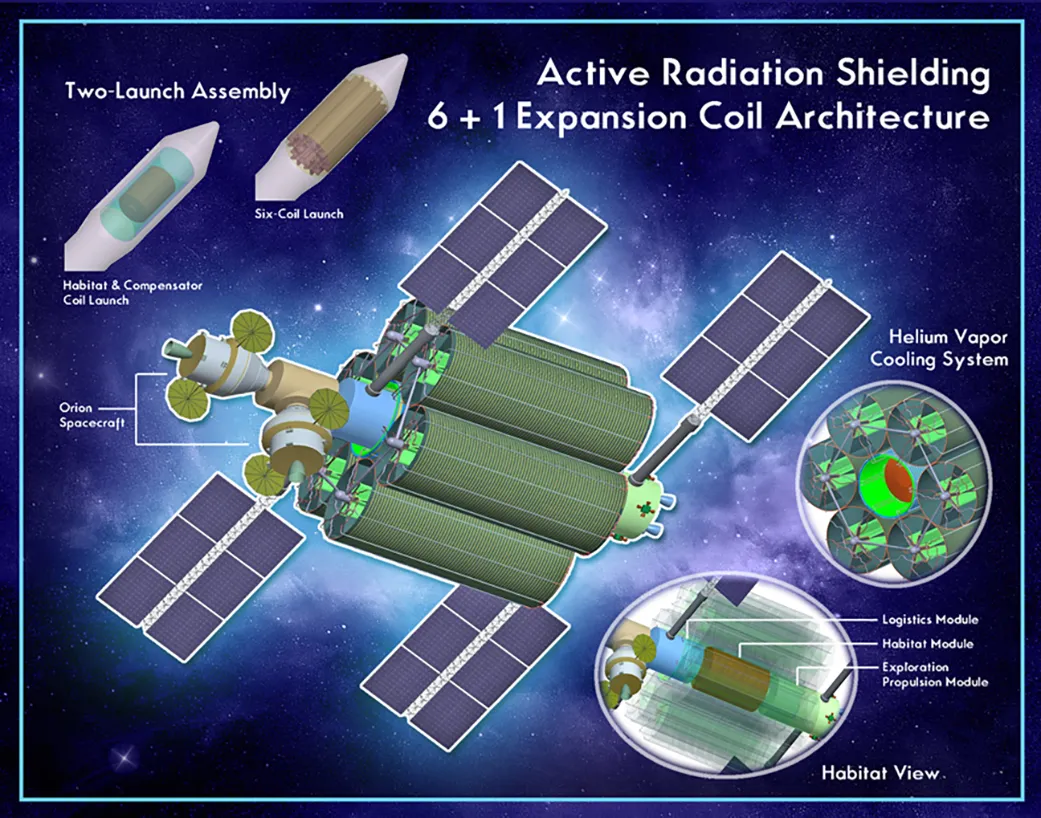
A spacecraft magnetic shield may need superconducting coils arranged around a crew module or habitat. These coils would create a magnetic field designed to deflect charged particles.
The challenge is that superconducting systems need cryogenic cooling. They must stay very cold to remain superconducting. In space, thermal management is already difficult. Adding large superconducting magnets makes the system more complex.
The magnets also need structural support. Strong magnetic fields create forces that must be handled safely. The spacecraft must also protect crew and electronics from unwanted magnetic effects.
This means a magnetic shield is not simply a magnet placed on a spacecraft. It is a full engineering system with power, cooling, structure, controls, radiation modeling, safety limits, and mission integration.
NASA Technical Studies on Active Magnetic Shielding
NASA technical studies have explored active magnetic shielding concepts for deep space missions. These studies examine questions such as magnetic field strength, coil architecture, radiation dose reduction, structural mass, thermal control, and feasibility.
One NASA technical report studied magnet architectures for active radiation shielding and discussed superconducting magnet systems. Another NASA-supported concept, CREW HaT, explored an open-geometry active magnetic shielding idea for protecting astronauts from galactic cosmic radiation during long-haul missions.
These studies are important because they show that magnetic shielding is not just science fiction. Engineers and researchers have seriously examined how it might work.
However, these studies also show that the technology is difficult. Magnetic shielding must become lighter, safer, more reliable, and more practical before it can be used in crewed spacecraft.
Magnetic Shielding for Moon Missions
Magnetic shielding is usually discussed more often for Mars missions than short lunar missions. The reason is mission duration.
A short lunar flyby or short Moon landing has less total radiation exposure than a months-long or years-long Mars mission. For lunar missions, practical protection may come from spacecraft shielding, storm shelters, radiation monitoring, surface habitat design, and space weather forecasting.
However, as lunar missions become longer, radiation protection becomes more important. Astronauts living or working on the Moon may need habitats with better shielding. Lunar regolith, water, structural materials, and underground or partially buried habitats may be considered for protection.
Magnetic shielding for lunar habitats is possible as a future research direction, but it is not currently the main operational protection method.
For more about NASA’s return to the Moon, read our article on the Artemis II lunar flyby mission.
Magnetic Shielding for Mars Missions
Mars missions are where magnetic shielding becomes especially interesting. A human mission to Mars would expose astronauts to radiation during the journey to Mars, while on the Martian surface, and during the return trip.
Mars does not have a strong global magnetic field like Earth. Its atmosphere is also much thinner than Earth’s. This means astronauts on Mars would still need serious radiation protection.
During the cruise between planets, a spacecraft magnetic shield could, in theory, help reduce charged particle exposure. If combined with passive shielding and storm shelters, it could become part of a layered protection system.
Mars missions also require mass efficiency. Carrying heavy shielding all the way to Mars is difficult. This is why active shielding remains an attractive long-term concept.
Still, the technology must be proven before it can protect Mars crews. Safety, reliability, power, cooling, and system failure modes must be understood extremely well.
Magnetic Shielding vs Material Shielding
| Feature | Material Shielding | Magnetic Shielding |
|---|---|---|
| Current use | Already used in spacecraft and habitats | Mostly research and concept studies |
| Main method | Absorbs or slows particles | Deflects charged particles |
| Best for | Practical protection, storm shelters, spacecraft design | Possible future deep space protection |
| Main challenge | Adds mass and may create secondary radiation | Requires strong fields, power, cooling, and complex systems |
| Technology readiness | Higher | Lower |
| Near-term role | Essential | Experimental and future-focused |
| Long-term role | Still important | Possible complement for Mars-class missions |
The best future may not be material shielding or magnetic shielding alone. It may be a hybrid system that uses both.
Why Magnetic Shielding Cannot Block Everything
Magnetic shielding can only affect charged particles. It does not block all types of radiation in the same way. Neutral particles and photons are not deflected by magnetic fields like charged particles are.
Even for charged particles, the shield must be strong enough and shaped correctly. High-energy particles are harder to deflect. The system must also avoid redirecting particles into other parts of the spacecraft.
Another issue is secondary radiation. Particles interacting with materials or fields can create complex radiation environments. Scientists must model not only what is blocked, but also what secondary effects are produced.
This is why radiation protection requires careful simulation and testing. A shielding method that looks good in a simple idea may behave differently in a real spacecraft environment.
A trustworthy article should avoid saying “magnetic shields will make astronauts completely safe.” The more accurate statement is that magnetic shielding may reduce certain radiation risks if technical challenges are solved.
Space Weather Forecasting and Magnetic Shielding
Magnetic shielding would not replace space weather forecasting. Even if future spacecraft use active shielding, mission teams will still need to monitor the Sun.
Solar storms can develop quickly. NASA and NOAA monitor solar activity to help protect astronauts and spacecraft. Forecasts can help crews move to storm shelters, delay spacewalks, or change mission operations.
A future spacecraft may combine magnetic shielding with real-time space weather forecasting. The shield could reduce some incoming particle exposure, while forecasting helps mission teams respond to changing conditions.
This layered approach is more realistic than relying on one technology alone.
Space protection is not a single wall. It is a system.
How Radiation Modeling Helps Shield Design
NASA uses radiation modeling tools to understand how particles move through space, spacecraft materials, and human tissue. These models help engineers design shielding more intelligently.
Radiation transport codes can estimate how different materials and configurations affect astronaut exposure. They can also help compare shielding options before a spacecraft is built.
This matters because testing every radiation condition in real space is difficult. Models help scientists predict risk, compare designs, and improve mission planning.
For active shielding, modeling is even more important. Engineers must understand how magnetic fields change particle paths, how particles interact with spacecraft materials, and what dose astronauts may receive.
Good shielding design depends on good physics, good data, and good simulation.
Active Magnetic Shielding Challenges
Active magnetic shielding faces several major challenges.
The first challenge is magnetic field strength. The shield must be strong enough to deflect dangerous charged particles.
The second challenge is mass. Magnets, structure, power systems, and cooling equipment can be heavy.
The third challenge is energy. Active systems may require significant power.
The fourth challenge is cooling. Superconducting magnets may need cryogenic systems.
The fifth challenge is safety. Strong magnetic fields must not create unacceptable risks for crew, electronics, or spacecraft systems.
The sixth challenge is reliability. A crewed Mars mission cannot depend on a system that is fragile or difficult to repair.
The seventh challenge is integration. The shield must fit into the spacecraft design without creating new problems.
These challenges do not make magnetic shielding impossible. They explain why it remains a future technology rather than a routine system today.
Could Magnetic Shielding Create an Artificial Magnetosphere?
Some future concepts imagine creating an artificial magnetosphere around a spacecraft. This would be a protective region shaped by magnetic fields, somewhat inspired by Earth’s natural magnetosphere.
The idea is exciting, but it should be described carefully. Earth’s magnetosphere is enormous and powered by planetary-scale processes. A spacecraft system would be much smaller and would need to be engineered with practical limits.
An artificial magnetic shield may help reduce certain charged particle exposure, but it would not be the same as Earth’s magnetosphere. It would also not remove every radiation risk.
Still, the concept is important because it represents a long-term vision: spacecraft that carry not only air, water, and engines, but also active protection systems that help humans survive beyond Earth.
How Magnetic Shielding Connects to Future Spacecraft Design
Future spacecraft may be designed differently if magnetic shielding becomes practical. Instead of treating radiation protection only as extra wall thickness, spacecraft could include active field systems, protected crew modules, storm shelters, water-based shielding, and smart radiation monitoring.
Designers may place sleeping areas, exercise equipment, medical systems, and command stations in better-protected zones. Supplies such as water and food could be arranged to add passive shielding. Active systems could be used to reduce certain particle exposure during cruise phases.
This would make radiation protection part of the spacecraft architecture from the beginning.
Future spacecraft will also need high-speed communication, advanced power systems, AI-assisted monitoring, and better materials. You can read more about future mission communication in our article on NASA deep space laser communication.
Magnetic Shielding and Space Habitats
Space habitats may also benefit from advanced shielding technologies. A habitat on the Moon, Mars, or in deep space must protect astronauts for long periods.
A habitat may use regolith, water, polyethylene, underground placement, or structural materials for passive shielding. Magnetic shielding could be considered for certain future habitats, especially if power and engineering challenges become manageable.
However, habitats have different design needs than spacecraft. A Mars habitat may use local materials for shielding. A lunar habitat may be partially covered with regolith. A deep space habitat may need more advanced active systems because it cannot rely on planetary terrain.
The best habitat protection strategy will depend on location, mission duration, available resources, power, and crew needs.
Magnetic Shielding and Astronaut Health
The main reason to study magnetic shielding is astronaut health. Radiation risk is one of the biggest biomedical challenges for deep space exploration.
NASA studies how space radiation may affect cancer risk, the central nervous system, cardiovascular health, immune response, and other biological systems. The goal is to keep astronaut risk within acceptable limits.
Magnetic shielding could help if it reduces exposure to harmful charged particles. But it must be evaluated carefully. Scientists need to know how much dose reduction is possible, which particle types are affected, and whether the system creates secondary risks.
Astronaut health protection will likely include many layers:
Shielding.
Dosimetry.
Space weather forecasting.
Mission timing.
Medical monitoring.
Biological countermeasures.
Storm shelters.
Operational procedures.
Magnetic shielding may become one layer in that larger system.
What People Often Get Wrong About Magnetic Shielding
Many people think magnetic shielding is already installed on NASA spacecraft. That is not correct. Magnetic shielding is still mainly a research and concept area.
Another mistake is thinking magnetic shielding would make astronauts completely immune to radiation. No realistic shielding system removes all risk.
Some people think magnetic shielding works like a science-fiction force field. Real magnetic shielding would require powerful magnets, field design, cooling, power, structural systems, and safety testing.
Another misunderstanding is thinking passive shielding is outdated. Passive shielding remains essential and will likely still be used even if active shielding becomes available.
Some people also think Earth’s magnetic field can be easily copied around a spacecraft. In reality, Earth’s magnetosphere is huge and created by planetary-scale processes. A spacecraft system would be much smaller and far harder to engineer.
A final mistake is ignoring space weather forecasting. Even with better shielding, astronauts will still need warnings and operational protection during solar storms.
Timeline: Magnetic Shielding and Space Radiation Protection
| Period | Development |
|---|---|
| Early space age | Scientists recognized radiation as a major challenge for human spaceflight |
| Apollo era | Short lunar missions relied on spacecraft shielding and mission timing |
| Space station era | Low Earth orbit missions benefited from partial Earth magnetic field protection |
| Modern NASA research | Human Research Program and Space Radiation Element study radiation health risks |
| Artemis era | Orion radiation data, dosimetry, storm shelter concepts, and space weather monitoring support lunar missions |
| Technical study phase | NASA and researchers examine active magnetic shielding concepts and superconducting magnet architectures |
| Future possibility | Magnetic shielding may complement passive systems for long-duration Moon, Mars, or deep space missions |
This timeline shows that magnetic shielding is part of a long research path. It is not a sudden invention, and it is not yet a finished operational system.
Comparison: Space Radiation Protection Methods
| Protection Method | Current Role | Future Potential |
|---|---|---|
| Spacecraft structure | Already used | Will remain essential |
| Water and supplies | Can add passive shielding | Useful for storm shelters and habitat design |
| Hydrogen-rich materials | Studied and used in shielding design | May support lighter passive shielding |
| Radiation dosimeters | Already used | Better real-time monitoring |
| Space weather forecasting | Already essential | More accurate AI-assisted alerts |
| Storm shelters | Practical for solar particle events | Important for Artemis and Mars missions |
| Magnetic shielding | Research and concept stage | Possible future active protection layer |
| Medical countermeasures | Research area | May reduce biological risk |
This comparison shows why magnetic shielding should be described as part of a larger protection strategy, not as the only answer.
Why This Technology Matters for Mars
Mars is the destination that makes advanced radiation protection especially important. A Mars mission would last much longer than a lunar mission. Astronauts may spend months traveling through deep space, then months on Mars, then months returning.
That means radiation exposure becomes a mission-limiting issue.
A successful Mars mission may need:
Better spacecraft shielding.
Protected storm shelters.
Advanced radiation sensors.
Accurate solar storm forecasting.
Surface habitats with shielding.
Mission planning around solar activity.
Possible active shielding systems.
Medical monitoring and countermeasures.
Magnetic shielding could help if it becomes practical, especially during interplanetary travel. But it would need to prove reliability before NASA could depend on it for crew survival.
Why This Technology Matters for the Public
Magnetic shielding for astronauts matters to the public because it is part of the larger question of whether humans can safely explore deep space.
Moon missions inspire students, engineers, scientists, and space fans. Mars missions may define the next great chapter of human exploration. But these missions must be safe enough to justify the risk.
Radiation protection is not as dramatic as rocket launches, but it may be just as important. A spacecraft cannot be judged only by how far it travels. It must also protect the humans inside.
This technology also has educational value. It connects physics, biology, medicine, engineering, materials science, superconductors, space weather, and mission design.
In simple words, magnetic shielding is not just a space idea. It is a problem at the intersection of human survival and advanced engineering.
Future Possibilities for NASA Magnetic Shielding
Future magnetic shielding systems may look very different from today’s concept studies. They may use lighter superconductors, improved cryogenic systems, better field geometries, advanced radiation modeling, and smarter spacecraft integration.
A future Mars transfer vehicle could include a protected central crew area surrounded by passive materials and supported by active magnetic systems. A deep space habitat could combine water shielding, storm shelters, and magnetic protection. A lunar or Mars base could use local material for passive shielding while reserving active systems for specific high-risk zones.
Future systems may also use AI to monitor radiation conditions and adjust operations. If a solar storm is detected, the spacecraft could recommend crew sheltering procedures, change orientation, or adjust shielding modes if active systems are available.
Still, this remains future-focused. NASA will need extensive testing before astronauts depend on magnetic shielding during a real mission.
Practical Reader Takeaway
The most important thing to understand is that magnetic shielding is not a magic force field. It is a possible future engineering solution to a real radiation problem.
NASA already protects astronauts using proven methods. Magnetic shielding could one day improve that protection, especially for long-duration missions beyond the Moon.
The future of space protection will likely be layered. No single technology will solve every radiation problem. The strongest approach will combine physics, engineering, forecasting, materials, medicine, and mission planning.
That is what makes the topic so important. Human exploration of the Moon and Mars depends not only on getting there, but on surviving there.
Frequently Asked Questions
What is NASA magnetic shielding for astronauts?
NASA magnetic shielding for astronauts refers to research and concepts that use magnetic fields to deflect charged space radiation away from crewed spacecraft or habitats. It is a future-focused active shielding idea, not a routine operational system today.
Is NASA already using magnetic shields on spacecraft?
No. NASA is not currently using a fully operational magnetic radiation shield to protect astronauts on crewed spacecraft. Current protection relies on spacecraft shielding, monitoring, storm shelters, space weather forecasting, mission planning, and health research.
Why do astronauts need radiation shielding?
Astronauts need shielding because space radiation can damage human tissue, increase cancer risk, affect organs and systems, and threaten long-duration missions beyond Earth’s protective atmosphere and magnetic field.
What types of radiation are dangerous in space?
The main concerns are solar particle events from the Sun and galactic cosmic rays from outside the solar system. Both can expose astronauts to harmful radiation beyond Earth’s magnetic field.
How would magnetic shielding work?
Magnetic shielding would use powerful magnetic fields to bend or deflect charged particles away from astronauts. The idea is inspired by Earth’s magnetic field, but a spacecraft system would be much smaller and harder to engineer.
Can magnetic shielding block all radiation?
No. Magnetic shielding cannot block all radiation. It mainly affects charged particles and would not eliminate every radiation risk. It would likely need to work with passive shielding and other protection methods.
Why is magnetic shielding difficult?
It may require powerful superconducting magnets, cryogenic cooling, strong structures, high reliability, power systems, radiation modeling, and careful safety testing.
Why is magnetic shielding important for Mars missions?
Mars missions would expose astronauts to deep space radiation for long periods. Magnetic shielding could one day help reduce radiation exposure during the journey, but the technology must become practical and reliable first.
What does NASA use for radiation protection now?
NASA uses spacecraft design, material shielding, radiation dosimeters, space weather monitoring, storm shelters, operational planning, and biomedical research to protect astronauts.
Is magnetic shielding the future of astronaut protection?
It may become part of the future, but probably not the only solution. The most realistic future is a layered system combining passive shielding, active shielding, forecasting, monitoring, medical countermeasures, and mission planning.
Conclusion
NASA’s magnetic shielding for astronauts is one of the most fascinating future concepts in human space exploration. It addresses one of the hardest problems beyond Earth: how to protect humans from invisible but dangerous space radiation.
The idea is powerful. If a spacecraft could generate a magnetic field that deflects charged particles, astronauts might gain an extra layer of protection during long missions to the Moon, Mars, and deep space. This could reduce dependence on heavy passive shielding and help make long-duration exploration safer.
But the technology must be described accurately. Magnetic shielding is not currently a finished NASA system protecting astronauts in space. It remains a challenging research and engineering concept. Today, NASA relies on spacecraft shielding, storm shelters, radiation monitoring, space weather forecasting, mission planning, and health studies.
The future of space protection will not depend on one technology alone. It will require layers of defense: better materials, smarter spacecraft design, accurate forecasting, medical research, protected habitats, and possibly active magnetic shielding.
The simplest way to understand the topic is this: Earth protects us with a magnetic field, and future spacecraft may one day use engineered magnetic fields to help protect astronauts beyond Earth. If NASA and researchers can solve the engineering challenges, magnetic shielding could become one of the key technologies that make human missions to Mars and deep space safer.
Sources and Further Reading
NASA: How to Protect Astronauts from Space Radiation on Mars
NASA: Artemis I Radiation Measurements Validate Orion Safety for Astronauts
NASA Science: To Protect Artemis II Astronauts, NASA Experts Keep Eyes on Sun
NASA Technical Reports: Magnet Architectures and Active Radiation Shielding Study
NASA Technical Reports: CREW HaT Active Magnetic Shielding Concept
NASA Technical Reports: Superconducting Magnets for Active Shielding