Venus is often called Earth’s twin, but that nickname can be misleading. The two planets are similar in size and structure, yet their environments could not be more different. Earth became a world of oceans, breathable air, and life. Venus became a crushing, scorching planet wrapped in thick carbon dioxide, sulfuric acid clouds, and a runaway greenhouse atmosphere.
The surface of Venus is hot enough to melt lead. Its surface pressure is more than 90 times Earth’s sea-level pressure. Its clouds are made of sulfuric acid. Its atmosphere is so thick that a spacecraft descending through it must survive heat, pressure, chemical corrosion, turbulence, and communication challenges.
That is why NASA Venus atmosphere probe design is one of the most fascinating engineering topics in planetary science.
NASA’s future DAVINCI mission, short for Deep Atmosphere Venus Investigation of Noble gases, Chemistry, and Imaging, is designed to send a probe through Venus’ atmosphere to study the planet from above its clouds down to near the surface. As of 2026, DAVINCI is not launching in 2026. NASA lists it as a future mission with a tentative 2030 launch. That distinction matters for accuracy and trust.
The real story is not that NASA has already sent a new probe to Venus in 2026. The real story is that NASA is designing and preparing a mission that could reveal why Venus became so different from Earth and whether it may have once had conditions more like our own planet.
In simple words, DAVINCI is being designed to survive one of the harshest planetary environments in the solar system and send back measurements that scientists have wanted for decades.
Editorial Note
This article explains confirmed NASA Venus atmosphere probe design work, the DAVINCI mission, Venus’ extreme environment, and future exploration possibilities. It does not claim that NASA launched a Venus atmosphere probe in 2026. NASA currently lists DAVINCI as a future flyby and atmospheric probe mission with a tentative 2030 launch. This article uses careful wording to separate confirmed mission design from future mission outcomes.
Key Statistics and Facts
| Fact | Why It Matters |
|---|---|
| Venus is the hottest planet in the solar system. | It is hotter than Mercury because its thick atmosphere traps heat. |
| Venus’ surface temperature is about 872°F, or 467°C. | Any probe must survive extreme heat near the surface. |
| Venus’ surface pressure is about 93 times Earth’s sea-level pressure. | A descent probe must be built like a pressure-resistant vessel. |
| Venus has a thick carbon dioxide atmosphere and sulfuric acid clouds. | Instruments must survive corrosive and chemically hostile conditions. |
| NASA’s DAVINCI mission is a future flyby/atmospheric probe mission. | It is designed to study Venus from above the clouds down to the surface. |
| NASA lists DAVINCI’s launch as tentative for 2030. | It should not be described as a 2026 launch. |
| DAVINCI will target Alpha Regio, a highland tessera region. | The region may preserve clues about Venus’ ancient geologic history. |
These facts show why Venus probe design is so difficult. A spacecraft descending into Venus is not simply falling through air. It is entering a high-pressure, high-temperature, chemically hostile world.
What Is NASA’s Venus Atmosphere Probe Design?
NASA’s Venus atmosphere probe design refers to the engineering and scientific planning behind a spacecraft probe that can enter Venus’ atmosphere, take measurements while descending, survive extreme conditions, and transmit valuable data back to Earth through a carrier spacecraft.
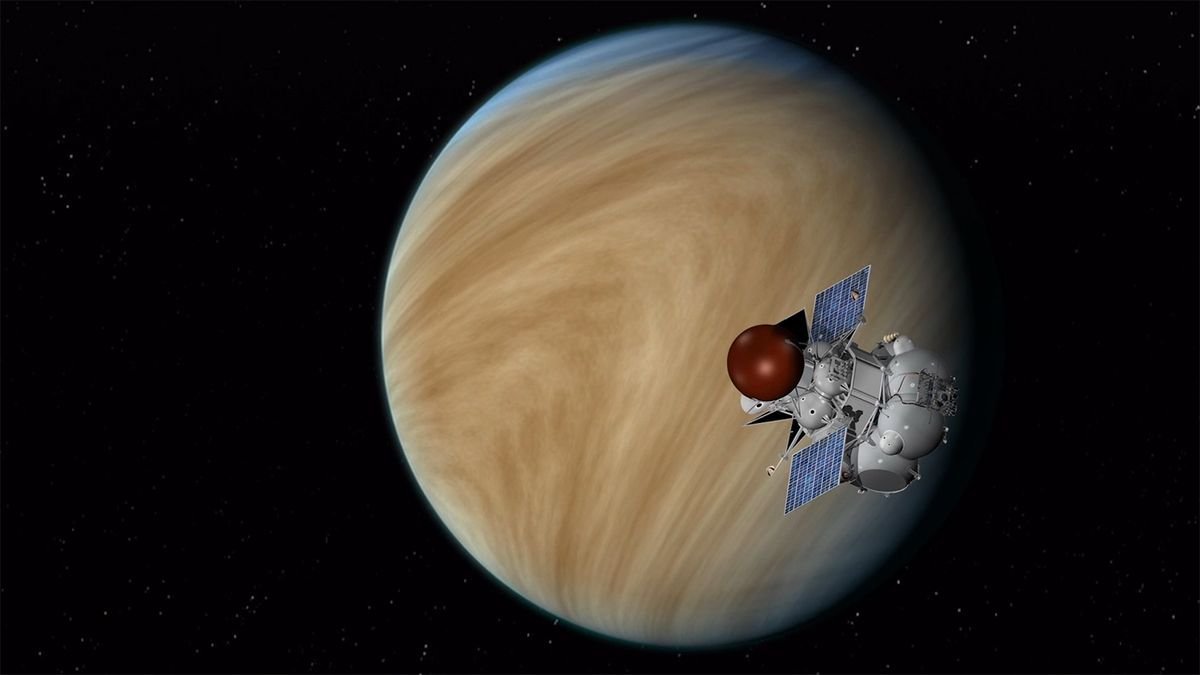
The main NASA mission connected to this topic is DAVINCI. DAVINCI will use a spacecraft and a descent probe. The spacecraft will conduct flybys and study Venus from above, while the probe will descend through the atmosphere and collect direct measurements.
The probe is designed to study:
Atmospheric chemistry.
Noble gases.
Trace gases.
Temperature.
Pressure.
Wind speed.
Cloud structure.
Deep atmosphere behavior.
Surface imaging near Alpha Regio.
Possible clues about ancient water.
Possible clues about Venus’ climate history.
This matters because many important Venus questions cannot be answered from orbit alone. Orbiters can map and observe from above, but a probe can directly sample the atmosphere as it falls through it.
For more NASA mission explainers, visit our NASA category.
Why Venus Is So Hard to Explore
Venus is difficult because its environment attacks spacecraft in several ways at once.
The first challenge is heat. The surface is around 872°F, or 467°C. That is hot enough to damage electronics, melt some materials, and shorten spacecraft survival time.
The second challenge is pressure. Venus’ surface pressure is about 93 times Earth’s sea-level pressure. A probe near the surface must withstand conditions similar to being deep underwater.
The third challenge is chemistry. Venus has clouds made of sulfuric acid. Instruments and outer surfaces must be designed to resist corrosion.
The fourth challenge is atmosphere thickness. The atmosphere is dense and turbulent, which affects descent speed, parachute design, thermal conditions, and communication.
The fifth challenge is communication. A probe descending through Venus must send data through the atmosphere to a relay spacecraft before it stops functioning.
The sixth challenge is time. A Venus descent probe has limited time to collect and transmit data before the environment overwhelms it.
This is why Venus probes are extremely difficult to build. Mars rovers can operate for years. A Venus surface probe may survive for minutes to hours depending on design. The mission must collect critical data quickly and reliably.
Why NASA Wants to Study Venus Again
Venus matters because it may reveal what happens when a rocky planet goes wrong.
Earth and Venus are similar in size and bulk composition, but they followed very different paths. Earth developed oceans and a stable climate suitable for life. Venus developed a thick carbon dioxide atmosphere, extreme heat, crushing pressure, and a runaway greenhouse state.
Understanding Venus can help scientists answer major questions:
Did Venus once have oceans?
How did its atmosphere evolve?
Why did Venus lose its water?
Did volcanism shape its atmosphere?
How does a runaway greenhouse effect begin?
What can Venus teach us about Earth’s climate stability?
How common are Venus-like planets around other stars?
These questions matter beyond Venus itself. As scientists discover thousands of exoplanets, many may be rocky worlds exposed to strong starlight. Some may become Earth-like. Others may become Venus-like. Studying Venus helps scientists understand the difference.
For a related topic, read our article on NASA exoplanet direct imaging tech, which explains how future telescopes may study alien worlds beyond our solar system.
What Is DAVINCI?
DAVINCI stands for Deep Atmosphere Venus Investigation of Noble gases, Chemistry, and Imaging. It is NASA’s future mission designed to study Venus from the top of its clouds down to the surface.
NASA says DAVINCI will be the first American spacecraft since the 1990s to explore Earth’s neighboring planet, along with VERITAS. It will include both a spacecraft and a descent probe.
The spacecraft will fly by Venus, study cloud motions, and map surface composition from orbit-like flyby observations. Later, it will release a probe into Venus’ atmosphere. That probe will descend through the atmosphere, taking measurements and images before reaching the surface region of Alpha Regio.
The mission is designed to answer questions about Venus’ formation, evolution, atmosphere, geology, and possible ancient habitability.
The most important correction is this: DAVINCI is not a completed mission in 2026. It is a future mission under development, with NASA listing launch as tentative for 2030.
Confirmed Facts vs Future Possibilities
| Topic | Status |
|---|---|
| Venus is the hottest planet in the solar system | Confirmed |
| Venus has a thick carbon dioxide atmosphere and sulfuric acid clouds | Confirmed |
| DAVINCI is a NASA future Venus mission | Confirmed |
| DAVINCI includes a flyby spacecraft and descent probe | Confirmed |
| DAVINCI launch in 2026 | Not confirmed |
| NASA lists DAVINCI launch as tentative for 2030 | Confirmed current NASA listing |
| DAVINCI will measure Venus’ atmosphere during descent | Mission objective |
| DAVINCI will prove Venus once had oceans | Not confirmed |
| DAVINCI will detect life on Venus | Not confirmed |
This distinction is important. A trustworthy article should not present mission goals as completed discoveries. DAVINCI is designed to investigate Venus’ past, not to announce conclusions before the mission flies.
Why 2026 Matters for Venus Probe Design
The year 2026 matters because Venus exploration is moving through a new preparation era. NASA, ESA, and other space agencies are planning missions that could return Venus to the center of planetary science in the 2030s.
DAVINCI is being prepared as a future probe mission. VERITAS is planned as a future orbiter mission no earlier than 2031. ESA’s EnVision is also planned for the 2030s. Together, these missions represent a renewed interest in Venus after decades of limited direct exploration.
In 2026, the accurate message is this: NASA is not launching a Venus atmosphere probe this year, but probe design, instrument planning, mission testing, and Venus science preparation are shaping the future of Venus exploration.
This careful wording is important for reader trust. The headline can mention 2026 as the article’s outlook year, but the body must clearly explain that DAVINCI is a future mission.
The DAVINCI Probe: Built for a Harsh World
The DAVINCI descent probe must be built to survive Venus long enough to complete its mission. NASA has described it as a meter-diameter probe designed to brave high temperatures and pressures near Venus’ surface.
The probe must protect delicate instruments while allowing some sensors to measure the atmosphere directly. It needs thermal protection, pressure resistance, chemical resistance, communication systems, batteries, instruments, and a structure strong enough for descent.
A useful way to imagine it is as a scientific submarine falling through an alien atmosphere. Like a submarine, it must resist pressure. Unlike a submarine, it must also deal with extreme heat, sulfuric acid clouds, and a one-way descent through another planet’s atmosphere.
The probe does not need to survive for years. It needs to survive long enough to collect and transmit the measurements that scientists need most.
That mission design is practical. Venus is too harsh for long-duration surface survival with normal spacecraft technology, so the probe focuses on a short but highly valuable descent.
What the Probe Will Measure
DAVINCI’s descent probe is designed to measure Venus’ atmosphere in detail.
The key measurements include:
Temperature changes during descent.
Atmospheric pressure.
Wind speed.
Atmospheric composition.
Noble gases.
Trace gases.
Chemical compounds linked to Venus’ past.
Oxygen fugacity in the deep atmosphere.
Cloud and lower-atmosphere structure.
Images of Alpha Regio.
These measurements can help scientists understand how Venus formed and evolved. Noble gases are especially important because they can preserve clues about a planet’s long-term atmospheric history. Trace gases can reveal chemical processes, volcanic influence, and possible water history.
Direct descent measurements are valuable because they provide altitude-by-altitude data. Instead of only seeing Venus from above, DAVINCI will sample the atmosphere layer by layer.
DAVINCI’s Main Instruments
NASA lists several important instruments for DAVINCI.
| Instrument | Purpose |
|---|---|
| VISOR | Takes ultraviolet cloud images and near-infrared images related to surface composition |
| CUVIS | Studies ultraviolet-visible light and helps investigate the mysterious “unknown absorber” in Venus’ atmosphere |
| VTLS | Measures chemical compounds that may reveal Venus’ past |
| VMS | Studies noble gases and trace gases from high altitude to near the surface |
| VASI | Measures pressure, temperature, and wind speed during descent |
| VenDI | Captures descent images of Alpha Regio through a sapphire window |
| VfOx | Student-built sensor designed to measure oxygen in the lowest atmosphere |
These instruments show why DAVINCI is more than a simple probe. It is a flying chemistry lab, weather station, imaging system, and planetary history tool.
The Venus Mass Spectrometer
The Venus Mass Spectrometer, or VMS, is one of DAVINCI’s most important instruments. It will study the atmosphere, including noble gases and trace gases, as the probe descends.
Noble gases matter because they do not react easily with other chemicals. That makes them useful records of planetary history. Their abundance can help scientists understand how Venus gained, lost, and changed its atmosphere over billions of years.
Trace gases also matter because they may reveal active chemical processes. They can provide clues about volcanic activity, surface-atmosphere interactions, and past water.
A mass spectrometer works by identifying molecules based on their mass and charge. In simple terms, it helps scientists determine what gases are present and in what amounts.
This is one reason the DAVINCI probe is so valuable. It can directly sample the atmosphere instead of only observing it remotely.
VASI: Measuring Temperature, Pressure, and Winds
The Venus Atmospheric Structure Investigation, or VASI, will measure pressure, temperature, and winds during the probe’s descent.
These measurements are important because Venus’ atmosphere is not uniform. Conditions change with altitude. Winds may move differently in different layers. Temperature and pressure profiles can reveal how the atmosphere behaves and how heat moves through the planet’s climate system.
NASA has described VASI as a key instrument for understanding Venus’ mysterious deep atmosphere. It will provide altitude reference information for the mission’s composition instruments and help scientists connect chemistry with atmospheric structure.
This is important because chemistry alone is not enough. Scientists also need to know where and under what conditions those chemical measurements were taken.
VASI helps turn DAVINCI’s descent into a vertical map of Venus’ atmosphere.
VenDI: Seeing Alpha Regio Up Close
The Venus Descent Imager, or VenDI, will capture images as the probe descends near Alpha Regio. NASA says VenDI will look through a transparent sapphire window at the bottom of the descent sphere.
This is a remarkable design choice. Sapphire is used because it can withstand harsh conditions while allowing the camera to see through it. Venus’ environment is too extreme for ordinary design choices.
Alpha Regio is a tessera region. Tesserae are cracked, folded, rugged highlands found on Venus. They may be among the oldest surfaces on the planet. Some scientists are interested in whether these highland regions could contain clues about ancient geologic processes, possible past water, or continent-like rocks.
VenDI’s images could help map the 3D topography and composition of Alpha Regio at close range. That would be a major improvement over older Venus imaging data.
Why Alpha Regio Matters
Alpha Regio matters because it may preserve ancient clues about Venus. Much of Venus’ surface is covered by volcanic plains, but tessera regions are more complex and may be older.
If Alpha Regio contains rocks different from surrounding volcanic plains, it could help scientists understand whether Venus once had more Earth-like geological processes.
Some questions include:
Are tesserae ancient crustal regions?
Did water help shape any parts of Venus’ surface?
Was Venus ever more habitable?
How did volcanism affect the atmosphere?
Did Venus once have continent-like rocks?
DAVINCI will not answer every question alone. But by descending near Alpha Regio and imaging it closely, the mission could provide unique data that orbiters cannot easily collect.
Why Venus Is the Hottest Planet
Venus is hotter than Mercury even though Mercury is closer to the Sun. The reason is Venus’ atmosphere.
Venus has a thick atmosphere dominated by carbon dioxide. Carbon dioxide is a greenhouse gas. It traps heat and prevents the planet from cooling efficiently. Venus also has clouds of sulfuric acid that help create a complex climate system.
NASA describes Venus as having a runaway greenhouse effect. This means heat became trapped so strongly that the planet’s surface reached extreme temperatures.
This is one reason Venus is scientifically important. It shows how a rocky planet can become hostile through atmospheric evolution.
Understanding Venus can help scientists understand climate processes on Earth and on exoplanets. Venus is not Earth’s future in a simple direct sense, but it is a powerful natural laboratory for studying greenhouse physics.
Venus Compared with Earth and Mars
| Feature | Venus | Earth | Mars |
|---|---|---|---|
| Atmosphere | Very thick, mostly carbon dioxide | Nitrogen-oxygen atmosphere | Thin, mostly carbon dioxide |
| Surface Temperature | Extremely hot | Moderate and life-supporting | Cold |
| Surface Pressure | About 93 times Earth sea level | 1 Earth atmosphere | Less than 1% of Earth sea level |
| Water Today | Very little water | Oceans and water cycle | Ice and possible past liquid water |
| Habitability | Surface is currently hostile | Habitable | Currently harsh, possibly habitable in the past |
| Main Science Question | Why did it become so hot and dry? | How does habitability persist? | Did it once support life-friendly environments? |
This comparison shows why Venus matters. It is not just another planet. It is a key example of how rocky planets can evolve very differently.
For more planetary science topics, read our article on how NASA maps the surface of Mars.
Engineering Challenge: Heat Protection
Heat protection is one of the biggest design challenges for any Venus probe. Electronics do not like high temperatures. Batteries, sensors, wires, cameras, and computer systems all have temperature limits.
The DAVINCI probe must protect its instruments during descent. This means using insulation, strong materials, careful thermal design, and mission timing.
A Venus probe does not need to operate forever. It needs to operate long enough to gather and transmit essential data. That changes the engineering approach. Instead of trying to make a rover survive for years, engineers design a probe that can survive a short but intense mission.
This is why descent missions are practical for Venus. They accept the harsh environment and focus on collecting data before the probe fails.
Engineering Challenge: Pressure Protection
Pressure on Venus is another major challenge. At the surface, atmospheric pressure is about 93 times what we experience at sea level on Earth.
This means the probe must be structurally strong. NASA has compared the descent sphere design to something like a pressure-resistant vessel. It must protect internal instruments while allowing exposed sensors to collect data.
Pressure can crush weak structures, deform materials, damage seals, and affect instrument readings. A Venus probe must be designed with strong pressure-bearing materials and careful engineering margins.
This is why Venus is harder than Mars in some ways. Mars is cold and dusty, but its atmosphere is thin. Venus is hot, dense, and crushing.
Engineering Challenge: Sulfuric Acid Clouds
Venus’ clouds contain sulfuric acid. This creates another design problem.
A probe falling through the clouds may encounter corrosive droplets or chemical exposure. Materials must resist corrosion long enough for the mission. Sensors exposed to the atmosphere must be designed to tolerate harsh chemistry.
This affects:
Outer shell materials.
Sensor housings.
Windows.
Parachute materials.
Seals.
Electrical connections.
Instrument ports.
A Venus atmosphere probe is not only a heat and pressure machine. It is also a chemical survival system.
Engineering Challenge: Communication
Communication is critical because the probe must transmit data before it reaches the surface or shortly after. It cannot store all data and wait for recovery. There is no recovery.
DAVINCI’s carrier spacecraft will serve as a relay. The probe sends data upward to the spacecraft, and the spacecraft sends data back to Earth.
This relay approach is important because Venus’ atmosphere and distance from Earth make direct communication more difficult during descent.
The probe must send measurements quickly and reliably. Every second matters because the mission has limited descent time.
This is one reason instrument design and communication design are connected. The probe must gather data, process it, and transmit it before the environment ends the mission.
Future deep space data systems may also benefit from improved communication technology. You can read more in our article on NASA deep space laser communication.
How DAVINCI Complements VERITAS
DAVINCI and VERITAS are both NASA Venus missions, but they have different roles.
DAVINCI is a flyby and atmospheric probe mission. It directly samples the atmosphere and images a specific descent region.
VERITAS is an orbiter mission designed to study Venus’ surface and interior using radar and other instruments. NASA lists VERITAS launch as no earlier than 2031.
Together, they could provide complementary data. DAVINCI gives direct atmospheric and descent measurements. VERITAS provides global mapping and geologic context.
| Mission | Type | Main Goal | Current Status |
|---|---|---|---|
| DAVINCI | Flyby and atmospheric probe | Study Venus from clouds to surface | Future mission, tentative 2030 launch |
| VERITAS | Orbiter | Map Venus’ surface and study interior | Future mission, no earlier than 2031 |
| EnVision | ESA orbiter | Study Venus geology, atmosphere, and climate | Future ESA mission planned for 2030s |
This combination could help scientists understand Venus as a complete planet: atmosphere, surface, interior, and climate history.
Why Venus Helps Us Understand Exoplanets
Venus is important for exoplanet science because many planets outside our solar system may be Venus-like.
Astronomers have found thousands of exoplanets. Some are rocky worlds close to their stars, receiving intense heat. Some may have thick atmospheres. Some may have undergone runaway greenhouse effects.
But exoplanets are far away. Scientists cannot send probes to them. Venus is nearby, which makes it a real laboratory for studying what can happen to rocky planets.
If scientists understand Venus better, they can interpret exoplanet data more accurately.
For example, when future telescopes observe a rocky exoplanet, scientists may ask whether it is more Earth-like or Venus-like. They may look at atmospheric gases, temperature clues, cloud behavior, and orbital distance.
DAVINCI’s direct Venus measurements could help improve these comparisons.
Could Venus Have Once Been Habitable?
One of the biggest Venus questions is whether it was ever habitable. Some models have suggested that early Venus may have had water or milder conditions. Other studies suggest Venus may have been dry for most of its history.
DAVINCI is designed to gather data that can help test these ideas. Measurements of noble gases, trace gases, atmospheric structure, and surface composition may help scientists understand whether Venus once had oceans or a more Earth-like climate.
It is important not to overstate this. DAVINCI will not automatically prove Venus had life. It may help scientists understand whether the planet ever had conditions that could have supported liquid water.
A careful phrase is: “DAVINCI may help scientists evaluate whether Venus was once wet or habitable.”
An unsafe phrase is: “DAVINCI will prove Venus once had life.”
For Raptive/Mediavine-quality content, careful wording like this improves trust.
Venus and the Runaway Greenhouse Effect
The runaway greenhouse effect is one of the most important concepts in Venus science. A greenhouse effect occurs when gases in a planet’s atmosphere trap heat. Earth has a natural greenhouse effect that keeps the planet warm enough for life.
Venus shows what can happen when greenhouse warming becomes extreme.
Its thick carbon dioxide atmosphere traps heat so effectively that the surface remains hotter than Mercury’s. The planet’s water history, volcanic activity, atmosphere, and solar heating may all be connected to this extreme state.
Studying Venus helps scientists understand climate stability. It also helps them compare rocky planets across the solar system and beyond.
This does not mean Earth will become Venus tomorrow. Venus is a different planet with different conditions. But Venus provides a powerful example of atmospheric evolution.
What People Often Get Wrong About Venus Probes
Many people think Venus is easy to explore because it is close to Earth. That is wrong. Venus is close, but its environment is much harder than many people realize.
Another mistake is thinking Venus is cooler than Mercury because it is farther from the Sun. Venus is actually hotter because of its runaway greenhouse atmosphere.
Some people think NASA is launching DAVINCI in 2026. NASA currently lists DAVINCI launch as tentative for 2030, so 2026 should be treated as a planning and technology outlook year.
Another misunderstanding is thinking DAVINCI will land and operate for years like a Mars rover. It will not. It is a descent probe designed for a short, intense data-gathering mission.
Some people also think a Venus probe will directly search for alien life. DAVINCI’s primary mission is atmospheric chemistry, imaging, and planetary evolution. It may provide clues related to habitability, but it is not a direct life-detection mission.
Timeline: NASA Venus Atmosphere Probe Development
| Period | Development |
|---|---|
| 1962 | NASA’s Mariner 2 became the first successful spacecraft flyby of Venus |
| 1978 | NASA’s Pioneer Venus mission studied Venus’ atmosphere with probes and orbiter data |
| 1990s | NASA’s Magellan mapped Venus with radar |
| 2021 | NASA selected DAVINCI and VERITAS as future Venus missions |
| 2024–2026 | DAVINCI mission design, instrument planning, and Venus science preparation continue |
| Tentative 2030 | NASA lists DAVINCI launch as tentative |
| No earlier than 2031 | NASA lists VERITAS launch timing |
| 2030s | DAVINCI, VERITAS, and ESA’s EnVision may renew detailed Venus exploration |
This timeline shows that Venus exploration is returning step by step. DAVINCI is part of a new era, but it is not already flying in 2026.
Comparison: Venus Probe vs Mars Rover
| Feature | Venus Atmosphere Probe | Mars Rover |
|---|---|---|
| Mission Duration | Short descent mission | Months to years |
| Environment | Extreme heat, pressure, sulfuric acid clouds | Cold, dusty, thin atmosphere |
| Main Goal | Measure atmosphere during descent | Explore surface over time |
| Survival Challenge | Heat and pressure | Cold, dust, terrain, power |
| Mobility | No long-term driving | Rover mobility |
| Data Collection | Fast, during descent | Repeated over long mission |
| Engineering Focus | Pressure, thermal protection, corrosion resistance | Mobility, power, autonomy, dust survival |
This comparison helps readers understand why Venus exploration is so different from Mars exploration. A Venus probe must act quickly because the environment is far more punishing.
What DAVINCI Could Teach Us
DAVINCI could help scientists learn:
How Venus’ atmosphere formed.
How Venus lost its water.
Whether Venus once had ocean-like conditions.
How volcanic gases may have shaped the atmosphere.
What the deep atmosphere is made of.
How winds behave during descent.
What Alpha Regio looks like up close.
Whether tessera regions contain clues to ancient crust.
Why Venus and Earth evolved so differently.
How to interpret Venus-like exoplanets.
This is why DAVINCI is scientifically valuable. It does not only study one planet. It helps answer broader questions about rocky planets, climate evolution, and habitability.
Why Probe Design Matters for the Future
The technology developed for Venus probes could support future missions to other difficult worlds. Designing instruments that survive heat, pressure, corrosive clouds, and fast descent requires advanced engineering.
Lessons from DAVINCI could help future Venus balloons, landers, long-duration probes, or atmospheric platforms. Future missions may try to survive longer in the clouds or on the surface. Some may use high-temperature electronics, advanced materials, or aerial platforms.
The first step is better data. DAVINCI is designed to collect the kind of measurements scientists need to plan future missions intelligently.
Space exploration often works this way. A short mission provides data. That data helps design longer and more capable missions later.
Practical Reader Takeaway
The most important thing to understand is that Venus is not simply a hot planet. It is a complete planetary mystery.
It is similar to Earth in size, yet radically different in environment. It may hold clues about climate evolution, planetary habitability, volcanism, atmospheric chemistry, and exoplanets.
NASA’s DAVINCI probe design is important because it will enter the atmosphere directly and measure conditions that cannot be fully understood from orbit.
In 2026, the mission is still future-focused. The correct way to describe it is: NASA is preparing a Venus atmosphere probe mission that could transform our understanding of the hottest planet in the solar system.
Frequently Asked Questions
What is NASA Venus atmosphere probe design?
NASA Venus atmosphere probe design refers to the engineering and mission planning behind a probe that can descend through Venus’ thick atmosphere, measure chemistry, pressure, temperature, winds, and capture images near the surface.
Is NASA launching a Venus probe in 2026?
No. NASA currently lists DAVINCI as a future mission with a tentative 2030 launch. The year 2026 should be treated as an article outlook year, not a confirmed launch date.
What is DAVINCI?
DAVINCI stands for Deep Atmosphere Venus Investigation of Noble gases, Chemistry, and Imaging. It is a NASA future mission designed to study Venus from above its clouds down to the surface.
Why is Venus the hottest planet?
Venus is the hottest planet because its thick carbon dioxide atmosphere traps heat in a runaway greenhouse effect. Its surface temperature is hot enough to melt lead.
What is Venus’ surface pressure?
Venus’ surface pressure is about 93 times Earth’s sea-level pressure, making it extremely difficult for spacecraft to survive near the surface.
What will DAVINCI measure?
DAVINCI will measure atmospheric chemistry, noble gases, trace gases, pressure, temperature, winds, and capture descent images near Alpha Regio.
What is Alpha Regio?
Alpha Regio is a mountainous tessera highland region on Venus. It may contain ancient rocks that could help scientists understand Venus’ geological history.
Will DAVINCI search for life?
DAVINCI is not primarily a life-detection mission. It will study Venus’ atmosphere, chemistry, and history, which may help scientists evaluate past habitability.
How is DAVINCI different from VERITAS?
DAVINCI is a flyby and atmospheric probe mission. VERITAS is a future orbiter designed to map Venus’ surface and study the planet’s interior.
Why does Venus matter for exoplanet science?
Venus helps scientists understand how rocky planets can become hot, dry, and hostile. This knowledge helps researchers interpret rocky exoplanets around other stars.
Conclusion
NASA Venus atmosphere probe design is one of the most challenging and exciting areas of planetary exploration. Venus is close to Earth, but it is extremely difficult to study directly. Its thick carbon dioxide atmosphere, sulfuric acid clouds, crushing pressure, and extreme heat make it one of the harshest places for spacecraft in the solar system.
NASA’s DAVINCI mission is designed to face that challenge. It will use a spacecraft and descent probe to study Venus from above the clouds down to the surface. The probe will measure atmospheric chemistry, pressure, temperature, winds, and capture images of Alpha Regio, a region that may preserve clues about Venus’ ancient past.
The most important point is accuracy. DAVINCI is not launching in 2026. NASA lists it as a future mission with a tentative 2030 launch. In 2026, the mission represents the future of Venus atmosphere probe design, not a completed spacecraft descent.
If successful, DAVINCI could help answer why Venus became so different from Earth, whether it once had water, how its atmosphere evolved, and what Venus can teach us about rocky planets across the galaxy.
The simplest way to understand the mission is this: Venus may look like Earth’s twin from a distance, but its atmosphere tells a very different story. NASA’s future probe is designed to enter that atmosphere and read the story directly.
Sources and Further Reading
NASA: DAVINCI Mission to Venus
NASA: DAVINCI Mission to Take the Plunge Through Venus’ Atmosphere
NASA: Instrument to Measure Temperature, Pressure, and Wind on Venus