Many people ask one question again and again: did NASA lose the technology to go to the Moon?
At first, the question sounds reasonable. NASA sent astronauts to the Moon during the Apollo era, yet humans did not walk on the lunar surface again for decades. If the United States could land astronauts on the Moon in 1969, why did returning become so difficult?
The short answer is no, NASA did not forget how to go to the Moon. The more accurate answer is that NASA no longer had the exact Apollo-era industrial system ready to restart. The scientific knowledge, mission records, engineering lessons, and historical documentation still exist, but the old factories, production lines, suppliers, tooling, budgets, and specialized workforce that built Apollo were not preserved as an active manufacturing system forever.
That difference is extremely important.
Losing knowledge means NASA no longer understands how lunar travel works. That is not true.
Losing production capability means NASA understands the mission but no longer has the complete old system needed to build the same Apollo hardware exactly as it was. That is much closer to the truth.
NASA identifies Apollo 17 as the last lunar landing mission of the Apollo program, launched in December 1972. NASA also states that the final Saturn V rocket launched in May 1973 for Skylab, not for another crewed Moon landing. Today, NASA’s modern Moon program uses new systems such as Orion, the Space Launch System, and Artemis mission architecture rather than simply rebuilding Apollo exactly.
Editorial Note
This article explains a popular Moon-landing question in a factual, non-conspiracy way. The purpose is to separate real Apollo history from the misleading claim that NASA somehow forgot how to reach the Moon. Where possible, the article points readers toward official NASA resources and related educational content for deeper reading.
Quick Answer
NASA did not lose the knowledge of how to go to the Moon. NASA lost the ready-to-use Apollo production ecosystem.
In simple words, NASA did not lose the recipe. It stopped operating the old kitchen.
The Apollo-era system included Saturn V rocket production, Apollo spacecraft manufacturing, specialized contractors, testing facilities, launch systems, materials, old electronics, trained engineers, mission operations, and Cold War-era funding priorities. Once Apollo ended, that entire system was not kept running forever.
Key Facts
| Question | Clear Answer |
|---|---|
| Did NASA lose the science of going to the Moon? | No. NASA still understands lunar mission planning, propulsion, navigation, life support, and re-entry. |
| Did NASA lose Apollo-era production capability? | Largely yes. The old factories, tooling, suppliers, and manufacturing lines were discontinued. |
| Did NASA destroy the technology to go to the Moon? | No. That phrase is misleading. Some hardware and production systems were retired, but the knowledge did not vanish. |
| Why not simply rebuild Saturn V? | The original suppliers, materials, electronics, tooling, and standards changed decades ago. |
| What does NASA use now? | NASA uses modern Artemis systems, including Orion and SLS. |
| Is Artemis the same as Apollo? | No. Artemis is a modern Moon-to-Mars exploration program, not a copy of Apollo. |
Why Do People Think NASA Lost the Moon Technology?
People usually believe NASA “lost” the Moon technology because no astronaut walked on the Moon after Apollo 17. NASA describes Apollo 17 as the final Apollo lunar landing mission, and that mission launched in December 1972.
That long gap creates a natural question:
If NASA did it before, why not just do it again?
The confusion happens because people imagine Moon travel as one machine sitting in storage. But a Moon landing is not one machine. It is a complete system.
It requires:
A heavy-lift rocket
A crew spacecraft
A lunar lander
Spacesuits
Mission control systems
Navigation systems
Life-support systems
Testing facilities
Launch infrastructure
Recovery operations
Thousands of trained workers
Long-term funding
Political support
Reliable suppliers
Modern safety approval
Apollo had all of those things because the Moon race was a national priority. After Apollo, the priority changed. NASA shifted toward Skylab, the Space Shuttle, robotic exploration, planetary science, Earth science, and later the International Space Station.
The old Apollo system was not kept alive as a permanent Moon transportation business.
What Actually Happened to Apollo Technology?
Apollo was not a normal product that could be paused and restarted like a car model. It was a massive government program created for a very specific historical purpose: landing humans on the Moon during the Cold War.
After the United States achieved several Moon landings, the political and budget environment changed. The Apollo production system was wound down. Saturn V was no longer manufactured. Apollo spacecraft production ended. Contractors moved on. Engineers retired. Factories changed. Some specialized tools and machines were stored, scrapped, repurposed, or simply became obsolete.
NASA still preserves major Apollo historical resources. NASA’s Apollo Program page includes histories, documents, publications, and program context. NASA also maintains Apollo journal resources that provide detailed insight into mission transcripts, historical records, and lunar surface activity.
So the accurate explanation is this:
The Apollo records and knowledge did not disappear.
The active Apollo production system disappeared.
That is why the phrase “NASA lost the technology” is too simple and often misleading.
Did NASA Destroy the Technology to Go to the Moon?
The keyword “did NASA destroy the technology to go to the Moon” is popular because it sounds dramatic. But it is not the best way to describe what happened.
NASA did not destroy the ability to go to the Moon. It did not erase lunar mission knowledge. It did not forget how rockets, navigation, or re-entry work.
What happened is more practical.
When Apollo ended, the old industrial system was no longer funded as an active production pipeline. Some equipment was no longer needed. Some systems became outdated. Some suppliers stopped producing the same parts. Some physical hardware went to museums. Some tooling was no longer preserved in working condition. Some documentation survived, but documentation alone cannot instantly recreate a complex rocket program.
A helpful example is an old aircraft factory.
Imagine a company built an advanced aircraft in 1970. The manuals, blueprints, and photographs still exist. A few museum aircraft still exist. Engineers still understand the principles. But after 50 years, the original factory has changed, the old machines are gone, the suppliers disappeared, and the workers retired.
Could engineers build a new aircraft with the same purpose? Yes.
Could they instantly restart the exact 1970 production line? No.
Apollo is similar, but much more complex.
Why Can’t NASA Just Rebuild Saturn V?
Saturn V was one of the most powerful rockets ever built. It was the rocket that launched Apollo astronauts toward the Moon. But rebuilding Saturn V today would not be simple.
NASA states that the final Saturn V launch happened on May 14, 1973, when it lifted Skylab into orbit. That means Saturn V has not been an active production system for decades.
There are several reasons NASA cannot simply rebuild it like an old model.
First, the supplier network changed. Saturn V depended on many contractors, subcontractors, materials, engines, electronics, and manufacturing systems from the 1960s and early 1970s. Many of those companies changed, merged, stopped producing certain parts, or disappeared.
Second, the technology is outdated. Apollo-era electronics were advanced for their time, but modern spacecraft use very different computers, sensors, software, communication systems, navigation methods, and safety controls.
Third, modern safety standards are different. NASA would not simply rebuild a 1960s spacecraft and place astronauts inside it without major retesting, redesign, certification, and risk analysis.
Fourth, old materials and methods may not be practical today. Some materials, manufacturing processes, and inspection methods from the Apollo era may be unavailable, expensive, outdated, or no longer preferred.
Fifth, rebuilding old technology can cost more than creating a modern system. If engineers must redesign old parts, find replacements for old materials, recreate old tooling, and certify everything again, the project becomes a new development program anyway.
That is why NASA is not trying to copy Apollo. It is using Artemis.
What Is NASA Using Instead of Apollo?
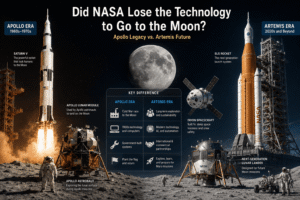
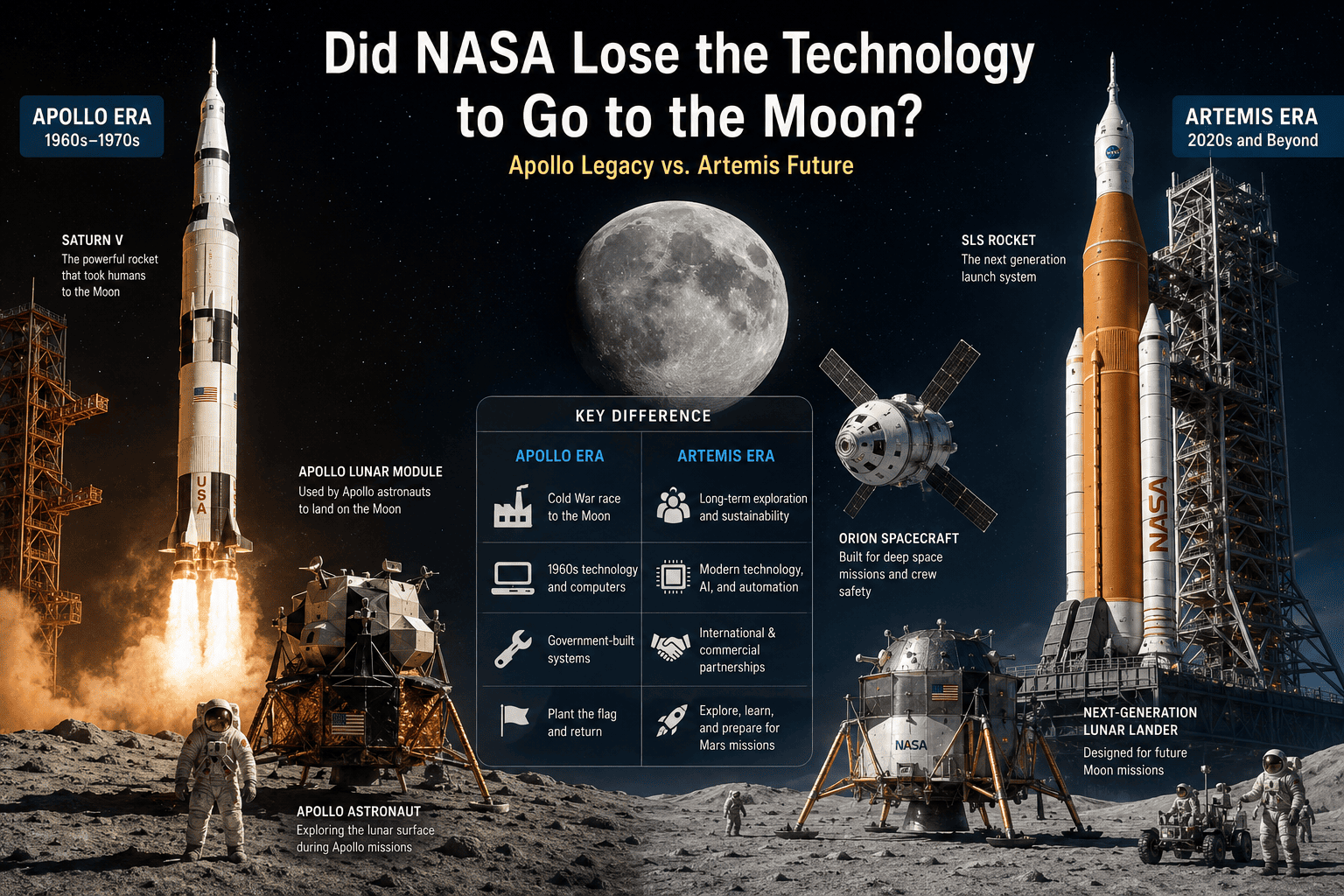
NASA’s modern Moon program is Artemis. Artemis is not simply Apollo 2.0. It is a broader Moon-to-Mars exploration program that uses modern spacecraft, launch systems, communication, commercial partnerships, and long-term surface planning.
NASA’s Orion spacecraft is designed to carry and sustain astronauts on Artemis missions to the Moon and return them safely to Earth. NASA’s Artemis program also uses the Space Launch System rocket and modern mission architecture for deep-space exploration.
This is where readers can explore your related article on Artemis II Lunar Flyby Mission, because Artemis II showed how NASA’s modern Moon-return architecture differs from Apollo.
Apollo was focused on short lunar landing missions.
Artemis is focused on returning humans to the Moon, preparing for longer-term exploration, testing modern systems, building partnerships, and eventually preparing for Mars.
That is a very different mission model.
Example: Apollo vs Artemis
Here is a simple way to understand the difference.
Apollo was like a historic sprint. The goal was clear: land astronauts on the Moon and bring them home safely.
Artemis is more like building a long-term exploration highway. The goal is not just to go once. The goal is to test modern spacecraft, improve lunar operations, support future surface missions, build international cooperation, and prepare for Mars.
This is why your internal articles on NASA Lunar Gateway Habitat Systems, NASA Space Habitat Technology, and NASA In-Situ Resource Utilization on the Moon fit naturally with this topic.
Apollo proved humans could reach and work on the Moon.
Artemis is about making future lunar exploration more repeatable, sustainable, and useful for long-term science and exploration.
Did NASA Lose the Original Apollo Documents?
No, not in the way people often imagine.
NASA still has extensive Apollo historical material. NASA’s Apollo Program page provides Apollo histories and publications. NASA’s Apollo Lunar Surface Journal and Apollo Flight Journal are also detailed historical resources for understanding mission activities, transcripts, crew operations, and lunar surface work.
The Lunar and Planetary Institute also provides Apollo-era documents, including technical documents related to exploration strategies, equipment, geology tools, landing sites, and mission summaries.
However, documents alone are not the same as an active factory.
A blueprint can tell you how something was designed. It does not automatically give you the original machines, people, suppliers, materials, test stands, quality systems, and budget needed to build it again.
That is the key difference.
Why Has It Taken So Long to Return to the Moon?
The long gap after Apollo was not mainly because NASA forgot how to go. It was because human Moon missions are expensive, dangerous, and politically difficult.
After Apollo, NASA’s focus changed. The agency invested in other major programs, including Skylab, the Space Shuttle, robotic planetary missions, Earth science missions, and the International Space Station.
Returning to the Moon required a new reason, a new budget, a new rocket, a new spacecraft, a new lander strategy, new spacesuits, new international partnerships, and new mission goals.
NASA’s Artemis II mission is an important modern example. NASA states that Artemis II launched on April 1, 2026, splashed down on April 10, 2026, and completed a crewed lunar flyby lasting 9 days, 1 hour, and 32 minutes.
That mission showed that NASA’s modern Moon-return effort is not based on reviving Apollo hardware. It is based on testing a new deep-space human exploration system.
Important Example: Artemis II Proves the Point
Artemis II is a useful example because it directly answers the “lost technology” claim.
If NASA had truly lost the ability to send humans toward the Moon, Artemis II would not make sense. But NASA’s Artemis II mission used the modern Orion spacecraft and SLS rocket to send astronauts around the Moon and bring them back to Earth. NASA’s mission page identifies Artemis II as the first crewed Artemis flight and a key step toward long-term return to the Moon and future missions to Mars.
This does not mean Artemis is easy. It also does not mean modern Moon missions are cheap. But it does show that NASA’s challenge is not “forgotten technology.”
The real challenge is building a modern, safe, funded, tested, and repeatable system for human deep-space exploration.
What People Often Get Wrong
Wrong Idea 1: NASA forgot how to go to the Moon
NASA did not forget the science. The laws of physics did not disappear. NASA still understands propulsion, navigation, re-entry, life support, mission control, and lunar trajectories.
Wrong Idea 2: NASA destroyed all Moon technology
NASA did not destroy the ability to go to the Moon. But the Apollo production system was discontinued after the program ended.
Wrong Idea 3: If Apollo worked, NASA should just use it again
This sounds simple, but it ignores manufacturing reality. Old rockets need old suppliers, old tooling, old materials, old test systems, and old production lines. After decades, those systems are gone or outdated.
Wrong Idea 4: Artemis proves Apollo was fake
This is false. Artemis does not prove Apollo was fake. It proves that modern lunar exploration requires modern systems.
Wrong Idea 5: Going to the Moon should be easy now
Human lunar missions are still extremely complex. Even with modern technology, NASA must manage risk, funding, engineering, crew safety, launch systems, lunar operations, and re-entry.
Real-Life Comparison: Why Old Technology Is Hard to Rebuild
Think about an old 1960s supercar.
A museum may still have the car. The company may still have drawings. Engineers may understand how the engine worked. But rebuilding the same car exactly would still be difficult.
Why?
The original parts may no longer be manufactured.
The old machines may no longer exist.
The original suppliers may be gone.
The materials may have changed.
Modern safety rules may be different.
Workers with exact production experience may no longer be available.
Some systems would need redesign.
Now imagine the same problem with a Moon rocket.
A rocket is far more complex than a car. It includes engines, tanks, avionics, guidance, life support, thermal protection, launch infrastructure, spacecraft separation systems, communications, testing facilities, mission control, and astronaut safety systems.
That is why “just rebuild Apollo” is not realistic.
Why the Claim Sounds Convincing
The “NASA lost the technology” claim sounds convincing because it contains a small piece of truth.
NASA did lose the active Apollo manufacturing ecosystem. The Saturn V is no longer built. The Apollo spacecraft production line is gone. The old supplier chain does not exist in the same form. Some tools and hardware were retired.
But conspiracy-style claims exaggerate that truth.
The misleading version says:
NASA lost the technology, so the Moon landings are suspicious.
The accurate version says:
NASA retired the Apollo-era industrial system, so returning to the Moon required a modern program.
Those are very different statements.
How Modern Moon Missions Are Different
Modern lunar exploration is not just about repeating Apollo. NASA and its partners now think about deeper long-term challenges.
For example, lunar dust is a serious problem for spacesuits, equipment, solar panels, seals, and habitats. That connects naturally to your article on NASA Lunar Dust Mitigation Technology.
Communication is another challenge. Modern missions need high-quality data links for crew safety, science, images, telemetry, and mission control. That connects with your article on NASA Deep Space Laser Communication.
Future Moon operations also need habitats, rovers, power systems, resource use, and surface mobility. That connects with your articles on NASA Space Habitat Technology and NASA In-Situ Resource Utilization on the Moon.
This shows why Artemis is not just a repeat of Apollo. It is a new era of lunar exploration.
The Best Simple Explanation
Here is the clearest way to explain the topic:
NASA did not lose the knowledge of how to go to the Moon. NASA lost the ready-to-use Apollo production system.
That means NASA still understands the science and engineering. But it cannot simply walk into a 1960s factory and build a new Saturn V tomorrow.
The old system was retired. The new system is Artemis.
Frequently Asked Questions
Did NASA lose the technology to go to the Moon?
No. NASA did not lose the knowledge of how to go to the Moon. The better explanation is that the Apollo-era production system was retired after the program ended.
Did NASA destroy the technology to go to the Moon?
No. NASA did not destroy the ability to go to the Moon. Some old hardware, tools, contracts, and manufacturing systems were discontinued, but the knowledge and historical records did not vanish.
Why did NASA stop going to the Moon?
NASA stopped sending astronauts to the Moon after Apollo because national priorities, budgets, and political goals changed. Apollo was created during a unique Cold War period, and after its goals were achieved, NASA moved toward other programs.
Why can’t NASA just rebuild Saturn V?
Rebuilding Saturn V would require old tooling, old suppliers, old materials, old manufacturing methods, and modern safety certification. It would likely be more practical to build modern systems than recreate a 1960s rocket exactly.
What replaced Apollo technology?
NASA’s modern Moon program uses Artemis systems, including Orion, SLS, modern spacesuits, commercial landing systems, mission control upgrades, and future lunar surface technologies.
Is Artemis more advanced than Apollo?
In many ways, yes. Artemis benefits from modern computing, software, materials, navigation, safety systems, and international partnerships. But modern missions also have different goals and safety requirements, so they are still extremely difficult.
Does the loss of Apollo production mean the Moon landings were fake?
No. The retirement of Apollo production systems does not mean Apollo was fake. It means the Apollo program ended and its industrial base was not kept active forever.
Can humans still go to the Moon today?
Yes. NASA’s Artemis program has already demonstrated a modern crewed lunar flyby with Artemis II, and the program is designed to support future lunar surface missions.
Conclusion
The idea that NASA lost the technology to go to the Moon is a misunderstanding.
NASA did not forget how lunar travel works. It did not lose the laws of physics. It did not erase Apollo’s history. NASA still has extensive Apollo records, mission resources, technical documents, and decades of spaceflight experience.
What NASA no longer has is the exact Apollo-era production ecosystem. The Saturn V is not being manufactured. Apollo spacecraft production ended decades ago. Many original suppliers, tools, machines, materials, and teams are no longer available in the same form.
That is why returning to the Moon required a new program.
Apollo was the first great chapter of human lunar exploration. Artemis is the next chapter. The real story is not that NASA forgot how to go to the Moon. The real story is that the old Apollo system was retired, and modern Moon exploration had to be rebuilt for a new era.
Sources and Further Reading
NASA Apollo 17 Mission: https://www.nasa.gov/mission/apollo-17/
NASA Apollo Program: https://www.nasa.gov/the-apollo-program/
NASA Saturn V / Skylab Final Launch: https://www.nasa.gov/history/50-years-ago-the-launch-of-skylab-americas-first-space-station/
NASA Orion Spacecraft: https://www.nasa.gov/humans-in-space/orion-spacecraft/
NASA Artemis Program: https://www.nasa.gov/humans-in-space/artemis/
NASA Artemis II Mission: https://www.nasa.gov/mission/artemis-ii/
NASA Apollo Lunar Surface Journal and Apollo Flight Journal: https://www.nasa.gov/history/alsj-and-afj/
Lunar and Planetary Institute Apollo-Era Documents: https://www.lpi.usra.edu/lunar/documents/