Open the USGS Latest Earthquakes Map on your phone or computer and zoom out until the whole planet is visible. At first, the dots may look scattered. After a few seconds, though, long arcs and narrow lines begin to appear around the Pacific, through the Atlantic, across Asia, and along the western edge of the Americas.
Those patterns show where much of Earth’s geological activity is concentrated. Many of the lines follow places where enormous sections of the planet’s rigid outer layer meet, pull apart, collide, or grind past one another.
The surprising part is how calm the ground feels most of the time. Roads, buildings, coastlines, and mountain ranges seem fixed, yet the plates beneath them may be moving several centimeters every year. That is roughly comparable to the speed at which fingernails grow, according to the U.S. Geological Survey.
A few centimeters does not sound dramatic. Over millions of years, however, that movement can open oceans, close older seas, lift mountain ranges, create volcanoes, and rearrange continents.
How tectonic plates move, in simple terms
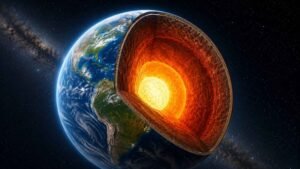
Tectonic plates are large, rigid pieces of Earth’s lithosphere. The lithosphere includes the crust and the solid uppermost part of the mantle. These plates move over a warmer and more deformable region below called the asthenosphere.
Earth’s internal heat supplies the energy for this system, while gravity and differences in rock density help drive the motion. A cold, dense oceanic plate may sink into the mantle and pull the rest of the plate behind it. Newly formed crust near an elevated mid-ocean ridge may slide slowly downhill under gravity. Movement within the mantle can also influence the direction and speed of the plates.
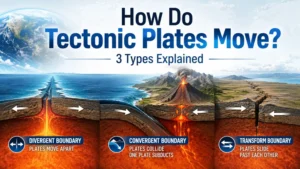
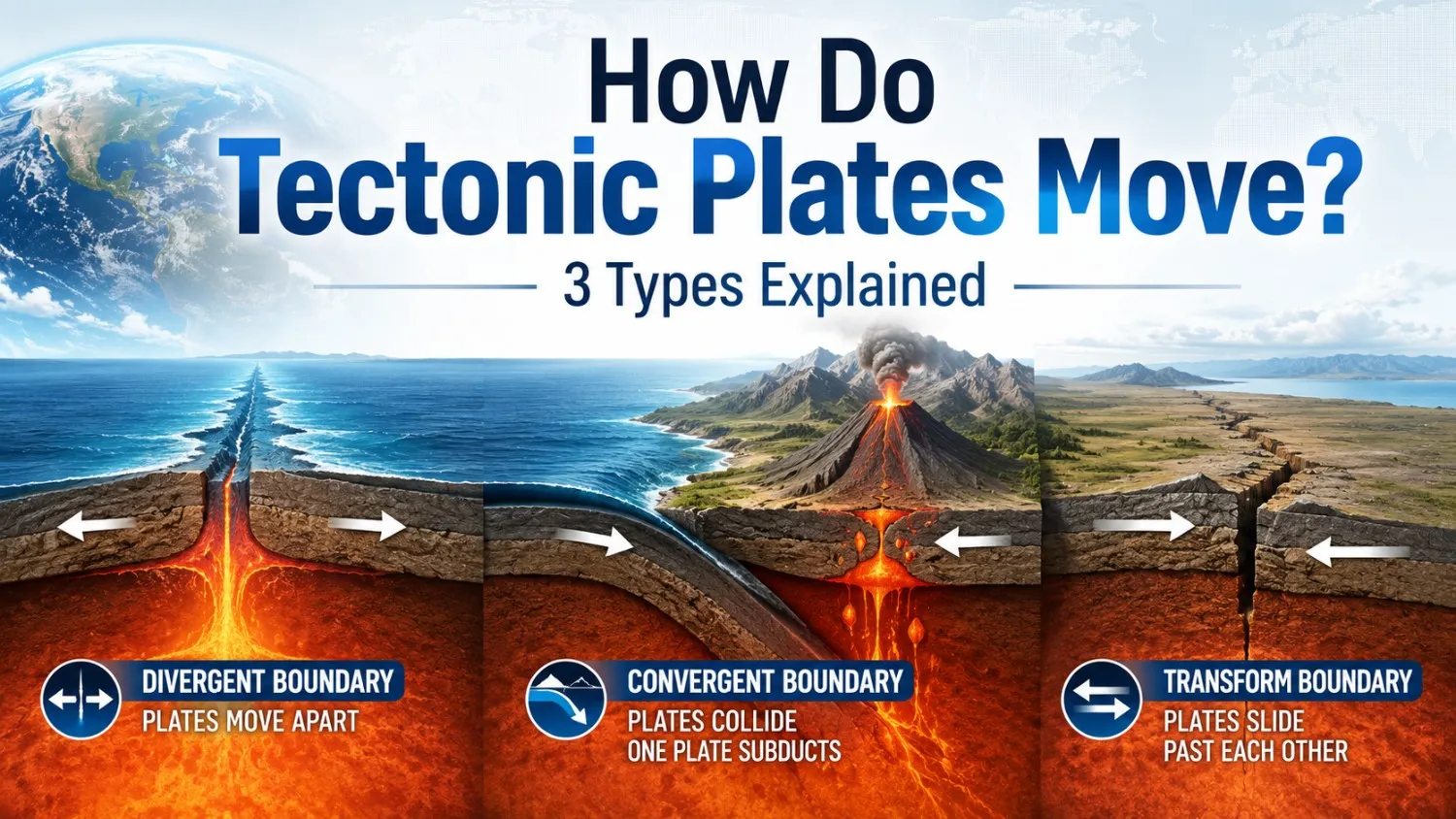
Where two plates meet, their relative movement creates three main types of boundaries:
- Divergent boundaries, where plates move apart
- Convergent boundaries, where plates move toward each other
- Transform boundaries, where plates slide sideways past one another
NOAA uses the same three-part classification in its guide to plate tectonic boundaries.
A tectonic plate is not just a piece of crust
The words “crust” and “tectonic plate” are often used as though they mean the same thing, but the difference matters.
Earth’s crust is the thin rocky layer at the surface. Beneath it is the mantle, which extends much deeper into the planet. A tectonic plate includes the crust and a rigid section of the uppermost mantle. Together, those layers form the lithosphere.
If you need a clearer picture of Earth’s outer layer before going further, Sanceen’s guide to facts about Earth’s crust explains its thickness, composition, and relationship with the mantle.
Earth has several major plates, including the Pacific, North American, South American, African, Eurasian, Antarctic, Indian, and Australian plates. Scientists also recognize many smaller plates and microplates.
A plate can carry both continental and oceanic crust. The North American Plate, for example, includes the continent as well as part of the floor of the Atlantic Ocean. Continents are therefore not separate rafts moving on their own. They are carried by larger sections of lithosphere.
This also explains why a plate boundary does not always follow a coastline. Some boundaries lie beneath oceans, while others cut through continents.
Are the plates floating on liquid magma?
The familiar classroom picture of bright orange material beneath the crust can give the impression that tectonic plates float on a global ocean of molten rock. Most of the mantle is actually solid.
That solid rock is extremely hot and under enormous pressure. Over a short period, it behaves like a rigid material. Over millions of years, however, it can deform and flow very slowly.
The asthenosphere is weaker and more deformable than the lithosphere above it, but it is not an open sea of liquid magma. The USGS addresses this directly in its explanation of whether tectonic plates float on magma.
Small amounts of molten rock do exist in certain regions, especially beneath spreading centers, volcanic systems, and parts of the mantle where melting conditions are met. That is different from saying the whole mantle is liquid.
What makes tectonic plates move?
A common school explanation says that convection currents in the mantle carry the plates around like objects on a conveyor belt. That is useful as an introduction, but it oversimplifies the process.
Plate motion is better understood as the result of several connected forces.
Slab pull
Slab pull is one of the most important forces in plate tectonics.
Oceanic lithosphere forms at mid-ocean ridges. As it moves away from the ridge, it cools, thickens, and becomes denser. When old oceanic lithosphere reaches a subduction zone, it bends and begins sinking into the mantle beneath another plate.
The descending section is called a slab. Gravity pulls the dense slab downward, and that sinking section can drag the rest of the plate behind it.
A simple comparison is a heavy edge of fabric pulling more material over the side of a table. The real process happens in solid rock under enormous pressure, so the comparison is not perfect, but it helps show how a sinking section can influence the entire plate.
EarthScope’s educational material on forces that drive plate tectonics explains how slab pull, ridge forces, and mantle interactions contribute to plate movement.
Ridge push
New oceanic lithosphere forms along long underwater mountain systems called mid-ocean ridges.
The newly formed crust near a ridge is hot and elevated. As it cools and moves away, gravity helps it slide down the gentle slope of the ridge. This is commonly called ridge push, although gravitational sliding is a more intuitive description.
Ridge push contributes to plate motion, but it is generally considered weaker than the pull created by large sinking slabs.
Mantle movement
Heat escaping from Earth’s interior causes very slow movement inside the mantle. This movement can apply force to the base and edges of plates.
It does not behave like one neat global conveyor belt. Mantle flow can help move a plate in one area, resist it in another, or redirect it around a sinking slab.
The plates and mantle are parts of one interacting system. Plates influence mantle flow, and mantle flow influences the plates.
Gravity and density
Gravity is involved throughout the process.
Cold oceanic lithosphere sinks because it becomes denser than the material beneath it. Elevated crust near ridges moves toward lower areas. Differences in temperature, thickness, and density help determine which parts of the lithosphere rise, sink, or slide.
The result is a planet-wide recycling system powered by heat but strongly shaped by gravity.
1. Divergent boundaries: plates move apart
A divergent boundary forms where two plates move away from each other.
As the plates separate, hot mantle material rises beneath the gap. The reduction in pressure allows some of that material to melt. Magma enters cracks, cools, and forms new crust.
This process is called seafloor spreading.
Most divergent boundaries are located beneath the oceans. The Mid-Atlantic Ridge is a well-known example. It runs through the Atlantic Ocean and marks a spreading boundary between plates on either side.
The movement is slow enough to be invisible from one year to the next. Over geological time, however, the repeated creation of new seafloor has widened the Atlantic Ocean by thousands of kilometers.
NOAA explains that divergent boundaries commonly form oceanic spreading ridges and are associated with volcanic activity and mostly shallow earthquakes.
What happens at a mid-ocean ridge?
At a spreading ridge, the sequence is roughly:
- Two plates move away from one another.
- Hot mantle material rises beneath the opening.
- Some of the rising material melts as pressure falls.
- Magma fills cracks or erupts onto the seafloor.
- The magma cools and becomes new oceanic crust.
- Older crust is gradually carried farther from the ridge.
This process does not create an empty gap between the plates. New material continuously fills the opening.
Divergence can split continents too
Divergent movement can begin inside a continent.
When continental lithosphere is stretched, it thins and breaks along large faults. Sections of land may sink between the faults, forming a rift valley.
The East African Rift is one of the clearest modern examples. The region is being stretched and contains faults, volcanoes, deep lakes, and areas of crustal thinning.
A new ocean does not appear quickly. Continental breakup can take tens of millions of years, and not every rift continues far enough to split a continent completely. If spreading persists, however, seawater may eventually enter the widening depression and a new ocean basin can form.
Iceland offers a visible example
Most mid-ocean ridges are hidden beneath deep water. Iceland is unusual because part of the Mid-Atlantic Ridge rises above sea level.
The island sits in a region where the North American and Eurasian plates are moving apart. Its rift valleys, volcanic systems, and frequent geological activity make plate divergence easier to observe than in most places.
Surface cracks seen at tourist sites are not always a perfect, razor-thin dividing line between two plates. Plate boundaries are often wider and more complicated than the lines shown on school maps.
2. Convergent boundaries: plates move together
A convergent boundary forms when two plates move toward one another.
The result depends on the type of crust carried by each plate. Oceanic lithosphere is usually denser than continental lithosphere, so different combinations produce different landscapes.
Oceanic plate meeting a continental plate
When an oceanic plate collides with a continental plate, the denser oceanic lithosphere commonly bends and sinks beneath the continent. This is called subduction.
A deep ocean trench forms near the boundary. As the slab descends, it releases water and other materials into the mantle above it. These substances lower the melting temperature of the surrounding rock, helping magma form.
The magma may then rise through the continental crust and feed volcanoes.
The Andes are a major example. The oceanic Nazca Plate is moving beneath the South American Plate, producing a long zone of earthquakes, crustal compression, mountain building, and volcanism.
One detail is often explained incorrectly: the descending plate does not simply melt like an ice cube. Water released from the slab helps trigger melting in the mantle above it, and that magma can rise toward the surface.
Two oceanic plates meeting
When two oceanic plates converge, the older and colder plate is usually denser and sinks beneath the other.
This process creates a subduction zone and often a very deep ocean trench. Magma generated above the descending slab may form a curved chain of volcanic islands known as an island arc.
Japan, the Aleutian Islands, and the Mariana region are associated with complex oceanic convergence systems.
These regions can experience shallow, intermediate, and deep earthquakes. They can also generate tsunamis when sudden movement displaces a large amount of seawater.
Two continental plates meeting
Continental crust is relatively buoyant, so neither continent easily sinks deep into the mantle.
When two continents collide, the crust is compressed, folded, faulted, and thickened. The result can be an enormous mountain range.
The Himalayas formed through the collision of the Indian and Eurasian plates. That collision continues to deform the region today.
Continental collisions are strongly associated with earthquakes and mountain building. They do not usually produce the same type of volcanic arc seen above an oceanic subduction zone.
3. Transform boundaries: plates slide sideways
A transform boundary forms where two plates move horizontally past one another.
Crust is not created in large amounts, as it is at a divergent boundary, and it is not normally destroyed through subduction. Instead, the plates grind past each other along faults.
The motion is rarely smooth. Rough sections of rock can lock together while the plates continue trying to move. Stress builds in the surrounding crust until friction is overcome and the fault slips.
That sudden release of energy produces an earthquake.
The San Andreas Fault system in California is the best-known example. It marks part of the boundary between the Pacific Plate and the North American Plate.
The fault is not one clean crack running through the landscape. It is a broad and complicated system containing several connected faults, bends, creeping sections, and locked segments.
This is why real plate boundaries often look messier than diagrams. The line on a map shows the general location of the boundary, but deformation may be spread across a wide region.
Transform boundaries also occur beneath the oceans, where they connect offset sections of mid-ocean ridges. These areas commonly produce shallow earthquakes.
How quickly are the plates moving?
Most tectonic plates move at rates measured in centimeters per year.
The exact speed depends on the plate, the location, the direction being measured, and the reference point used. Some plates move slowly, while parts of the Pacific Plate move several centimeters per year and can approach roughly ten centimeters annually in certain comparisons.
Scientists describe motion relative to another plate, a hotspot, or a global reference frame. Saying that a plate moves west or north is incomplete unless the reference point is clear.
A useful calculation shows why slow movement still matters. At five centimeters per year, a plate would travel:
- 50 centimeters in 10 years
- 5 meters in 100 years
- 50 kilometers in one million years
- 5,000 kilometers in 100 million years
Plate speeds and directions do change over geological time, but the calculation shows how a tiny annual movement can reshape the planet.
How scientists measure plate motion
Plate tectonics is supported by much more than the visual match between continents.
Modern instruments can measure current movement directly, while rocks and ocean-floor patterns preserve evidence of past motion.
High-precision GPS
Scientists install GPS stations on stable rock and measure their positions repeatedly.
These systems are far more precise than the location service in a phone. The USGS notes that satellite-based GPS can measure crustal movement to within a fraction of a millimeter per year.
A station may shift only a few millimeters or centimeters annually, but years of data reveal the direction and speed of movement. Networks of stations also show how the crust bends near locked faults.
Satellite radar
Radar instruments aboard satellites can detect subtle changes in Earth’s surface.
By comparing radar observations made at different times, researchers can map ground movement caused by earthquakes, volcanoes, landslides, and the slow deformation of faults.
Similar remote-sensing principles are also used on other planets. Sanceen’s guide to how NASA maps the surface of Mars explains how orbiters, cameras, and elevation data help scientists study terrain that cannot be surveyed directly on foot.
Magnetic stripes on the seafloor
As molten rock cools at a mid-ocean ridge, magnetic minerals inside it align with Earth’s magnetic field.
Earth’s magnetic field has reversed many times. As new crust forms during periods of normal and reversed polarity, it records alternating magnetic patterns.
Scientists discovered matching stripes on opposite sides of mid-ocean ridges. This symmetry became powerful evidence that new seafloor forms at ridges and moves outward.
The age of the ocean floor
The youngest oceanic crust is generally found near spreading ridges. Older seafloor lies farther away.
Oceanic crust is also much younger overall than the oldest continental rocks because it is repeatedly created at ridges and recycled at subduction zones.
Earthquake depth
Earthquakes reveal the shape of plate boundaries.
At divergent and transform boundaries, earthquakes are usually shallow. In a subduction zone, earthquakes may occur from near the surface to hundreds of kilometers deep.
When plotted in cross-section, the earthquake locations form a sloping zone that traces the descending plate.
A practical way to see plate tectonics yourself
The easiest hands-on activity requires only a browser.
Open the USGS earthquake map and select earthquakes from the past week or month. Zoom out and focus on patterns rather than individual events.
Around the Pacific Ocean, earthquakes form arcs near the western coasts of North and South America, Alaska, Japan, the Philippines, Indonesia, and New Zealand. These regions contain multiple subduction zones and transform boundaries and are commonly grouped under the name “Ring of Fire.”
Next, look down the center of the Atlantic Ocean. Shallow earthquakes follow sections of the Mid-Atlantic Ridge, where plates are moving apart.
Then compare earthquake depths around a subduction zone such as Japan or the western coast of South America. The deeper earthquakes tend to occur farther beneath the overriding plate, tracing the slab as it descends.
This activity does not turn a reader into a seismologist, but it changes the way a world map looks. The boundaries stop feeling like abstract textbook lines and begin to appear as active geological zones.
Why plate movement causes earthquakes
A plate can keep moving even when part of a fault is locked.
As movement continues, the surrounding rocks bend and store elastic energy. When the stress becomes greater than the friction holding the fault in place, the rocks slip suddenly.
The released energy travels through Earth as seismic waves.
An earthquake does not normally mean an entire plate jumps forward at once. Rupture occurs along a section of a fault, while other sections may remain locked.
Plate tectonics helps scientists identify areas with higher earthquake hazard, but it does not provide a reliable way to predict an exact date, time, location, and magnitude.
Claims that a particular cloud, weather change, animal behavior, or planetary alignment proves an earthquake will happen on a specific day should not replace information from official geological agencies.
Why plate movement creates volcanoes
Many volcanoes form near divergent and convergent boundaries, but the process differs in each setting.
At a divergent boundary, mantle material rises as the plates separate. The drop in pressure allows some of the material to melt, creating magma that can form new crust.
At a subduction zone, water and other materials released from the descending plate promote melting in the mantle above it. That magma may rise and feed a volcanic arc.
Not every volcano is located at a plate boundary. Hotspots can create volcanoes inside a plate. Hawaii is a well-known example. As the Pacific Plate moves over a long-lived source of magma, volcanoes form in a chain, with older islands located farther from the currently active area.
Why mountains form at plate boundaries
Mountain building occurs in several tectonic settings.
When two continents collide, crust is shortened, folded, faulted, and thickened. The Himalayas are the clearest modern example.
At oceanic-continental convergent boundaries, compression and volcanic activity can create long mountain chains such as the Andes.
Mountains can also form when stretched crust breaks into large fault blocks.
Uplift is only part of the story. Rivers, glaciers, landslides, weathering, and erosion begin removing rock as soon as mountains rise. The landscape we see reflects the balance between ongoing uplift and continuous erosion.
Frequently asked questions
What are the three ways tectonic plates move?
Plates move apart at divergent boundaries, toward one another at convergent boundaries, and sideways past one another at transform boundaries.
What is the main force moving tectonic plates?
No single force explains every plate, but slab pull is considered especially important. Dense oceanic lithosphere sinks at subduction zones and can pull the rest of the plate behind it. Ridge push, mantle movement, gravity, and resistance along plate edges also contribute.
How fast do tectonic plates move?
Most move a few centimeters per year, although speeds vary. That is roughly comparable to fingernail growth.
Can people feel tectonic plates moving?
People do not normally feel the steady yearly movement. They can feel sudden motion when a fault slips during an earthquake.
Are tectonic plates floating on magma?
No. They move over the asthenosphere, which is mostly solid rock capable of slow deformation. Localized molten rock exists in some regions, but the mantle is not a global liquid ocean.
Why are most earthquakes near plate boundaries?
Plate boundaries are where plates interact and stress becomes concentrated. Most earthquakes occur in these zones, although some happen inside plates along older faults.
Can tectonic movement split a continent?
Yes. Continental rifting can stretch and thin the lithosphere. If it continues for millions of years, the continent may separate and a new ocean basin can form.
Are the Himalayas still growing?
The Indian and Eurasian plates are still converging, so the region continues to deform and experience uplift. Erosion and landslides remove material at the same time, meaning the rate of change differs from one location to another.
The ground is moving even when it feels still
Plate tectonics is easier to understand when Earth is viewed as a slow recycling system.
New oceanic lithosphere forms at spreading ridges. It cools and becomes denser as it travels away. Some of it eventually reaches a subduction zone and sinks back into the mantle.
Continents move with the plates beneath them. Faults lock and release. Mountain ranges rise while erosion wears them down. Oceans widen in some regions and shrink in others.
None of this happens fast enough to watch from a window. The evidence appears instead in GPS measurements, earthquake maps, volcanic chains, ocean trenches, magnetic stripes, and folded mountain belts.
The ground seems permanent because a human lifetime is short compared with geological time. On Earth’s timescale, the surface is still being rebuilt.