NASA deep space laser communication is one of the most important technologies for the future of interplanetary data transmission. Space missions are collecting more data than ever before. Modern spacecraft can carry high-resolution cameras, science instruments, navigation systems, environmental sensors, and health-monitoring equipment. The farther these spacecraft travel, the harder it becomes to send that data back to Earth quickly.
For decades, NASA has mainly used radio frequency communication to talk with spacecraft. Radio communication is reliable and proven, but future missions may need much higher data rates. A Mars mission, lunar habitat, asteroid probe, or outer solar system spacecraft may need to send images, video, science measurements, navigation data, and system updates across millions of miles.
This is where NASA deep space laser communication becomes important. Instead of using only radio waves, laser communication uses light to transmit information. NASA’s Deep Space Optical Communications experiment, also called DSOC, successfully demonstrated high-bandwidth laser communication from deep space for the first time. JPL says DSOC concluded on Sept. 2, 2025, after exceeding all technical goals, making it one of the strongest examples of how future space missions may send more data across interplanetary distances.
Editorial Note
This article uses careful wording for accuracy. NASA deep space laser communication does not mean every spacecraft already uses laser links as its main communication system in 2026. The more accurate explanation is that NASA has successfully demonstrated key optical communication technologies and is building the foundation for future missions that may use laser communication alongside traditional radio systems.
Confirmed examples include DSOC on the Psyche spacecraft, the Laser Communications Relay Demonstration, ILLUMA-T, deep-space optical ground terminals, and hybrid radio-optical antenna testing. Future possibilities include faster Mars data transmission, higher-resolution science return, video from deep space, improved astronaut communication, and stronger data links for future lunar and planetary missions.
Key Facts About NASA Deep Space Laser Communication
| Key Point | Simple Explanation |
|---|---|
| Laser communication uses light | It sends data through optical beams instead of relying only on radio waves. |
| DSOC was NASA’s first deep-space optical communication demonstration | It flew aboard the Psyche spacecraft and tested laser communication at deep-space distances. |
| DSOC concluded in 2025 | JPL says the demonstration ended after exceeding its technical goals. |
| Laser links can send more data | DSOC demonstrated data rates at least 10 times higher than comparable radio systems of similar size and power. |
| DSOC streamed UHD video from deep space | In 2023, it sent ultra-high-definition video from more than 19 million miles away at 267 Mbps. |
| DSOC reached Mars-like distances | In 2024, it downlinked Psyche data from 307 million miles away. |
| Laser communication needs precise pointing | Spacecraft and ground systems must aim extremely accurately across millions of miles. |
| Weather can affect optical links | Clouds, atmosphere, and ground-station conditions matter more for lasers than for radio. |
What Is Deep Space Laser Communication?
Deep space laser communication, also called optical communication, is a method of sending data through beams of light. Instead of transmitting information mainly by radio waves, an optical system encodes data into laser light and sends that light across space to a receiver.
The concept sounds simple, but it is technically difficult. A spacecraft may be millions or hundreds of millions of miles away. Earth and the spacecraft are both moving. The laser beam must be pointed with extreme accuracy. The signal must pass through space, reach Earth, and be detected by highly sensitive optical equipment.
NASA explains that laser communications use invisible infrared light to send and receive information at higher data rates, giving spacecraft the ability to send more data back to Earth in a single transmission.
A simple example is the difference between a flashlight and a wide floodlight. Radio waves spread more broadly, while a laser beam is much narrower. The narrow beam can carry data efficiently, but it must be aimed much more precisely.
Why NASA Needs Faster Space Communication
Future space missions will create huge amounts of data. A rover on Mars may take detailed images and videos. A space telescope may produce large science files. A crewed Mars mission may need high-quality communication for medical support, mission planning, scientific work, and crew connection with Earth.
Radio communication is still essential, but future missions may need more bandwidth than radio alone can easily provide. NASA says new deep-space missions are producing more data, and laser-based communication can significantly augment radio frequency telecommunications. JPL also states that DSOC demonstrated data rates at least 10 times higher than state-of-the-art radio systems of comparable size and power.
For readers, the basic idea is simple: better communication means more science returns to Earth. Instead of waiting longer for limited images or compressed data, future missions may send richer information more quickly.
This connects naturally with NASA AI navigation system for deep space, because autonomous spacecraft may need to send large amounts of navigation, mapping, and system-health data back to mission teams.
DSOC: NASA’s Deep Space Optical Communications Demonstration
NASA’s Deep Space Optical Communications experiment was a technology demonstration carried aboard the Psyche spacecraft. Its purpose was not to serve as Psyche’s main mission communication system. Instead, DSOC tested whether high-bandwidth laser communication could work across deep-space distances.
JPL describes DSOC as a pioneering technology demonstration that took laser communication into deep space. The flight laser transceiver launched aboard Psyche, NASA’s mission to the metal-rich asteroid Psyche, and tested high-bandwidth optical communications with Earth during the first two years of the spacecraft’s journey.
The demonstration is important because it proved that data encoded in laser light could be sent, received, and decoded after traveling millions of miles through space. JPL reported in September 2025 that the project completed its 65th and final pass after sending a laser signal to Psyche and receiving the return signal from 218 million miles away.
This makes DSOC one of the strongest real examples of future interplanetary data transmission technology.
DSOC’s Historic Deep Space Video
One of DSOC’s most famous achievements was sending the first ultra-high-definition video from deep space to Earth.
On Dec. 11, 2023, DSOC streamed an ultra-high-definition video from more than 19 million miles away, about 80 times the Earth-Moon distance. JPL reported that the transmission reached the system’s maximum bitrate of 267 megabits per second, comparable to household broadband internet speeds.
This event became famous because the video featured a cat named Taters chasing a laser pointer. The cat was fun, but the technical achievement was serious. It showed that laser communication could transmit video-like data from far beyond the Moon.
For future missions, this kind of capability could mean higher-quality Mars surface video, richer science data, clearer spacecraft inspection footage, and better mission awareness.
DSOC’s Distance Records
DSOC did not only send a video from deep space. It continued testing at greater distances as Psyche traveled farther from Earth.
NASA’s DSOC timeline says the experiment transmitted engineering data from 140 million miles away on April 8, 2024, at a maximum rate of 25 Mbps. It later sent flight instrument telemetry from 249 million miles away on June 24, 2024, at a maximum rate of 8.3 Mbps. On Dec. 3, 2024, the project downlinked Psyche data from 307 million miles away, farther than the average distance between Earth and Mars.
These results matter because Mars communication is one of the biggest future use cases. If humans or advanced robotic missions operate on Mars, NASA will need stronger ways to move large amounts of data between planets.
How Deep Space Laser Communication Works
Deep space laser communication works through a combination of spacecraft hardware and ground systems.
The spacecraft carries a laser transceiver that can send and receive optical signals. On Earth, ground stations use powerful lasers and sensitive detectors to communicate with the spacecraft. A beacon laser from Earth can help the spacecraft determine where to point its own laser back toward Earth.
JPL explains that DSOC used a flight laser transceiver mounted on Psyche and two ground stations. A 3-kilowatt uplink laser at JPL’s Table Mountain Facility sent a laser beacon to Psyche, helping the spacecraft transceiver aim its optical communications laser back to Earth.
The returning photons were directed to a detector system at the observatory, where the information encoded in those photons could be processed.
A simple way to imagine this is two moving archers trying to hit tiny targets across a huge distance. The spacecraft and Earth are both moving, the beam must be aimed precisely, and the receiver must detect very faint light.
Why Pointing Accuracy Is So Important
Laser communication is powerful because the beam is narrow. That narrowness helps concentrate energy and increase data efficiency. But it also creates a challenge: if the beam is aimed slightly wrong, it can miss Earth.
In deep space, even a tiny pointing error becomes huge over millions of miles. A spacecraft must know where Earth is, compensate for motion, and aim its laser with extreme precision.
JPL noted that Psyche and Earth are moving through space at tremendous speeds, and the laser signal can take several minutes to reach its destination. By using precise pointing from ground and flight laser transmitters, teams proved optical communication could support future missions throughout the solar system.
This is why deep space laser communication connects with NASA quantum navigation in space. Future missions may need precise timing, pointing, navigation, and communication systems working together.
Laser Communication vs Radio Communication
Laser communication is not meant to make radio communication disappear immediately. Radio remains extremely important because it is reliable, well understood, and supported by NASA’s communication networks. The future is more likely to use both systems together.
| Feature | Radio Communication | Laser Communication |
|---|---|---|
| Signal type | Radio waves | Optical/infrared light |
| Beam width | Wider | Narrower |
| Pointing difficulty | Easier than laser | Much more precise |
| Data rate potential | Reliable but limited by bandwidth | Higher data rates possible |
| Weather sensitivity | Less affected by clouds | More affected by clouds and atmosphere |
| Best use | Reliable command, tracking, and communication | High-volume data return and future broadband-like links |
| Future role | Still essential | Strong augmentation to radio systems |
The safest way to understand the future is this: radio provides proven reliability, while laser communication can add higher data capacity.
LCRD: NASA’s Laser Communications Relay Demonstration
Deep-space laser communication is part of a larger NASA optical communications roadmap. Another important mission is the Laser Communications Relay Demonstration, or LCRD.
LCRD launched in December 2021 and was designed to demonstrate laser communication from geosynchronous orbit. NASA says LCRD can help pave the way for future optical communications missions and could potentially serve as a relay for future missions that use optical communication.
LCRD is different from DSOC because it operates closer to Earth. DSOC tested laser communication from deep space, while LCRD supports optical communication relay demonstrations closer to Earth.
Together, these missions show that NASA is testing laser communication in different environments: near Earth, in orbit, and across deep space.
ILLUMA-T and Laser Communication From the Space Station
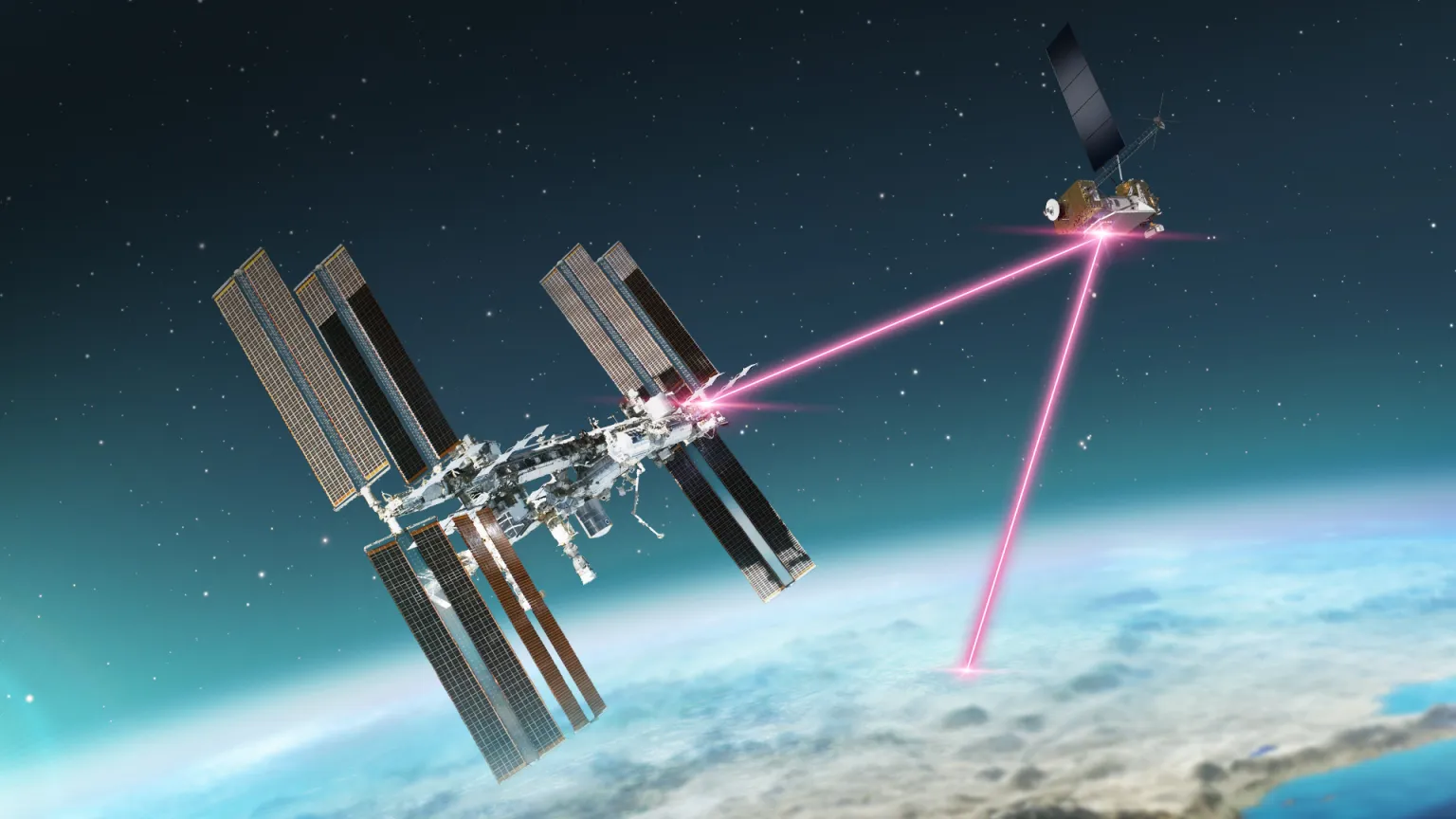
ILLUMA-T is another important NASA laser communication demonstration. It worked with LCRD to demonstrate laser relay communication from the International Space Station.
NASA explained that ILLUMA-T would relay data from the space station to LCRD at 1.2 gigabits per second, and then LCRD would send the data to optical ground stations in California or Hawaii.
This matters because future space communication networks may not rely on one direct link. Instead, data may move from spacecraft to relay satellites, then to Earth. This is similar to how internet data can move through different network nodes before reaching its destination.
For future lunar habitats, Mars missions, and space stations, relay systems could make laser communication more practical.
Hybrid Radio-Optical Antennas
One of the most practical future ideas is hybrid communication, where a system can handle both radio and optical signals.
JPL reported that DSOC data was downlinked to an experimental radio-frequency optical “hybrid” antenna at the Deep Space Network’s Goldstone complex. The antenna was retrofitted with seven mirrors, allowing it to receive radio frequency and optical signals from Psyche simultaneously.
This is important because future missions may need flexibility. If clouds block an optical ground station, radio may still be available. If the mission needs to return large science files, the optical system may provide higher capacity.
A hybrid approach may become especially useful for future Mars missions, where communication reliability and data volume will both matter.
Why Weather Matters for Laser Communication
Laser communication has one major limitation: Earth’s atmosphere. Clouds, storms, smoke, turbulence, and poor weather can interfere with optical signals.
Radio waves can pass through some atmospheric conditions more easily than laser light. This is why optical communication may require multiple ground stations in different locations. If one site is cloudy, another site may have clear skies.
JPL’s 2025 DSOC report noted that the team faced challenges including weather events that closed ground stations and wildfires in Southern California that affected team members.
This does not make laser communication weak. It means future networks must be designed carefully, with backup stations, hybrid radio-optical systems, and smart scheduling.
Why This Matters for Mars Missions
Mars is one of the clearest reasons NASA is developing deep space laser communication. Future Mars missions may send far more data than current systems can comfortably handle.
A Mars rover may send high-resolution images, video, environmental readings, drill data, weather reports, and navigation maps. A crewed Mars mission would need even more: medical data, scientific data, habitat status, engineering telemetry, and possibly video communication.
JPL said DSOC’s success sets up the foundation for high-speed communication for future human missions to Mars.
This does not mean Mars will have Earth-like internet in 2026. It means NASA has demonstrated technology that could help future Mars missions send more data, faster, across interplanetary distances.
Why This Matters for Robotic Missions
Robotic spacecraft are becoming more capable. They can carry better cameras, more complex instruments, autonomous systems, and onboard computers. But all of that data has limited value if it cannot return to Earth efficiently.
NASA deep space laser communication could help robotic missions by sending:
Higher-resolution images
Larger science files
More frequent telemetry
Better navigation data
Video from spacecraft
More detailed instrument measurements
Engineering health data
Surface maps from rovers and landers
This connects with NASA autonomous spacecraft repair, because future servicing robots may need to transmit inspection images, repair videos, telemetry, and tool-use data back to Earth.
Why This Matters for Astronauts
Human spaceflight needs communication for safety, science, operations, and crew well-being. Astronauts on the Moon or Mars may need to send medical data, engineering updates, scientific observations, video, and emergency information.
Laser communication could help by increasing data capacity. A future Mars crew may need stronger communication than robotic missions because human missions involve more complex operations.
NASA’s laser communication work with ILLUMA-T and LCRD also shows how optical systems could support human spaceflight in near-Earth environments. NASA described the ILLUMA-T and LCRD system as NASA’s first bi-directional end-to-end laser communications relay demonstration.
For long-duration missions, communication is not just technical. It is also human. Better data links can support mission planning, science collaboration, and crew connection with Earth.
Connection With Future Space Habitats
Future lunar and Mars habitats will need reliable communication. Habitats may send environmental data, medical information, scientific results, video, and system-health reports.
This connects with NASA space habitat technology. A habitat is not only a shelter; it is also a data system. Life support, power, communication, science, navigation, and crew operations all depend on information moving reliably.
Laser communication may help future habitats send large data files, especially if they are supported by relay networks and hybrid communication systems.
Practical Example: Sending Mars Rover Video
Imagine a future Mars rover exploring a canyon. It collects ultra-high-resolution video, 3D terrain maps, mineral data, and engineering telemetry.
With limited bandwidth, mission teams may need to compress data heavily or wait longer for transmission. With laser communication, the rover or relay system could send much larger files more efficiently.
That would help scientists study the surface in greater detail and help engineers monitor the rover more effectively.
This example shows why faster communication can improve science. Better data links can help mission teams make better decisions.
Practical Example: A Deep Space Probe Returning Science Data
Now imagine a probe exploring an asteroid or icy moon. It captures high-resolution images and instrument readings during a short flyby. The spacecraft may have limited time to collect and transmit data.
A high-bandwidth optical communication system could help return more of that valuable data before the opportunity is lost.
This matters because deep-space missions are expensive and rare. Every bit of returned science data is valuable.
Practical Example: A Future Mars Crew
Imagine astronauts living on Mars. They need to send medical scans, engineering updates, scientific images, habitat status, and video messages to Earth.
Laser communication could help increase the amount of information sent back. It may not remove time delay, because the speed of light still limits communication between Earth and Mars. But it could improve the volume and quality of data transmitted.
That distinction is important. Laser communication does not make messages travel faster than light. It helps carry more data through the light-speed link.
Confirmed Facts vs Future Possibilities
| Confirmed Fact | Future Possibility |
|---|---|
| NASA’s DSOC demonstrated high-bandwidth laser communication from deep space. | Future Mars missions may use optical communication to send larger science and video files. |
| DSOC concluded in September 2025 after exceeding technical goals. | Future systems may build on DSOC lessons for operational deep-space networks. |
| DSOC streamed UHD video from more than 19 million miles away. | Future spacecraft may send richer visual data from Mars and beyond. |
| DSOC downlinked Psyche data from 307 million miles away. | Similar technology may support future Mars-distance communication architectures. |
| LCRD demonstrated laser communication relay technology near Earth. | Future relay networks may support the Moon, Mars, and deep-space missions. |
| ILLUMA-T worked with LCRD for laser relay communication from the ISS. | Human spaceflight missions may eventually use optical links for larger data return. |
| Weather and pointing accuracy remain major challenges. | Future networks may use multiple ground stations and hybrid radio-optical systems. |
What People Often Get Wrong
One common misunderstanding is that laser communication means messages travel faster than light. That is not true. Laser communication still uses light, so it cannot remove the time delay between Earth and Mars. It can, however, increase the amount of data carried through the link.
Another misunderstanding is that NASA has already replaced all radio communication with lasers. That is also not true. Radio communication remains essential. Laser communication is better understood as an additional high-capacity option.
A third misunderstanding is that DSOC was Psyche’s main communication system. DSOC was a technology demonstration aboard Psyche, not the primary system for Psyche mission operations.
A fourth misunderstanding is that laser communication is easy because lasers are common on Earth. Deep-space laser communication is much harder because of distance, pointing accuracy, weak signals, atmospheric effects, and spacecraft motion.
Benefits for the Reader
Understanding NASA deep space laser communication helps readers understand how future space missions may become more powerful.
First, it explains why future missions need faster data links.
Second, it shows how laser communication can send more information than traditional systems of similar size and power.
Third, it helps readers understand why Mars missions, deep-space probes, and space habitats may need higher-bandwidth communication.
Fourth, it explains why optical links require precise pointing and careful ground-station planning.
Fifth, it gives a realistic view of 2026 progress by explaining what NASA has demonstrated and what still needs development.
Challenges NASA Must Still Solve
NASA deep space laser communication still faces major challenges.
The first challenge is pointing accuracy. A laser beam must be aimed with extreme precision across millions of miles.
The second challenge is atmosphere and weather. Clouds, turbulence, smoke, and ground-station conditions can affect optical links.
The third challenge is network coverage. Future operational systems may need multiple optical ground stations in different locations.
The fourth challenge is spacecraft power and pointing stability. A spacecraft must support optical hardware while also meeting mission power and thermal limits.
The fifth challenge is integration with existing networks. Laser communication will likely work alongside radio systems, not instantly replace them.
These challenges explain why DSOC was a technology demonstration and why future operational systems need careful development.
Future Outlook: The Road to Interplanetary Data Transmission
The future of interplanetary data transmission will likely be hybrid. Spacecraft may use radio for reliable command, tracking, and backup communication, while using laser links for high-volume science data.
Future networks may include optical ground stations, relay spacecraft, hybrid radio-optical antennas, space-based relays, and advanced onboard terminals. Over time, this could create a stronger communication architecture for the Moon, Mars, asteroids, and deep space.
NASA’s DSOC demonstration showed that laser communication can work at deep-space distances. LCRD and ILLUMA-T showed how relay systems can support optical communication closer to Earth. Together, these projects point toward a future where spacecraft return more data, faster, from farther away.
Frequently Asked Questions
What is NASA deep space laser communication?
NASA deep space laser communication is a technology approach that uses optical or laser signals to transmit data between spacecraft and Earth across deep-space distances.
What was DSOC?
DSOC stands for Deep Space Optical Communications. It was a NASA technology demonstration aboard the Psyche spacecraft that tested high-bandwidth laser communication from deep space.
Is DSOC still active in 2026?
No. JPL says DSOC concluded on Sept. 2, 2025, after exceeding all of its technical goals.
Did NASA send video from deep space using a laser?
Yes. On Dec. 11, 2023, DSOC streamed an ultra-high-definition video from more than 19 million miles away at 267 Mbps.
Does laser communication remove the delay between Earth and Mars?
No. Laser communication cannot break the speed of light. It can increase data capacity, but messages still take several minutes to travel between Earth and Mars depending on planetary distance.
Is laser communication better than radio?
Laser communication can provide much higher data rates, but it requires more precise pointing and is more affected by weather. Radio communication remains essential for reliability.
Why is laser communication important for Mars missions?
Mars missions may need to send large volumes of images, video, science data, telemetry, and crew information. Laser communication could help increase the amount of data returned to Earth.
What is LCRD?
LCRD stands for Laser Communications Relay Demonstration. It is a NASA optical communications relay demonstration in geosynchronous orbit.
What is ILLUMA-T?
ILLUMA-T was a NASA payload designed to demonstrate laser communication from the International Space Station to LCRD at high data rates.
Will future spacecraft use both radio and laser communication?
Most likely, yes. A hybrid approach can combine the reliability of radio with the high data capacity of laser communication.
Conclusion
NASA deep space laser communication is shaping the future of interplanetary data transmission. The successful DSOC demonstration proved that high-bandwidth optical communication can work across deep-space distances. It streamed ultra-high-definition video from more than 19 million miles away, returned data from hundreds of millions of miles away, and concluded after exceeding its technical goals.
The technology is not a magic replacement for all communication systems. It does not remove light-speed delay, and it does not make radio communication obsolete. But it does show how future missions may send more data from the Moon, Mars, asteroids, and deep space.
For future astronauts, laser communication could support better science, richer video, improved mission awareness, and stronger connections with Earth. For robotic missions, it could return larger science files and higher-resolution images. For future space habitats and deep-space spacecraft, it could become part of a broader communication network that combines radio, optical links, relays, and ground stations.
The future of space exploration depends not only on reaching distant worlds, but also on bringing knowledge back home. NASA deep space laser communication is one of the technologies that could make that future much more data-rich.
Sources and Further Reading
NASA Deep Space Optical Communications
JPL Deep Space Optical Communications Mission
JPL: NASA’s Deep Space Communications Demo Exceeds Project Expectations
NASA Laser Communications Relay Demonstration
NASA First Two-Way End-to-End Laser Communications Relay System
NASA Laser Communications Roadmap
JPL Psyche DSOC Press Kit