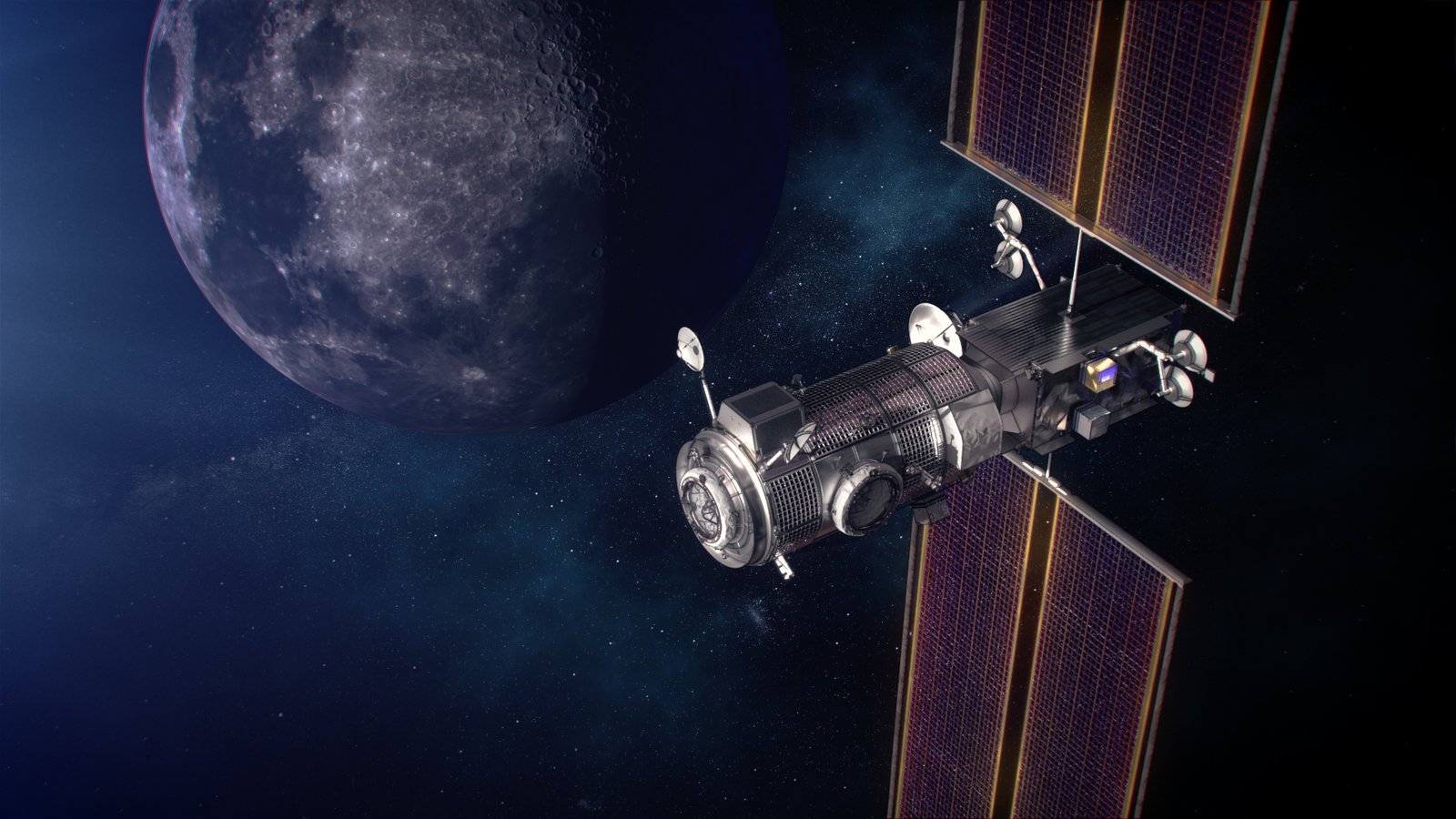
NASA Lunar Gateway habitat systems in 2026 are an important part of the Moon-to-Mars exploration story, but they must be explained carefully. The Gateway was originally planned as a small space station in lunar orbit, with habitat modules, docking ports, power systems, communications, and science instruments designed to support Artemis missions near the Moon.
However, the most important 2026 update is that NASA announced a shift in its lunar strategy. In a March 2026 official update, NASA said it intends to pause Gateway in its current form and focus more directly on infrastructure that supports sustained lunar surface operations. This means Gateway habitat systems should not be described as a completed or operating 2026 lunar station. They should be explained as developed hardware, planned systems, and possible repurposed infrastructure within NASA’s changing Moon architecture.
For more related Moon exploration topics, read our articles on NASA lunar base power infrastructure, NASA in-situ resource utilization on the Moon, NASA lunar dust mitigation technology, and NASA deep space laser communication technology.
Editorial Note
This article separates confirmed NASA information from future possibilities. It does not claim that the Lunar Gateway is already operating in 2026. NASA has described Gateway as a planned lunar orbit station, but its latest 2026 policy update says the agency intends to pause Gateway in its current form and shift toward lunar surface infrastructure. For that reason, this article explains Gateway habitat systems as planned, developed, or potentially repurposed systems rather than completed operational infrastructure.
Key Statistics and Facts
NASA’s official Gateway page describes Gateway as a small lunar space station intended to support lunar surface missions, science in lunar orbit, and future human exploration beyond the Moon. The same page lists Gateway’s launch as no earlier than 2027 and describes its planned near-rectilinear halo orbit around the Moon.
NASA’s 2026 policy update says the agency intends to pause Gateway in its current form and shift focus toward infrastructure that enables sustained lunar surface operations. This is the most important update for accuracy.
HALO, the Habitation and Logistics Outpost, arrived in Arizona in April 2025 for final outfitting after its structure was fabricated in Italy. NASA says HALO would provide living and working space, command and control, data handling, power distribution, thermal regulation, communications, docking ports, and support for science payloads.
NASA describes the Power and Propulsion Element, or PPE, as a 60-kilowatt solar electric power system designed to support power, communications, propulsion, and orbital control for Gateway.
ESA describes Lunar I-Hab as a pressurized habitation module with about 10 cubic meters of living space, docking ports, sleeping areas, dining space, and crew support systems. ESA also says Lunar I-Hab and HALO together were expected to support up to four astronauts for stays of up to 90 days.
What Are Lunar Gateway Habitat Systems?
Lunar Gateway habitat systems are the modules and technologies designed to help astronauts live and work near the Moon. A space habitat is not just an empty room. It must provide breathable air, pressure control, temperature regulation, electrical power, communications, docking access, storage, crew workstations, science support, emergency protection, and safe movement between spacecraft.
Example: On Earth, a classroom or office already has air, pressure, gravity, temperature, and easy exit routes. In lunar orbit, none of these are naturally available. A habitat module must create a small controlled environment where astronauts can breathe, work, sleep, eat, monitor spacecraft systems, and survive emergencies.
This is why Gateway habitat systems are important. They represent the type of infrastructure astronauts would need for future operations around the Moon, even if NASA’s latest strategy changes how or where that hardware is used.
Confirmed Facts vs Future Possibilities
| Topic | Status in 2026 | Safe Explanation |
|---|---|---|
| Gateway concept | Confirmed NASA architecture history | Originally planned as a lunar orbit station |
| Gateway in current form | Paused according to NASA’s 2026 update | Should not be described as fully active or guaranteed |
| HALO module | Hardware built and delivered for final outfitting | Developed as Gateway’s first pressurized habitat module |
| PPE | Developed as Gateway’s power and propulsion element | Designed to provide power, propulsion, communications, and orbit control |
| Lunar I-Hab | ESA habitation module | Planned to expand living space and docking capability |
| Crewed Gateway operations | Future goal under older architecture | Should not be described as completed in 2026 |
| Moon base infrastructure | NASA’s newer focus | NASA is shifting toward phased lunar surface infrastructure |
In simple words, Gateway systems are real, but the mission architecture changed. The safe article angle is not “Gateway is already building the next step to the Moon.” The safer angle is “Gateway habitat systems show how NASA developed lunar living infrastructure, while 2026 strategy shifts toward Moon base systems.”
HALO: The Core Habitat and Command Module
HALO stands for Habitation and Logistics Outpost. It was designed as the first pressurized habitat module for Gateway. NASA says HALO would provide astronauts with space to live, work, conduct research, and prepare for lunar surface missions. It would also support command and control, data handling, energy storage, power distribution, thermal regulation, communications, tracking, docking, and science payloads.
Example: HALO can be understood as a small apartment, control room, docking hub, and science support area combined into one module. Astronauts would not use it like a hotel. They would use it as a compact survival and mission operations system.
HALO is important because lunar missions require more than rockets and landers. Astronauts need a protected place where they can monitor mission systems, prepare equipment, manage docking operations, and support science.
PPE: The Powerhouse Behind the Habitat
The Power and Propulsion Element, or PPE, is not a living module, but it is essential for habitat operations. A habitat cannot function without power, communications, orientation control, and orbital maintenance.
NASA says PPE is designed to generate 60 kilowatts of electrical power. It would power Gateway subsystems and its solar electric propulsion system. NASA also says PPE would provide high-rate communications between the station, the lunar surface, and Earth.
Example: If HALO is the living and working room, PPE is the power plant, engine, and communication tower. Without PPE, the habitat cannot stay powered, connected, or properly positioned.
This is why PPE remains important even if Gateway’s architecture changes. Power and propulsion technologies developed for Gateway can still inform future lunar infrastructure.
Lunar I-Hab: Expanding Crew Living Space
Lunar I-Hab is an ESA-provided habitation module planned for Gateway. ESA describes it as a pressurized module with living quarters, docking ports, sleeping space, dining space, exercise and medical areas, and experiment capability inside and outside the module.
Example: HALO alone would be extremely limited. Lunar I-Hab would add extra habitable volume so astronauts could have more realistic living and working space during longer missions.
ESA says Lunar I-Hab would provide around 10 cubic meters of living space, comparable to the volume inside a medium campervan. This example is useful for readers because it shows that space habitats are much smaller than people imagine.
Docking Systems: The Spacecraft Connection Point
Docking systems are a major part of any lunar habitat architecture. Gateway was planned to connect with Orion, lunar landers, logistics modules, and future station elements. NASA says HALO would include docking ports for visiting vehicles such as Orion, lunar landers, and logistics modules.
Example: Imagine Orion arriving near the Moon with astronauts inside. For the crew to transfer safely, Orion must connect to a pressurized docking port. The docking system must create a sealed passage so astronauts can move between spacecraft without entering space.
Docking ports are not simple doors. They must align spacecraft, seal pressure, transfer power or data where needed, and support safe crew and cargo movement.
Life Support: The Most Important Habitat Function
Life support is the heart of any astronaut habitat. A lunar habitat system must provide oxygen, remove carbon dioxide, control humidity, regulate temperature, monitor cabin pressure, manage waste, and detect emergencies.
Example: If carbon dioxide builds up inside a habitat, astronauts can become sick or unconscious. That is why a habitat needs carbon dioxide removal systems, sensors, alarms, and backup procedures.
Lunar I-Hab’s environmental control and life-support system includes major JAXA contributions, according to ESA. This shows how international partners support different technical parts of the habitat system.
Communications: Why Lunar Link Matters
A lunar habitat needs constant communication with Earth, spacecraft, landers, and surface systems. NASA says HALO would use Lunar Link, a high-rate lunar communication system provided by ESA.
Example: If astronauts are preparing for a lunar landing, mission control needs real-time telemetry, voice communication, video, spacecraft health data, and navigation updates. A habitat without strong communication is not useful as a mission hub.
This is where your internal article on NASA deep space laser communication technology fits naturally. Gateway-style operations and future Moon bases both need stronger data links for crew safety, science, and mission control.
Gateway and the Shift Toward Moon Base Infrastructure
The biggest 2026 update is NASA’s shift toward lunar surface infrastructure. NASA announced that it intends to pause Gateway in its current form and build a phased lunar base strategy focused on sustained surface operations. NASA described phases involving technology demonstrations, early infrastructure, regular logistics, and eventually long-duration human presence.
This does not make Gateway habitat systems irrelevant. It means the article must explain them as part of a changing architecture.
Example: A module originally designed for lunar orbit may still teach engineers valuable lessons about pressure vessels, docking, life support, crew systems, thermal control, and logistics. Some applicable hardware or partner commitments may also be repurposed for surface infrastructure, according to NASA’s update.
This is why the topic remains useful for readers. Gateway habitat systems show the engineering foundation behind future lunar living, even as NASA’s strategy increasingly focuses on the lunar surface.
Gateway vs Moon Base: Simple Comparison
| Feature | Lunar Gateway | Moon Base |
|---|---|---|
| Location | Lunar orbit | Lunar surface |
| Main purpose | Docking, staging, orbital science, crew support | Long-term surface living, power, mobility, construction, resource use |
| Main habitat challenge | Compact orbital living and docking | Surface survival, dust, radiation, terrain, power, logistics |
| Main power need | Station power and propulsion | Surface power grid, storage, backup systems |
| Dust exposure | Indirect, through visiting surface equipment | Direct and continuous |
| Best related article | Gateway habitat systems | NASA lunar base power infrastructure |
Example: Gateway is like an orbital station near the Moon. A Moon base is like a small settlement on the Moon’s surface. Both need life support, power, communication, and safety systems, but they solve different problems.
Why Lunar Dust Still Matters
Even if Gateway itself would orbit the Moon, it is connected to lunar surface missions. Astronauts, suits, landers, tools, and cargo may move between the surface and spacecraft. Lunar dust can cling to equipment and become a serious operational problem.
Example: If astronauts return from the lunar surface with dust on suits, tools, seals, or containers, that dust could enter pressurized systems and affect filters, joints, fabrics, and sensitive equipment.
For a deeper related topic, read our guide on NASA lunar dust mitigation technology. This internal link fits naturally because dust control is part of making future lunar habitats and surface systems practical.
How Gateway Systems Connect to ISRU
In-situ resource utilization, or ISRU, means using local resources at the destination instead of carrying everything from Earth. Gateway itself would not mine lunar resources because it was planned for orbit, but Gateway-style systems connect to the wider Moon infrastructure story.
Example: If future astronauts extract oxygen from lunar regolith or process water ice, they will need power, storage, logistics, crew support, and communication systems. Habitat technology and resource-use technology must work together.
For a full explanation, read our article on NASA in-situ resource utilization on the Moon.
Practical Reader Takeaway
NASA Lunar Gateway habitat systems are best understood as a set of technologies designed for human life and work near the Moon. These systems include pressurized modules, docking ports, power systems, communications, thermal control, life support, logistics, science payload support, and international partner contributions.
The most important 2026 accuracy point is this: NASA has said it intends to pause Gateway in its current form and shift toward infrastructure for sustained lunar surface operations. That means the article should explain Gateway habitat systems as planned and developed systems within a changing Artemis architecture, not as a completed 2026 lunar station.
Frequently Asked Questions
What are NASA Lunar Gateway habitat systems?
NASA Lunar Gateway habitat systems are the modules and technologies designed to help astronauts live and work in lunar orbit. They include HALO, Lunar I-Hab, docking ports, communications, life support, power distribution, thermal control, and science support.
Is Lunar Gateway operating in 2026?
No. It should not be described as an operating 2026 lunar station. NASA’s Gateway page lists launch as no earlier than 2027, and NASA’s March 2026 update says the agency intends to pause Gateway in its current form and focus on surface infrastructure.
What is HALO?
HALO is the Habitation and Logistics Outpost. It was designed as Gateway’s first pressurized habitat and command module, providing astronauts with space to live, work, conduct research, manage systems, and prepare for lunar surface missions.
What is PPE?
PPE means Power and Propulsion Element. It was designed to provide electrical power, solar electric propulsion, communications, and orbit control for Gateway. NASA says PPE is designed to generate 60 kilowatts of electrical power.
What is Lunar I-Hab?
Lunar I-Hab is an ESA habitation module planned for Gateway. It would provide living space, sleeping areas, dining space, docking ports, experiment support, and environmental control and life-support contributions from JAXA.
Why did NASA shift focus from Gateway?
NASA’s March 2026 update says the agency intends to pause Gateway in its current form and shift focus toward infrastructure that enables sustained lunar surface operations. NASA also said applicable equipment and partner commitments may be repurposed to support those objectives.
Is Gateway the same as a Moon base?
No. Gateway was planned as a lunar orbit station. A Moon base is surface infrastructure on the Moon. A Gateway supports orbital staging and docking, while a Moon base supports surface living, power, mobility, construction, and resource use.
Conclusion
NASA Lunar Gateway habitat systems in 2026 should be explained with accuracy and caution. Gateway was originally planned as a small lunar orbit station with HALO, PPE, Lunar I-Hab, docking systems, communications, and science payloads. These systems show how NASA and its partners developed infrastructure for astronauts to live and work far from Earth.
However, the latest 2026 update changes the framing. NASA has stated that it intends to pause Gateway in its current form and shift attention toward lunar surface infrastructure. That means high-quality articles should avoid saying Gateway is already operating or guaranteed in its original form. The safer and more trustworthy explanation is that Gateway habitat systems represent important developed technology within a changing Moon exploration architecture.
For readers, the simplest explanation is this: Gateway habitat systems show how astronauts could live and work near the Moon, while NASA’s latest 2026 strategy places greater emphasis on building the infrastructure needed for sustained operations on the lunar surface.
Sources and Further Reading
NASA: Gateway Mission Overview
NASA: Gateway Space Station Reference
NASA: 2026 National Space Policy Initiatives and Gateway Update
NASA: HALO Module Arrives in the United States
NASA: Gateway Power and Propulsion Element
NASA: Gateway Frequently Asked Questions