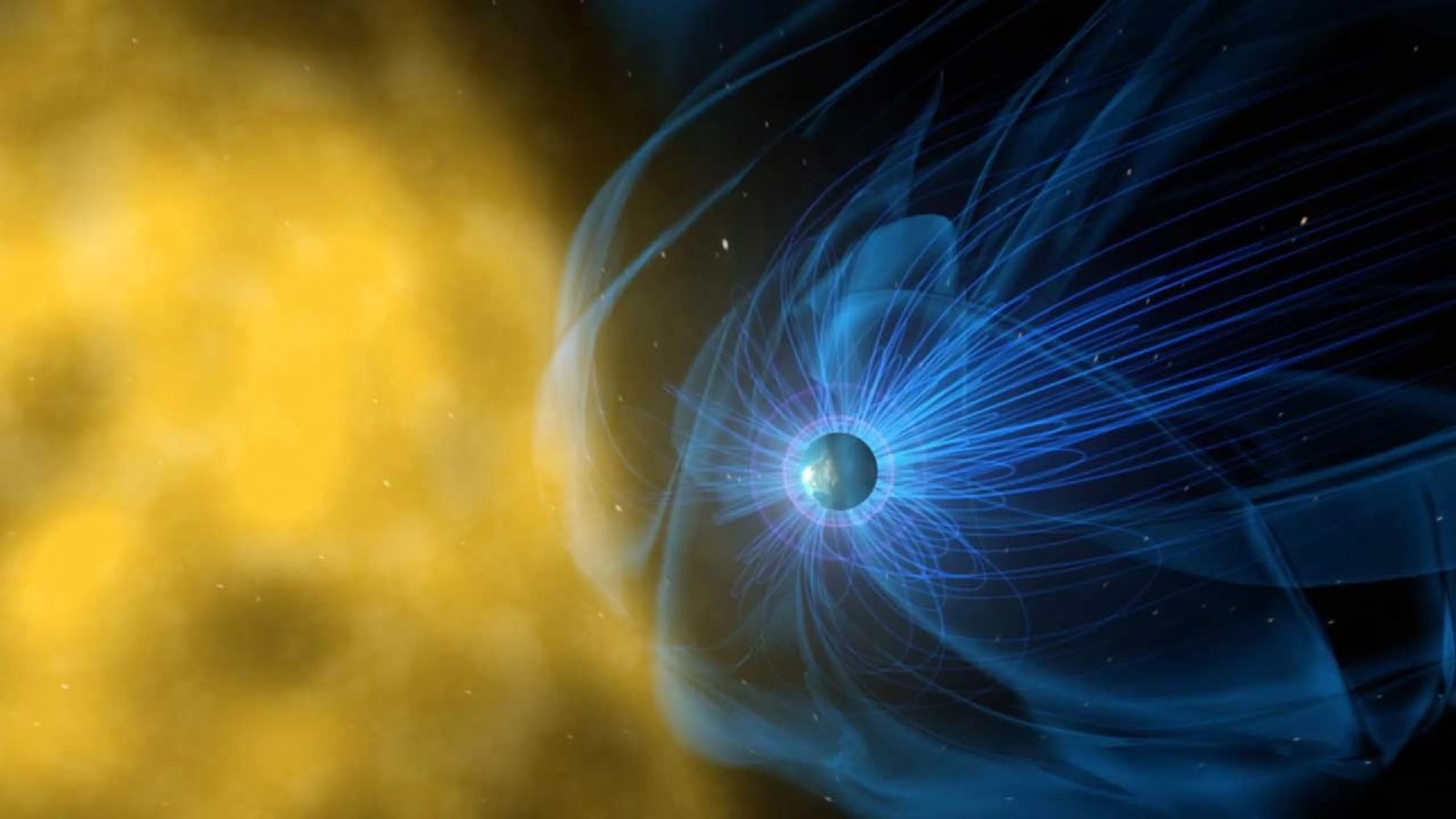
Earth may look calm from the ground, but above the atmosphere, our planet is surrounded by a constantly changing magnetic environment. Every day, the Sun sends streams of charged particles through space. Some of these particles move toward Earth, where they meet an invisible protective region known as the magnetosphere.
NASA magnetosphere observation missions help scientists study this protective shield. These missions show how Earth interacts with solar wind, how auroras form, why satellites can be affected by space weather, and how magnetic storms may influence communication systems, GPS, aviation, power grids, and future astronaut missions.
In simple words, Earth’s magnetosphere is one of the most important natural protection systems around our planet. NASA explains that the magnetosphere helps shield Earth from solar and cosmic particle radiation and also helps protect the atmosphere from erosion by the solar wind. Readers can explore NASA’s official explanation through this NASA magnetosphere overview.
Editorial Note
This article uses careful and factual wording. There is not one single NASA mission officially named “NASA Magnetosphere Observation Mission.” Instead, NASA studies Earth’s magnetic shield through several heliophysics missions, including MMS, THEMIS, TRACERS, and STORIE.
This distinction matters for reader trust. It also keeps the article safe for AdSense, Journey by Mediavine, Mediavine, and Raptive-style editorial standards because it separates confirmed NASA missions from general explanation and future possibilities.
Key Facts About NASA Magnetosphere Observation Missions
| Key Point | Simple Explanation |
|---|---|
| Earth has a magnetosphere | It is the magnetic region around Earth that helps protect the planet from solar wind and charged particles. |
| NASA studies it through heliophysics | Heliophysics studies the Sun, space weather, and how solar activity affects planets and technology. |
| MMS studies magnetic reconnection | This mission uses four spacecraft to study how magnetic fields break and reconnect in space. |
| THEMIS studies auroras and substorms | THEMIS helps explain how energy moves through Earth’s magnetic environment and creates auroras. |
| TRACERS launched in July 2025 | TRACERS studies how Earth’s magnetic shield responds to solar wind near polar regions. |
| STORIE is scheduled for ISS-based observations | STORIE will study Earth’s ring current from the International Space Station. |
| This research has real-world value | It helps protect satellites, GPS, astronauts, communications, aviation, and power systems. |
What Is Earth’s Magnetosphere?
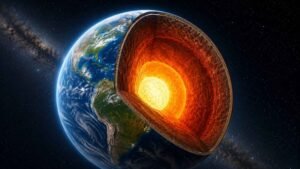
Earth’s magnetosphere is the region around our planet controlled by Earth’s magnetic field. It is not a solid wall. It is an invisible magnetic environment that changes shape depending on solar activity.
When solar wind reaches Earth, the magnetosphere compresses on the side facing the Sun and stretches outward on the night side into a long magnetic tail. This shape is important because it shows that Earth is constantly interacting with the Sun.
A simple example is to imagine Earth inside an invisible shield. The shield does not block every particle, but it redirects many charged particles and reduces their direct impact on Earth’s atmosphere.
NASA describes the magnetosphere as a major protective system that shields Earth from harmful solar and cosmic particle radiation. It can also change shape in response to incoming space weather from the Sun.
Why NASA Studies Earth’s Magnetic Shield
NASA studies Earth’s magnetic shield because space weather is not only a scientific topic. It affects modern technology.
Space weather can disturb satellites, GPS signals, radio communication, power grids, aviation systems, and spacecraft operations. NASA’s Heliophysics Division studies the Sun and space environment to understand these risks and help protect technology and astronauts from space weather effects. NASA notes that space weather events can interfere with communications, satellites, and power grids.
This is why magnetosphere missions matter to ordinary readers. If a satellite loses stability, if GPS becomes inaccurate, if auroras appear unusually far from the poles, or if power-grid systems face magnetic disturbance, the cause may be connected to space weather and Earth’s magnetic response.
For a related technology topic, read our article on NASA deep space laser communication, because spacecraft communication can also be affected by the space environment.
NASA’s Heliophysics Approach
NASA’s magnetosphere research belongs to heliophysics. Heliophysics is the study of the Sun, solar wind, space weather, and how these forces affect Earth and the rest of the solar system.
This field matters because Earth is not isolated in space. We live inside the extended influence of the Sun. Solar wind, radiation, magnetic activity, and energetic particles move through space and interact with planets.
NASA does not study Earth’s magnetic shield with only one spacecraft. It uses different missions, instruments, models, and observations. Some missions study the Sun. Others study solar wind. Some observe Earth’s magnetosphere, auroras, radiation belts, and upper atmosphere.
In simple words, NASA builds a larger picture by combining many pieces of data. That is the only way to understand how solar activity moves from the Sun to Earth and how it affects technology.
MMS: NASA’s Mission to Study Magnetic Reconnection
One of NASA’s most important magnetosphere missions is MMS, which stands for Magnetospheric Multiscale.
The NASA MMS mission uses four identically instrumented spacecraft to study Earth’s magnetosphere. NASA describes MMS as a mission made up of four spacecraft designed to study Earth’s magnetic environment.
MMS focuses on a process called magnetic reconnection. Magnetic reconnection happens when magnetic field lines break and reconnect, releasing stored energy. This process can accelerate particles, heat plasma, and help drive space weather effects.
A simple example is a stretched rubber band. When it snaps or suddenly changes shape, stored energy is released. Magnetic reconnection is not exactly the same as a rubber band, but the idea helps beginners understand how magnetic energy can be released quickly.
NASA’s Goddard Space Flight Center explains that MMS studies magnetic reconnection, a process that powers events ranging from solar explosions to auroras on Earth.
THEMIS: Understanding Auroras and Substorms
THEMIS is another important NASA mission connected to Earth’s magnetic shield. THEMIS stands for Time History of Events and Macroscale Interactions during Substorms.
NASA’s THEMIS mission studies substorms in near-Earth space. Substorms happen when Earth’s magnetosphere suddenly releases large amounts of energy. Some of that energy and particles can reach the upper atmosphere and create the Northern and Southern Lights.
Auroras are beautiful, but they are also scientific signals. They show that charged particles and magnetic energy are interacting with Earth’s upper atmosphere.
A useful example is a storm cloud. Lightning is visible, but the deeper cause is electrical activity inside the storm system. In the same way, auroras are visible, but the deeper cause is energy moving through Earth’s magnetic environment.
This is why NASA does not study auroras only as colorful lights. It studies them as evidence of space weather and magnetic energy transfer.
TRACERS: A New NASA Mission Studying Earth’s Magnetic Shield
TRACERS is one of the most important recent NASA missions for studying Earth’s magnetic shield. TRACERS stands for Tandem Reconnection and Cusp Electrodynamics Reconnaissance Satellites.
NASA confirmed that the twin TRACERS spacecraft launched on July 23, 2025, aboard a SpaceX Falcon 9 rocket from Vandenberg Space Force Base in California. The mission is designed to study how Earth’s magnetic shield protects the planet from the effects of space weather. Readers can view NASA’s official update on the TRACERS mission.
TRACERS focuses on polar cusps. These are regions near Earth’s poles where charged particles from space can enter the upper atmosphere more easily. This makes the polar regions especially important for understanding auroras and space weather.
The mission uses two satellites flying one behind the other. This twin-satellite method helps scientists compare measurements from nearly the same region at different moments. That matters because magnetic reconnection and particle movement can change very quickly.
For readers, the benefit is simple: TRACERS may help scientists better understand when and how solar activity can affect Earth’s magnetic shield.
STORIE: Studying Earth’s Ring Current from the ISS
STORIE is another NASA heliophysics mission connected to Earth’s magnetic environment. STORIE stands for Storm Time O+ Ring current Imaging Evolution.
NASA published an update on May 1, 2026, explaining that STORIE is scheduled to launch in May aboard the 34th SpaceX commercial resupply mission to the International Space Station. The mission will study Earth’s ring current, an invisible doughnut-shaped region of charged particles around the planet. Readers can check NASA’s official article on the STORIE mission.
The ring current is important because it changes during solar storms. NASA explains that changes in the ring current can affect satellites, power grids, pipelines, and satellite drag.
STORIE is especially interesting because it will observe the ring current from the International Space Station. Instead of looking at Earth from far away, it will look outward from low Earth orbit. NASA’s Scientific Visualization Studio explains that STORIE’s inside-out view can help scientists study how the ring current grows, shrinks, and changes during solar storms.
For a related space-protection topic, read our guide on NASA magnetic shielding for astronauts.
How Space Weather Affects Daily Life
Many people think space weather only matters to astronauts or scientists. That is not true. Space weather can affect systems people use every day.
Strong solar activity can disturb Earth’s upper atmosphere and magnetic environment. This can affect satellite signals, GPS accuracy, radio communication, and power systems. NASA’s heliophysics work specifically studies these connections so scientists can better understand and predict space weather effects.
A practical example is GPS. GPS signals travel from satellites to receivers on Earth. During strong space weather events, changes in the upper atmosphere can disturb these signals. The result may be reduced accuracy or temporary disruption.
Another example is satellites. Satellites can experience surface charging, electronic glitches, and increased atmospheric drag during geomagnetic storms. This is one reason missions like STORIE and TRACERS are important.
Why Magnetosphere Missions Matter for Satellites
Satellites operate in space, but they are not free from Earth’s magnetic environment. They move through regions affected by charged particles, radiation belts, atmospheric drag, and solar storms.
When solar storms energize Earth’s magnetic system, satellites may face additional risks. Their electronics can be affected by charged particles. Their orbits can also be influenced if the upper atmosphere expands and increases drag.
STORIE is directly connected to this issue because it studies the ring current. NASA says changes in the ring current during solar storms can contribute to satellite charging, increased satellite drag, and magnetic fluctuations that may affect systems on the ground.
This topic also connects with wider space safety. You can read more about planetary-scale protection in our article on NASA planetary defense missions.
Why This Research Matters for Astronauts
Astronauts need protection from space radiation and space weather. On Earth, the atmosphere and magnetosphere provide natural protection. In space, astronauts have less protection, especially during deep-space missions beyond low Earth orbit.
NASA studies heliophysics partly because space weather can affect astronaut safety. Understanding solar storms, charged particles, and magnetic disturbances helps mission planners prepare safer operations.
This is especially important for future Moon and Mars missions. Astronauts traveling far from Earth will spend more time outside the strongest protection of our planet’s magnetic field.
For readers interested in future astronaut protection, our related article on NASA magnetic shielding for astronauts explains how scientists think about engineered protection systems for deep space.
Why Magnetosphere Missions Matter for Communication
Space communication depends on stable signals. Solar storms and charged particles can affect radio signals, satellite links, and spacecraft operations.
This is one reason magnetosphere research connects with future communication systems. Better space weather knowledge can help engineers design more reliable spacecraft communication networks.
For example, NASA’s future space communication systems may use optical and radio technologies together. You can read more in our guide to NASA deep space laser communication.
The reader benefit is clear: better space weather understanding can support more reliable communication for satellites, space missions, navigation, and future exploration.
Magnetic Reconnection Explained in Simple Words
Magnetic reconnection is one of the most important processes in magnetosphere science.
Magnetic field lines can stretch, twist, break, and reconnect. When they reconnect, they can release energy into surrounding particles. This can accelerate particles and create powerful effects in space.
A simple example is two stretched elastic bands. If they suddenly snap into a new shape, energy is released. In space, magnetic field lines can also rearrange and release energy, although the physics is much more complex.
MMS and TRACERS both help scientists study magnetic reconnection. MMS studies reconnection in detailed three-dimensional measurements, while TRACERS studies reconnection near polar cusp regions where charged particles can enter Earth’s upper atmosphere.
Auroras: The Visible Sign of Invisible Forces
Auroras are among the most beautiful results of magnetosphere activity. They happen when charged particles travel along magnetic field lines and collide with gases in Earth’s upper atmosphere.
These collisions create glowing colors in the sky. Oxygen can produce green and red light, while nitrogen can contribute blue and purple tones.
But auroras are not only beautiful. They are visible signs of energy transfer from space into Earth’s atmosphere. That is why NASA studies auroras scientifically.
THEMIS is especially important here because it studies substorms and auroras. These observations help scientists understand how energy moves through near-Earth space before reaching the upper atmosphere.
Confirmed Facts vs Future Possibilities
| Confirmed Fact | Future Possibility |
|---|---|
| Earth has a magnetosphere that helps shield the planet from solar and cosmic particle radiation. | Better magnetosphere observations may improve future space weather forecasting. |
| MMS uses four spacecraft to study Earth’s magnetosphere. | MMS data may continue improving scientific models of magnetic reconnection. |
| THEMIS studies substorms and auroras. | Better substorm understanding may support more accurate aurora and space weather alerts. |
| TRACERS launched in July 2025 to study Earth’s magnetic shield. | TRACERS data may help explain how reconnection changes quickly near polar cusps. |
| STORIE is scheduled for ISS-based ring-current observations. | STORIE may improve understanding of satellite drag, charging, and storm-time ring-current behavior. |
This section is important because science articles should not turn future possibilities into confirmed facts. Careful wording helps readers trust the content.
Benefits for the Reader
Understanding NASA magnetosphere observation missions gives readers several practical benefits.
First, it helps readers understand why auroras happen and why they sometimes appear farther from the poles during strong solar activity.
Second, it explains how solar storms can affect satellites, GPS, communication systems, aviation, and power grids.
Third, it helps readers understand why astronaut protection is a major challenge for future Moon and Mars missions.
Fourth, it shows how invisible space forces can influence everyday technology on Earth.
Fifth, it gives readers a better understanding of Earth as part of a larger Sun-Earth system.
For more science updates, explore our article on latest science and technology breakthroughs.
Practical Example: From Solar Storm to Technology Impact
Here is a simple step-by-step example of how solar activity can affect Earth:
The Sun releases charged particles and magnetic energy.
Solar wind carries some of that energy toward Earth.
Earth’s magnetosphere responds by compressing, stretching, and reconnecting magnetic field lines.
Some particles enter near the polar regions.
Auroras may appear in the upper atmosphere.
The ring current may strengthen during the storm.
Satellites may experience charging or drag.
GPS and communication systems may become less accurate.
Power systems may face magnetic disturbance during strong events.
This example shows why NASA needs multiple missions. One spacecraft cannot measure every part of the Sun-Earth system. Scientists need different missions in different regions to build a clearer picture.
Common Misunderstandings About Earth’s Magnetic Shield
One common misunderstanding is that Earth’s magnetosphere blocks everything harmful from space. It does not. It reduces and redirects many charged particles, but some particles can still enter, especially near polar regions.
Another misunderstanding is that auroras are only beautiful lights. Auroras are beautiful, but they are also scientific evidence of energy transfer between space and Earth’s upper atmosphere.
A third misunderstanding is that space weather only affects astronauts. In reality, space weather can affect satellites, GPS, radio communication, aviation, pipelines, and power systems.
A fourth misunderstanding is that NASA’s magnetosphere research is only theoretical. In reality, it has practical value for technology protection, space exploration, and space weather forecasting.
NASA Magnetosphere Research and the Future of Space Science
NASA’s study of Earth’s magnetic shield also helps scientists understand other planets and space environments.
Magnetospheres exist around several planets, including Jupiter and Saturn. Studying Earth’s magnetosphere gives scientists a nearby laboratory where they can measure magnetic fields, charged particles, plasma behavior, and energy transfer in detail.
This research can also support future space missions. Better understanding of space weather can help protect satellites, improve mission planning, and support astronaut safety.
Magnetosphere research also connects with future observatories and space instruments. For a wider view of space science technology, read our article on next-generation space telescope technology.
Frequently Asked Questions
What are NASA magnetosphere observation missions?
NASA magnetosphere observation missions are spacecraft and instruments that study Earth’s magnetic shield, solar wind interaction, auroras, magnetic reconnection, ring current behavior, and space weather effects.
Why is Earth’s magnetosphere important?
Earth’s magnetosphere helps protect the planet from solar wind and charged particles. It also plays an important role in auroras, satellite safety, GPS reliability, communication systems, and astronaut protection.
What is NASA’s MMS mission?
MMS stands for Magnetospheric Multiscale. It uses four spacecraft to study magnetic reconnection in Earth’s magnetosphere.
What is NASA’s THEMIS mission?
THEMIS studies substorms and auroras. It helps scientists understand how energy is released in Earth’s magnetic environment and how auroras form near the poles.
What is NASA’s TRACERS mission?
TRACERS is a NASA mission launched in July 2025 to study Earth’s magnetic shield, especially magnetic reconnection near polar cusp regions.
What is NASA’s STORIE mission?
STORIE is a NASA heliophysics mission scheduled for ISS-based observations of Earth’s ring current. It will help scientists understand how the ring current changes during solar storms.
Can space weather affect GPS?
Yes. Strong space weather can disturb Earth’s upper atmosphere and affect GPS signal accuracy.
Can space weather affect satellites?
Yes. Space weather can contribute to satellite charging, electronic issues, orbital drag, and operational challenges.
Are auroras connected to Earth’s magnetosphere?
Yes. Auroras happen when charged particles move along Earth’s magnetic field lines and collide with gases in the upper atmosphere.
Why does NASA study the magnetosphere?
NASA studies the magnetosphere to understand space weather, protect technology, improve forecasting, support astronaut safety, and learn how magnetic fields behave in space.
Conclusion
NASA magnetosphere observation missions help unlock the secrets of Earth’s magnetic shield. They show how our planet interacts with the Sun, how solar storms affect near-Earth space, and why space weather matters for modern technology.
Missions such as MMS, THEMIS, TRACERS, and STORIE each study a different part of this system. MMS focuses on magnetic reconnection, THEMIS studies auroras and substorms, TRACERS studies Earth’s magnetic shield near polar cusps, and STORIE is designed to observe the ring current from the International Space Station.
The main lesson is simple: Earth’s magnetic shield is invisible, but it protects many things people depend on. It helps explain auroras, supports satellite safety, affects GPS and communication systems, and matters for future astronaut missions.
For readers, this topic is valuable because it connects space science with real life. NASA’s magnetosphere research is not only about distant spacecraft. It is about understanding the invisible forces that help protect Earth, technology, and future exploration.
Sources and Further Reading
NASA Magnetosphere Overview
NASA Heliophysics Division
NASA MMS Mission
NASA THEMIS Mission
NASA TRACERS Mission
NASA STORIE Mission