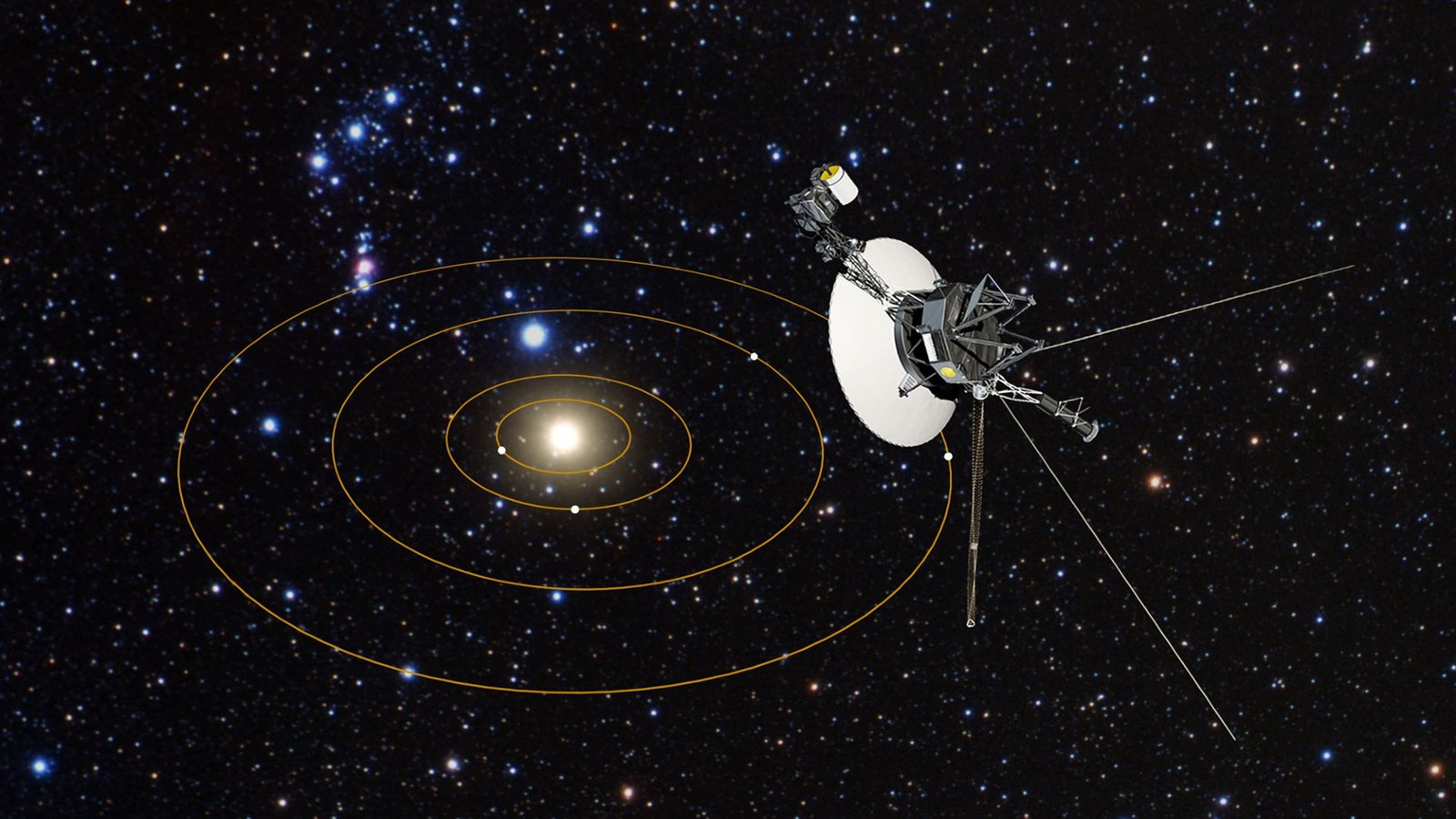
Few machines in human history have traveled farther, lasted longer, or carried more meaning than NASA’s Voyager spacecraft.
Voyager 1 and Voyager 2 launched in 1977 with a mission that was already ambitious: visit the outer planets and send back close-up science from worlds humanity had only seen as distant points of light. They were originally built for a mission lasting about five years. Instead, they became one of the greatest exploration stories ever told.
Voyager 1 visited Jupiter and Saturn. Voyager 2 visited Jupiter, Saturn, Uranus, and Neptune, becoming the only spacecraft ever to fly past all four giant planets. After completing their planetary mission, both spacecraft continued outward. Voyager 1 crossed into interstellar space in 2012, and Voyager 2 followed in 2018.
Now, in 2026, the Voyager mission has entered a fragile but historic next phase.
The spacecraft are still alive, but they are extremely old by spacecraft standards. Their power is fading. Their instruments are being shut down one by one. Commands from Earth take many hours to reach them. Their computers, thrusters, heaters, and science systems are being managed with extraordinary care by NASA engineers.
This is not a new Voyager launch. It is not a new spacecraft mission. The “next phase” of Voyager in 2026 means something more delicate and more meaningful: keeping humanity’s farthest explorers operating in interstellar space for as long as possible.
In simple words, Voyager’s next phase is survival, science, and legacy.
Editorial Note
This article explains the confirmed status of NASA’s Voyager mission in 2026, including Voyager 1, Voyager 2, their interstellar mission, remaining science instruments, power-saving decisions, and future outlook. It does not claim that NASA launched a new Voyager spacecraft in 2026. The Voyager spacecraft were launched in 1977 and are now operating in extended interstellar mission mode. Future operating timelines depend on power, spacecraft health, Deep Space Network communication, and unexpected technical issues.
Key Statistics and Facts
| Fact | Why It Matters |
|---|---|
| Voyager 2 launched on August 20, 1977. | It was the first of the two Voyager spacecraft launched. |
| Voyager 1 launched on September 5, 1977. | It followed Voyager 2 but traveled on a faster path. |
| Voyager 1 entered interstellar space in 2012. | It became the first human-made object to cross the heliopause. |
| Voyager 2 entered interstellar space in 2018. | It became the second spacecraft to enter interstellar space. |
| Voyager 2 is the only spacecraft to visit Uranus and Neptune. | Its planetary flybys remain unique in space exploration history. |
| NASA shut down Voyager 1’s LECP instrument on April 17, 2026. | This was done to conserve power and extend the mission. |
| NASA says each Voyager’s RTG produces about 4 watts less power each year. | Fading power is the mission’s biggest long-term limitation. |
| NASA/JPL believes power-saving steps could allow at least one science instrument to operate into the 2030s, if the spacecraft remain healthy. | The mission may still return unique interstellar data for several more years. |
These facts show why Voyager still matters. The spacecraft are no longer exploring planets, but they are now measuring a region of space no other operating spacecraft has reached.
What Are the NASA Voyager Next Phase Missions?
NASA’s Voyager next phase missions are not new spacecraft launches. They refer to the continued extended operations of Voyager 1 and Voyager 2 as part of the Voyager Interstellar Mission.
After finishing their planetary flybys, the Voyagers continued outward. Their new mission became the study of the outer heliosphere and interstellar space.
The heliosphere is the bubble of particles and magnetic fields created by the Sun. Beyond its outer boundary, called the heliopause, begins interstellar space. This does not mean the Voyagers have left the Sun’s gravity or passed beyond every part of the solar system in the broadest possible sense. It means they have moved beyond the Sun’s protective bubble of solar wind and entered the interstellar medium.
In 2026, the mission’s next phase is focused on:
Preserving power.
Keeping essential instruments alive.
Returning unique interstellar data.
Maintaining communication through NASA’s Deep Space Network.
Managing aging spacecraft systems.
Testing new power-saving procedures.
Extending the mission as long as possible.
The Voyagers are now operating on borrowed time, but that time is scientifically valuable.
For more NASA mission explainers, visit our NASA category.
Why Voyager Still Matters in 2026
Voyager still matters because no other operating spacecraft is doing what Voyager 1 and Voyager 2 are doing.
They are measuring the environment beyond the heliosphere. They are studying magnetic fields, plasma waves, charged particles, and the conditions of interstellar space. These measurements help scientists understand how the Sun interacts with the galaxy.
The Sun does not exist in isolation. It moves through the Milky Way, surrounded by interstellar gas, dust, magnetic fields, and cosmic rays. The heliosphere acts like a protective bubble around the solar system. Understanding that boundary helps scientists understand both the Sun and the space environment around it.
Voyager provides direct measurements, not just telescope observations or computer simulations. That makes its data unique.
The mission also matters emotionally and culturally. Voyager carries the Golden Record, a message from Earth containing sounds, images, music, and greetings. Long after the spacecraft stop communicating, they will continue drifting through the galaxy as silent ambassadors of humanity.
Voyager 1: The Farthest Human-Made Object
Voyager 1 is the farthest human-made object from Earth. It launched after Voyager 2 but traveled on a faster trajectory, passing Jupiter in 1979 and Saturn in 1980.
Its path was designed to fly close to Saturn’s moon Titan. That encounter changed its trajectory, sending it upward out of the plane where most planets orbit the Sun. Because of that path, Voyager 1 did not continue to Uranus and Neptune. Voyager 2 took that extended planetary route instead.
Voyager 1 entered interstellar space on August 25, 2012. Since then, it has been measuring conditions beyond the heliopause.
In 2026, Voyager 1 is still operating, but with very limited power. NASA shut down its low-energy charged particle instrument on April 17, 2026, to save energy. According to NASA’s current instrument status, Voyager 1’s magnetometer and plasma wave subsystem remain on.
That means Voyager 1 is still returning science from interstellar space, but its remaining scientific life is narrowing.
Voyager 2: The Grand Tour Explorer
Voyager 2 is the only spacecraft to have visited Jupiter, Saturn, Uranus, and Neptune. That alone makes it one of the most important spacecraft ever launched.
It flew past Jupiter in 1979, Saturn in 1981, Uranus in 1986, and Neptune in 1989. Its Uranus and Neptune flybys remain especially important because no spacecraft has returned to those planets since.
Voyager 2 discovered moons, studied rings, measured magnetic fields, and returned images that transformed humanity’s understanding of the outer solar system.
Voyager 2 entered interstellar space in 2018, joining Voyager 1 beyond the heliopause. Because it travels in a different direction from Voyager 1, it gives scientists a second measurement point in interstellar space.
That matters. Space is not the same in every direction. Having two spacecraft measuring different regions helps scientists understand the shape and behavior of the heliosphere more fully.
In 2026, Voyager 2 remains active with multiple instruments still operating, including its magnetometer, plasma wave subsystem, and cosmic ray subsystem according to NASA’s current instrument table.
Voyager 1 vs Voyager 2
| Feature | Voyager 1 | Voyager 2 |
|---|---|---|
| Launch Date | September 5, 1977 | August 20, 1977 |
| Major Planet Flybys | Jupiter and Saturn | Jupiter, Saturn, Uranus, Neptune |
| Entered Interstellar Space | 2012 | 2018 |
| Unique Achievement | Farthest human-made object | Only spacecraft to visit Uranus and Neptune |
| Direction | North of the ecliptic plane | South of the ecliptic plane |
| 2026 Mission Status | Extended interstellar mission | Extended interstellar mission |
| Current Role | Interstellar magnetic and plasma wave science | Interstellar particle, magnetic, and plasma wave science |
This comparison helps readers understand why both spacecraft remain important. Voyager 1 is farther away, but Voyager 2 completed the more complete planetary tour.
What Does “Beyond the Solar System” Really Mean?
The phrase “beyond the solar system” can be confusing.
Voyager 1 and Voyager 2 are in interstellar space because they have crossed the heliopause, the boundary where the solar wind gives way to the interstellar medium. In that sense, they are beyond the Sun’s protective bubble.
However, they have not escaped every possible definition of the solar system. The Sun’s gravity extends far beyond the heliopause. The distant Oort Cloud, a theoretical region of icy bodies, may extend much farther out than the Voyagers have traveled.
So the most accurate wording is:
Voyager 1 and Voyager 2 are in interstellar space.
They have crossed beyond the heliosphere.
They are still influenced by the Sun’s gravity.
They have not reached another star system.
This careful wording is important for credibility. Voyager’s achievement is already historic without exaggerating it.
The Voyager Interstellar Mission
The Voyager Interstellar Mission began after the planetary flybys were complete. Its goal is to study the outer heliosphere and interstellar space.
This mission includes measurements of:
Magnetic fields.
Plasma waves.
Cosmic rays.
Charged particles.
Solar influence at extreme distances.
Interstellar medium conditions.
The edge of the Sun’s protective bubble.
These measurements help scientists understand how stars interact with their galactic environment. Our Sun is one star among hundreds of billions in the Milky Way, and its heliosphere is one example of how stars carve bubbles in surrounding space.
Voyager’s data helps answer questions such as:
How does the heliosphere protect planets from cosmic rays?
What happens at the boundary between solar wind and interstellar space?
How does the interstellar magnetic field behave?
How does plasma density change beyond the heliopause?
What is the environment like beyond the Sun’s bubble?
These are not ordinary spacecraft measurements. They are first-of-their-kind data from the frontier between the solar system and the galaxy.
Current Voyager Instrument Status in 2026
NASA’s current Voyager instrument table shows that many instruments have already been turned off or stopped operating, mostly because of power limits and performance issues.
| Instrument | Voyager 1 Status | Voyager 2 Status |
|---|---|---|
| Cosmic Ray Subsystem | Off to save power, February 25, 2025 | On |
| Low-Energy Charged Particles | Off to save power, April 17, 2026 | Off to save power, March 24, 2025 |
| Magnetometer | On | On |
| Plasma Wave Subsystem | On | On |
| Plasma Science | Off because of degraded performance, February 1, 2007 | Off to save power, September 26, 2024 |
This table shows the difficult reality of the next phase. The mission is still alive, but NASA must choose carefully which instruments can remain powered.
The most valuable instruments now are the ones that can continue studying fields and particles in interstellar space.
Why NASA Is Turning Instruments Off
NASA is turning instruments off because the Voyagers’ power source is slowly fading.
Each spacecraft uses radioisotope thermoelectric generators, or RTGs. These systems convert heat from radioactive decay into electricity. They are extremely reliable and have powered the spacecraft for decades, but their output declines over time.
NASA says each Voyager RTG produces about 4 watts less power each year. That may sound small, but for an aging spacecraft with limited electricity, every watt matters.
Engineers must decide what to keep on and what to shut down. The goal is to preserve the instruments most likely to produce unique science.
This is why Voyager’s next phase is so delicate. NASA is not simply “running the spacecraft.” Engineers are actively balancing power, heat, communication, science priorities, and spacecraft survival.
The 2026 Voyager 1 LECP Shutdown
On April 17, 2026, NASA engineers shut down Voyager 1’s low-energy charged particle instrument. This was done to save power and keep the spacecraft operating longer.
The decision was not easy. The instrument had been part of Voyager’s science mission for decades. But keeping it running would have consumed power needed for other spacecraft systems.
NASA said the shutdown gives Voyager 1 about a year of breathing room. Engineers are using that time to work on a more ambitious energy-saving effort nicknamed “the Big Bang.”
This is an important example of Voyager’s current phase. The mission is not ending suddenly. It is being carefully stretched, one engineering decision at a time.
What Is the “Big Bang” Voyager Power Fix?
NASA’s Voyager team has described a planned power-saving effort nicknamed “the Big Bang.” The idea is to switch out a group of powered devices all at once, turning off some things and replacing them with lower-power alternatives to keep the spacecraft warm enough to continue collecting science data.
NASA plans to test this first on Voyager 2 because it has a little more power to spare and is closer to Earth, making it the safer test case. Tests were planned for May and June 2026. If successful, the team would attempt the fix on Voyager 1 no sooner than July 2026.
This does not guarantee the spacecraft will operate for many more years. It means NASA is still actively finding ways to extend the mission.
That is one of the remarkable parts of Voyager: nearly five decades after launch, engineers are still inventing new survival strategies for spacecraft built in the 1970s.
Deep Space Communication: Talking Across Billions of Miles
Communication with Voyager is one of the greatest engineering achievements in space exploration.
NASA communicates with the spacecraft through the Deep Space Network, a global system of large antennas that can send and receive signals from distant missions.
The distances are enormous. NASA/JPL reported in 2025 that Voyager 1 was more than 15 billion miles from Earth and Voyager 2 was over 13 billion miles away. At those distances, a radio signal takes many hours to travel one way.
NASA/JPL said it takes over 23 hours for a signal to reach Voyager 1 and about 19½ hours to reach Voyager 2. That means a command sent today may not be received until nearly a day later, and the response takes another many hours to come back.
This makes troubleshooting extremely slow. Engineers cannot interact with Voyager like a normal computer. Every command must be planned carefully, tested, transmitted, and then waited on.
For more on future space communication, read our article on NASA deep space laser communication.
How Voyager Changed Planetary Science
Before Voyager, the outer planets were mysterious. Telescopes could show Jupiter, Saturn, Uranus, and Neptune, but not in the detail needed to understand their moons, rings, magnetic fields, and atmospheres.
Voyager changed that.
The mission revealed volcanic activity on Jupiter’s moon Io. It showed details of Jupiter’s storms and cloud bands. It transformed views of Saturn’s rings and moons. Voyager 2 gave humanity its only close-up visits to Uranus and Neptune.
Voyager 2 discovered new moons and rings and revealed Neptune’s Great Dark Spot. It showed that the outer solar system was not quiet or simple. It was dynamic, complex, and full of surprises.
The Voyager mission helped rewrite planetary science because it turned distant worlds into real places.
Voyager and the Golden Record
Each Voyager spacecraft carries a Golden Record. It is a 12-inch gold-plated copper phonograph record designed as a message from Earth.
The record includes sounds and images selected to represent the diversity of life and culture on our planet. It includes greetings, natural sounds, music, and information about Earth.
The Golden Record is not a science instrument. It is a symbolic message.
It was created for the possibility that another civilization, far in the future, might one day find one of the spacecraft. That possibility is extremely unlikely in human timescales, but the record gives Voyager a cultural meaning beyond science.
The spacecraft are both probes and time capsules.
Long after their power runs out, they will continue carrying a message from Earth into the galaxy.
Why the Golden Record Still Matters
The Golden Record still matters because it represents humanity’s desire to be known.
It tells a future finder that Earth existed, that life developed here, that humans created music and language, and that we looked outward with curiosity.
In a technical sense, the record may never be found. Space is vast, and the Voyagers will not pass close to another star for tens of thousands of years.
But the point of the record is not only practical. It is philosophical. It asks what humanity would choose to say if given one small chance to speak to the universe.
That makes the Voyager mission different from most spacecraft. It is scientific, historical, and deeply human at the same time.
Confirmed Facts vs Future Possibilities
| Topic | Status |
|---|---|
| Voyager 1 and Voyager 2 launched in 1977 | Confirmed |
| Both spacecraft are in interstellar space | Confirmed |
| Voyager 1 entered interstellar space in 2012 | Confirmed |
| Voyager 2 entered interstellar space in 2018 | Confirmed |
| NASA launched a new Voyager spacecraft in 2026 | False |
| Voyager 1 still has all original instruments operating | False |
| NASA is shutting down instruments to save power | Confirmed |
| Voyager science may continue into the 2030s | Possible if power and spacecraft health allow |
| Voyager can communicate forever | False |
| The Golden Records will continue traveling after the spacecraft go silent | Expected |
This distinction is important. Voyager is still active, but it is also nearing the end of its powered scientific life.
Why 2026 Matters for Voyager
The year 2026 matters because Voyager is approaching a critical survival stage.
The spacecraft are nearly 50 years old. Their power is low. Some instruments have already been shut down. NASA is making difficult decisions to preserve the most valuable science.
Voyager 1’s LECP shutdown in April 2026 was one example. The planned “Big Bang” power-saving tests are another.
This makes 2026 a year of careful mission extension, not a year of new planetary flybys or new launches.
The most accurate 2026 message is this:
NASA is trying to keep Voyager 1 and Voyager 2 operating in interstellar space for as long as possible by conserving power, protecting remaining instruments, and maintaining communication through the Deep Space Network.
That is the true next phase of Voyager.
How Long Can Voyager Continue?
No one can give a perfect answer.
NASA explains that each spacecraft loses power each year, and engineers must keep turning off systems to conserve electricity. NASA’s FAQ notes that even after science data ends, engineering data could continue for several more years. It also says the two spacecraft could remain within range of the Deep Space Network through about 2036, depending on how much power they still have to transmit a signal.
NASA/JPL has also said that with power-saving steps, the spacecraft could continue operating with at least one science instrument into the 2030s, though unexpected problems could shorten that timeline.
So the honest answer is:
Science may continue for a limited number of years.
Engineering signals may continue longer.
Communication could become impossible later as power fades.
Unexpected failures could end operations sooner.
Voyager’s future is not guaranteed, but every additional day matters.
What Will Happen After Voyager Goes Silent?
Eventually, Voyager 1 and Voyager 2 will stop communicating with Earth. Their RTG power will decline too much. Their transmitters will no longer send usable signals. Their instruments will shut down. Their mission as active spacecraft will end.
But the spacecraft themselves will continue traveling.
They will become silent interstellar objects, carrying the Golden Records and the marks of human engineering.
They will not reach another star soon. NASA’s FAQ notes that Voyager 1 will pass within about 1.7 light-years of a small star in Ursa Minor more than 38,000 years from now. Voyager 2 will pass within about 1.7 light-years of Ross 248 in about 40,000 years.
That means Voyager’s symbolic journey will last far longer than its powered mission.
In a way, the spacecraft will have two lives: one as working probes and one as silent messengers.
Voyager and the Meaning of Interstellar Exploration
Voyager teaches an important lesson about exploration: the greatest missions often become greater than their original plan.
The spacecraft were built for planetary flybys. They became interstellar explorers.
They were designed for five years. They operated for nearly half a century.
They were sent to study planets. They became symbols of humanity’s place in the cosmos.
This is why Voyager remains powerful in 2026. The mission is not only about data. It is about endurance.
It shows what careful engineering, mission planning, and scientific curiosity can achieve when a spacecraft is given time.
Voyager Compared with New Horizons
Voyager is not the only spacecraft on an interstellar path. NASA’s New Horizons spacecraft, which flew past Pluto in 2015 and Arrokoth in 2019, is also heading outward.
But Voyager remains unique because both spacecraft are already in interstellar space and still returning measurements from beyond the heliopause.
| Spacecraft | Main Achievement | Current Importance |
|---|---|---|
| Voyager 1 | First spacecraft to enter interstellar space | Farthest human-made object, still returning limited interstellar data |
| Voyager 2 | Only spacecraft to visit Uranus and Neptune | Second interstellar spacecraft, different measurement direction from Voyager 1 |
| New Horizons | First close flyby of Pluto and Arrokoth | Still traveling outward and studying distant solar system regions |
This comparison shows that interstellar exploration is not one mission. It is a long-term pathway. Voyager opened the door.
Voyager and Future Interstellar Missions
Voyager was not designed as a modern interstellar probe. It became one because it kept traveling after its planetary mission.
Future interstellar missions may be designed from the beginning to study the heliosphere, interstellar medium, and nearby stars. These missions could use more advanced power systems, propulsion, instruments, communication, and autonomy.
Future spacecraft may travel faster than Voyager. They may carry better detectors. They may use more efficient communication systems. They may be designed specifically to cross the heliopause.
But Voyager will always be first.
Every future interstellar mission will be compared with Voyager because Voyager proved that a spacecraft can leave the Sun’s bubble and continue sending data from beyond it.
For broader future space technology, visit our Future & Technology section.
What People Often Get Wrong About Voyager
Many people think Voyager has completely left the solar system. The more accurate statement is that Voyager has entered interstellar space beyond the heliosphere, but it is still under the Sun’s gravitational influence.
Another mistake is thinking Voyager is moving toward a nearby star quickly. In reality, it will take tens of thousands of years to pass near another star.
Some people think Voyager still has all its instruments working. It does not. NASA has shut down several instruments to conserve power or because of degraded performance.
Another misunderstanding is thinking NASA launched a new Voyager mission in 2026. It did not. The current mission is the continuation of the original 1977 spacecraft.
Some people think the Golden Record was meant as a serious expectation of alien contact. It is better understood as a symbolic message and cultural time capsule.
A final mistake is thinking Voyager’s silence will mean failure. When Voyager eventually stops communicating, it will end one of the most successful missions in space history.
Timeline: Voyager’s Journey
| Year | Event |
|---|---|
| 1977 | Voyager 2 launched on August 20 |
| 1977 | Voyager 1 launched on September 5 |
| 1979 | Voyager 1 and Voyager 2 flew past Jupiter |
| 1980 | Voyager 1 flew past Saturn |
| 1981 | Voyager 2 flew past Saturn |
| 1986 | Voyager 2 flew past Uranus |
| 1989 | Voyager 2 flew past Neptune |
| 1990 | Voyager 1 captured the famous “Pale Blue Dot” family portrait |
| 2012 | Voyager 1 entered interstellar space |
| 2018 | Voyager 2 entered interstellar space |
| 2025 | NASA shut down some Voyager instruments to save power |
| 2026 | Voyager 1 LECP was shut down to extend operations |
| 2030s | At least limited operations may continue if power and hardware allow |
| Far future | The spacecraft continue silently through interstellar space |
This timeline shows why Voyager is one of the longest and most meaningful exploration stories ever created.
Voyager’s Next Phase: Science, Survival, and Legacy
The next phase of Voyager can be understood in three parts.
The first part is science. The spacecraft are still collecting rare measurements from interstellar space.
The second part is survival. NASA engineers are conserving power, shutting down instruments, testing energy-saving procedures, and managing aging systems.
The third part is legacy. Even after the science ends, Voyager will remain a symbol of human curiosity.
This is why the mission is so powerful in 2026. It is no longer about dramatic planetary images. It is about listening to faint signals from the edge of human reach.
Why Voyager Matters for the Public
Voyager matters because it gives people a sense of scale.
A spacecraft launched before the modern internet, smartphones, and many current technologies is still sending data from beyond the Sun’s bubble. That is almost difficult to believe, but it is true.
The mission also helps people understand that space exploration is not always fast. Some discoveries require patience measured in decades.
Voyager reminds us that human achievements can outlive the generation that created them. Engineers and scientists who launched the spacecraft could not have known every chapter of their future story.
That makes Voyager more than hardware. It is a long-running conversation between Earth and the unknown.
Practical Reader Takeaway
The most important thing to understand is that Voyager’s 2026 next phase is not about a new launch. It is about extending the final scientific years of two spacecraft that have already changed history.
Voyager 1 and Voyager 2 are in interstellar space.
They are still communicating with Earth.
Their power is fading.
NASA is shutting down instruments carefully.
Some science may continue into the 2030s if conditions allow.
The Golden Records will continue traveling long after the spacecraft go silent.
Voyager is both a science mission and a human message.
Frequently Asked Questions
What are NASA Voyager next phase missions?
NASA Voyager next phase missions refer to the continued extended operations of Voyager 1 and Voyager 2 in interstellar space. They are not new spacecraft launches.
Did NASA launch a new Voyager mission in 2026?
No. NASA did not launch a new Voyager spacecraft in 2026. The active Voyager spacecraft were launched in 1977.
Are Voyager 1 and Voyager 2 still working?
Yes. As of NASA’s 2026 updates, both spacecraft are still functioning, though with fewer science instruments operating because of power limits.
Where are Voyager 1 and Voyager 2 now?
Both spacecraft are in interstellar space beyond the heliopause, the outer boundary of the Sun’s heliosphere.
Has Voyager left the solar system?
Voyager has left the heliosphere and entered interstellar space. However, it has not left every possible gravitational definition of the solar system.
Why is NASA turning off Voyager instruments?
NASA is turning off instruments to conserve power. Each spacecraft’s RTG produces less electricity every year, so engineers must prioritize the most valuable remaining science.
What instruments are still working on Voyager 1?
NASA’s current status lists Voyager 1’s magnetometer and plasma wave subsystem as operating after the April 2026 shutdown of the low-energy charged particle instrument.
What instruments are still working on Voyager 2?
NASA’s current status lists Voyager 2’s cosmic ray subsystem, magnetometer, and plasma wave subsystem as operating, while other instruments have been shut down.
How long will Voyager keep communicating?
NASA says engineering data could continue for several more years after science ends, and the spacecraft could remain in range of the Deep Space Network through about 2036, depending on available power.
What is the Voyager Golden Record?
The Voyager Golden Record is a gold-plated copper phonograph record carried by each spacecraft. It contains sounds, images, music, and greetings selected to represent Earth and humanity.
Conclusion
NASA Voyager next phase missions in 2026 represent one of the most emotional and scientifically valuable chapters in space exploration. Voyager 1 and Voyager 2 are not new spacecraft, but their mission is still alive in a way few people could have imagined in 1977.
They have visited the giant planets, transformed planetary science, crossed into interstellar space, and continued sending data from beyond the Sun’s protective bubble. Now, nearly five decades after launch, NASA engineers are carefully managing their final years of powered science.
The next phase is not glamorous in the usual sense. There are no new close-up images of Jupiter or Neptune. There is no landing, no rover, and no new launch. Instead, there are faint signals, power-saving decisions, instrument shutdowns, and measurements from a region of space no other operating spacecraft has reached.
That is what makes this phase so meaningful.
Voyager’s story is about endurance. It is about how far human engineering can go when built with care. It is about science continuing long after the original mission was complete. It is about a tiny spacecraft carrying Earth’s message into the dark between the stars.
The simplest way to understand Voyager in 2026 is this: humanity’s farthest explorers are aging, but they are still speaking. Every signal we receive from them is a message from the edge of our reach.
Sources and Further Reading
NASA: Where Are Voyager 1 and Voyager 2 Now?
NASA: Voyager Frequently Asked Questions
NASA/JPL: NASA Turns Off Two Voyager Science Instruments to Extend Mission
NASA: NASA Shuts Off Instrument on Voyager 1 to Keep Spacecraft Operating