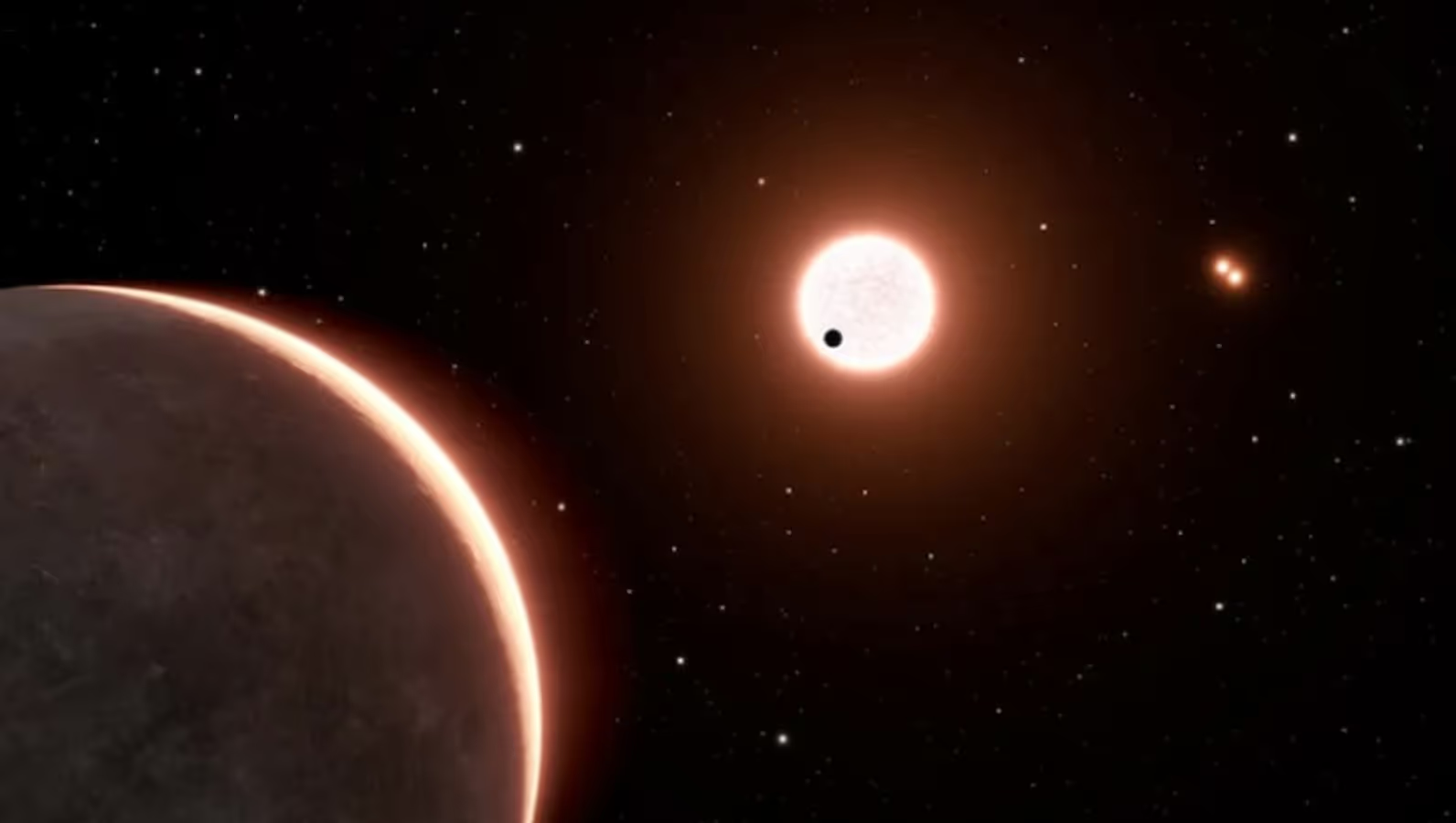
For centuries, humans looked at the night sky and wondered whether other worlds existed beyond our solar system. Today, that question has changed. Scientists no longer ask only whether exoplanets exist. They ask what those planets are like, what their atmospheres contain, how they formed, whether they have clouds or storms, and whether any of them might support life.
The challenge is that most exoplanets are extremely hard to see directly.
A planet orbiting another star is usually hidden in the overwhelming glare of its host star. From far away, the star can be billions of times brighter than the planet. It is like trying to see a tiny firefly flying beside a stadium floodlight from thousands of kilometers away. The planet may be there, but the star’s light drowns it out.
This is why NASA exoplanet direct imaging tech is so important.
Direct imaging is the method of actually capturing light from an exoplanet itself instead of only detecting the planet indirectly. Many exoplanets are discovered because they make their stars dim slightly during a transit or wobble gravitationally. Direct imaging is different. It aims to separate the planet’s faint light from the star’s glare so scientists can study the planet more directly.
In 2026, this technology is entering a critical stage. NASA’s Nancy Grace Roman Space Telescope is targeted for launch as soon as early September 2026, and its Coronagraph Instrument is designed to demonstrate advanced starlight-blocking technology. This technology could help prepare the way for future observatories that may one day directly image Earth-like planets around nearby stars.
In simple words, NASA is developing the tools needed to turn distant alien worlds from invisible points into real objects of study.
Table of Contents
ToggleEditorial Note
This article explains confirmed NASA exoplanet direct imaging technology, current mission status, future observatory concepts, and scientific possibilities. It does not claim that NASA has already directly imaged an Earth-like inhabited planet. The Roman Space Telescope is targeted for launch as soon as early September 2026, while its Coronagraph Instrument is a technology demonstration. NASA’s Habitable Worlds Observatory is a future mission concept designed to directly image potentially habitable planets, but it is not a completed mission.
Key Statistics and Facts
| Fact | Why It Matters |
|---|---|
| NASA has confirmed more than 6,000 exoplanets. | The search for planets beyond our solar system has become a major field of astronomy. |
| Most exoplanets are discovered indirectly, not by direct imaging. | Direct imaging is difficult because planets are faint compared with their stars. |
| NASA says exoplanets can be billions of times dimmer than their host stars. | This explains why blocking starlight is essential. |
| Roman’s Coronagraph Instrument is designed to demonstrate advanced direct imaging technology. | It may help reduce risk for future missions designed to study Earth-like planets. |
| NASA’s Webb telescope has directly imaged exoplanets such as HIP 65426 b. | Webb has shown how infrared imaging can study young, giant exoplanets. |
| NASA’s Habitable Worlds Observatory aims to directly image 25 potentially habitable worlds. | Future direct imaging could help search for atmospheric signs related to habitability. |
These facts show why direct imaging is one of the most important frontiers in exoplanet science. Finding planets is only the first step. The next step is learning what those planets are actually like.
What Is Exoplanet Direct Imaging?
Exoplanet direct imaging is a method used to observe planets outside our solar system by capturing light from the planets themselves. Instead of only watching how a planet affects its star, direct imaging tries to separate the planet’s own reflected or emitted light from the star’s much brighter light.
This is extremely difficult because stars are incredibly bright and planets are very faint. A planet may orbit close to its star from our point of view, making it appear almost hidden in the star’s glare. Even if the planet is large, it can still be difficult to see.
Direct imaging usually works best for young, large, hot planets that orbit far from their stars. These planets glow more brightly in infrared light because they are still warm from formation. Smaller Earth-like planets are much harder to image because they are dimmer and closer to their stars.
However, direct imaging is valuable because it can reveal information that other methods cannot easily provide. It can help scientists study a planet’s brightness, color, temperature, orbit, atmosphere, clouds, and possible chemical composition.
For more space science explainers, visit our Space & Beyond section.
Why Direct Imaging Is So Difficult
Direct imaging is difficult because of contrast. The star is bright, and the planet is faint. The planet may be billions of times dimmer than its host star. That brightness difference is the main reason scientists need advanced technology.
Another challenge is angular separation. Even if a planet is far from its star in space, it may appear very close to the star when viewed from Earth. Telescopes must separate two objects that look extremely close together.
A third challenge is telescope stability. Tiny movements, optical imperfections, and scattered light can make the planet impossible to detect. To directly image faint planets, a telescope must be extremely stable and precise.
A fourth challenge is atmosphere. Ground-based telescopes must deal with Earth’s turbulent atmosphere, which blurs starlight. Space telescopes avoid much of this problem, but they still need advanced optics and starlight suppression systems.
A fifth challenge is data processing. Even after a telescope collects light, scientists must carefully remove noise, glare, and artifacts to confirm whether a faint signal is truly a planet.
This is why NASA exoplanet direct imaging tech is not one invention. It is a combination of coronagraphs, starshades, deformable mirrors, wavefront sensing, detectors, telescope stability, image processing, and mission design.
How NASA Blocks Starlight
The key to direct imaging is blocking or suppressing the star’s light. NASA studies two major approaches: coronagraphs and starshades.
A coronagraph is an instrument inside a telescope that blocks the light of a star so nearby faint objects can become visible. It works somewhat like creating an artificial eclipse inside the telescope. By reducing the star’s glare, a coronagraph can reveal planets or dusty disks around the star.
A starshade is different. It is a large external spacecraft that would fly far away from a telescope and block starlight before the light enters the telescope. A starshade would need to align very precisely with the telescope and the target star. Its shape would be designed to reduce diffraction and create a deep shadow where the telescope could observe faint planets.
Both methods aim to solve the same problem: the star is too bright.
Coronagraphs are built into telescopes. Starshades would operate separately from telescopes. Each approach has strengths and challenges. Future exoplanet missions may use one or both methods depending on mission design.
NASA’s Roman Coronagraph Instrument
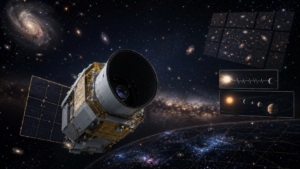
NASA’s Nancy Grace Roman Space Telescope is one of the most important missions for the future of exoplanet direct imaging. Roman is a wide-field space telescope designed to study dark energy, dark matter, exoplanets, and infrared astrophysics. It will also carry a Coronagraph Instrument.
The Roman Coronagraph Instrument is not mainly a planet-discovery survey tool. It is a technology demonstration. Its purpose is to prove advanced methods for blocking starlight and directly imaging planets and disks around other stars.
NASA describes the Roman Coronagraph Instrument as a system of masks, prisms, detectors, filters, and deformable mirrors designed to block star glare and directly image planets and disks around stars.
This matters because future observatories will need extremely high-contrast imaging to see smaller and fainter planets. Roman’s coronagraph can help test the technologies that may later support missions designed to study Earth-like worlds.
For more NASA technology topics, visit our NASA category.
Confirmed Facts vs Future Possibilities
It is important to separate what is confirmed from what is still a future possibility.
| Topic | Status |
|---|---|
| NASA has confirmed thousands of exoplanets | Confirmed |
| Webb has directly imaged some exoplanets | Confirmed |
| Roman is targeted for launch as soon as early September 2026 | Confirmed NASA target |
| Roman will carry a Coronagraph Instrument | Confirmed |
| Roman’s coronagraph is a technology demonstration | Confirmed |
| Roman will directly image Earth-like inhabited planets | Not confirmed |
| Habitable Worlds Observatory will search for potentially habitable worlds | Future mission concept |
| Direct imaging of Earth-like planets around Sun-like stars | Future goal |
| Direct detection of alien life | Not confirmed |
This distinction is essential for trust. Direct imaging is advancing quickly, but it has not yet given scientists a confirmed image of an inhabited Earth-like planet. The accurate statement is that NASA is developing the technology needed to make that kind of future science possible.
Why 2026 Matters for Exoplanet Direct Imaging
The year 2026 matters because NASA’s Roman Space Telescope is targeted for launch as soon as early September 2026. Roman’s Coronagraph Instrument represents a major step in testing direct imaging technology from space.
This does not mean Roman will instantly reveal Earth-like alien worlds. Its coronagraph is a demonstration of high-contrast imaging technology. The lessons learned from Roman may help future missions become more capable.
In 2026, direct imaging is also important because exoplanet science has matured. Scientists are no longer satisfied with only counting planets. They want to characterize them. They want to know what exoplanets are made of, how their atmospheres behave, what their climates may be like, and whether any could be habitable.
Roman, Webb, ground-based observatories, and future concepts such as the Habitable Worlds Observatory all fit into this larger direction.
The future of exoplanet science is moving from discovery to characterization.
Webb and Direct Imaging of Exoplanets
NASA’s James Webb Space Telescope has already shown the power of direct imaging for certain types of exoplanets. Webb directly imaged HIP 65426 b, a gas giant exoplanet, using infrared instruments. This planet is much larger than Earth and orbits far from its star, making it easier to image than a small rocky planet.
Webb’s direct imaging work is important because it shows how powerful infrared telescopes can study young giant planets. These observations can help scientists understand planet temperature, atmosphere, clouds, and formation history.
However, Webb was not designed primarily to directly image Earth-like planets around Sun-like stars. That challenge is much harder. Earth-like planets are smaller, dimmer, and closer to their stars from our point of view.
This is why Roman and future missions matter. They are part of the technological path toward stronger starlight suppression and more advanced exoplanet characterization.
Roman vs Webb: Different Strengths
Roman and Webb are both powerful space telescopes, but they are designed for different strengths.
| Feature | James Webb Space Telescope | Nancy Grace Roman Space Telescope |
|---|---|---|
| Main Strength | Deep infrared observations of selected targets | Wide-field surveys and large-scale sky observations |
| Exoplanet Role | Atmosphere studies, transits, direct imaging of some giant planets | Microlensing surveys and coronagraph technology demonstration |
| Direct Imaging | Can image some young giant exoplanets | Will test advanced coronagraph direct imaging technology |
| Field of View | Narrower, deeper views | Much wider sky coverage |
| Technology Role | High-sensitivity infrared observatory | Wide-field survey telescope with direct imaging technology demo |
This comparison helps readers understand why no single telescope solves every exoplanet question. Webb can study selected planets in detail. Roman can survey large areas and test coronagraph technology. Future observatories may build on both.
What Scientists Can Learn from Direct Images
Direct images of exoplanets can reveal information that is difficult to get from indirect detection alone.
They can help measure a planet’s brightness at different wavelengths. Brightness can give clues about temperature, atmosphere, clouds, and surface or atmospheric conditions.
Direct imaging can also help estimate orbit. If scientists observe a planet multiple times, they can track how it moves around its star.
Spectroscopy is especially important. Spectroscopy splits light into different wavelengths, revealing chemical fingerprints. If a direct imaging telescope can collect enough light from a planet, scientists may study gases in its atmosphere.
Possible atmospheric gases may include water vapor, methane, carbon dioxide, oxygen, ozone, or other molecules. Some gases may help scientists evaluate habitability, but no single gas automatically proves life. Atmospheric interpretation requires caution, context, and multiple lines of evidence.
Direct imaging may also reveal circumstellar disks, which are dusty disks around stars. These disks can show where planets are forming or how planetary systems evolve.
Why Alien Worlds Are Hard to Understand
Discovering a planet does not mean scientists fully understand it. A planet may have a known size or orbit, but its atmosphere, climate, surface, clouds, and chemistry may remain uncertain.
Many exoplanets are known only through indirect signals. For example, the transit method can show a planet’s size and orbit if it passes in front of its star. The radial velocity method can help estimate mass by measuring the star’s wobble. These methods are powerful, but they do not always reveal what the planet looks like.
Direct imaging gives scientists another tool. It can help observe planets that are far from their stars and bright enough to detect. It may also help future missions study potentially habitable planets more directly.
This is why direct imaging is often described as a major step toward understanding alien worlds. It moves astronomy closer to seeing planets as actual worlds rather than only mathematical signals.
Habitable Worlds Observatory: The Future Goal
NASA’s Habitable Worlds Observatory, or HWO, is a future mission concept designed to search for and directly image potentially habitable planets around nearby stars. NASA describes its main objective as identifying and directly imaging 25 potentially habitable worlds.
This is one of the most ambitious goals in modern astronomy.
The idea is not only to detect planets but also to study their atmospheres. If a planet has an atmosphere, spectroscopy could reveal gases that may relate to habitability. Scientists may look for water vapor, oxygen, methane, carbon dioxide, or other chemical combinations.
However, this must be explained carefully. Searching for biosignatures is not the same as confirming life. A biosignature candidate would need careful scientific analysis, repeated observations, and alternative explanations.
HWO is important because it represents the long-term direction of exoplanet direct imaging: moving toward smaller, colder, more Earth-like planets that are much harder to see than the giant planets currently easier to image.
Coronagraphs vs Starshades
NASA studies both coronagraphs and starshades as tools for direct imaging.
| Technology | How It Works | Strength | Challenge |
|---|---|---|---|
| Coronagraph | Blocks starlight inside the telescope | Compact and integrated with telescope | Requires extreme optical precision |
| Starshade | Blocks starlight before it enters the telescope | Can create a very dark shadow for planet imaging | Requires precise formation flying over huge distances |
| Deformable mirrors | Correct tiny wavefront errors | Improves starlight suppression | Technically complex |
| Wavefront sensing | Measures optical distortions | Helps keep images stable | Requires continuous precision |
| Advanced detectors | Capture faint planet light | Improves sensitivity | Must handle low signal and noise |
This table shows why direct imaging technology is so advanced. It requires not only a large telescope but also precise control of light.
Why Starshades Are So Interesting
A starshade sounds like science fiction, but it is a serious concept. The idea is to place a large specially shaped spacecraft far in front of a telescope. The starshade blocks the light of a target star, allowing the telescope to see faint planets nearby.
The shape of a starshade is important. It cannot be a simple circle because diffraction would create unwanted light patterns. Instead, starshade designs use petal-like shapes that help create a deep shadow.
A starshade would need to fly in extremely precise alignment with the telescope and the target star. That makes the engineering difficult. But the scientific payoff could be huge because it may help reveal smaller planets near bright stars.
NASA continues to study starshade technology because it could enhance future direct imaging missions and expand the ability to search for Earth-like planets.
The Role of Deformable Mirrors
Deformable mirrors are another key part of high-contrast imaging. These mirrors can change shape very slightly to correct distortions in the light path.
Even tiny imperfections in a telescope can scatter starlight and hide a planet. A deformable mirror can adjust to reduce those imperfections and improve the image.
Roman’s Coronagraph Instrument includes deformable mirrors as part of its starlight suppression system. This kind of technology helps create the stable, high-contrast conditions needed for direct imaging.
Deformable mirrors are important because direct imaging requires extreme precision. A small optical error can make the difference between detecting a planet and missing it completely.
Direct Imaging and Planet Atmospheres
One of the most exciting goals of direct imaging is atmosphere study. If scientists can isolate light from a planet, they can use spectroscopy to look for chemical signatures.
Atmospheres can tell scientists whether a planet is hot or cold, cloudy or clear, hydrogen-rich or rocky, dry or possibly water-bearing.
For giant planets, direct imaging can help study cloud layers, heat, and atmospheric chemistry. For future Earth-like planet studies, scientists hope spectroscopy could reveal gases connected to habitability.
However, atmosphere interpretation is difficult. A gas can have multiple causes. Oxygen, methane, or carbon dioxide alone may not prove life. Scientists must look at the full planetary context: star type, planet orbit, atmosphere, geology, radiation environment, and possible false positives.
A trustworthy article must avoid saying “NASA will find alien life” as a fact. The accurate statement is that direct imaging may help search for signs that could be related to habitability or life.
Direct Imaging and Planet Formation
Direct imaging is also valuable for studying how planets form. Young planetary systems may contain dusty disks, gaps, rings, and forming planets.
When a telescope images a disk around a star, scientists can study structures that may be shaped by planets. A planet can carve gaps, create spiral patterns, or influence dust distribution.
This helps scientists understand how solar systems form. Our own solar system formed from a disk of gas and dust around the young Sun. By studying other systems at different stages, scientists can compare them with our history.
Direct imaging can therefore answer more than “Is there another Earth?” It can also help answer “How do planets form?” and “How common are systems like ours?”
How Direct Imaging Complements Other Exoplanet Methods
Direct imaging is powerful, but it is not the only way to study exoplanets. It works best when combined with other methods.
| Method | What It Detects | Best For |
|---|---|---|
| Transit method | Planet blocks a small amount of starlight | Planet size and orbit |
| Radial velocity | Star wobbles because of planet gravity | Planet mass and orbit |
| Microlensing | Gravity magnifies background star light | Distant planets and cold worlds |
| Direct imaging | Light from the planet itself | Young giant planets, wide-orbit planets, and future Earth-like studies |
| Spectroscopy | Chemical fingerprints in light | Atmospheres and possible composition |
This combination is important because no single method gives the full picture. A planet’s size, mass, orbit, atmosphere, and brightness all help scientists understand what kind of world it is.
Internal Link: Why Direct Imaging Connects to Space Technology
Exoplanet direct imaging depends on some of the most precise technology ever developed for astronomy. It requires stable telescopes, advanced optics, high-performance detectors, powerful data processing, and careful mission design.
This connects direct imaging with many other NASA technology efforts. For example, high-speed communication is important because future space telescopes may produce huge amounts of data. You can read more about that in our article on NASA deep space laser communication.
Direct imaging also connects with future artificial intelligence tools. AI may help process telescope data, remove noise, detect faint signals, and identify possible planets hidden in complex images. For a broader look at AI and future technology, visit our Future & Technology section.
How Direct Imaging Could Change the Search for Life
Direct imaging could change the search for life because it may eventually allow scientists to study Earth-like planets more directly.
Today, many exoplanet studies depend on indirect signals. Scientists may infer that a planet exists, estimate its size, or measure some atmospheric clues. Future direct imaging missions could collect light from smaller rocky planets and examine their atmospheres more carefully.
This could help scientists search for combinations of gases that may suggest biological activity. For example, oxygen and methane together may be interesting because they can react with each other and may need a source to persist. But even then, scientists would need caution. Planetary chemistry is complex, and non-biological processes can sometimes produce surprising signals.
Direct imaging could also help study whether a planet has clouds, seasons, oceans, continents, or reflective surface features. These goals are extremely difficult, but they explain why direct imaging is such an important long-term technology.
The dream is not just to find another planet. The dream is to understand whether it could be a world.
What People Often Get Wrong About Exoplanet Direct Imaging
Many people think direct imaging means NASA can already take clear photographs of Earth-like alien planets. That is not true. Direct imaging is possible for some exoplanets, especially young and giant ones, but Earth-like planets around Sun-like stars remain extremely challenging.
Another mistake is thinking every image of an exoplanet looks like a detailed planet photo. Most direct images are small points of light, not detailed surface pictures. Scientists learn from brightness, color, spectra, motion, and repeated observations.
Some people think direct imaging is the only important exoplanet method. In reality, transit, radial velocity, microlensing, and spectroscopy are all essential.
Another misunderstanding is thinking a biosignature automatically proves life. A possible biosignature would need careful scientific confirmation and alternative explanations.
A final mistake is thinking Roman will immediately find alien civilizations. Roman’s Coronagraph Instrument is a technology demonstration, not a mission designed to prove extraterrestrial life.
Timeline: Exoplanet Direct Imaging Progress
| Period | Development |
|---|---|
| Early exoplanet era | Most planets were detected indirectly through star wobble or transits |
| 2000s | Direct imaging began revealing young giant exoplanets in wide orbits |
| 2022 | Webb directly imaged HIP 65426 b in infrared light |
| 2023–2025 | Roman Coronagraph Instrument development and testing advanced |
| 2026 | Roman is targeted for launch as soon as early September, carrying a coronagraph technology demonstration |
| Future | Habitable Worlds Observatory aims to directly image potentially habitable worlds |
| Long-term goal | Direct study of Earth-like planets and atmospheric biosignature candidates |
This timeline shows that direct imaging is developing step by step. Each stage improves the tools needed for the next one.
Why This Technology Matters for the Public
Exoplanet direct imaging matters because it changes how people understand the universe. Most people can understand the idea of a distant world more easily when it is not only a graph or a signal.
Even if direct images are small points of light, they are powerful. They show that planets around other stars are real places. They may have clouds, heat, orbits, atmospheres, and histories.
This kind of science also inspires education. Exoplanets connect astronomy, physics, chemistry, engineering, optics, biology, and computer science. A student who learns about direct imaging may become interested in telescopes, space missions, AI, optics, or astrobiology.
Direct imaging also asks one of humanity’s oldest questions in a modern scientific way: Are there other worlds like Earth?
That question is not only emotional. It is scientific. Direct imaging is one of the technologies that may help answer it.
Why NASA’s Work Matters in 2026 and Beyond
NASA’s work matters because exoplanet science is entering a new era. The first era proved that planets exist around other stars. The next era is about understanding them.
The Roman Space Telescope may help by testing advanced coronagraph technology. Webb continues to study selected planets in infrared light. Ground-based observatories are improving adaptive optics. Future missions like the Habitable Worlds Observatory may push direct imaging toward smaller and more Earth-like planets.
This progress will not happen instantly. It requires engineering, funding, testing, mission planning, telescope stability, and scientific caution.
But the direction is clear. NASA’s exoplanet direct imaging tech is helping astronomy move closer to seeing alien worlds directly.
Practical Uses of Exoplanet Direct Imaging
Direct imaging can support many scientific goals.
It can help study young giant planets.
It can reveal dusty disks around stars.
It can help track planetary orbits.
It can support atmosphere studies.
It can help test planet formation theories.
It can prepare technology for future Earth-like planet imaging.
It can help identify targets for more detailed follow-up observations.
It can support the long-term search for habitable worlds.
This makes direct imaging valuable even before it reaches the ultimate goal of imaging Earth-like planets. Every step teaches scientists more about planets, telescopes, and the universe.
Comparison: Current Direct Imaging vs Future Goals
| Area | Current Capability | Future Goal |
|---|---|---|
| Main targets | Young giant planets and dusty disks | Smaller rocky planets in habitable zones |
| Image detail | Often points of light | More detailed spectra and possible planet characterization |
| Main tools | Webb, ground-based telescopes, coronagraphs | Roman tech demo, HWO, advanced coronagraphs, starshades |
| Scientific focus | Planet formation, giant planet atmospheres | Habitability, biosignature candidates, Earth-like worlds |
| Main challenge | Starlight glare and faint planet light | Even higher contrast and stability |
| Public expectation | Clear planet photos | More realistic: data-rich images and spectra |
This comparison helps set realistic expectations. Direct imaging is powerful, but it is not the same as taking a close-up photo of another Earth.
Frequently Asked Questions
What is NASA exoplanet direct imaging tech?
NASA exoplanet direct imaging tech refers to the tools and methods used to capture light from planets outside our solar system. It includes coronagraphs, starshades, deformable mirrors, wavefront sensing, advanced detectors, and image processing.
Why is direct imaging difficult?
Direct imaging is difficult because exoplanets are extremely faint compared with their host stars. A planet can be billions of times dimmer than its star, so scientists must block or suppress starlight to see the planet.
What is a coronagraph?
A coronagraph is an instrument that blocks the bright light of a star so faint nearby objects, such as planets or disks, can become visible.
What is a starshade?
A starshade is a proposed external spacecraft that would fly far from a telescope and block starlight before it enters the telescope, helping reveal faint planets.
What is Roman’s Coronagraph Instrument?
Roman’s Coronagraph Instrument is a technology demonstration on NASA’s Nancy Grace Roman Space Telescope. It is designed to test advanced methods for blocking starlight and directly imaging planets and disks around stars.
Is Roman launching in 2026?
NASA is targeting launch as soon as early September 2026, ahead of the agency’s commitment to launch no later than May 2027. Mission dates should always be checked against NASA’s latest updates.
Has NASA directly imaged exoplanets before?
Yes. NASA’s James Webb Space Telescope has directly imaged exoplanets such as HIP 65426 b. Direct imaging is currently easier for young, large, hot planets than for small Earth-like planets.
Can direct imaging find alien life?
Direct imaging may help future missions search for atmospheric signs related to habitability or life, but it cannot automatically prove life. Any possible biosignature would need careful scientific confirmation.
What is the Habitable Worlds Observatory?
NASA’s Habitable Worlds Observatory is a future mission concept designed to identify and directly image potentially habitable planets around nearby stars and study their atmospheres.
Will direct images show detailed alien landscapes?
Not with current technology. Most exoplanet direct images appear as small points of light. Scientists learn from brightness, colors, spectra, motion, and repeated observations rather than detailed surface pictures.
Conclusion
NASA’s exoplanet direct imaging tech is one of the most exciting frontiers in modern astronomy. It aims to solve one of the hardest problems in space science: how to see a faint planet hidden beside a blinding star.
This technology matters because finding exoplanets is no longer enough. Scientists now want to understand them. They want to study atmospheres, temperatures, clouds, orbits, disks, chemistry, and possible signs of habitability.
Roman’s Coronagraph Instrument is a major step in this direction. It will demonstrate advanced starlight suppression technology that could help prepare future missions. Webb has already shown how direct imaging can study some giant exoplanets. NASA’s Habitable Worlds Observatory represents the longer-term goal of directly imaging potentially habitable planets.
The most important point is accuracy. NASA has not yet directly imaged an inhabited Earth-like planet. Roman is not a mission that will immediately prove alien life exists. But NASA is building the technology that may one day allow scientists to study distant rocky worlds in far greater detail.
The simplest way to understand this technology is this: direct imaging is how astronomy begins to turn hidden exoplanets into visible worlds. In 2026 and beyond, NASA’s work on coronagraphs, starshades, and future observatories may bring humanity closer than ever to seeing alien worlds like never before.
Sources and Further Reading
NASA: Roman Space Telescope Direct Imaging
NASA JPL: The Roman Coronagraph Instrument
NASA: Roman Space Telescope Exoplanets
NASA: Roman Space Telescope Mission
NASA: NASA Targets Early September for Roman Space Telescope Launch
NASA: Webb Takes Its First-Ever Direct Image of Distant World
NASA Exoplanet Catalog: HIP 65426 b
About the Author
Shahzaib Ali
Shahzaib Ali is the founder and editor of Sanceen, a science, space, NASA, and future technology educational website. He writes beginner-friendly articles about space missions, astronomy, scientific discoveries, and emerging technology.