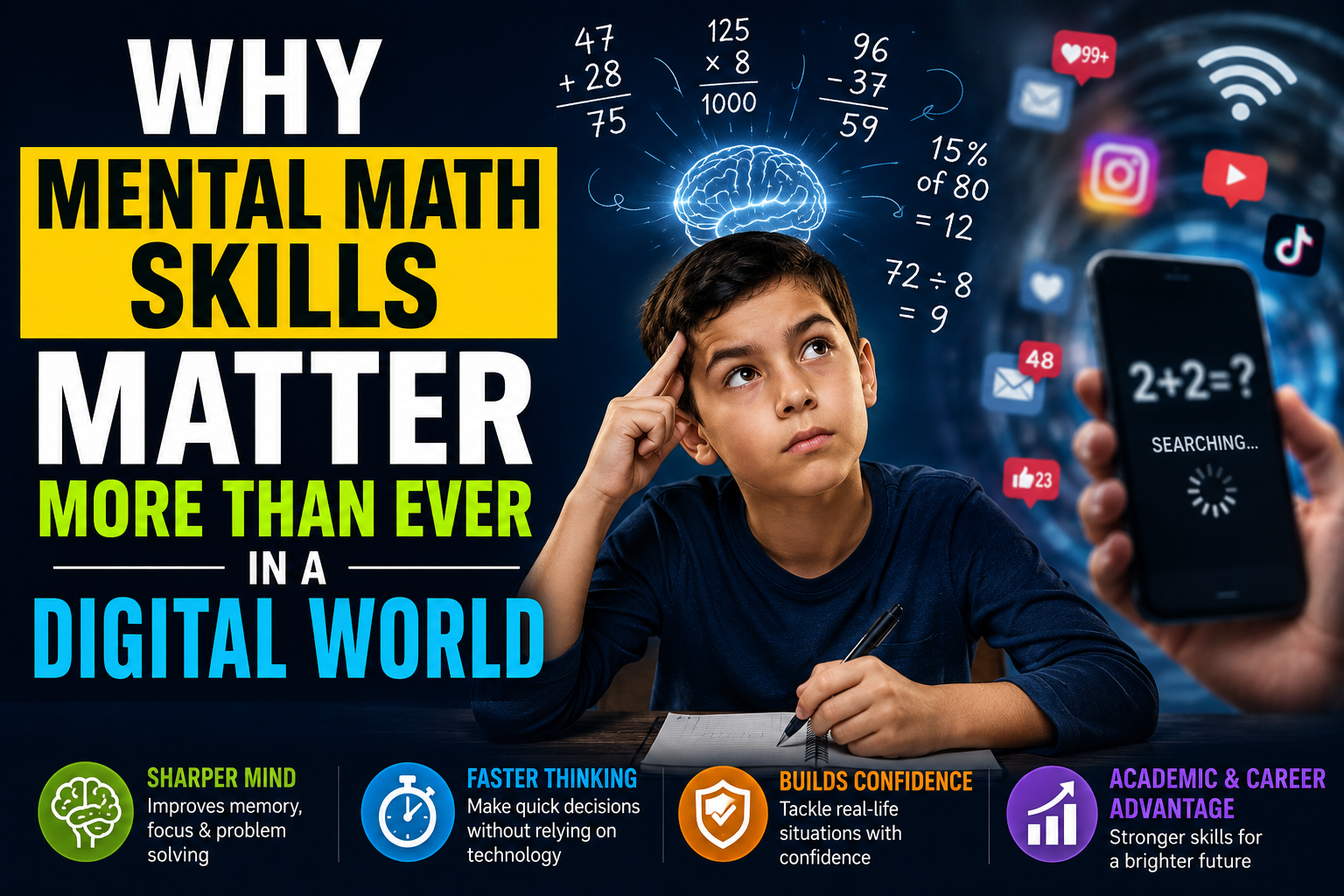
In today’s technology-driven world, children have instant access to calculators, smartphones, and digital assistants capable of solving almost any mathematical problem within seconds. While these tools offer convenience, they also raise an important question for parents and educators: Are children still developing the mental math skills they need to succeed?
The answer matters more than many people realize.
Mental math is about much more than quickly solving arithmetic problems. It helps children develop logical thinking, strengthens memory, improves concentration, and builds the confidence needed to tackle increasingly complex mathematical concepts. Whether a child is estimating the total cost while shopping, calculating change, measuring ingredients in a recipe, or solving classroom problems without relying on technology, strong mental arithmetic remains an essential life skill.
As education continues to evolve alongside digital technology, maintaining a balance between traditional mathematical fluency and modern learning tools has become increasingly important. Rather than replacing mental calculation, technology should complement it by providing engaging opportunities for practice and reinforcement.
What Is Mental Math?
Mental math refers to performing mathematical calculations in your head without using calculators, paper, or other external aids. These calculations may involve simple addition and subtraction or more advanced multiplication, division, percentages, fractions, and estimation.
However, mental math isn’t simply about memorizing facts. It requires children to recognize patterns, apply efficient strategies, and develop flexible problem-solving skills.
For example, instead of calculating 49 + 38 digit by digit, a student with strong number sense might think:
- 50 + 38 = 88
- Then subtract 1
- Final answer = 87
This type of flexible thinking helps students become more efficient and confident mathematicians.
Mental math also encourages children to understand why mathematical concepts work instead of simply memorizing procedures.
Why Mental Math Still Matters
Some people argue that calculators have made mental arithmetic unnecessary. While technology certainly has its place, relying on calculators too early can prevent children from developing essential numerical intuition.
Mental calculation strengthens the brain in ways that technology cannot replicate.
Children who regularly practice mental math often demonstrate stronger:
- Number sense
- Logical reasoning
- Working memory
- Problem-solving abilities
- Mathematical confidence
These skills extend far beyond mathematics itself. They contribute to better academic performance across many subjects and support everyday decision-making throughout adulthood.
Building Strong Number Sense
Number sense is one of the most valuable outcomes of regular mental math practice.
Children with strong number sense understand relationships between numbers naturally. They recognize that:
- 8 × 25 is the same as 4 × 50
- 99 is almost 100
- Half of 48 is 24
- Ten percent of 200 is 20
Instead of following rigid formulas, they approach problems creatively.
This flexibility becomes increasingly valuable as mathematical concepts grow more complex in upper primary and secondary education.
Students with strong number sense often find algebra, geometry, and statistics less intimidating because they already possess a deep understanding of numerical relationships.
Improving Memory and Concentration
Mental arithmetic exercises several important cognitive functions simultaneously.
When solving calculations mentally, children must:
- Remember numbers
- Apply mathematical rules
- Hold intermediate results
- Focus attention
- Monitor accuracy
This process strengthens working memory, which plays an essential role in reading comprehension, writing, scientific reasoning, and general learning.
Research has consistently shown that working memory is closely connected to academic achievement across multiple subjects.
Developing this cognitive capacity early provides long-term educational benefits.
Confidence Begins with Small Successes
One overlooked benefit of mental math is confidence.
Children who quickly recall multiplication facts or confidently solve arithmetic problems are more likely to participate in classroom discussions.
Instead of worrying about basic calculations, they can focus on understanding larger concepts.
Confidence creates momentum.
Small daily successes encourage children to attempt more challenging problems, ask thoughtful questions, and develop a positive relationship with mathematics.
Conversely, children who constantly struggle with basic facts often experience anxiety that affects overall academic performance.
Everyday Situations That Require Mental Math
Many adults use mental arithmetic without realizing it.
Daily examples include:
- Calculating discounts while shopping
- Estimating restaurant tips
- Comparing product prices
- Splitting bills among friends
- Measuring ingredients during cooking
- Managing household budgets
- Planning travel times
- Tracking sports statistics
Children who regularly practice these skills become more independent and capable in everyday situations.
Parents can encourage mental math naturally by involving children in these real-life activities instead of turning every calculation into a formal lesson.
How Parents Can Encourage Mental Math at Home
Parents don’t need advanced mathematical knowledge to help their children improve.
Simple daily conversations often provide excellent learning opportunities.
For example:
While grocery shopping:
“These apples cost £2.40 and the bananas cost £1.60. About how much will both cost together?”
During cooking:
“If this recipe serves four people but we have six guests, how much more of each ingredient do we need?”
While travelling:
“If we’re driving 120 miles at approximately 60 miles per hour, roughly how long will the journey take?”
These practical examples help children understand that mathematics exists everywhere, not just inside textbooks.
Keeping activities enjoyable and conversational reduces pressure while reinforcing important concepts.
Using Educational Games to Reinforce Learning
Children are naturally motivated by play.
Interactive educational games can transform repetitive practice into enjoyable learning experiences.
Short sessions that focus on multiplication tables, number bonds, division facts, and quick recall often keep children engaged longer than traditional worksheets.
Many teachers also recommend interactive resources like hit the button maths for short, focused practice sessions that help children strengthen arithmetic fluency while making learning feel more engaging and rewarding.
The key is consistency rather than lengthy study sessions. Five or ten minutes of regular practice often produces better long-term results than occasional extended practice.
Common Mistakes Parents Should Avoid
Despite good intentions, some approaches can unintentionally discourage children.
Focusing Only on Speed
Speed should never become the primary goal.
Accuracy and understanding matter far more than completing calculations quickly.
As confidence develops, speed naturally improves.
Making Mistakes Feel Like Failure
Mistakes are an essential part of learning.
Children should view incorrect answers as opportunities to understand new strategies rather than reasons to become discouraged.
Comparing Children
Every child develops mathematical confidence at a different pace.
Comparing siblings or classmates often creates unnecessary anxiety instead of motivation.
Celebrate individual progress rather than measuring success against others.
Creating a Five-Minute Daily Routine
Consistency is far more effective than occasional intensive practice.
A simple weekly routine might look like this:
Monday: Addition and subtraction facts
Tuesday: Multiplication tables
Wednesday: Division practice
Thursday: Number bonds and estimation
Friday: Mixed review games
Keeping sessions brief helps maintain enthusiasm while establishing positive habits.
Looking Beyond the Classroom
Mental math is ultimately about preparing children for life.
Strong numerical reasoning supports informed decision-making, financial literacy, critical thinking, and problem-solving in countless situations.
Whether children pursue careers in science, business, engineering, healthcare, education, or the arts, the confidence gained through strong mathematical foundations continues to provide lifelong value.
Technology will undoubtedly remain an important educational tool, but it should enhance—not replace—the development of essential mental arithmetic skills.
Final Thoughts
As digital tools become increasingly integrated into education, mental math remains one of the most valuable skills children can develop. Beyond improving arithmetic ability, it strengthens logical reasoning, enhances memory, builds confidence, and encourages flexible thinking that benefits learning across every subject.
Parents and educators don’t need complicated lesson plans to make a difference. Simple conversations, practical real-world examples, enjoyable games, and a few minutes of daily practice can significantly improve a child’s mathematical confidence over time.
By helping children develop strong mental math skills today, we equip them with abilities that will continue supporting their education, careers, and everyday decision-making for years to come.