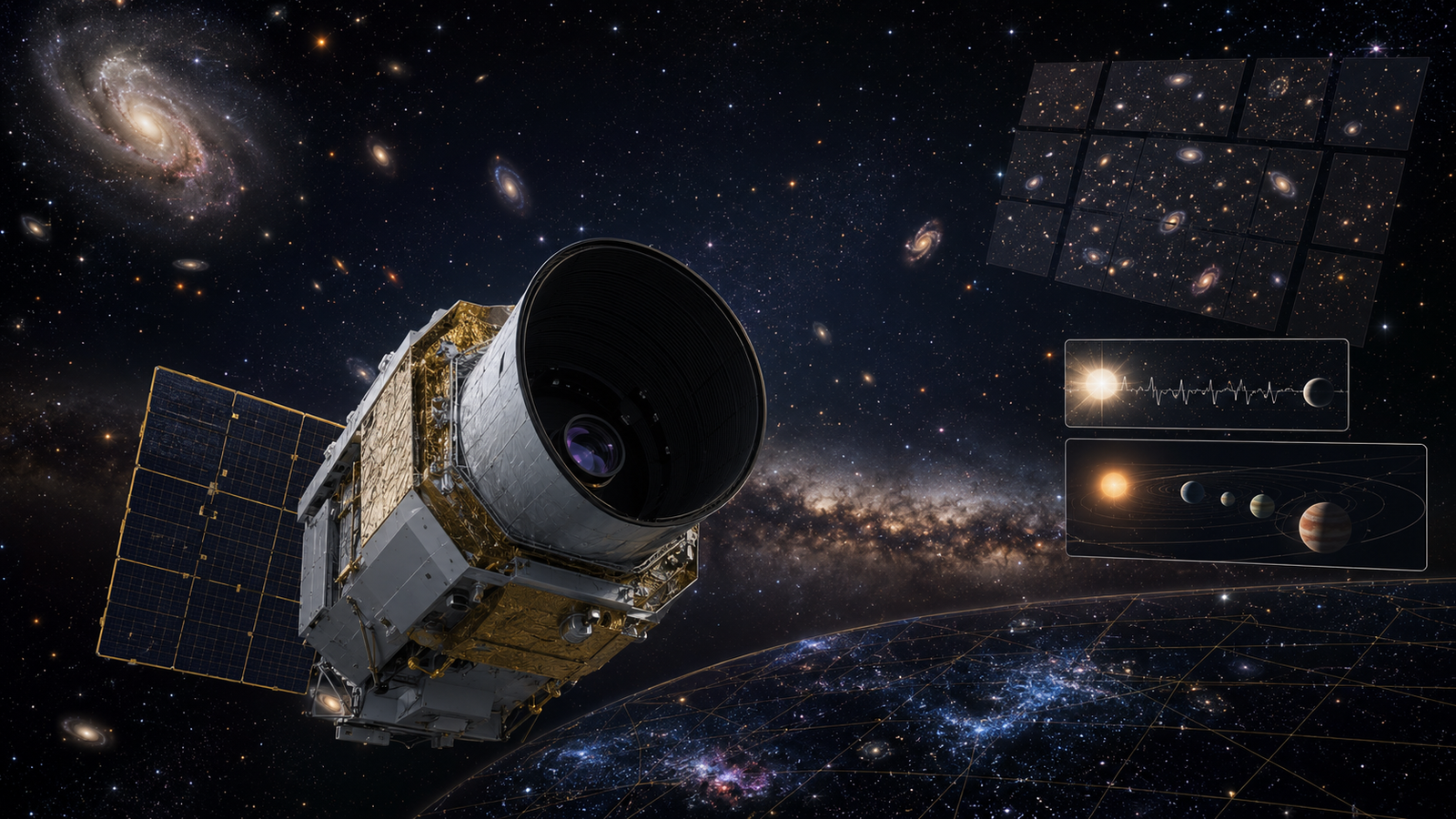
NASA Roman Space Telescope 2026 is one of the most important astronomy topics of the year because the Nancy Grace Roman Space Telescope is moving from construction and testing toward launch preparation. Roman is not just another space telescope. It is designed to survey huge areas of the sky, study dark energy, investigate dark matter, discover exoplanets, observe distant galaxies, and help scientists understand how the universe has changed over cosmic time.
The most accurate 2026 update is this: NASA reported in April 2026 that the Roman Space Telescope team is targeting launch as soon as early September 2026, ahead of NASA’s commitment to fly no later than May 2027. NASA also said the observatory was on track for delivery to Kennedy Space Center in Florida in June 2026. That makes Roman one of the most important upcoming NASA science missions to watch.
In simple words, Roman is built to see the universe differently from Hubble and Webb. Hubble can capture extremely detailed views, and Webb can study deep infrared targets with extraordinary sensitivity. Roman’s strength is wide-field survey power. NASA says Roman will have a field of view at least 100 times larger than Hubble’s, allowing it to measure light from enormous numbers of galaxies and survey the sky much faster than older narrow-field observatories.
For more related space science explainers, visit our NASA section and Space & Beyond category. You can also read our related guide on NASA exoplanet direct imaging technology because Roman’s coronagraph will test important technology for directly imaging planets around other stars.
Editorial Note
This article explains the NASA Roman Space Telescope using currently available official NASA information. It does not claim that Roman has already launched unless NASA confirms the launch. As of NASA’s April 2026 update, Roman is targeting launch as soon as early September 2026, with a formal launch commitment no later than May 2027. Future discoveries described in this article are explained as expected mission goals, not completed results.
Key Statistics and Facts
NASA describes the Nancy Grace Roman Space Telescope as a future space telescope designed to investigate dark matter, dark energy, exoplanets, infrared astrophysics, and other major questions about the universe. Its official launch commitment is by May 2027, while NASA’s April 2026 update says the team is targeting launch as soon as early September 2026.
Roman’s Wide Field Instrument is a 300-megapixel visible and infrared camera. NASA says this primary instrument will allow scientists to perform revolutionary astrophysics surveys and study topics such as the expansion of the universe, exoplanets in the Milky Way, and faraway galaxies.
Roman’s field of view is one of its biggest advantages. NASA says its 300-megapixel Wide Field Instrument can image a sky area 100 times larger than Hubble while maintaining Hubble-like sensitivity. In practical terms, one Roman image can contain the equivalent detail of about 100 Hubble images.
Roman’s High-Latitude Wide-Area Survey is designed to cover more than 5,000 square degrees, about 12 percent of the sky, in just under a year and a half. NASA says scientists will use this survey to analyze hundreds of millions of galaxies and study dark matter, dark energy, and other science topics.
Roman will also carry a Coronagraph Instrument. NASA/JPL describes the Roman Coronagraph as a technology demonstration that will help directly image reflected light from planets around other stars, especially worlds similar to Jupiter in size, temperature, and distance from their parent stars.
What Is the NASA Roman Space Telescope?
The NASA Roman Space Telescope, officially called the Nancy Grace Roman Space Telescope, is a next-generation space observatory named after Nancy Grace Roman, NASA’s first Chief of Astronomy and one of the key figures behind the Hubble Space Telescope. Roman was previously known as WFIRST, or the Wide Field Infrared Survey Telescope.
Roman is designed to study large-scale cosmic questions. It will observe galaxies, galaxy clusters, supernovae, exoplanets, stars, and deep-space structures. Its wide-field view makes it especially useful for surveys, which means it can observe large regions of the sky and collect huge amounts of data.
Example: imagine Hubble as a powerful camera that can zoom in on a small piece of the sky with beautiful detail. Roman is like a wide-angle camera with similar sharpness that can capture much larger areas at once. That difference is what makes Roman so powerful for cosmic surveys.
This wide-field ability matters because many of the biggest questions in astronomy require huge data sets. To understand dark energy, scientists need to study large numbers of galaxies and supernovae. To understand exoplanet populations, scientists need to monitor huge numbers of stars. Roman is built for exactly that kind of large-scale science.
Confirmed Facts vs Future Expectations
| Topic | Status in 2026 | Safe Explanation |
|---|---|---|
| Roman Space Telescope construction | Completed/prelaunch phase | NASA has completed construction and is preparing for launch operations |
| Launch timing | Targeting as soon as early September 2026 | NASA’s commitment remains no later than May 2027 |
| Wide Field Instrument | Confirmed primary instrument | 300-megapixel visible and infrared camera for wide surveys |
| Coronagraph Instrument | Confirmed technology demonstration | Designed to test direct imaging technology for exoplanets |
| Dark energy research | Mission goal | Roman is expected to help study cosmic expansion and dark energy |
| Exoplanet discoveries | Mission goal | Roman is expected to find many exoplanets through microlensing and other methods |
| Roman discoveries | Future results | Should not be described as already completed before launch and science operations |
In simple words, Roman is real and preparing for launch, but its major science discoveries will come after launch, commissioning, and full science operations.
Why Roman Is Important for Astronomy
Roman is important because it fills a gap between deep targeted observation and wide-field survey astronomy. Some telescopes are excellent at studying small areas in great detail. Roman is designed to study huge areas of the sky efficiently.
This matters because the universe is not understood by looking at only a few objects. Dark energy, dark matter, galaxy evolution, and planet populations all require large samples. Scientists need to compare millions or even billions of objects to find patterns.
Example: if a doctor wants to understand a rare disease, studying one patient is not enough. They need a large medical survey. In astronomy, Roman will act like a large cosmic survey machine, helping scientists collect enough information to find patterns across the universe.
NASA says Roman’s large field of view and fast survey speed will reveal many cosmic objects and help shine a light on dark matter and dark energy. That is why Roman is often described as a survey telescope rather than only a traditional imaging telescope.
Roman and Dark Energy
One of Roman’s main science goals is to study dark energy. Dark energy is the name scientists use for the mysterious force or property that appears to be driving the accelerated expansion of the universe. Scientists know the expansion of the universe is speeding up, but they do not fully understand why.
Roman will help study dark energy by mapping galaxies, measuring cosmic structure, observing supernovae, and analyzing how the universe expanded over time. NASA says Roman will usher in a new era of dark energy exploration and could help scientists investigate the true nature of this cosmic mystery.
Example: imagine the universe as a balloon being inflated. Galaxies are like dots on the surface of the balloon. As the balloon expands, the dots move farther apart. Dark energy is connected to why that expansion is accelerating. Roman will help scientists measure that expansion more precisely.
Roman’s High-Latitude Wide-Area Survey is especially important here. NASA says the survey will combine imaging and spectroscopy to uncover hundreds of millions of galaxies and create wide and deep 3D images that help astronomers explore the structure and expansion of the universe through cosmic time.
Roman and Dark Matter
Roman will also help scientists study dark matter. Dark matter does not emit light like stars, gas, or galaxies, but scientists can detect its gravitational effects. It helps shape galaxies, galaxy clusters, and the large-scale structure of the universe.
Roman can study dark matter using gravitational lensing. Gravitational lensing happens when the gravity of massive objects bends the light from objects behind them. By measuring these distortions, scientists can infer where invisible mass is located.
Example: imagine looking through a glass lens that slightly distorts a background image. If you study the distortion carefully, you can learn about the lens itself. In space, dark matter acts like an invisible gravitational lens. Roman’s wide-field images can help scientists map these subtle distortions across huge regions of the sky.
NASA’s High-Latitude Wide-Area Survey technical page explains that Roman’s survey is designed to study cosmic acceleration using weak gravitational lensing and galaxy clustering, along with spectroscopic measurements such as baryon acoustic oscillations and redshift-space distortions.
Roman’s Wide Field Instrument
The Wide Field Instrument is Roman’s primary science instrument. NASA describes it as a 300-megapixel visible-to-near-infrared imaging camera and slitless spectrometer. It is built for large-scale surveys, meaning it can gather massive amounts of astronomical information efficiently.
The Wide Field Instrument is important because it gives Roman its biggest advantage: wide, sharp, deep survey imaging. It can capture huge sky areas while still collecting detailed scientific data.
Example: if Hubble needed 100 separate images to cover a certain sky region, Roman could cover a similar area in one image while maintaining high scientific value. This makes Roman extremely powerful for projects that need large sky coverage.
Roman’s camera will work in visible and infrared wavelengths. Infrared light is valuable because it helps astronomers see through dust, study cooler objects, and observe distant galaxies whose light has been stretched by the expansion of the universe.
Roman and Exoplanet Discovery
Roman is also expected to transform exoplanet science. Exoplanets are planets outside our solar system. Roman will help discover exoplanets using a method called gravitational microlensing.
Microlensing happens when the gravity of a foreground star bends and magnifies the light from a background star. If the foreground star has a planet, that planet can create a small extra signal in the brightness pattern. This can reveal planets that would otherwise be very hard to detect.
Example: imagine a background star brightening briefly because another star passes in front of it from our point of view. If there is a planet near the foreground star, the brightness pattern may show a small additional bump. That bump can reveal the planet’s existence.
Roman’s Galactic Bulge Time-Domain Survey will repeatedly observe fields toward the center of the Milky Way. NASA says the survey will revisit six fields covering 1.7 square degrees, including one field pointed toward the galaxy’s center, during two 72-day observing windows each spring and fall.
This kind of repeated monitoring is important because microlensing events are temporary. Roman must watch many stars over time to catch the brief signals that reveal hidden planets.
For a related article, read our guide on NASA exoplanet direct imaging technology.
Roman’s Coronagraph Instrument
Roman will carry a Coronagraph Instrument that is designed to demonstrate future direct imaging technology for exoplanets. A coronagraph blocks the bright light from a star so that much fainter objects near the star, such as planets or disks, become easier to see.
NASA’s direct imaging page explains that Roman will demonstrate direct imaging technology by observing Jupiter-sized worlds around Sun-like stars and imaging planets that are up to several billion years old. NASA says these results could help pave the way for future missions to study worlds that are more Earth-like.
Example: trying to see an exoplanet next to its star is like trying to see a tiny firefly next to a bright searchlight from far away. The star overwhelms the planet’s light. A coronagraph helps block the searchlight so the faint planet becomes easier to detect.
This does not mean Roman will directly photograph Earth twins and confirm alien life. Roman’s coronagraph is a technology demonstration focused on giant planets and planet-forming disks. Its larger importance is that it helps develop tools future missions may need to study smaller, more Earth-like worlds.
Roman vs Hubble vs Webb
Roman, Hubble, and Webb are not competitors. They are different tools for different science jobs.
Hubble is famous for sharp visible and ultraviolet images. Webb is optimized for infrared observations and deep studies of early galaxies, stars, planets, and exoplanet atmospheres. Roman is designed for wide-field surveys, which means it can observe much larger sky areas quickly.
Example: Hubble is like a detailed portrait camera. Webb is like a powerful infrared observatory that can see through dust and study faint distant objects. Roman is like a wide-angle survey camera that can scan cosmic landscapes efficiently.
NASA describes Roman as Hubble’s “wide-eyed cousin” because Roman’s Wide Field Instrument is just as sensitive as Hubble’s cameras but can image a sky area 100 times larger.
This makes Roman especially powerful when scientists need statistics. Instead of studying only a few galaxies, Roman can study huge populations. Instead of finding only a few microlensing events, Roman can monitor millions of stars.
Roman and the High-Latitude Wide-Area Survey
One of Roman’s core surveys is the High-Latitude Wide-Area Survey. This survey is designed to create a large 3D map of the universe and help scientists study dark energy, dark matter, galaxy evolution, and cosmic structure.
NASA says the survey will cover more than 5,000 square degrees, about 12 percent of the sky, in just under a year and a half. Scientists will use it to analyze hundreds of millions of galaxies and investigate the universe’s large-scale structure.
Example: if the universe is like a giant city at night, Roman’s survey is like flying over that city and mapping millions of lights at once. Each galaxy tells scientists something about how the universe expanded and how matter formed cosmic structures.
This survey could become one of Roman’s most valuable contributions because dark energy research depends on massive data sets. The more galaxies scientists can measure, the better they can test models of cosmic expansion.
Roman and the Galactic Bulge Time-Domain Survey
Another major Roman survey is the Galactic Bulge Time-Domain Survey. This survey will observe stars toward the central region of the Milky Way. It is especially important for exoplanet discovery through microlensing.
NASA says the survey will conduct repeat visits to six fields covering 1.7 square degrees total, including one field that points toward the very center of the galaxy. These fields will be visible to Roman during two 72-day periods each spring and fall.
Example: if Roman watches millions of stars over time, it can detect tiny changes in brightness. Some changes may come from variable stars, while others may come from microlensing events caused by planets. This is why repeated observations are essential.
This survey may help reveal planets that are far from their stars, free-floating planets, and planets in regions of the galaxy that are difficult for other methods to study.
Why Roman Matters for Future Exoplanet Science
Roman’s exoplanet work is important because different planet-detection methods reveal different kinds of worlds. The transit method, used by missions like Kepler and TESS, finds planets when they pass in front of their stars. The radial velocity method detects star wobble caused by orbiting planets. Microlensing can reveal planets at larger distances from their stars and even planets that may not be bound to a star.
Example: if astronomers only use one method, they may get an incomplete picture of planet populations. Roman’s microlensing survey can help fill missing parts of the exoplanet census.
Roman’s coronagraph adds another piece by testing direct imaging technology. Together, these tools make Roman valuable not only for finding planets but also for preparing future missions that may study potentially habitable worlds.
Roman and Infrared Astronomy
Roman observes in visible and near-infrared wavelengths. Infrared astronomy is important because many objects in space are hidden by dust or are so distant that their light has shifted toward infrared wavelengths.
Example: the center of the Milky Way is crowded and dusty. Visible light can be blocked by dust clouds, but infrared light can pass through more effectively. This helps Roman study crowded star fields toward the galactic bulge.
Infrared observations also help astronomers study distant galaxies. As the universe expands, light from faraway galaxies stretches into longer wavelengths. Roman’s infrared capabilities will help scientists observe these distant objects across wide areas of the sky.
Roman and Big Data Astronomy
Roman will produce enormous amounts of scientific data. This is one of the reasons the mission is so important for modern astronomy. Instead of only creating individual beautiful images, Roman will generate survey data that researchers around the world can analyze for many different scientific questions.
Example: one Roman survey may help dark energy researchers study cosmic expansion, exoplanet scientists search for planets, galaxy researchers study structure formation, and transient-event scientists identify changing objects.
This kind of large public data can create discoveries beyond the mission’s original goals. A scientist may use Roman data years later to answer a question that was not even part of the original survey plan.
As NASA missions produce larger data volumes, communication and data systems become increasingly important. For related background, read our article on NASA deep space laser communication technology.
Why 2026 Matters for Roman
The year 2026 matters because Roman is entering a major transition period. NASA has completed major construction and testing milestones, and the agency is preparing the observatory for launch operations.
NASA reported in April 2026 that Roman is targeting launch as soon as early September 2026. The same update said the observatory was on track for delivery to Kennedy Space Center in June 2026, ahead of NASA’s commitment to launch no later than May 2027.
This is the safe 2026 wording:
Roman has not yet produced science results from space.
NASA is targeting launch as soon as early September 2026.
The official commitment remains no later than May 2027.
Roman’s major discoveries will come after launch, commissioning, and science operations.
This careful distinction keeps the article accurate and prevents misleading mission-status claims.
What Roman Could Reveal
Roman could help answer some of the biggest questions in astronomy.
It could help scientists understand dark energy by measuring how cosmic expansion changed over time.
It could help map dark matter by studying gravitational lensing and galaxy clustering.
It could discover large numbers of exoplanets through microlensing.
It could test direct imaging technology through its coronagraph.
It could observe distant galaxies and help scientists understand how cosmic structure formed.
It could identify transient events, such as exploding stars or other changing objects.
Example: if Roman detects thousands of microlensing signals, scientists may gain a much better understanding of how common planets are in different parts of the Milky Way. If Roman maps hundreds of millions of galaxies, scientists may better test models of dark energy and cosmic expansion.
What People Often Get Wrong
Many people think Roman is just another version of Hubble. That is not correct. Roman has a Hubble-sized mirror class, but its main strength is wide-field survey capability. It can image much larger sky areas than Hubble.
Another mistake is saying Roman has already launched. As of NASA’s April 2026 update, Roman is targeting launch as soon as early September 2026, with the formal commitment no later than May 2027.
A third mistake is claiming Roman will immediately find alien life. Roman may help study exoplanets and demonstrate direct imaging technology, but it is not a mission that should be described as confirming life beyond Earth.
A fourth mistake is ignoring the difference between Roman and Webb. Webb is deeper and highly sensitive for selected targets, especially in infrared. Roman is designed for wide-field surveys and large population studies.
Finally, some articles make the 2026 angle too strong. The safe wording is “targeting launch,” “preparing for launch,” or “expected mission goals,” not “Roman has already transformed astronomy” before science operations begin.
Practical Reader Takeaway
NASA Roman Space Telescope 2026 is important because Roman is expected to become one of NASA’s most powerful survey observatories.
Roman is targeting launch as soon as early September 2026.
Its official launch commitment is no later than May 2027.
Its Wide Field Instrument is a 300-megapixel visible and infrared camera.
Its field of view is at least 100 times larger than Hubble’s.
It will study dark energy, dark matter, exoplanets, galaxies, and infrared astrophysics.
Its coronagraph will demonstrate direct imaging technology for exoplanets.
Roman’s greatest strength is not only sharp images. Its greatest strength is wide, deep, fast survey power.
Frequently Asked Questions
What is the NASA Roman Space Telescope?
The NASA Roman Space Telescope is a future space observatory designed to study dark energy, dark matter, exoplanets, galaxies, and infrared astrophysics. It is officially called the Nancy Grace Roman Space Telescope.
Is the Roman Space Telescope launching in 2026?
NASA reported in April 2026 that Roman is targeting launch as soon as early September 2026, ahead of the agency’s commitment to fly no later than May 2027.
Why is Roman called Hubble’s wide-eyed cousin?
Roman is called Hubble’s wide-eyed cousin because its Wide Field Instrument can image a sky area 100 times larger than Hubble while maintaining Hubble-like sensitivity.
What will Roman study?
Roman will study dark energy, dark matter, galaxies, exoplanets, infrared astrophysics, and cosmic structure. NASA says the mission will investigate dark matter, dark energy, exoplanets, and other mysteries.
How will Roman study exoplanets?
Roman will study exoplanets through microlensing surveys and through its Coronagraph Instrument. Microlensing can reveal planets by measuring how gravity changes the brightness of background stars, while the coronagraph will test direct imaging technology.
What is Roman’s Wide Field Instrument?
Roman’s Wide Field Instrument is a 300-megapixel visible and infrared camera that will allow scientists to perform large astrophysics surveys.
What is Roman’s Coronagraph Instrument?
Roman’s Coronagraph Instrument is a technology demonstration designed to block starlight so scientists can directly image faint planets and disks around nearby stars.
Will Roman replace Hubble or Webb?
No. Roman will not replace Hubble or Webb. Hubble, Webb, and Roman have different strengths. Roman’s main advantage is wide-field survey power.
Can Roman find alien life?
Roman is not designed to directly confirm alien life. It can help discover exoplanets and test imaging technology that may support future missions designed to study potentially habitable worlds in more detail.
Conclusion
NASA Roman Space Telescope 2026 is one of the most important astronomy stories to watch because Roman is moving toward launch preparation after years of development, construction, and testing. NASA’s April 2026 update says the mission is targeting launch as soon as early September 2026, ahead of the official commitment to launch no later than May 2027.
Roman is important because it combines wide-field imaging, infrared sensitivity, exoplanet science, dark energy research, and advanced survey capability. Its 300-megapixel Wide Field Instrument can observe large areas of the sky with Hubble-like sensitivity, while its coronagraph will test technology needed for future direct imaging of exoplanets.
The simplest way to understand Roman is this: Hubble showed us the universe in extraordinary detail, Webb opened deeper infrared views, and Roman is designed to survey the universe at massive scale. It could help scientists map cosmic structure, study dark energy, investigate dark matter, discover new exoplanets, and create data sets that astronomers will use for many years.
Roman has not yet made its space discoveries, but its mission goals are powerful. If successful, it could become one of the defining space observatories of the next decade.
Sources and Further Reading
NASA: Roman Space Telescope Mission Overview
NASA: Roman Targets Early September 2026 Launch
NASA: Introducing the Roman Space Telescope
NASA: Wide Field Instrument Poster
NASA: High-Latitude Wide-Area Survey
NASA: Galactic Bulge Time-Domain Survey