A dangerous asteroid impact is one of the rare natural disasters humans may be able to prevent before it happens.
Earth has been hit by asteroids before. Most small objects burn up harmlessly in the atmosphere, creating bright meteors or small meteorites. But larger asteroids can cause regional or global damage depending on their size, speed, composition, and impact location. That is why asteroid detection and planetary defense are not science fiction. They are real parts of modern space science.
NASA planetary defense asteroid missions are designed to answer one of the most important questions in space safety: if a dangerous asteroid were ever found on a collision path with Earth, could humanity detect it early enough and do something about it?
In 2026, the answer is more hopeful than ever, but it must be explained carefully. NASA is not warning that a known asteroid is about to destroy Earth. NASA’s asteroid monitoring systems show no known significant asteroid impact threat for the next hundred years or more. The real story is not panic. The real story is preparation.
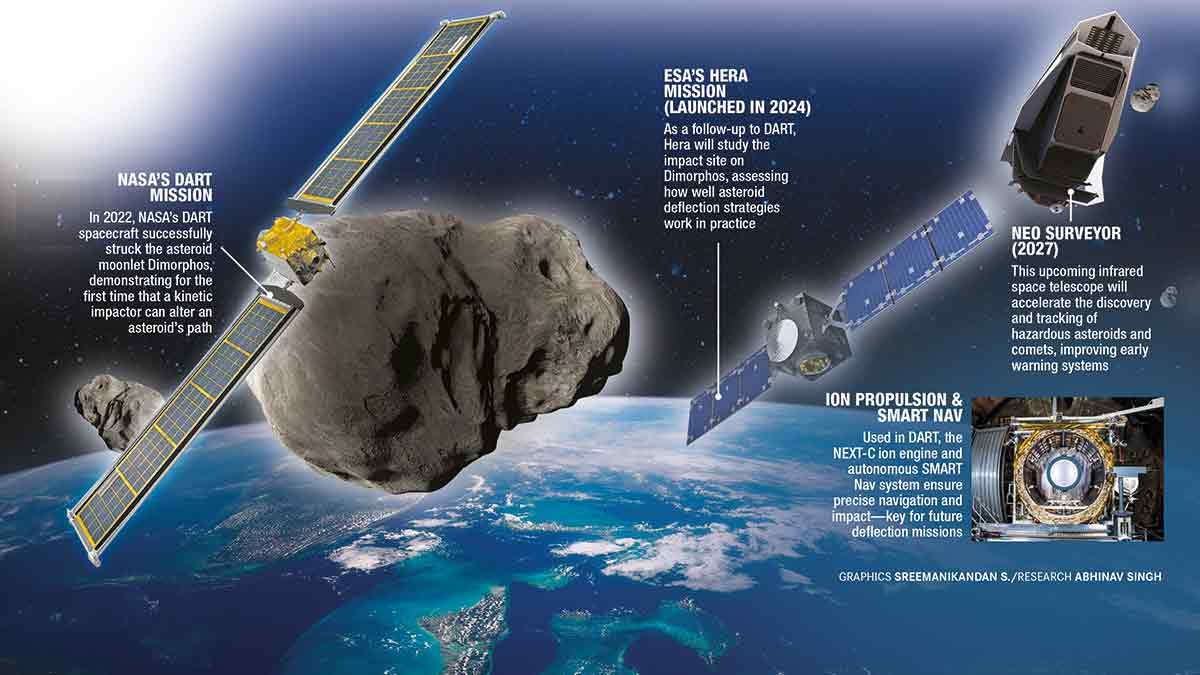
NASA’s planetary defense work includes detecting near-Earth objects, tracking their orbits, calculating impact probabilities, studying asteroid composition, testing deflection methods, and preparing future missions such as NEO Surveyor. NASA’s DART mission already demonstrated that a spacecraft impact can change the motion of an asteroid, while NEO Surveyor is being developed to find more potentially hazardous asteroids that may be difficult to detect from the ground.
In simple words, planetary defense is about finding asteroids before they find us.
Table of Contents
ToggleEditorial Note
This article explains confirmed NASA planetary defense missions, asteroid tracking systems, current mission status, and future protection strategies. It does not claim that Earth is facing a confirmed asteroid impact in 2026. NASA’s current planetary defense work focuses on preparedness, detection, tracking, science, and technology demonstration. Future mission dates and asteroid risk updates should always be checked against official NASA and CNEOS information.
Key Statistics and Facts
| Fact | Why It Matters |
|---|---|
| NASA’s DART mission was the first planetary defense technology demonstration to change an asteroid’s motion in space. | It proved that a kinetic impactor could alter an asteroid’s orbit under test conditions. |
| DART impacted Dimorphos on September 26, 2022. | This was humanity’s first intentional asteroid deflection test. |
| DART changed Dimorphos’ orbit around Didymos by about 32 minutes. | The result showed measurable asteroid deflection. |
| NEO Surveyor is the first space telescope designed specifically to detect potentially hazardous asteroids and comets. | Better detection is the first step in planetary defense. |
| NEO Surveyor is planned to launch no earlier than September 2027. | It is a future mission, not a completed 2026 mission. |
| NASA/JPL’s CNEOS says there is currently no known significant asteroid impact threat for the next 100 years or more. | Planetary defense is about preparation, not panic. |
| NASA’s Sentry system continually scans known asteroid orbits for possible future impacts. | Continuous orbit monitoring helps scientists update risk assessments. |
These facts show why planetary defense matters. Earth is not under a confirmed asteroid threat in 2026, but NASA is building the systems needed to detect and respond to possible hazards in the future.
What Is Planetary Defense?
Planetary defense is the science and technology of protecting Earth from potentially hazardous asteroids and comets. It includes discovering near-Earth objects, tracking their orbits, studying their physical properties, calculating impact risks, and developing possible methods to prevent a future impact.
The term may sound dramatic, but much of planetary defense is careful observation and mathematics. Scientists need to know where asteroids are, how fast they are moving, what paths they follow, and whether those paths could ever cross Earth’s orbit at the wrong time.
Planetary defense includes several main steps:
Finding near-Earth objects.
Tracking their motion.
Calculating their future orbits.
Identifying possible impact risks.
Studying asteroid size, shape, composition, and structure.
Testing deflection methods.
Preparing response plans if a real threat is found.
The most important idea is early detection. If scientists discover a dangerous asteroid many years before a possible impact, even a small change in its path could make it miss Earth. If it is discovered too late, options become much more limited.
For more space science explainers, visit our Space & Beyond section.
Why Asteroids Matter for Earth Safety
Asteroids are leftover building blocks from the early solar system. Most orbit safely in the asteroid belt between Mars and Jupiter, but some travel closer to Earth. These are called near-Earth objects, or NEOs.
A near-Earth object does not automatically mean danger. Many pass by Earth at safe distances. Some are small enough to burn up in the atmosphere. Others may be large enough to cause damage if they ever impacted the planet.
The risk depends on several factors:
The object’s size.
Its speed.
Its composition.
Its orbit.
The impact location.
The warning time before impact.
Small asteroids enter Earth’s atmosphere regularly and usually disintegrate. Larger objects are much rarer, but they are the reason planetary defense exists. A large impact could damage a city, a region, or, in extreme cases, affect the global environment.
NASA’s planetary defense work is based on a practical idea: asteroid impacts are natural hazards, and natural hazards can be studied, tracked, and prepared for.
Is Earth in Danger from a Known Asteroid in 2026?
No known asteroid poses a significant impact threat to Earth in 2026.
This is an important trust point. Planetary defense should not be presented as fear-based content. NASA and JPL’s Center for Near-Earth Object Studies, known as CNEOS, track near-Earth objects and calculate possible future impact risks. CNEOS states that there is currently no known significant threat of impact for the next hundred years or more.
That does not mean planetary defense is unnecessary. It means the current known risk is low, and the best strategy is continued detection and monitoring.
Asteroid risk can change as new objects are discovered and new observations improve orbit calculations. Sometimes an asteroid may briefly appear to have a small chance of future impact, then later observations reduce or eliminate that risk. This happened with asteroid 2024 YR4, which NASA later said posed no significant threat to Earth in 2032 and beyond.
The accurate message is this: Earth is not facing a confirmed asteroid emergency, but NASA is preparing because early detection and planning are the best protection.
NASA’s Planetary Defense Coordination Office
NASA’s Planetary Defense Coordination Office, or PDCO, leads NASA’s efforts to find, track, and understand potentially hazardous near-Earth objects. It supports asteroid discovery programs, tracking systems, impact risk assessment, science missions, and technology demonstrations.
PDCO works with observatories, researchers, mission teams, international partners, and other agencies. Planetary defense is not only a NASA issue. A serious asteroid threat would be a global concern.
The office focuses on three major goals.
First, find and track near-Earth objects that could pose a risk.
Second, study asteroid properties so scientists understand what kind of object they are dealing with.
Third, support technology and planning that could help deflect or respond to a future threat.
NASA’s DART mission and NEO Surveyor are two major examples of planetary defense work. DART tested asteroid deflection. NEO Surveyor is designed to improve asteroid detection.
For more NASA mission explainers, visit our NASA category.
DART: NASA’s First Asteroid Deflection Test
DART stands for Double Asteroid Redirection Test. It was NASA’s first mission designed to test whether a spacecraft could change an asteroid’s motion by deliberately crashing into it.
DART targeted Dimorphos, a small moonlet orbiting the larger asteroid Didymos. Neither asteroid threatened Earth. That made the Didymos-Dimorphos system a safe test target.
On September 26, 2022, DART intentionally impacted Dimorphos at high speed. The goal was to see whether the impact could change Dimorphos’ orbit around Didymos.
It worked.
NASA confirmed that DART changed Dimorphos’ orbit by about 32 minutes. This marked the first time humans intentionally changed the motion of a celestial object in a measurable way for planetary defense.
DART did not “save Earth” from a real threat, because there was no threat from Didymos or Dimorphos. Its purpose was to test a technique before it might ever be needed.
That distinction is important. DART was a demonstration, not an emergency response.
How DART Changed Planetary Defense
Before DART, asteroid deflection was mostly a theoretical idea supported by simulations and laboratory studies. After DART, scientists had real mission data.
DART showed that a kinetic impactor can change an asteroid’s motion under the right conditions. A kinetic impactor is a spacecraft that hits an asteroid to change its speed and path slightly. If done early enough, even a small change can make a dangerous asteroid miss Earth years later.
DART also taught scientists that asteroid material matters. Dimorphos was not a solid metal ball. Its surface and debris behavior affected how momentum transferred from the spacecraft impact to the asteroid.
When DART hit Dimorphos, debris was blasted into space. That ejecta added extra momentum, making the deflection stronger than the spacecraft impact alone would have produced.
This is why planetary defense needs asteroid science. To know how to deflect an asteroid, scientists must understand what it is made of, how it is structured, how it rotates, and how it reacts to force.
New 2026 DART Findings
NASA reported new research in 2026 showing that DART did more than change Dimorphos’ orbit around Didymos. The impact also slightly changed the orbit of the Didymos-Dimorphos system around the Sun.
This matters because it shows how precise asteroid tracking has become. Scientists can measure extremely small changes in celestial motion and use that data to improve planetary defense models.
The lesson is not that every asteroid can be easily moved. The lesson is that asteroid motion can be changed, and careful measurement helps scientists understand how effective a deflection method may be.
DART remains one of the most important planetary defense milestones because it moved asteroid deflection from theory to real-world demonstration.
NEO Surveyor: Finding Asteroids Before They Find Us
Detection is the first rule of planetary defense. NASA can only respond to an asteroid threat if the object is found early.
NEO Surveyor is NASA’s next-generation asteroid-hunting space telescope. It is designed specifically to detect asteroids and comets that may be potential hazards to Earth. NASA says NEO Surveyor will be the first spacecraft built specifically to find large numbers of potentially hazardous asteroids and comets.
NEO Surveyor will use infrared detection. This is important because some asteroids are dark and do not reflect much visible light. But they absorb sunlight and glow in infrared wavelengths. Infrared detection can help reveal objects that visible-light telescopes may miss.
NEO Surveyor is also designed to help find asteroids that approach Earth from the direction of the Sun, where they can be difficult for ground-based telescopes to detect because of sunlight glare.
As of current NASA information, NEO Surveyor is a future mission planned for launch no earlier than September 2027. It should not be described as already launched or operating in 2026.
Why Infrared Detection Matters
Infrared asteroid detection is important because not all asteroids are equally bright. Some are dark, carbon-rich, and difficult to see with visible-light telescopes. A dark asteroid can be large but still reflect very little sunlight.
Infrared telescopes detect heat. Even a dark asteroid warmed by the Sun can glow in infrared light. This helps scientists estimate asteroid size more reliably because infrared brightness depends partly on heat emission.
Visible-light observations can sometimes make asteroid size harder to estimate because a small bright asteroid and a large dark asteroid may reflect similar amounts of sunlight. Infrared data helps reduce that uncertainty.
Size matters for planetary defense. A small asteroid may burn up in the atmosphere. A larger asteroid could reach the ground or cause serious damage. Knowing the size helps scientists understand the level of risk.
NEO Surveyor’s infrared capability is one reason it is important for the future of planetary defense.
CNEOS and Sentry: Tracking Future Impact Risk
NASA’s Center for Near-Earth Object Studies, or CNEOS, is managed by NASA’s Jet Propulsion Laboratory. CNEOS calculates asteroid and comet orbits, close approaches, and possible future impact probabilities.
One of its key tools is Sentry. Sentry is an automated impact monitoring system that continuously scans known asteroid orbits and looks for possible future Earth impacts over the next 100 years.
This kind of monitoring is essential because asteroid risk is not based on one observation. When a new asteroid is discovered, scientists need multiple observations to refine its orbit. Early orbit calculations can contain uncertainty. As more data comes in, the uncertainty usually shrinks.
Sometimes an asteroid may appear on a risk list because its orbit is not yet well known. Later observations may show that it is not a threat. This does not mean scientists were wrong. It means the uncertainty was reduced.
Planetary defense depends on this process: discover, observe, calculate, update, and communicate clearly.
2024 YR4: A Useful Example of Risk Updates
Asteroid 2024 YR4 is a good example of how planetary defense monitoring works. When it was first discovered, it briefly drew attention because early observations showed a very small but notable chance of future impact.
As astronomers collected more observations, the orbit became clearer. NASA later reported that the asteroid posed no significant threat to Earth in 2032 and beyond.
This is an important lesson for readers. Early asteroid risk estimates can change. A temporary risk listing does not automatically mean disaster. It means scientists are watching carefully while orbit uncertainty is reduced.
Good planetary defense communication must avoid panic. It should explain uncertainty, update readers, and use official sources.
That is also important for website credibility. Articles about asteroid threats should never exaggerate risk for clicks.
Confirmed Facts vs Future Possibilities
| Topic | Status |
|---|---|
| NASA’s DART mission successfully impacted Dimorphos | Confirmed |
| DART changed Dimorphos’ orbit around Didymos | Confirmed |
| DART tested one asteroid deflection method | Confirmed |
| NEO Surveyor is designed to find potentially hazardous asteroids and comets | Confirmed |
| NEO Surveyor is launching in 2026 | Not confirmed |
| NEO Surveyor launch no earlier than September 2027 | Current NASA target |
| A known asteroid is confirmed to hit Earth in 2026 | Not confirmed |
| NASA can perfectly prevent every asteroid impact | Not confirmed |
| Future asteroid deflection missions | Future possibility if a threat is found |
This table is important because planetary defense content can easily become misleading. The safest and most accurate message is that NASA has demonstrated asteroid deflection and is improving detection, but there is no confirmed asteroid impact emergency in 2026.
How Asteroid Deflection Could Work
If scientists discovered a dangerous asteroid years or decades before impact, several response methods could be considered. The best method would depend on the asteroid’s size, composition, orbit, warning time, and impact probability.
One method is kinetic impact. This is what DART tested. A spacecraft hits the asteroid to slightly change its speed and path.
Another method is a gravity tractor. A spacecraft flies near an asteroid for a long time, using its small gravitational pull to slowly tug the asteroid onto a different path.
A third possibility is changing the asteroid’s surface properties or using focused energy to alter its motion, but these methods are more experimental.
Nuclear options are sometimes discussed for extreme cases, but they would involve major technical, political, and safety considerations.
The key point is that early warning makes deflection easier. If an asteroid is found decades in advance, a small change may be enough. If it is found very late, the problem becomes much harder.
Planetary Defense Is Not Just One Mission
Planetary defense is not a single spacecraft or one dramatic impact. It is a complete system.
It includes:
Telescopes that discover asteroids.
Follow-up observations that refine orbits.
Databases that store asteroid data.
Models that calculate future paths.
Missions that study asteroid properties.
Technology demonstrations like DART.
Future survey missions like NEO Surveyor.
International coordination.
Public communication.
Emergency planning.
Scientific research.
This system matters because asteroid risk is complex. A dangerous object must be found, confirmed, tracked, studied, and responded to properly.
In simple words, planetary defense is a chain. If one link is weak, the whole system becomes less effective.
NASA Missions That Support Planetary Defense
NASA has several asteroid-related missions that support planetary defense directly or indirectly.
DART directly tested asteroid deflection.
NEO Surveyor is designed to improve detection of potentially hazardous asteroids and comets.
OSIRIS-REx returned a sample from asteroid Bennu, helping scientists understand asteroid material.
OSIRIS-APEX will study asteroid Apophis after its close approach to Earth in 2029.
Psyche is studying a metal-rich asteroid, improving knowledge of asteroid diversity.
Lucy is exploring Trojan asteroids, helping scientists understand early solar system bodies.
Not all asteroid missions are planetary defense missions. Some are science missions. But asteroid science can still help planetary defense because understanding asteroid structure, composition, and behavior is important if humans ever need to redirect one.
For more on the future of asteroid resources and asteroid science, read our article on NASA asteroid mining mission plans.
Asteroid Science and Planetary Defense
Planetary defense depends on asteroid science. To deflect or respond to an asteroid, scientists need to know what kind of object it is.
Important asteroid properties include:
Size.
Mass.
Shape.
Rotation.
Density.
Surface structure.
Internal structure.
Composition.
Porosity.
Orbit.
Binary or single-body status.
A solid metallic asteroid may respond differently to an impact than a loose rubble-pile asteroid. A fast-rotating asteroid may create different operational challenges than a slow one. A binary asteroid system may behave differently from a single object.
This is why missions like OSIRIS-REx and Psyche matter even when they are not deflection missions. They help scientists understand the diversity of asteroids.
The more NASA learns about asteroids, the better future planetary defense strategies can become.
Planetary Defense and Asteroid Resources
Asteroid resources and planetary defense are different topics, but they overlap in some technologies. Both require spacecraft to approach small bodies, navigate in weak gravity, study composition, and understand surface behavior.
A future asteroid resource mission would need to know how to collect material safely. A planetary defense mission would need to know how an asteroid responds to impact, gravity, or other forces.
Both fields benefit from better asteroid mapping, surface imaging, spectroscopy, and sample analysis.
However, they should not be confused. Planetary defense is about protecting Earth. Asteroid mining is about possible future resource use. NASA’s current planetary defense mission work is not the same as commercial asteroid mining.
Why 2026 Matters for Planetary Defense
The year 2026 matters because planetary defense is entering a more mature phase. DART has already demonstrated one deflection method. NEO Surveyor is moving toward a planned launch no earlier than September 2027. CNEOS and Sentry continue monitoring known near-Earth objects. NASA’s asteroid science missions continue improving knowledge of small bodies.
This makes 2026 a year of preparation, analysis, and future mission readiness.
It is not accurate to say NASA is launching a new asteroid defense mission in 2026 unless NASA announces one. It is accurate to say NASA’s planetary defense program is building on DART, preparing for NEO Surveyor, tracking asteroid risks, and improving future protection strategies.
That wording is safer for trust, search quality, and premium ad-network approval.
Comparison: DART vs NEO Surveyor
| Feature | DART | NEO Surveyor |
|---|---|---|
| Mission Type | Asteroid deflection test | Asteroid detection space telescope |
| Status | Completed technology demonstration | Future mission |
| Main Goal | Test kinetic impact deflection | Find potentially hazardous asteroids and comets |
| Target | Dimorphos, moonlet of Didymos | Near-Earth objects |
| Threat to Earth? | Target was not a threat | Designed to help find possible future hazards |
| Main Lesson | Asteroid motion can be changed | Detection is essential before defense is possible |
| Importance | Demonstrated response capability | Improves early warning capability |
This comparison shows why both missions matter. DART tested what humans might do if a threat is found. NEO Surveyor is designed to help find threats earlier.
How Planetary Defense Protects Everyday Life
Asteroid defense may sound like a distant space issue, but it is connected to life on Earth. A large asteroid impact could affect cities, infrastructure, agriculture, climate, communication, transportation, and public safety depending on its size and impact location.
Planetary defense helps protect:
People.
Cities.
Power systems.
Communication networks.
Transportation systems.
Agriculture.
Emergency services.
Scientific infrastructure.
Global stability.
The goal is not to scare people. The goal is to prepare in a calm, scientific way.
This is similar to earthquake monitoring, hurricane forecasting, or volcano observation. Scientists cannot stop natural forces from existing, but they can study them, warn people, and reduce risk.
How International Cooperation Matters
Asteroid impacts would not respect national borders. A serious threat would require global coordination.
NASA works with international partners, observatories, space agencies, and scientific organizations. The International Asteroid Warning Network and the Space Mission Planning Advisory Group are examples of global coordination efforts related to planetary defense.
International cooperation matters for several reasons.
More telescopes mean better sky coverage.
More observations mean better orbit calculations.
More agencies mean more technical options.
More communication reduces confusion.
Global planning helps avoid political conflict during a real threat.
Planetary defense is one of the clearest examples of space science serving all of humanity.
What People Often Get Wrong About Planetary Defense
Many people think planetary defense means NASA is preparing for a confirmed asteroid impact. That is not true. Planetary defense is preparation for possible future risks, not proof that disaster is coming.
Another mistake is thinking all near-Earth asteroids are dangerous. Most are not on impact paths.
Some people think DART destroyed an asteroid. It did not. DART changed the motion of Dimorphos; it did not blow it apart.
Another misunderstanding is thinking asteroid deflection would work the same for every asteroid. Different asteroids have different structures and materials.
Some people think NEO Surveyor already launched in 2026. It has not. NASA lists launch as no earlier than September 2027.
A final mistake is thinking asteroid warnings should always create panic. In reality, early warnings are useful because they give scientists time to refine calculations and, if needed, prepare a response.
Timeline: NASA Planetary Defense Progress
| Period | Development |
|---|---|
| Early asteroid surveys | Scientists began cataloging near-Earth objects and tracking possible hazards |
| 2016 | NASA established the Planetary Defense Coordination Office |
| 2021 | DART launched to test asteroid deflection |
| 2022 | DART impacted Dimorphos and changed its orbit around Didymos |
| 2023–2025 | Continued DART analysis improved understanding of asteroid deflection |
| 2026 | NASA continues planetary defense monitoring, DART analysis, and NEO Surveyor preparation |
| No earlier than September 2027 | NEO Surveyor planned launch |
| 2029 | OSIRIS-APEX expected to study Apophis after its close Earth flyby |
| Future | More detection, tracking, science, and possible response technologies may develop |
This timeline shows that planetary defense is a long-term effort. It is not one event, one mission, or one year.
Asteroid Apophis and the 2029 Flyby
Asteroid Apophis is one of the most famous near-Earth asteroids because early observations once raised concern about possible future impacts. Later NASA analysis ruled out impact risk for at least the next 100 years.
Apophis will make a very close approach to Earth in 2029, but it will not hit Earth. This close flyby creates a valuable scientific opportunity. Scientists can study how Earth’s gravity affects the asteroid’s orbit, rotation, and surface.
NASA’s OSIRIS-APEX mission is expected to study Apophis after the flyby. This will help scientists understand asteroid behavior during a close planetary encounter.
Apophis is a good example of how planetary defense works: discover, track, refine calculations, remove false risk when data improves, and use the opportunity for science.
The Role of Public Communication
Public communication is a major part of planetary defense. Asteroid stories can spread quickly online, and misleading headlines can cause unnecessary fear.
Good communication should explain:
Whether an asteroid is actually a threat.
How certain the orbit calculation is.
What NASA or other agencies are doing.
Whether the risk has changed.
What the public should understand.
What is confirmed and what is not confirmed.
This matters for trust. A website that exaggerates asteroid danger may get attention briefly, but it damages credibility. A strong science article should inform readers clearly and calmly.
For premium ad-network quality, asteroid content should be accurate, useful, source-backed, and not fear-driven.
Future Possibilities for Asteroid Defense
Future planetary defense may include more advanced detection systems, improved infrared telescopes, faster orbit calculations, better asteroid characterization, and more deflection technology tests.
Possible future tools include:
More space-based asteroid surveys.
Improved ground-based observatories.
Kinetic impactor missions.
Gravity tractor concepts.
Rapid reconnaissance spacecraft.
Better asteroid composition models.
International response planning.
Advanced simulations.
AI-assisted detection and orbit analysis.
Future asteroid defense will likely depend on early warning and flexible response options. No single method solves every possible threat.
How AI Could Support Planetary Defense
Artificial intelligence may become useful in planetary defense by helping process large amounts of telescope data. Sky surveys generate enormous datasets. AI could help identify moving objects, filter false detections, prioritize follow-up observations, and improve pattern recognition.
AI may also help mission planning, simulation, and risk analysis. However, AI would not replace expert astronomers and orbital dynamicists. Planetary defense decisions require validated data, physics-based models, and careful human oversight.
The best future system may combine automated detection, human expertise, physics models, and international communication.
AI is also shaping other areas of space technology. For a broader future-tech explanation, read our article on AI with long-term memory.
Planetary Defense and Future Space Technology
Planetary defense depends on advanced technology. Telescopes, cameras, infrared detectors, spacecraft navigation, autonomous guidance, high-speed communication, propulsion, and modeling systems all play a role.
DART used autonomous navigation to target Dimorphos during its final approach. NEO Surveyor will use infrared detection to find objects that may be difficult to see in visible light. Future response missions may need rapid launch systems, precision guidance, and reliable communication.
Space technology improvements in one area can help another. Better deep space communication can support asteroid missions. Better solar storm forecasting can protect spacecraft. Better AI can support data analysis.
For more on space communication technology, read our article on NASA deep space laser communication.
Practical Reader Takeaway
The most important thing to understand is this: NASA planetary defense is not about panic. It is about preparation.
There is no known significant asteroid impact threat for the next hundred years or more, according to NASA/JPL tracking. But history shows that asteroids can impact planets, and science gives humanity a chance to reduce that risk.
NASA’s work combines detection, tracking, science, technology demonstration, and future mission planning. DART proved that asteroid motion can be changed. NEO Surveyor is designed to improve detection. CNEOS and Sentry continue monitoring known objects.
Planetary defense is one of the rare global risks where early science could make a real difference.
Frequently Asked Questions
What are NASA planetary defense asteroid missions?
NASA planetary defense asteroid missions are missions and programs designed to find, track, study, and test ways to respond to potentially hazardous asteroids and comets.
Is an asteroid going to hit Earth in 2026?
No known asteroid is confirmed to hit Earth in 2026. NASA/JPL’s CNEOS says there is currently no known significant impact threat for the next hundred years or more.
What was NASA’s DART mission?
DART was NASA’s Double Asteroid Redirection Test. It intentionally impacted the asteroid moonlet Dimorphos in 2022 to test whether a spacecraft could change an asteroid’s motion.
Did DART work?
Yes. NASA confirmed that DART changed Dimorphos’ orbit around Didymos by about 32 minutes, demonstrating one method of asteroid deflection.
Did DART destroy an asteroid?
No. DART did not destroy Dimorphos. It changed the asteroid moonlet’s motion through kinetic impact.
What is NEO Surveyor?
NEO Surveyor is NASA’s future space telescope designed to detect potentially hazardous asteroids and comets, especially objects that may be difficult to find from the ground.
Is NEO Surveyor launching in 2026?
No. NASA lists NEO Surveyor’s launch as no earlier than September 2027.
What is CNEOS?
CNEOS is NASA/JPL’s Center for Near-Earth Object Studies. It calculates asteroid and comet orbits, close approaches, and possible future impact risks.
What is Sentry?
Sentry is NASA’s automated impact monitoring system that scans known asteroid orbits for possible future Earth impacts over the next 100 years.
Can NASA stop every asteroid?
No system can guarantee protection from every possible asteroid. But early detection, tracking, and tested deflection methods can greatly improve humanity’s ability to respond to a future threat.
Conclusion
NASA planetary defense asteroid missions are one of the most important examples of science protecting humanity. The goal is not to create fear. The goal is to find possible hazards early, understand them clearly, and develop realistic ways to reduce risk.
In 2026, Earth is not facing a confirmed asteroid impact emergency. NASA/JPL tracking shows no known significant asteroid impact threat for the next hundred years or more. But planetary defense remains important because asteroid impacts are real natural hazards, and early preparation is the best protection.
NASA’s DART mission proved that a spacecraft can change an asteroid’s motion. NEO Surveyor is being developed to find more potentially hazardous asteroids and comets. CNEOS and Sentry continue monitoring known objects. Asteroid science missions help researchers understand what these small worlds are made of and how they behave.
The future of planetary defense will depend on detection, tracking, international cooperation, technology testing, and clear public communication. The strongest defense is not panic. It is knowledge, preparation, and time.
The simplest way to understand NASA planetary defense is this: humanity cannot control the solar system, but with enough warning and the right technology, we may be able to prevent one of nature’s rarest but most serious threats.
Sources and Further Reading
NASA: Planetary Defense Overview
NASA: Planetary Defense — DART
NASA: DART Mission Changed Orbit of Asteroid Didymos Around Sun
NASA JPL: Near-Earth Object Surveyor
NASA CNEOS: Sentry Earth Impact Monitoring
NASA: Latest Calculations Conclude Asteroid 2024 YR4 Now Poses No Significant Threat
About the Author
Shahzaib Ali
Shahzaib Ali is the founder and editor of Sanceen, a science, space, NASA, and future technology educational website. He writes beginner-friendly articles about space missions, astronomy, scientific discoveries, and emerging technology.