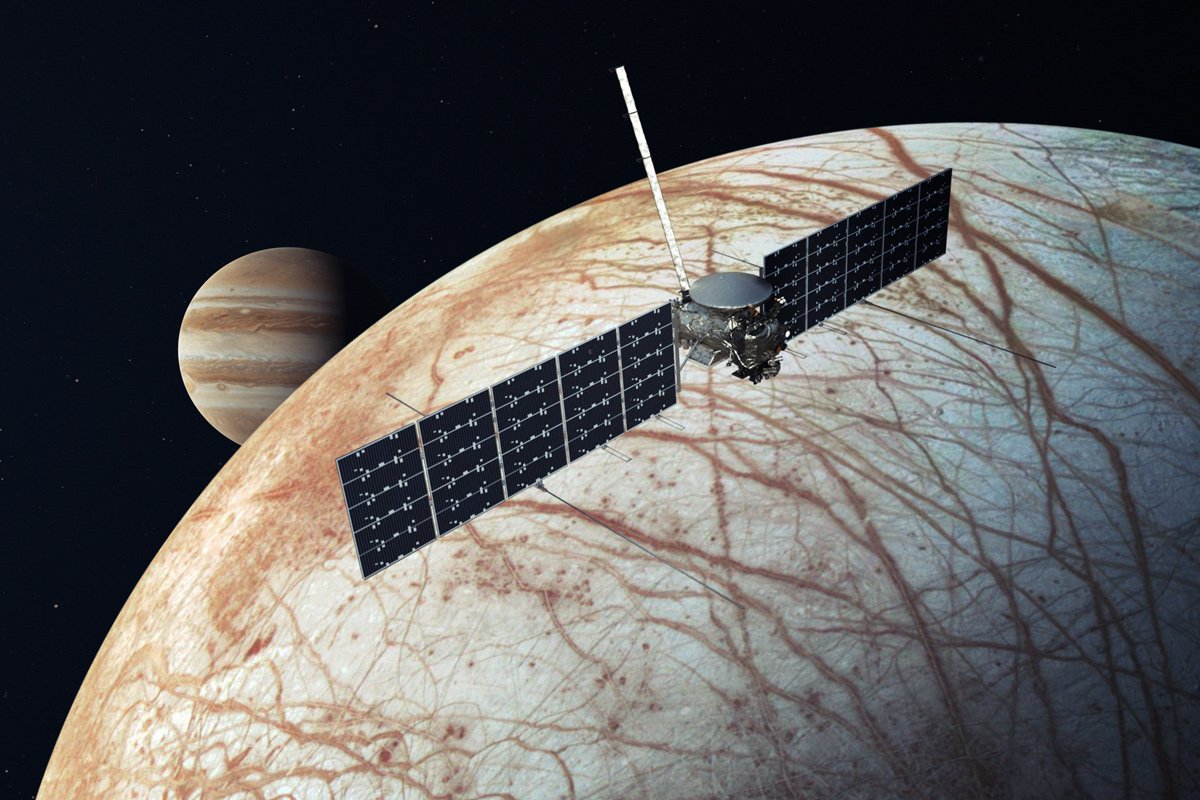
Jupiter’s moon Europa is one of the most mysterious worlds in the solar system. From a distance, it looks like a bright icy sphere marked by reddish cracks, ridges, and chaotic terrain. But beneath that frozen surface, scientists believe Europa may hide something extraordinary: a global ocean of salty liquid water.
That possibility makes Europa one of the most important places in the search for habitable environments beyond Earth.
The phrase “NASA Europa surface exploration plans” must be understood carefully. NASA has already launched Europa Clipper, a major mission designed to study Europa in detail through repeated close flybys. However, Europa Clipper is not a lander. It will not touch the surface. It will orbit Jupiter and fly past Europa many times to study its ice shell, ocean, surface composition, geology, atmosphere, and habitability.
NASA and JPL have also studied a Europa Lander concept, which would be a future surface mission designed to look for signs of life in Europa’s icy surface material. But as of now, that lander remains a proposed future concept, not an active launched mission.
That distinction is important for accuracy.
The real story is still exciting: NASA is building the knowledge needed to understand Europa’s surface and prepare for possible future landed exploration. Europa Clipper will help identify what Europa’s surface is made of, how thick its ice shell may be, whether water or plume material reaches the surface, and where future missions might search for biosignatures.
In simple words, Europa Clipper is the scout. A future Europa lander would be the surface investigator.
Editorial Note
This article explains confirmed NASA Europa exploration work, Europa Clipper’s mission, surface science goals, future Europa Lander concepts, and the scientific importance of Jupiter’s icy moon. It does not claim that NASA has already approved, launched, or landed a Europa surface mission. Europa Clipper is an active NASA mission launched in 2024, while Europa Lander remains a proposed future concept. Future mission schedules should always be checked against NASA and JPL updates before publication.
Key Statistics and Facts
| Fact | Why It Matters |
|---|---|
| Europa Clipper launched on October 14, 2024. | NASA’s main Europa mission is already active and traveling toward Jupiter. |
| Europa Clipper is scheduled to arrive at Jupiter in April 2030. | Europa science observations will begin after arrival and orbital setup. |
| The spacecraft will conduct 49 close flybys of Europa. | It will study Europa repeatedly without landing. |
| Europa Clipper will fly as low as about 16 miles, or 25 kilometers, above Europa’s surface during some flybys. | Close passes can provide detailed surface and subsurface data. |
| Europa is thought to have a saltwater ocean beneath its icy crust. | This ocean is the reason Europa is considered a major astrobiology target. |
| NASA says Europa’s ocean may contain more than twice as much liquid water as all of Earth’s oceans combined. | Europa may have one of the largest known liquid-water reservoirs in the solar system. |
| Europa Lander is listed by JPL as a proposed future concept. | A surface mission is possible in concept, but it is not currently an active landed mission. |
These facts show why Europa is so important. The moon’s surface may hold clues about its hidden ocean, and that hidden ocean may have conditions suitable for life.
What Is Europa?
Europa is one of Jupiter’s four large Galilean moons, discovered by Galileo Galilei in 1610. It is slightly smaller than Earth’s Moon, but scientifically it may be one of the most important worlds ever studied.
At first glance, Europa appears icy and frozen. Its surface is covered with bright ice, long cracks, ridges, reddish-brown streaks, and chaotic regions where the surface seems to have broken and shifted.
But Europa is not simply a frozen ball.
Scientists believe that beneath Europa’s icy crust is a global ocean of salty liquid water. This ocean may be in contact with a rocky seafloor. If that is true, Europa could have water, chemistry, and energy sources—three key ingredients often discussed in the search for habitable environments.
Europa does not need sunlight at its surface to be interesting. On Earth, life exists in dark ocean environments near hydrothermal vents, where chemistry and heat from the seafloor support ecosystems. Scientists do not know whether anything similar exists on Europa, but the possibility is one reason NASA is so interested in the moon.
For more space science explainers, visit our Space & Beyond section.
Why Europa’s Surface Matters
Europa’s surface matters because it may be connected to the ocean below.
If material from the ocean rises through cracks, fractures, plumes, or disrupted ice, then Europa’s surface may contain chemical clues from the hidden ocean. That means scientists may not need to drill through miles of ice immediately to learn something about the ocean. They may be able to study surface materials that were once part of the subsurface environment.
This is one of the biggest reasons Europa surface exploration is so important.
A future lander could sample ice, dust, salts, or chemically altered material near the surface. Europa Clipper, meanwhile, will study the surface from close flybys using cameras, radar, spectrometers, magnetometer measurements, and other instruments.
Surface features may reveal:
Where the ice shell is active.
Where ocean material may have reached the surface.
Where the surface is young or geologically disturbed.
Where future landers might safely touch down.
Where radiation has damaged surface chemistry.
Where biosignature clues might be better preserved.
Europa’s surface is not just the outer layer of the moon. It may be a scientific message from the ocean underneath.
Is NASA Landing on Europa Right Now?
No. NASA is not landing on Europa right now.
This is the most important accuracy point in this article. Europa Clipper is an active NASA mission, but it is not a surface mission. It will not land. It will orbit Jupiter and repeatedly fly past Europa to study the moon in detail.
NASA/JPL’s Europa Lander page describes the lander as a concept for a potential future mission. Its purpose would be to look for signs of life in Europa’s icy surface material. But proposed does not mean launched, approved, or operating.
The correct wording is:
NASA is actively exploring Europa with Europa Clipper.
NASA has studied future Europa surface lander concepts.
NASA has not currently landed a probe on Europa.
This careful wording protects trust. Articles about space missions should not present future concepts as completed missions.
For more NASA mission explainers, visit our NASA category.
Europa Clipper: NASA’s Main Europa Mission
Europa Clipper is NASA’s major mission to study Jupiter’s icy moon Europa. It launched on October 14, 2024, aboard a SpaceX Falcon Heavy rocket and is now traveling toward the Jupiter system.
The spacecraft will arrive at Jupiter in April 2030. After entering orbit around Jupiter, it will perform repeated close flybys of Europa. NASA says the mission will conduct 49 close flybys, allowing the spacecraft to study different regions of the moon.
This mission design is important because Jupiter’s radiation environment is harsh. Instead of orbiting Europa directly, Europa Clipper will orbit Jupiter and only pass close to Europa during flybys. This reduces the spacecraft’s total radiation exposure while still allowing detailed science observations.
Europa Clipper’s main goal is to determine whether Europa has conditions suitable to support life. It will not search directly for living organisms. Instead, it will study the moon’s habitability.
That means it will investigate whether Europa has:
Liquid water.
The right chemistry.
Energy sources.
A dynamic ice shell.
Surface-ocean exchange.
Potentially habitable environments below the ice.
Europa Clipper Mission Timeline
| Date or Phase | Mission Event |
|---|---|
| October 14, 2024 | Europa Clipper launched from Kennedy Space Center |
| March 1, 2025 | Mars gravity assist |
| December 2026 | Earth gravity assist planned |
| April 2030 | Jupiter orbit insertion planned |
| Spring 2031 | First Europa flyby expected |
| May 2031 | First science campaign begins |
| May 2033 | Second science campaign begins |
| Main mission | 49 close flybys of Europa |
This timeline shows why 2026 is a journey year, not a Europa arrival year. In 2026, Europa Clipper is still on its way to Jupiter and is expected to use an Earth gravity assist to gain energy for the rest of the trip.
What Europa Clipper Will Study
Europa Clipper is designed to answer several major questions about Europa.
First, how thick is Europa’s ice shell? Scientists want to understand whether the ice is thin, thick, layered, active, or connected to the ocean below.
Second, what is Europa’s surface made of? Surface chemistry may reveal salts, organics, sulfur compounds, or other materials that could help scientists understand ocean chemistry.
Third, does Europa have plumes? Some observations have suggested possible water vapor plumes erupting from Europa, but confirming and characterizing them is difficult.
Fourth, how deep and salty is the ocean? Magnetic and gravity measurements may help scientists infer properties of the subsurface ocean.
Fifth, how active is Europa today? Cracks, ridges, chaos terrain, and surface changes may reveal whether the ice shell is geologically active.
Sixth, does Europa have the ingredients for habitability? The mission is not looking for life directly, but it is looking for conditions that could support life.
Europa Clipper’s Science Instruments
Europa Clipper carries nine science instruments and will also use its telecommunications system for gravity science.
| Instrument Type | What It Helps Study |
|---|---|
| Cameras | Surface geology, cracks, ridges, terrain, landing-site context |
| Ice-penetrating radar | Ice shell structure and possible subsurface water pockets |
| Spectrometers | Surface composition and chemical fingerprints |
| Magnetometer | Europa’s ocean properties through magnetic field measurements |
| Plasma and particle instruments | Europa’s environment and interaction with Jupiter |
| Thermal instrument | Warmer surface regions and possible activity |
| Mass spectrometer | Gases and particles near Europa |
| Dust analyzer | Small particles possibly ejected from Europa |
| Gravity science | Interior structure and ocean clues |
Together, these instruments will help scientists build a more complete picture of Europa as an ocean world.
Why Europa Clipper Does Not Land
A natural question is: if Europa is so important, why not land immediately?
The answer is risk, radiation, cost, complexity, and uncertainty.
Europa is far from Earth. Jupiter’s radiation environment is intense. Landing safely on Europa would require extremely precise navigation, strong radiation protection, a reliable landing system, autonomous operations, and instruments that can work in a cold, irradiated environment.
Scientists also need better surface maps before choosing a landing site. Europa’s surface may be rough, cracked, chaotic, or covered with hazards. A lander mission would need to know where it can safely land and where the science return would be strongest.
Europa Clipper helps solve that problem. It will map and study the surface in detail, giving scientists information that could support future landed mission planning.
In simple terms, landing before scouting would be risky. Europa Clipper is the scouting mission.
The Europa Lander Concept
NASA/JPL’s Europa Lander is a concept for a potential future surface mission. Its goal would be to search for signs of life in icy surface material.
The lander concept would collect samples from about 4 inches, or 10 centimeters, below Europa’s surface. That depth matters because Jupiter’s radiation can damage surface chemistry. Material slightly below the surface may be better protected and more scientifically valuable.
A Europa lander could include:
A sample collection system.
A miniature onboard laboratory.
A microscope.
A camera.
A seismometer.
Chemical analysis instruments.
Radiation-protected electronics.
A short-duration surface operations plan.
The mission would be extremely difficult. Europa’s radiation environment could damage electronics quickly, so the lander would need strong shielding and a focused science plan.
This is why Europa Lander remains a future concept. It is scientifically exciting, but technically demanding.
Confirmed Facts vs Future Possibilities
| Topic | Status |
|---|---|
| Europa Clipper launched in 2024 | Confirmed |
| Europa Clipper will arrive at Jupiter in 2030 | Planned mission timeline |
| Europa Clipper will conduct 49 close flybys of Europa | Confirmed mission design |
| Europa Clipper will land on Europa | False |
| Europa Lander is a proposed future concept | Confirmed |
| NASA has an active landed Europa mission operating in 2026 | Not confirmed |
| A future lander could sample icy surface material | Proposed concept |
| Europa has a confirmed ocean beneath the ice | Strong scientific evidence, not directly sampled |
| Life has been found on Europa | Not confirmed |
This distinction is critical. Europa is one of the best places to search for habitable conditions beyond Earth, but scientists have not found life there.
Why a Future Europa Lander Would Be So Important
A future Europa lander would be important because it could study the icy surface directly.
Flybys can provide incredible data, but a lander can touch, sample, and analyze material in place. That would allow scientists to study surface chemistry in a more direct way.
A lander could search for biosignatures. A biosignature is a chemical, structural, or physical sign that may be associated with life. However, biosignatures are not simple proof of life. Scientists must rule out non-biological explanations.
A future Europa lander might look for:
Organic molecules.
Salts.
Complex chemical patterns.
Textural signs in ice.
Evidence of ocean-derived material.
Surface changes.
Seismic activity.
Subsurface ice structure.
The key scientific question would be: does Europa’s surface contain chemical evidence that connects to a potentially habitable ocean?
Why Sampling Depth Matters
JPL’s Europa Lander concept mentions collecting samples from about 4 inches, or 10 centimeters, below the surface. This detail matters because Europa sits inside Jupiter’s intense radiation environment.
Radiation can alter or destroy delicate chemical compounds on the surface. If potential biosignatures exist, the most exposed top layer may not preserve them well.
Sampling slightly below the surface could provide better-protected material. That material may contain chemical clues from the ocean or subsurface ice.
This is also why landing-site selection matters. Some locations may have younger surface material, recent exchange with the subsurface, or lower radiation exposure. Other places may be older, more damaged, or less scientifically useful.
Europa Clipper’s maps could help identify the best future sampling locations.
Europa’s Ocean: Why Scientists Care So Much
Europa’s hidden ocean is the main reason the moon is so exciting.
Scientists believe Europa may have a global ocean beneath its icy shell. NASA says that ocean may contain more than twice as much liquid water as all of Earth’s oceans combined.
Water alone does not prove habitability. But liquid water is one of the essential ingredients scientists look for when considering whether life could exist.
A habitable environment usually needs:
Liquid water.
Essential chemical elements.
Energy sources.
A stable environment over time.
Europa may have all of these. The ocean may be salty. The rocky seafloor may provide chemical energy. Tidal forces from Jupiter may heat the interior and help maintain the ocean.
The big question is whether the ocean and surface communicate. If ocean material reaches the surface through cracks, plumes, or ice movement, missions may be able to study ocean chemistry without drilling through the entire ice shell.
Europa’s Ice Shell
Europa’s ice shell is one of the biggest mysteries. Scientists want to know how thick it is, whether it contains pockets of liquid water, and whether it moves like a slow icy crust.
The surface shows ridges, cracks, bands, and chaotic terrain. These features suggest that Europa’s ice has been stretched, broken, and reshaped over time.
Some scientists think the ice shell may be active, with material cycling between the surface and subsurface. Others study whether briny pockets or lakes may exist within the ice.
Europa Clipper’s radar instrument will help investigate the ice shell. Radar can send signals into the ice and measure reflections from subsurface layers. This could help reveal ice thickness, internal structure, and possible liquid reservoirs.
Understanding the ice shell is essential for future surface exploration. A lander mission needs to know what kind of ice it is landing on and what materials might be accessible near the surface.
Surface Features: Cracks, Ridges, and Chaos Terrain
Europa’s surface is one of the most visually striking in the solar system. It is covered with long dark lines, ridges, cracks, and broken-looking regions called chaos terrain.
These features may reveal how the moon’s ice shell moves and interacts with the ocean below.
Cracks may form because Europa is flexed by Jupiter’s gravity. As Europa orbits Jupiter, tidal forces stretch and squeeze the moon, creating stress in the ice shell.
Ridges may form where ice opens and refreezes or where material is pushed upward.
Chaos terrain may form where the surface breaks into blocks that shift and refreeze, possibly involving warmer ice or subsurface water.
Scientists are especially interested in whether these features allow material exchange between the ocean and surface. If they do, they may be ideal targets for future exploration.
Plumes: Could Europa Spray Ocean Material into Space?
One of the most exciting possibilities is that Europa may produce water vapor plumes. These would be eruptions of vapor or particles from beneath the ice into space.
If plumes exist and are active, a spacecraft could potentially fly through them and sample material without landing or drilling. That would be a major scientific opportunity.
However, Europa’s plumes are not as clearly established as the plumes on Saturn’s moon Enceladus. Some observations suggest possible plume activity, but confirming them remains challenging.
Europa Clipper may help investigate this question. Its instruments could look for gases, particles, thermal anomalies, and surface features connected to possible plume activity.
A confirmed plume would strongly influence future surface exploration planning. It could point scientists toward active regions where ocean material may reach the surface.
Radiation: The Biggest Surface Challenge
Europa is located within Jupiter’s powerful magnetic environment. That creates intense radiation around the moon.
Radiation is a major challenge for both spacecraft and future landers. It can damage electronics, degrade materials, and alter surface chemistry.
Europa Clipper is designed to reduce radiation exposure by orbiting Jupiter instead of Europa directly. It will make short close flybys, collect data, and then move away from the harshest regions.
A future lander would face even greater challenges because it would sit on the surface. It would need radiation-protected electronics, careful mission timing, and possibly a short surface lifetime.
Radiation also affects science. Surface compounds may be chemically changed by radiation. That is why sampling below the surface may be important.
Future Europa Surface Exploration: What Would a Lander Need?
A future Europa lander would need to survive and work in one of the hardest environments ever attempted.
It would need:
Precise landing navigation.
A strong landing system.
Radiation shielding.
Thermal control.
Autonomous operations.
Sampling tools.
A miniature laboratory.
Reliable communication relay.
Power for surface operations.
Hazard avoidance.
Surface cameras.
A clear biosignature science strategy.
The lander would likely operate for a limited time because Europa’s environment is harsh. The mission would need to collect and transmit the most important data quickly.
A future lander would not be a simple rover. Europa’s radiation and terrain make long surface operations extremely difficult. A stationary lander with a focused science plan may be more realistic than a long-distance rover.
Could NASA Drill Through Europa’s Ice?
Drilling through Europa’s ice to reach the ocean is one of the most exciting long-term ideas, but it is far beyond current approved NASA mission plans.
Europa’s ice shell could be miles thick. A mission designed to drill or melt through it would need enormous power, long-duration operation, contamination control, communication through ice, and protection from radiation.
It would also need planetary protection standards to avoid contaminating a potentially habitable ocean with Earth microbes.
This means direct ocean access is a long-term future possibility, not a near-term mission.
A more realistic next step is surface and shallow subsurface exploration. That could help scientists study materials that may have come from the ocean without needing to drill all the way down.
Planetary Protection and Europa
Planetary protection is extremely important for Europa. Because Europa may have a habitable ocean, missions must avoid contaminating it with Earth life.
If a spacecraft carrying Earth microbes were to reach Europa’s ocean, it could confuse future life-detection experiments or damage a pristine environment.
NASA and international planetary protection policies require careful cleaning, sterilization, trajectory planning, and mission design for worlds that may be habitable.
Europa Clipper was designed with planetary protection considerations. A future lander or ocean-access mission would face even stricter requirements.
This is not only a technical issue. It is an ethical issue. If humanity explores possible habitats beyond Earth, it must do so responsibly.
Europa Compared with Other Ocean Worlds
Europa is not the only ocean world, but it is one of the most important.
| World | Ocean Evidence | Why It Matters |
|---|---|---|
| Europa | Strong evidence for global subsurface ocean | Major target for habitability and future biosignature search |
| Enceladus | Active plumes from subsurface ocean | Ocean material is ejected into space and easier to sample |
| Titan | Subsurface ocean and surface methane lakes | Complex organic chemistry |
| Ganymede | Evidence for deep internal ocean | Largest moon in the solar system |
| Callisto | Possible subsurface ocean | Less geologically active but scientifically important |
Europa is special because it combines a likely ocean, a young icy surface, possible surface-ocean exchange, and strong tidal energy from Jupiter.
For broader future exploration topics, visit our Future & Technology section.
Europa and the Search for Life
Europa is one of NASA’s most important targets in the search for life beyond Earth. But the wording must be careful.
Europa Clipper is not designed to detect life directly. Its goal is to determine whether Europa has habitable conditions.
A future lander concept could look for signs of life in icy surface material. But even then, detecting life would be difficult. Scientists would need multiple lines of evidence, careful controls, and strong confidence that any signal is not caused by non-biological chemistry or contamination.
The correct statement is:
Europa may have conditions suitable for life.
Europa Clipper will study habitability.
A future lander could search for biosignatures.
Life has not been confirmed on Europa.
This careful distinction helps keep the article scientifically trustworthy.
How Europa Exploration Helps Exoplanet Science
Europa is not an exoplanet, but it helps scientists understand worlds beyond our solar system.
Many exoplanets may have oceans, ice shells, or subsurface water. Scientists cannot send probes to those worlds, but they can study ocean worlds in our own solar system.
Europa provides a nearby laboratory for understanding how water, ice, rock, chemistry, and energy can interact beyond Earth.
If Europa has a habitable ocean beneath ice, that expands the definition of where life-friendly environments may exist. Life may not require an Earth-like surface with sunlight and oceans exposed to the sky. It may be possible in dark oceans beneath ice, if chemistry and energy are present.
For readers interested in planets beyond our solar system, read our article on NASA exoplanet direct imaging tech.
Europa Clipper and Deep Space Communication
Europa Clipper will operate far from Earth in the Jupiter system. Sending data back from that distance is not simple. The spacecraft must store data during flybys, turn toward Earth, and transmit information across hundreds of millions of miles.
This is another reason flyby mission design matters. Between flybys, the spacecraft has time to send data back to Earth.
Future deep-space missions will need even stronger communication systems as data volume grows. High-resolution images, radar data, spectrometer readings, and environmental measurements all require reliable transmission.
For a related technology topic, read our article on NASA deep space laser communication.
What People Often Get Wrong About Europa Exploration
Many people think Europa Clipper will land on Europa. It will not. It will perform repeated close flybys while orbiting Jupiter.
Another mistake is thinking Europa Lander is already approved and launched. It is not. It remains a proposed future concept.
Some people think NASA has already found life on Europa. That is false. Europa is considered potentially habitable, but life has not been detected.
Another misunderstanding is thinking scientists must drill through the entire ice shell immediately. Surface materials may already contain clues from the ocean, especially if there is exchange between the ocean and surface.
Some people think Europa is just another frozen moon. In reality, it may contain a global ocean with more liquid water than Earth’s oceans.
A final mistake is ignoring radiation. Jupiter’s radiation environment makes Europa surface exploration extremely difficult.
Timeline: NASA Europa Exploration
| Period | Development |
|---|---|
| 1610 | Galileo Galilei discovered Europa and Jupiter’s other large moons |
| 1979 | Voyager spacecraft provided early detailed images of Europa |
| 1995–2003 | Galileo mission studied Jupiter and its moons, strengthening evidence for Europa’s ocean |
| 2015 | NASA selected Europa Clipper science instruments |
| 2024 | Europa Clipper launched on October 14 |
| 2025 | Mars gravity assist |
| 2026 | Planned Earth gravity assist |
| 2030 | Europa Clipper scheduled to enter Jupiter orbit |
| 2031 | First Europa flyby and first science campaign expected |
| Future | A Europa Lander or other surface mission could be considered based on science priorities and funding |
This timeline shows that Europa exploration is a long-term process. A surface mission would be a future step, not a current 2026 event.
Europa Clipper vs Europa Lander
| Feature | Europa Clipper | Europa Lander Concept |
|---|---|---|
| Mission Status | Active NASA mission | Proposed future concept |
| Mission Type | Jupiter orbiter with Europa flybys | Surface lander |
| Launch Status | Launched in 2024 | Not launched |
| Arrival/Operation | Jupiter arrival planned in 2030 | No approved launch date |
| Main Goal | Determine whether Europa has habitable conditions | Search for signs of life in icy surface material |
| Surface Contact | No | Yes, if ever approved and flown |
| Science Method | Remote sensing and flyby measurements | Direct surface sampling and in-situ analysis |
| Main Challenge | Jupiter radiation and long-distance operations | Landing, radiation, sampling, surface survival |
This comparison helps readers understand NASA’s real Europa exploration pathway. Clipper studies habitability from flybys. A future lander would test the surface more directly.
Why 2026 Matters for Europa Surface Exploration Plans
The year 2026 matters because Europa Clipper is in its cruise phase and is scheduled for an Earth gravity assist in December 2026. That gravity assist helps give the spacecraft enough energy to reach Jupiter.
In 2026, Europa surface exploration is not happening physically on Europa. Instead, the mission is moving toward the data-gathering phase that begins after Jupiter arrival.
This makes 2026 a preparation year. Scientists, engineers, and mission planners are preparing for future observations that may guide the next generation of Europa exploration.
The safest and most accurate wording is:
Europa surface exploration plans are being shaped by Europa Clipper and future lander concepts.
Europa Clipper is not a lander.
A future Europa lander remains proposed, not active.
Europa’s surface may hold clues to its hidden ocean.
Why Europa Matters for the Public
Europa matters because it asks one of humanity’s biggest questions: could life exist somewhere else?
The moon is not habitable on the surface. It is cold, icy, and exposed to radiation. But beneath the ice, conditions may be very different. A salty ocean, a rocky seafloor, tidal heating, and chemical energy could create an environment worth studying.
This possibility inspires scientists, students, engineers, and space fans because it expands the search for life beyond Earth-like planets.
Europa also teaches a broader lesson: the most interesting worlds are not always the most obvious. A frozen moon around Jupiter may be one of the best places to search for habitable conditions.
That is why NASA is sending Europa Clipper across 1.8 billion miles to study it.
Practical Reader Takeaway
The most important thing to understand is that NASA’s Europa surface exploration plans are step-by-step.
Europa Clipper is already on the way to Jupiter.
It will study Europa through repeated close flybys.
It will not land.
A future Europa lander could search the icy surface for biosignatures, but it remains a proposed concept.
Europa’s surface matters because it may contain clues from the hidden ocean below.
The long-term goal is not only to look at Europa. It is to understand whether this icy moon has the ingredients and conditions needed for life.
Frequently Asked Questions
What are NASA Europa surface exploration plans?
NASA’s Europa surface exploration plans include studying Europa’s surface with Europa Clipper and considering future lander concepts that could analyze icy surface material. Europa Clipper is active, while a Europa lander remains a proposed future concept.
Is Europa Clipper landing on Europa?
No. Europa Clipper will not land on Europa. It will orbit Jupiter and conduct 49 close flybys of Europa.
When did Europa Clipper launch?
Europa Clipper launched on October 14, 2024.
When will Europa Clipper arrive at Jupiter?
Europa Clipper is scheduled to arrive at Jupiter in April 2030.
What is Europa Lander?
Europa Lander is a proposed future mission concept that would land on Europa and search for signs of life in icy surface material.
Has NASA approved a Europa lander?
NASA/JPL currently lists Europa Lander as a proposed concept, not an active launched mission.
Why is Europa important?
Europa may have a global ocean beneath its icy crust. That ocean may contain more than twice as much water as Earth’s oceans and could have conditions suitable for life.
Has life been found on Europa?
No. Life has not been found on Europa. NASA missions are studying whether Europa has habitable conditions and whether future missions could search for biosignatures.
Why is Europa hard to explore?
Europa is far from Earth, located in Jupiter’s intense radiation environment, and covered by an icy surface that may be rough and difficult to land on.
Could a future mission drill into Europa’s ocean?
Possibly in the far future, but drilling through Europa’s ice would be extremely difficult. Near-term concepts focus more on flyby science and possible surface or shallow subsurface sampling.
Conclusion
NASA Europa surface exploration plans are among the most exciting topics in modern planetary science. Europa is not just another icy moon. It may be an ocean world with liquid water beneath its frozen crust, surface chemistry shaped by deep processes, and conditions that could help scientists understand habitability beyond Earth.
The most important point is accuracy. Europa Clipper is an active NASA mission, launched in 2024 and scheduled to arrive at Jupiter in 2030. It will conduct repeated close flybys of Europa, but it will not land. NASA/JPL’s Europa Lander remains a proposed future concept that could one day sample icy surface material for signs of life.
That means Europa surface exploration is not a completed 2026 event. It is a developing pathway.
Europa Clipper will scout the moon, map its surface, study its ice shell, investigate its ocean, and search for signs of habitability. Those findings may guide future missions that could land on Europa and study the surface directly.
The simplest way to understand Europa exploration is this: NASA is first learning where the secrets are hidden. A future lander may one day touch the ice and search for what lies beneath the story written on Europa’s surface.
Sources and Further Reading
NASA: Europa Clipper Mission Timeline
NASA: Europa Clipper Science Goals