Space exploration is entering a new data age. Future missions will not only send simple signals back to Earth. They will send high-resolution images, scientific measurements, navigation data, crew updates, video, instrument readings, and possibly live ultra-HD views from the Moon, Mars, and deep space.
That creates one major challenge: space missions are producing more data than traditional communication systems were originally designed to handle.
For decades, NASA has relied mainly on radio waves to communicate with spacecraft. Radio communication is reliable, proven, and still essential. It has supported missions to the Moon, Mars, Jupiter, Saturn, asteroids, and beyond. But as spacecraft become more advanced, cameras become sharper, instruments become more powerful, and human exploration moves farther from Earth, NASA needs faster ways to move data across space.
This is where NASA’s deep space laser communication technology becomes important.
Laser communication, also called optical communication, uses light instead of traditional radio waves to transmit data. In simple words, it can send more information in a single transmission, making it possible for future missions to return larger amounts of data faster than before.
By 2026, this technology is no longer just a futuristic idea. NASA’s Deep Space Optical Communications experiment, known as DSOC, has already demonstrated laser communication across deep-space distances. NASA also tested the Orion Artemis II Optical Communications system, known as O2O, to show how laser communication could support future human missions around the Moon.
This article explains what NASA deep space laser communication is, how it works, what has already been confirmed, why it matters, and how it could change the future of high-speed data in space.
Editorial Note
This article explains confirmed NASA laser communication demonstrations, current optical communication technology, and future possibilities for space data transmission. It does not claim that NASA launched a new deep space laser communication mission in 2026. NASA’s DSOC technology demonstration launched with the Psyche spacecraft in 2023 and completed its planned demonstration in 2025. In 2026, NASA’s laser communication progress is especially important because optical communication is becoming part of the wider future of lunar, Mars, and deep space exploration.
Key Statistics and Facts
| Fact | Why It Matters |
|---|---|
| NASA’s DSOC launched with the Psyche spacecraft on October 13, 2023. | It was the first NASA demonstration of optical communication beyond the Earth-Moon system. |
| DSOC completed its 65th and final pass on September 2, 2025. | The demonstration successfully tested laser communication over deep-space distances. |
| NASA reported DSOC received a return signal from about 218 million miles, or 350 million kilometers, away. | This showed that laser communication can work across distances comparable to Mars. |
| NASA says laser communication can transmit more data in a single downlink than traditional radio frequency systems. | More data means better images, more science, and stronger mission support. |
| NASA’s O2O system on Artemis II was designed to support high-resolution images and video from Orion. | Optical communication may help future crewed Moon missions send richer data back to Earth. |
| NASA’s O2O system was designed for data rates up to 260 megabits per second. | This shows how laser communication can dramatically improve mission data flow near the Moon. |
These facts show why laser communication matters. Spacecraft are becoming more capable, and powerful spacecraft need powerful communication systems. NASA’s future missions will need to send more data, faster, and across greater distances.
What Is NASA Deep Space Laser Communication?
NASA deep space laser communication refers to the use of optical communication systems to send data between spacecraft and Earth using laser light. Instead of relying only on radio frequency signals, optical communication uses narrow beams of infrared light to carry information.
In simple words, laser communication is like upgrading from an old narrow data pipe to a much wider one. Radio communication still works and remains important, but laser communication can carry far more data because light waves can be packed with information more efficiently.
NASA’s Deep Space Optical Communications experiment, or DSOC, was designed to test whether this approach could work beyond the Earth-Moon system. DSOC flew aboard NASA’s Psyche spacecraft and tested laser communication while Psyche traveled through deep space.
This matters because future missions to the Moon, Mars, asteroids, and outer planets will need to send large volumes of data. A Mars mission, for example, may need to send high-resolution surface video, crew health data, scientific readings, robotic mission updates, and navigation information. Traditional radio systems can handle important data, but laser communication could greatly increase the amount that can be sent.
For more NASA mission explainers, visit our NASA category.
Why Space Missions Need Faster Data
Modern space missions are data-heavy. A spacecraft is no longer just a simple transmitter sending basic signals. Today’s missions carry high-resolution cameras, spectrometers, radar systems, weather instruments, navigation tools, and sometimes human crews.
Each of these systems produces data.
A Mars rover may capture panoramic images, study rocks, analyze atmosphere, monitor weather, and send engineering updates. A lunar mission may send crew video, surface images, navigation data, and mission operations information. A deep space probe may observe asteroids, planets, moons, dust, magnetic fields, and radiation.
The more advanced the mission, the more data it creates.
This creates a bottleneck. If a spacecraft can collect more data than it can send home, scientists may have to wait longer, compress information, prioritize only some data, or reduce how much is collected. Laser communication helps solve this problem by increasing the data rate.
For future exploration, communication speed is not just a convenience. It affects science, safety, planning, public engagement, and mission success.
How Laser Communication Works in Space
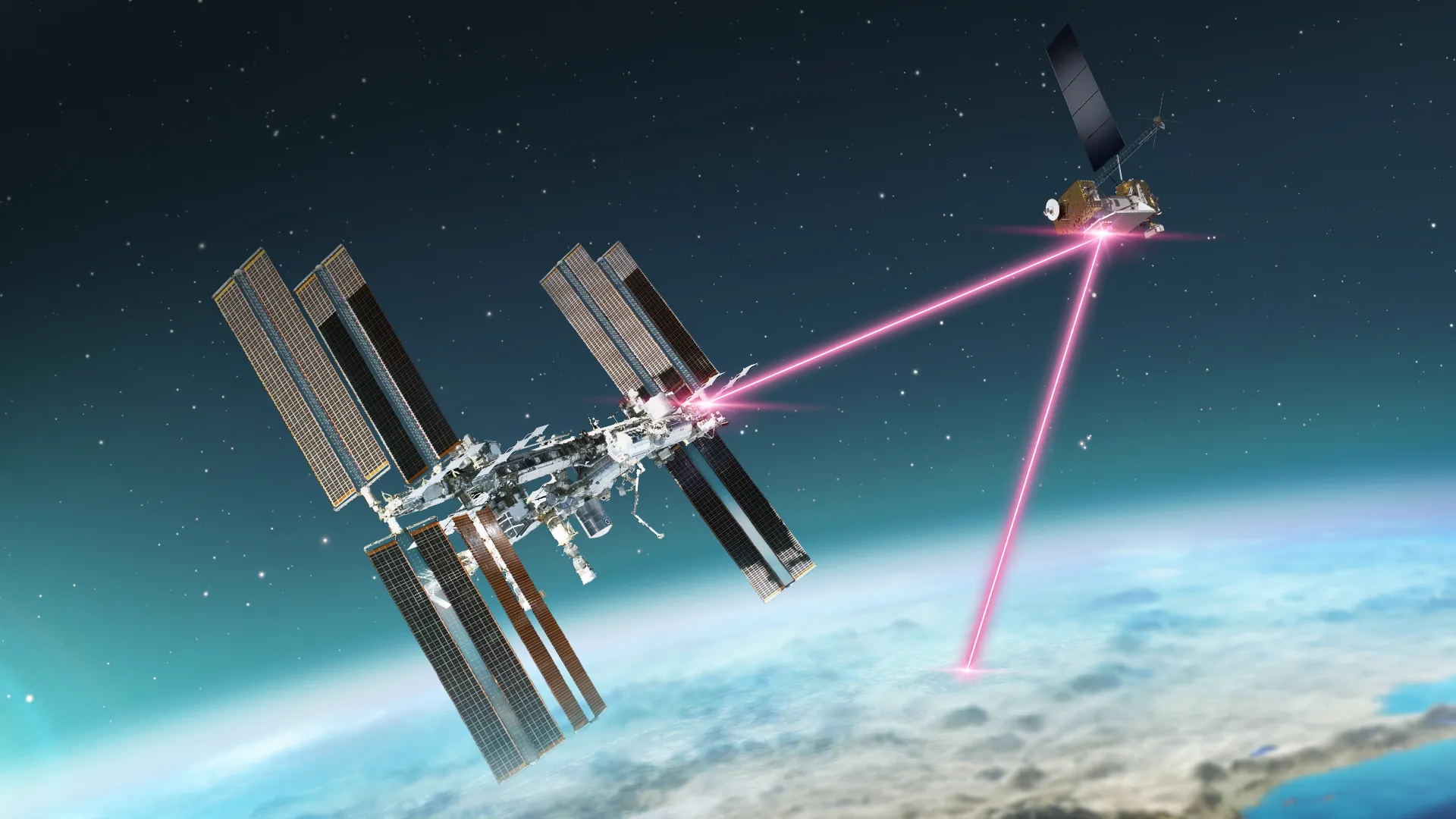
Laser communication uses light to carry data. A spacecraft sends a narrow laser beam toward Earth. A ground station receives the signal, decodes it, and turns it into usable data.
The process may sound simple, but it is technically very difficult.
The spacecraft must point the laser extremely accurately. A laser beam is much narrower than a radio signal. This narrowness is one reason it can carry more data efficiently, but it also means the spacecraft and ground station must align very precisely.
The receiving station on Earth must detect a very faint light signal after it has traveled millions of miles through space. That signal may be affected by distance, spacecraft motion, Earth’s atmosphere, weather, and pointing accuracy.
NASA’s DSOC system included three major parts: a flight laser transceiver on the spacecraft, a ground laser transmitter, and a ground laser receiver. Together, these elements allowed NASA to test laser communication across deep-space distances.
In a successful system, data can travel from a spacecraft to Earth through encoded laser photons. Those photons are received, decoded, and converted into images, video, science data, or engineering information.
DSOC: NASA’s Deep Space Optical Communications Demonstration
NASA’s DSOC experiment is one of the most important steps in the history of space communication. DSOC was launched aboard the Psyche spacecraft in 2023 as a technology demonstration.
Its goal was not to replace all radio communication immediately. Its goal was to prove that laser communication could work across deep-space distances.
NASA reported that DSOC successfully demonstrated that data encoded in lasers could be transmitted, received, and decoded after traveling millions of miles from Earth. The demonstration completed its 65th and final pass in September 2025, receiving a return signal from 218 million miles away.
That result matters because deep space is extremely challenging. Communication across millions of miles requires precise pointing, sensitive receivers, strong timing, and reliable system performance. DSOC showed that optical communication can work at distances comparable to Mars.
This makes DSOC a foundation for future high-speed communication systems.
Confirmed Facts vs Future Possibilities
It is important to separate confirmed NASA achievements from future possibilities.
| Topic | Status |
|---|---|
| DSOC launched with NASA’s Psyche mission in 2023 | Confirmed |
| DSOC demonstrated optical communication beyond the Earth-Moon system | Confirmed |
| DSOC completed its final planned pass in September 2025 | Confirmed |
| DSOC received a return signal from about 218 million miles away | Confirmed |
| O2O was tested during Artemis II | Confirmed |
| Laser communication replacing all radio communication immediately | Not confirmed |
| Deep space laser communication for future Mars crew missions | Future possibility |
| Routine ultra-HD livestreams from Mars | Future possibility |
| Laser communication becoming part of future mission infrastructure | Strong future direction, but mission-dependent |
This distinction is important for accuracy. NASA’s deep space laser communication technology has made real progress, but not every future use is already guaranteed. The correct way to describe this topic is that laser communication has been successfully demonstrated and may become a major part of future exploration systems.
NASA O2O and Artemis II Laser Communication
NASA’s Orion Artemis II Optical Communications system, known as O2O, showed how laser communication could support crewed missions near the Moon. O2O was designed to send high-resolution images and video from Orion during Artemis II.
This matters because future human missions will need more than basic voice communication. Astronauts may need to send video, mission data, medical information, spacecraft diagnostics, high-resolution images, and scientific observations.
NASA has explained that laser communication systems can provide increased data rates while also offering reduced size, weight, and power requirements compared with some traditional systems. These benefits are important because every spacecraft has limited space, mass, and power.
During Artemis II, O2O demonstrated the benefits that laser communication could bring to future human spaceflight missions to the Moon.
For readers interested in Artemis missions, you can also read our article on the Artemis II lunar flyby mission.
Laser Communication vs Radio Communication
Laser communication is not simply “better” in every situation. Radio communication remains essential because it is reliable, proven, and less affected by some atmospheric conditions. Laser communication offers higher data rates but also requires more precise pointing and can be affected by clouds and weather.
| Feature | Radio Communication | Laser Communication |
|---|---|---|
| Signal Type | Radio waves | Infrared laser light |
| Beam Width | Wider beam | Very narrow beam |
| Data Capacity | Reliable but lower data rate | Higher data rate potential |
| Pointing Accuracy | Less demanding | Extremely precise |
| Weather Sensitivity | Less affected by clouds | More affected by clouds and atmosphere |
| Current Role | Backbone of space communication | Emerging high-speed complement |
| Best Use | Reliable command, telemetry, deep space support | High-resolution images, video, large science data |
This comparison shows why laser communication is likely to complement radio communication rather than immediately replace it. Future missions may use both: radio for reliability and command support, laser for high-volume data transmission.
Why Laser Communication Could Transform Space Science
Laser communication could transform space science because better communication means more data. More data can mean better discoveries.
A spacecraft orbiting Mars could send sharper images and larger science files. A lunar mission could transmit high-definition video and detailed surface data. An asteroid mission could send more complete instrument readings. A future mission to the outer planets could return richer observations from moons, rings, atmospheres, and magnetic fields.
This matters because scientists often need detailed data to understand distant worlds. A low-resolution image may show a surface feature, but a high-resolution image may reveal its structure. A small data file may provide basic measurements, but a larger dataset may reveal patterns, chemistry, or changes over time.
Laser communication could also help mission teams make decisions faster. If data returns more quickly, scientists and engineers can analyze it sooner and adjust mission plans when needed.
In space exploration, data is not just information. Data is the mission’s connection to Earth.
Why Laser Communication Matters for Human Missions
Human missions need strong communication. Astronauts traveling to the Moon or Mars need to stay connected with mission control. They need to send health data, spacecraft updates, video, navigation information, science observations, and emergency information.
Laser communication could help make crewed missions more capable.
For lunar missions, optical communication may allow high-definition video from the Moon or from spacecraft near the Moon. For future Mars missions, laser communication could help send large volumes of mission data across interplanetary distances.
This does not mean there will be instant communication with Mars. Distance still matters. Even at light speed, signals between Earth and Mars can take minutes to travel one way depending on planetary positions. Laser communication can increase data capacity, but it cannot remove the basic delay caused by distance.
That distinction is important. Laser communication can make data transfer faster and richer, but it does not make deep space communication instantaneous.
The Role of NASA’s Deep Space Network
NASA’s Deep Space Network, often called DSN, is the system of large antennas that helps NASA communicate with spacecraft across the solar system. It supports missions to the Moon, Mars, asteroids, and the outer planets.
Laser communication does not make the Deep Space Network useless. Instead, it points toward an expanded future where NASA may combine traditional radio systems with optical communication systems.
Radio systems remain important for reliability, commands, tracking, and backup communication. Optical systems may add high-speed data capability where conditions allow.
A strong future communication system may use both methods. This hybrid approach could make missions more flexible. If weather blocks an optical ground station, radio may continue supporting essential communication. If optical conditions are clear, laser systems may send large data volumes.
This balanced approach is more realistic than saying lasers will simply replace radio.
Challenges of Deep Space Laser Communication
Deep space laser communication is powerful, but it is not easy.
The first challenge is pointing accuracy. A laser beam is narrow, so the spacecraft must aim very precisely at Earth.
The second challenge is distance. As the spacecraft moves farther away, the signal becomes harder to detect.
The third challenge is Earth’s atmosphere. Clouds, weather, turbulence, and atmospheric effects can interfere with optical signals.
The fourth challenge is ground station coverage. Laser communication needs ground stations in suitable locations, often with clear skies and good atmospheric conditions.
The fifth challenge is spacecraft stability. A spacecraft must point its laser while also performing mission operations.
The sixth challenge is integration. Future missions must decide how to combine optical communication with radio systems, power budgets, spacecraft design, and mission schedules.
These challenges explain why NASA treats laser communication as a developing capability. The progress is real, but the technology must be carefully tested before it becomes routine for deep space missions.
Timeline: NASA Laser Communication Progress
| Year | Milestone |
|---|---|
| 2013 | NASA’s Lunar Laser Communication Demonstration tested high-speed optical communication from lunar orbit |
| 2021 | NASA launched the Laser Communications Relay Demonstration to test optical relay technology |
| 2023 | DSOC launched aboard the Psyche spacecraft |
| 2023 | O2O hardware was delivered for the Artemis II Orion spacecraft |
| 2024 | DSOC achieved major deep-space laser communication milestones during Psyche’s cruise |
| 2025 | DSOC completed its final planned pass after successful deep-space testing |
| 2026 | Artemis II demonstrated optical communication benefits for crewed lunar missions |
| Future | Optical communication may support future Moon, Mars, and deep space missions |
This timeline shows that NASA laser communication is not a single event. It is a long-term technology path that includes lunar tests, relay demonstrations, deep space experiments, and crewed mission applications.
How Laser Communication Could Help Mars Missions
Mars missions may benefit greatly from laser communication. Mars spacecraft already send large amounts of data, but future missions could generate much more.
A future human Mars mission may need to send crew health data, habitat information, rover video, surface science results, navigation data, mission logs, and emergency updates. Robotic Mars missions may also produce larger datasets from advanced cameras, drills, sensors, weather stations, and sample analysis tools.
Laser communication could help send more of that information back to Earth.
However, Mars communication still faces major limits. Signals cannot travel faster than light. Depending on the distance between Earth and Mars, one-way communication delays can range from several minutes to more than twenty minutes. Laser communication can increase bandwidth, but it cannot remove the time delay.
This means future Mars missions will still need autonomous systems, careful planning, and strong local decision-making. Laser communication improves the data pipeline, but it does not eliminate the realities of interplanetary distance.
How Laser Communication Could Help Lunar Missions
Lunar missions are closer to Earth than Mars missions, so the communication delay is much smaller. This makes the Moon an ideal place to test laser communication for human exploration.
Future lunar missions may need to send high-definition video, surface maps, spacesuit data, rover data, instrument readings, and habitat information. Laser communication could help return this information more efficiently.
O2O on Artemis II was an important step because it showed how optical communication could work with a crewed spacecraft near the Moon. Future systems may build on this experience.
Laser communication could also help public engagement. High-quality video from the Moon would allow people on Earth to see exploration in a clearer and more immediate way. This could inspire students, researchers, engineers, and the public.
For more space exploration articles, visit our Space & Beyond section.
Why High-Speed Space Data Matters to the Public
High-speed space communication is not only useful for scientists. It also changes how the public experiences space exploration.
During the Apollo era, people watched grainy video from the Moon. That footage became historic, but technology has changed dramatically since then. Today, people expect high-quality images, live streams, detailed visuals, and fast updates.
Laser communication could make future missions more visible and understandable. Instead of waiting for limited data, the public may see richer images, clearer video, and more detailed mission coverage.
This matters because public interest supports science education. When people see space exploration clearly, they understand it better. When students see high-quality images from the Moon or Mars, they may become more interested in physics, engineering, robotics, astronomy, and computer science.
Better communication can make space exploration more human, more visual, and more engaging.
How Laser Communication Supports Future Space Technology
Deep space laser communication connects with many future technologies. Advanced spacecraft, lunar habitats, Mars missions, robotic explorers, and AI-assisted mission systems will all need better data links.
A future lunar base may need constant communication between astronauts, rovers, habitats, satellites, and Earth. A Mars mission may need high-volume data transfer between surface systems and orbiters. A deep space probe may need to return complex scientific data from far beyond Mars.
Laser communication could support all of these goals.
It may also work alongside artificial intelligence. Future spacecraft may use AI to manage data, select important images, compress information, diagnose problems, and decide what to transmit first. High-speed laser links would help move that selected data back to Earth.
This connection between communication, AI, robotics, and exploration is part of the broader future of technology. You can explore more topics like this in our Future & Technology section.
What People Often Get Wrong About Space Laser Communication
Many people misunderstand laser communication in space.
The first mistake is thinking it is science fiction. It is not. NASA has already tested optical communication in real missions.
The second mistake is thinking lasers make communication instant. They do not. Signals still travel at the speed of light, so distance still creates delay.
The third mistake is thinking lasers will immediately replace radio. That is not accurate. Radio communication remains essential and reliable. Lasers are more likely to complement radio systems.
The fourth mistake is thinking space lasers are weapons. NASA’s communication lasers are used to transmit data, not to attack objects.
The fifth mistake is thinking laser communication works perfectly in all conditions. Optical links can be affected by clouds, weather, atmosphere, pointing accuracy, and station availability.
The sixth mistake is thinking every future mission will automatically use laser communication. Mission design depends on cost, power, risk, data needs, and technical readiness.
Understanding these points makes the technology easier to appreciate without exaggeration.
Comparison: DSOC, O2O, and Traditional Radio
| System | Main Purpose | Where It Was Used | Why It Matters |
|---|---|---|---|
| Traditional Radio Communication | Reliable spacecraft communication | Used across NASA missions for decades | Proven, dependable, essential for commands and telemetry |
| DSOC | Deep space optical communication demonstration | Psyche spacecraft cruise phase | Proved laser communication can work beyond the Earth-Moon system |
| O2O | Crewed mission optical communication demonstration | Orion during Artemis II | Showed how laser communication can support high-resolution data near the Moon |
This comparison helps explain the bigger picture. DSOC tested laser communication at deep-space distances. O2O tested optical communication in a human spaceflight context near the Moon. Radio communication remains the backbone, while laser communication adds a powerful high-data option.
Why This Technology Matters After 2026
The year 2026 matters because NASA’s laser communication work is moving from demonstrations toward practical future mission planning. DSOC proved deep-space optical communication can work. O2O showed how optical communication can help crewed lunar missions.
The next challenge is turning these demonstrations into dependable mission infrastructure.
Future missions will need systems that are reliable, affordable, weather-aware, compatible with spacecraft design, and integrated with mission operations. NASA and its partners will need more optical ground stations, better tracking systems, and stronger hybrid networks that combine radio and optical communication.
This transition will not happen overnight. But the direction is clear: future exploration will need more bandwidth, and laser communication is one of the strongest tools for meeting that need.
Could Laser Communication Change Space Exploration Forever?
Laser communication could change space exploration because it changes the flow of information. Space missions are only as useful as the data they can return. A spacecraft may collect amazing observations, but if it cannot send them home efficiently, the mission is limited.
With laser communication, future missions may send more images, more video, more scientific readings, and more operational data. This could help scientists make better discoveries and help the public experience missions more clearly.
For deep space missions, better communication could mean richer science. For human missions, it could mean stronger support and better situational awareness. For public engagement, it could mean clearer views of the Moon, Mars, and beyond.
The future of exploration will not be built only on rockets and spacecraft. It will also be built on data. NASA’s deep space laser communication work is helping create the high-speed data future that space exploration will need.
Frequently Asked Questions
What is NASA deep space laser communication?
NASA deep space laser communication is the use of optical laser systems to send data between spacecraft and Earth. It uses infrared light instead of only traditional radio waves to transmit information.
What is DSOC?
DSOC stands for Deep Space Optical Communications. It was a NASA technology demonstration launched with the Psyche spacecraft in 2023 to test laser communication beyond the Earth-Moon system.
Is DSOC still active in 2026?
NASA’s DSOC demonstration completed its planned final pass in September 2025. In 2026, its importance continues because the results help guide future optical communication systems.
What is O2O?
O2O stands for Orion Artemis II Optical Communications. It was NASA’s optical communication system tested on Orion during Artemis II to demonstrate high-data communication for crewed lunar missions.
Does laser communication replace radio communication?
No. Laser communication does not immediately replace radio communication. Radio remains essential for reliability, commands, tracking, and backup support. Laser communication can add high-speed data capability.
Why is laser communication faster?
Laser communication can carry more data because optical light has properties that allow higher information capacity than many traditional radio frequency systems. It can send more data in a single downlink.
Can laser communication work from Mars?
NASA’s DSOC demonstration tested optical communication across distances comparable to Mars. Future Mars missions may use laser communication, but it must be integrated carefully with mission design and ground systems.
Does laser communication remove the delay between Earth and Mars?
No. Laser communication can improve data rates, but it cannot remove the delay caused by distance. Signals still travel at the speed of light.
Why does weather matter for laser communication?
Optical signals can be affected by clouds, atmosphere, and weather. This is why optical communication systems need carefully selected ground stations and may work alongside radio systems.
Why is this technology important for future missions?
Future missions will collect more high-resolution images, video, science data, and crew information. Laser communication can help send that data back to Earth faster and more efficiently.
Conclusion
NASA’s deep space laser communication technology represents one of the most important upgrades in the future of space exploration. Rockets carry spacecraft into space, but communication systems bring the discoveries home.
For decades, radio communication has been the reliable foundation of space missions. It will remain essential. But future missions need more data capacity, especially as spacecraft collect high-resolution images, video, instrument readings, and crew information.
NASA’s DSOC experiment proved that optical communication can work across deep-space distances. NASA’s O2O system on Artemis II showed how laser communication can support future crewed missions near the Moon. Together, these demonstrations point toward a future where space missions can send more data, faster, and with greater detail.
The most important point is accuracy: DSOC was a completed technology demonstration, not a new 2026 launch. O2O was tested during Artemis II. Future Moon, Mars, and deep space missions may build on these results, but each mission will depend on NASA’s official planning, technology readiness, and operational needs.
The simplest way to understand NASA deep space laser communication is this: future exploration will depend not only on where spacecraft can go, but also on how much they can tell us when they get there. Laser communication may become the high-speed bridge between distant worlds and Earth.
Sources and Further Reading
NASA: Deep Space Optical Communications
NASA: Deep Space Communications Demo Exceeds Project Expectations
NASA: Orion Artemis II Optical Communications System
NASA: Laser Terminal Enhances Views During Artemis II Mission