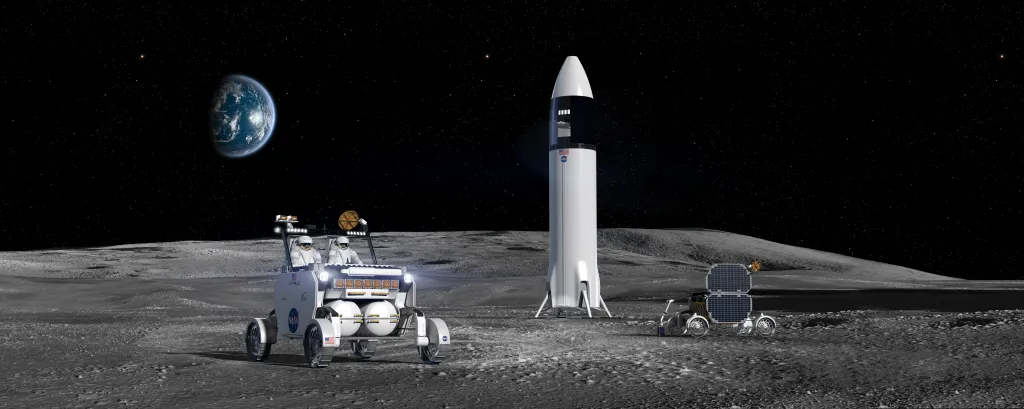
NASA lunar surface mobility systems are becoming one of the most important parts of future Moon exploration. Landing astronauts on the Moon is only the beginning. Once crews reach the lunar surface, they need safe ways to move, carry tools, transport samples, reach science sites, inspect equipment, support habitats, and return safely from difficult terrain.
Moon transportation is not like driving on Earth. There are no roads, no GPS road maps, no repair shops, no rescue teams nearby, and no breathable atmosphere. The lunar surface includes dust, rocks, craters, slopes, darkness, extreme temperature changes, and regions that may be difficult to reach on foot. Because of these challenges, NASA’s future Artemis missions need rovers, surface mobility systems, navigation tools, communication links, power management, and safety planning.
In 2026, the most accurate way to describe this topic is that NASA is developing and planning next-generation lunar mobility systems for Artemis and future Moon-to-Mars exploration. NASA has selected commercial teams to advance Lunar Terrain Vehicle capabilities, is studying pressurized rover concepts, and is using its Moon to Mars Architecture to define the systems needed for long-term human-led exploration beyond Earth. NASA says its Moon to Mars Architecture defines the elements needed for long-term human-led scientific discovery in deep space.
Editorial Note
This article uses careful mission-status wording. NASA has not completed a permanent Moon transportation network in 2026. Instead, NASA is advancing lunar transportation technologies that could support future Artemis missions and sustained lunar exploration.
Confirmed examples include the Lunar Terrain Vehicle, commercial LTV development teams, pressurized rover concepts, science instruments for lunar rovers, uncrewed rover operations, and NASA’s broader Moon-to-Mars planning. Future possibilities include longer rover traverses, robotic cargo transport, lunar base support, autonomous route planning, and a more connected lunar surface transportation system.
This distinction matters for reader trust and for AdSense, Journey by Mediavine, Mediavine, and Raptive-quality publishing. The article explains confirmed NASA work while clearly separating current development from future possibilities.
Key Facts About NASA Lunar Surface Mobility Systems
| Key Point | Simple Explanation |
|---|---|
| Lunar mobility is essential | Astronauts cannot safely explore large lunar areas by walking only. |
| NASA’s Lunar Terrain Vehicle is an unpressurized rover concept | Astronauts would drive it while wearing spacesuits. |
| NASA selected commercial teams for LTV development | Intuitive Machines, Lunar Outpost, and Venturi Astrolab were selected to advance LTV capabilities. |
| NASA plans LTV use for Artemis surface science | NASA says it intends to begin using the LTV for crewed operations during Artemis V. |
| Pressurized rovers are different | They act like mobile habitats and allow astronauts to travel farther for longer periods. |
| Lunar mobility must handle harsh conditions | Dust, darkness, radiation, temperature changes, rough terrain, and limited rescue options are major challenges. |
| Rovers can also support science | NASA has selected instruments planned for integration with the LTV. |
| 2026 is a development and planning stage | It is not the year NASA completes a full lunar transportation network. |
Why Moon Transportation Matters
A Moon mission does not end when astronauts land. The real exploration begins after landing, when crews need to move across the surface.
Astronauts may need to travel from a lander to a science site, from a habitat to a storage zone, from a rover to a crater rim, or from a power station to a communication system. Carrying equipment by hand while wearing a spacesuit is slow and tiring. Walking long distances also increases risk because astronauts must conserve oxygen, energy, cooling capacity, and time.
NASA’s Extravehicular Activity and Human Surface Mobility Program explains that Artemis astronauts exploring the Moon’s south pole will be able to go farther and conduct more science with the next-generation Lunar Terrain Vehicle. NASA describes the LTV as an unpressurized rover that will transport crew and equipment across wide areas while astronauts conduct experiments and collect samples.
For readers, the main idea is simple: rockets take astronauts to the Moon, but mobility systems help them explore it.
What Are NASA Lunar Surface Mobility Systems?
NASA lunar surface mobility systems include the vehicles, tools, software, infrastructure, and operational planning needed to help astronauts and robots move across the Moon safely.
These systems may include unpressurized crew rovers, pressurized rovers, robotic science rovers, cargo movers, autonomous driving software, route-planning tools, communication systems, navigation systems, power and charging support, dust protection, and science instrument platforms.
The word “mobility” is broader than “rover.” A rover is one part of the system. A complete lunar mobility network also needs power, communication, mapping, navigation, safety rules, rescue planning, and support from habitats or landers.
This is why lunar mobility connects naturally with NASA space habitat technology. A future Moon base will need transportation just as much as it needs shelter.
The Lunar Terrain Vehicle: NASA’s Next Moon Rover
The Lunar Terrain Vehicle, or LTV, is one of the most important NASA lunar surface mobility systems for Artemis.
NASA describes the LTV as a lunar surface vehicle with advanced power management, autonomous driving, modern communications, navigation systems, and other extreme-environment technologies. NASA also says it plans to contract the LTV as a service from industry instead of simply owning the vehicle directly.
This service-based approach is important. It means NASA is using commercial partnerships to develop future Moon transportation, similar to how commercial partnerships have supported cargo and crew transportation in low Earth orbit.
In April 2024, NASA selected Intuitive Machines, Lunar Outpost, and Venturi Astrolab to advance lunar mobility capabilities for Artemis missions. NASA said the LTV would increase astronauts’ ability to explore and conduct science on the lunar surface and could also serve as a science platform between crewed missions. NASA also said it intends to begin using the LTV for crewed operations during Artemis V.
This makes the LTV one of the clearest confirmed examples of NASA’s future Moon transportation planning.
How the LTV Is Different From the Apollo Rover
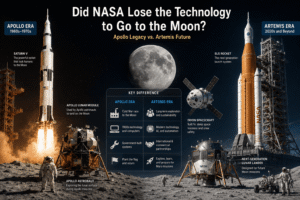
Many readers naturally compare the Artemis Lunar Terrain Vehicle with the Apollo Lunar Roving Vehicle. That comparison is useful, but the Artemis vehicle is expected to support a more advanced exploration model.
The Apollo rover helped astronauts drive across the Moon during short missions. It extended exploration range, helped crews carry tools, and allowed astronauts to collect more samples. But Apollo missions were brief.
Artemis is different because NASA’s long-term goal is not only to visit the Moon, but to learn how to live and work there for longer periods and prepare for Mars. That requires more capable mobility systems.
The LTV is expected to include modern navigation, communication, autonomous driving, and power management. It is also expected to support science between crewed missions. That means it is not just a “Moon car.” It is a mobile science and exploration platform.
A simple comparison is this: the Apollo rover helped astronauts explore during short field trips. The Artemis LTV is being developed as part of a broader lunar exploration architecture.
Commercial Teams Working on the Lunar Terrain Vehicle
NASA selected three commercial teams to advance Lunar Terrain Vehicle Services:
Intuitive Machines
Lunar Outpost
Venturi Astrolab
NASA’s goal is to combine industry innovation with NASA’s experience in developing and operating rovers. The selected teams are advancing designs that could support Artemis astronauts on the lunar surface.
This does not mean all three vehicles will automatically operate on the Moon. The selection advanced development and service concepts. NASA will continue evaluating mission needs, cost, safety, schedule, technical maturity, and operational value.
A reader-friendly way to explain it is this: NASA is asking commercial teams to help build the next generation of Moon transportation, while NASA defines the mission needs and safety expectations.
2026 Status: Development, Testing, and Planning
The year 2026 should be explained carefully. NASA lunar surface mobility systems are important in 2026, but that does not mean a complete Moon transportation network already exists.
NASA’s Johnson Space Center reported that all three LTV contractors completed Preliminary Design Review milestones in June 2025, marking the end of Phase 1 feasibility study task orders that began in May 2024. NASA also said it was preparing to award Phase 2 of the Lunar Terrain Vehicle Services contract with a demonstration mission task order that would result in development, delivery, and demonstration of an LTV on the Moon later this decade.
This is important for accurate publishing. The correct wording is not “NASA already has full Moon transportation in 2026.” The correct wording is that NASA is advancing commercial Lunar Terrain Vehicle development and preparing for future lunar surface operations.
In March 2026, NASA also announced initiatives connected with national space policy and said that beyond Artemis V it would begin incorporating more commercially procured and reusable hardware for frequent and affordable crewed missions to the lunar surface.
That makes lunar transportation even more important. More surface missions need better mobility.
Pressurized Rover: A Mobile Home on the Moon
The Lunar Terrain Vehicle is unpressurized. Astronauts would drive it while wearing spacesuits. A pressurized rover is different because it functions more like a small mobile habitat.
NASA explains that a pressurized rover would expand the ability to explore, conduct scientific research, and live and work on the lunar surface by providing a home for astronauts away from base camp for extended periods.
This is important because spacesuit operations are physically demanding and time-limited. A pressurized rover could allow astronauts to travel farther while spending much of the journey inside a protected environment. They would only need to wear spacesuits when they leave the rover to collect samples, inspect equipment, or perform surface tasks.
A simple example is a multi-day lunar traverse. Instead of returning to a fixed habitat after every short surface trip, astronauts could travel to distant science sites, sleep inside the rover, perform fieldwork, and return later.
That changes the scale of lunar exploration.
LTV vs Pressurized Rover
| Feature | Lunar Terrain Vehicle | Pressurized Rover |
|---|---|---|
| Cabin pressure | Unpressurized | Pressurized |
| Astronaut clothing | Spacesuits required while driving | Astronauts can travel inside without wearing suits during internal operations |
| Main purpose | Local crew and equipment mobility | Long-distance exploration and temporary living away from base |
| Exploration range | Greater than walking, but limited by spacesuit and mission constraints | Much greater range for extended traverses |
| Complexity | Lower than pressurized rover | Higher because it needs pressure systems and life support |
| Best use | Shorter science trips, sample collection, equipment transport | Multi-day science campaigns and distant exploration |
| NASA status | Commercial LTV services are being advanced | Future capability under NASA planning and architecture discussion |
Both systems matter. The LTV helps astronauts move efficiently near mission areas. A pressurized rover could support longer science campaigns away from base camp.
Why the Lunar South Pole Needs Better Mobility
NASA’s Artemis exploration focus includes the lunar south pole region. This area is scientifically valuable because permanently shadowed regions may preserve water ice and other volatiles. But it is also difficult terrain for human movement.
The south pole can include crater rims, deep shadows, steep slopes, rough surfaces, rocks, and extreme temperature differences between sunlight and shadow. Some areas may be hard to navigate because shadows make terrain harder to interpret. Other regions may be difficult for solar power because sunlight can be uneven.
A rover in this region must handle dust, darkness, slopes, rough terrain, thermal stress, and communication needs. It must also operate safely with astronauts nearby.
This is why NASA’s Lunar Terrain Vehicle description emphasizes advanced power management, autonomous driving, communications, navigation, and extreme-environment technologies.
Autonomy: Why Future Moon Rovers Need Smarter Navigation
Future lunar mobility will likely depend heavily on autonomy. A rover may need to drive without constant human control, avoid obstacles, return to a charging area, carry science instruments, reposition itself, or operate between crewed missions.
NASA’s LTV concept specifically includes autonomous driving capability.
Autonomy matters because astronaut time is limited. Every minute on the Moon is valuable. If a rover can scout terrain, carry instruments, move supplies, or prepare for a science task before astronauts arrive, it increases mission productivity.
This topic connects with NASA AI navigation systems for deep space, because future lunar rovers may use advanced navigation software, hazard detection, map matching, and route planning to operate more efficiently.
Communication and Navigation on the Moon
A lunar rover must communicate with astronauts, landers, habitats, relay systems, and mission control. It also needs accurate navigation so crews know where they are and how to return safely.
On Earth, vehicles use GPS, maps, roads, and communication networks. The Moon does not yet have the same infrastructure. Future lunar mobility may require local navigation beacons, relay satellites, onboard sensors, optical navigation, surface maps, and autonomous route planning.
This connects with NASA quantum navigation in space, because future space navigation may need systems that work beyond normal Earth GPS.
It also connects with NASA deep space laser communication, because future rover missions may need high-quality communication for telemetry, science data, maps, and mission updates.
Rovers as Science Platforms
A lunar rover is not only a vehicle. It can also be a moving science platform.
In July 2025, NASA selected three instruments to travel to the Moon, with two planned for integration onto a Lunar Terrain Vehicle and one for a future orbital opportunity. This shows that the LTV is expected to support scientific investigation, not only astronaut transport.
A rover can carry cameras, spectrometers, drills, sample containers, environmental sensors, and communication equipment. It can help astronauts reach locations that would be too far or too risky to access on foot. It can also collect useful data between crewed missions.
In simple words, a future lunar rover can work like a moving laboratory.
VIPER: A Robotic Rover Lesson for Lunar Mobility
VIPER, the Volatiles Investigating Polar Exploration Rover, was designed to search for water ice and other resources near the lunar south pole. In July 2024, NASA announced that it intended to discontinue VIPER development after an internal review, citing cost increases, launch delays, and future budget risks.
VIPER should be mentioned carefully. It should not be described as an active NASA rover already exploring the Moon. However, it remains relevant as a lesson in lunar mobility planning, resource exploration, cost control, delivery risk, and mission scheduling.
The reader benefit is clear: building a Moon rover is not only an engineering challenge. It is also a logistics, funding, delivery, and risk-management challenge.
Cargo Mobility: Moving More Than Astronauts
Future Moon transportation is not only about moving people. A sustained lunar presence will need cargo mobility.
Rovers and robotic movers may transport science instruments, power cables, solar panels, construction materials, life-support supplies, sample containers, communication hardware, spare parts, tools, and resource-extraction equipment.
NASA has also asked U.S. industry for innovative architecture solutions to help land and move cargo on the lunar surface during future Artemis missions.
This matters because a Moon base cannot function if astronauts must carry everything by hand. Mobility systems will support logistics, maintenance, science, and emergency operations.
Lunar Dust: A Serious Mobility Problem
Lunar dust is one of the biggest challenges for Moon transportation. It is not like ordinary household dust. Lunar regolith is sharp, abrasive, and can cling to surfaces. It can damage seals, wheels, joints, radiators, sensors, spacesuits, and mechanical systems.
A lunar rover must be designed to survive dust exposure. Wheels, motors, cables, bearings, optical sensors, brakes, thermal systems, and electronics must keep working after repeated surface operations.
Dust also affects astronaut safety. If dust enters a habitat or spacesuit system, it can create health and equipment risks.
This is why lunar mobility must be designed as a complete environmental system, not just a vehicle with wheels.
Power Challenges for Moon Vehicles
Power is another major challenge. The Moon has extreme lighting conditions, especially near the poles. Some areas receive useful sunlight, while others remain in deep shadow. Temperatures can vary dramatically.
A lunar rover may need batteries, solar panels, thermal control, charging systems, power-saving modes, or future connection with surface power infrastructure.
NASA’s LTV page specifically highlights advanced power management as one of the vehicle’s core technology areas.
For long-term lunar exploration, power and mobility are connected. If rovers can recharge reliably, they can support more science, longer traverses, and better logistics.
Safety and Rescue Planning
Transportation on the Moon must be designed with safety first. If a rover fails far from a habitat or lander, astronauts could face serious danger.
A safe lunar mobility system needs reliable navigation, backup communication, emergency power, spacesuit compatibility, route planning, return-to-base capability, redundant systems, rescue procedures, thermal protection, dust-resistant design, and hazard detection.
This is one reason NASA’s lunar surface mobility work is complex. A rover must not only drive. It must drive safely, predictably, and recover from problems.
Practical Example: A Short LTV Science Trip
Imagine two Artemis astronauts preparing for a science trip near the lunar south pole.
They put on spacesuits and board an unpressurized Lunar Terrain Vehicle. The rover carries tools, cameras, sample containers, navigation systems, communication equipment, and safety supplies. Mission planners have selected a route to a crater rim where rocks may reveal clues about lunar history.
The rover moves across rough terrain, avoiding rocks and steep slopes. Astronauts stop at several stations, collect samples, take images, and place instruments. The rover tracks location and keeps communication with mission support.
Without the LTV, this trip would be shorter and more physically demanding. With the LTV, astronauts can explore farther and return with more scientific value.
Practical Example: A Pressurized Rover Traverse
Now imagine a future pressurized rover mission.
Astronauts leave a lunar base and travel to a distant region over several days. Inside the pressurized rover, they can work without wearing spacesuits all the time. They sleep, eat, plan, communicate, and monitor systems inside the rover. When they reach important science targets, they put on spacesuits, exit through an airlock, collect samples, and return inside.
This kind of rover could change lunar exploration from short local trips into extended field campaigns.
NASA describes the pressurized rover as a system that could provide a home for astronauts away from base camp for extended periods.
Practical Example: Robotic Rover Between Crewed Missions
Future rovers may also work when astronauts are not on the Moon.
An uncrewed rover could move to a new science site, recharge, send data to Earth, inspect hardware, transport small cargo, or prepare for the next crew. If a rover can operate between crewed missions, it increases the value of every lunar delivery.
NASA’s LTV concept includes autonomous driving and science platform use, which supports the idea that rovers may be valuable even when astronauts are not physically present.
Confirmed Facts vs Future Possibilities
| Confirmed Fact | Future Possibility |
|---|---|
| NASA selected Intuitive Machines, Lunar Outpost, and Venturi Astrolab to advance LTV capabilities. | One or more commercial LTV services may support future Artemis surface missions. |
| NASA describes the LTV as an unpressurized rover. | Future LTV designs may include more autonomy, improved power, and stronger science payload support. |
| NASA intends to begin using the LTV for crewed operations during Artemis V. | LTVs may later support uncrewed science and logistics between astronaut visits. |
| NASA describes the pressurized rover as a home away from base camp for extended surface work. | Pressurized rovers may one day support multi-day lunar science traverses. |
| NASA selected instruments planned for the LTV. | Future rovers may operate as mobile science laboratories. |
| VIPER was discontinued as a NASA project in 2024. | VIPER-related lessons may still inform lunar resource and mobility planning. |
| NASA is planning commercially procured and reusable hardware beyond Artemis V. | Future lunar transportation may connect habitats, landing sites, science zones, and resource areas. |
Benefits for the Reader
Understanding NASA lunar surface mobility systems helps readers understand the practical side of Moon exploration.
First, it explains why astronauts need rovers instead of relying only on walking.
Second, it shows the difference between an unpressurized Lunar Terrain Vehicle and a pressurized rover.
Third, it explains how mobility supports science, sample collection, habitat operations, logistics, and future Moon bases.
Fourth, it helps readers understand why dust, darkness, power, navigation, and safety make Moon transportation difficult.
Fifth, it connects lunar mobility with other future technologies such as AI navigation, space habitats, deep space communication, and lunar resource exploration.
Sixth, it gives readers a realistic view of Artemis transportation without exaggerating 2026 progress.
What People Often Get Wrong
One common misunderstanding is that NASA already has a fleet of Artemis rovers operating on the Moon in 2026. That is not correct. NASA is advancing rover systems and commercial mobility services, but the full operational lunar transportation network is still future-facing.
Another misunderstanding is that all Moon rovers are the same. An unpressurized rover, a pressurized rover, a robotic science rover, and a cargo mover have different purposes.
A third misunderstanding is that rover design is only about wheels. In reality, a lunar rover needs power, communication, navigation, thermal control, dust protection, autonomy, safety systems, and mission operations.
A fourth misunderstanding is that a rover is only useful when astronauts are present. Future systems may also support uncrewed science and logistics between crewed missions.
How Lunar Mobility Supports Future Moon Bases
A future Moon base will need transportation in the same way a research station on Earth needs vehicles. Astronauts may need to move between habitats, landing pads, laboratories, power stations, resource sites, storage areas, and communication equipment.
Mobility systems may support crew transportation, cargo delivery, science fieldwork, emergency response, habitat inspection, power system maintenance, resource scouting, sample return, surface construction, and robotic operations.
This makes lunar mobility a foundation technology. A Moon base without reliable transportation would have a very limited exploration range.
Challenges NASA Must Still Solve
NASA and its partners still face major challenges before lunar surface mobility becomes routine.
Rovers must survive dust, radiation, temperature extremes, vibration, launch loads, landing loads, limited repair options, and uncertain terrain. They must carry astronauts safely. They must integrate with spacesuits, landers, habitats, communication relays, and mission control.
Power remains difficult because some lunar areas experience long darkness or extreme cold. Navigation remains difficult because the Moon does not yet have a mature GPS-like infrastructure. Maintenance remains difficult because astronauts cannot easily replace large components or call for quick rescue.
These challenges explain why NASA is using a careful development process instead of treating rovers as ordinary vehicles.
Future Outlook: The Moon Transportation Network
The future of Moon transportation will likely include multiple vehicle types. One rover will not solve every problem.
A likely future system may include unpressurized LTVs for short crew trips, pressurized rovers for long traverses, robotic cargo movers for logistics, autonomous scouts for terrain mapping, and mobility platforms for science instruments. These systems may connect with habitats, landing pads, solar power stations, communication relays, and resource sites.
In this future, the Moon begins to look less like a single landing site and more like a working exploration zone.
But this will happen step by step. The current stage is development, testing, commercial partnership, and architecture planning.
Frequently Asked Questions
What are NASA lunar surface mobility systems?
NASA lunar surface mobility systems are vehicles, tools, software, and infrastructure that help astronauts and robots move across the Moon. They include rovers, navigation systems, cargo transport, communication links, power systems, and safety planning.
What is the NASA Lunar Terrain Vehicle?
The Lunar Terrain Vehicle, or LTV, is an unpressurized rover concept for Artemis astronauts. It is designed to transport crew and equipment across the lunar surface while supporting science and exploration.
Is the Lunar Terrain Vehicle pressurized?
No. NASA describes the Lunar Terrain Vehicle as an unpressurized rover. Astronauts would drive it while wearing spacesuits.
What is a pressurized rover?
A pressurized rover is a mobile habitat-style vehicle. It allows astronauts to travel farther and live or work away from a base camp for extended periods.
When will NASA use the Lunar Terrain Vehicle?
NASA has said it intends to begin using the LTV for crewed operations during Artemis V.
Which companies did NASA select for LTV development?
NASA selected Intuitive Machines, Lunar Outpost, and Venturi Astrolab to advance Lunar Terrain Vehicle capabilities for Artemis missions.
Why is Moon transportation difficult?
Moon transportation is difficult because of dust, rocks, craters, steep slopes, darkness, extreme temperatures, radiation, limited power, and high safety requirements.
What happened to NASA’s VIPER rover?
NASA announced in July 2024 that it intended to discontinue VIPER development because of cost increases, launch delays, and future budget risks.
Can lunar rovers drive autonomously?
NASA’s LTV concept includes autonomous driving capabilities, along with advanced power, communication, and navigation systems.
Why do astronauts need rovers on the Moon?
Astronauts need rovers to travel farther, carry equipment, collect more samples, reduce physical strain, and conduct more science than they could by walking alone.
Conclusion
NASA lunar surface mobility systems are one of the most important foundations for the future of Moon exploration. Landing astronauts on the Moon is only the first step. To explore the lunar south pole, support science, build infrastructure, and prepare for Mars, astronauts need reliable transportation.
The Lunar Terrain Vehicle is NASA’s next-generation unpressurized rover concept for Artemis surface missions. It is being advanced through commercial partnerships and is intended to support crewed operations during Artemis V. Pressurized rovers could later expand exploration even further by giving astronauts a mobile home away from base camp.
The future of Moon transportation will not be one vehicle. It will likely be a connected system of crew rovers, pressurized rovers, robotic movers, navigation tools, communication links, power systems, and surface infrastructure. These systems will help astronauts travel farther, work more safely, collect better science, and build the foundation for future homes beyond Earth.
For readers, the key lesson is simple: rockets take humans to the Moon, but mobility systems let them explore it.
Sources and Further Reading
NASA Lunar Terrain Vehicle
NASA Pressurized Rover
NASA Extravehicular Activity and Human Surface Mobility Program
NASA Selects Companies to Advance Moon Mobility for Artemis Missions
NASA Selects Instruments for Artemis Lunar Terrain Vehicle
NASA Moon to Mars Architecture
NASA Artemis Program
NASA Ends VIPER Project, Continues Moon Exploration
NASA Johnson 2025 Milestones
NASA Seeks Innovative Artemis Lunar Logistics and Mobility Solutions