Table of Contents
ToggleNASA Titan Submarine Concepts: How Future Missions Could Explore Saturn’s Alien Seas
Saturn’s moon Titan is one of the most unusual worlds in the solar system. It has a thick atmosphere, clouds, rain, rivers, lakes, seas, dunes, organic chemistry, and weather patterns that make it look strangely familiar. But Titan is not like Earth in a simple way. Its environment is deeply alien. The liquids on Titan’s surface are not water. They are mostly liquid methane and ethane, flowing across a frozen landscape under an orange, hazy sky.
This is why NASA Titan submarine concepts are so fascinating. A future submarine on Titan would not explore a water ocean like submarines on Earth. It would explore a hydrocarbon sea, possibly Kraken Mare, Titan’s largest known sea. NASA has studied a concept for an autonomous submarine that could travel through Titan’s alien seas and measure their chemistry, depth, currents, waves, tides, and seafloor features.
In simple words, a Titan submarine would be a robotic spacecraft designed to land on Saturn’s moon Titan, enter one of its methane-rich seas, and study an extraterrestrial sea from the inside. This would be one of the boldest ideas in planetary exploration because it would combine spaceflight, oceanography, robotics, chemistry, and extreme-environment engineering.
This article explains what NASA Titan submarine concepts are, why Titan’s seas matter, what is already confirmed, what remains only a future possibility, and how future missions could explore Saturn’s alien seas.
Editorial Note
This article explains confirmed NASA discoveries, NASA-studied Titan submarine concepts, and possible future mission ideas. A Titan submarine has not been officially selected as an active NASA mission. NASA’s confirmed future mission to Titan is Dragonfly, while submarine exploration remains a concept and future possibility.
What Is Titan?
Titan is Saturn’s largest moon and one of the most scientifically important moons in the solar system. It is larger than the planet Mercury and has a dense atmosphere, which makes it very different from most moons. Its atmosphere is mainly nitrogen, with methane and other organic compounds that create its orange haze.
Titan is especially important because it has Earth-like surface processes. It has clouds, rainfall, rivers, lakes, and seas. However, Titan is extremely cold, so water behaves more like solid rock on its surface. Instead of a water cycle like Earth’s, Titan has a methane cycle. Methane can evaporate, form clouds, fall as rain, flow through river-like channels, and collect in lakes and seas.
NASA’s Cassini mission revealed that Titan’s northern region contains large seas such as Kraken Mare, Ligeia Mare, and Punga Mare. These seas are not filled with liquid water. They are mostly filled with methane and ethane. This makes Titan the only known world in the solar system other than Earth with stable liquid on its surface.
For more deep space explainers, visit our Space & Beyond section.
Why Titan’s Seas Are So Important
Titan’s seas are important because they are unlike anything found on Earth. On Earth, oceans are made of liquid water. On Titan, the seas are made mostly of liquid hydrocarbons. Hydrocarbons are chemical compounds made mainly of hydrogen and carbon. Methane and ethane are two common examples.
This makes Titan a natural laboratory for studying chemistry in extreme conditions. Scientists want to understand how organic molecules behave in liquid methane and ethane. They also want to know whether Titan’s seas are chemically layered, how deep they are, how they interact with the atmosphere, and whether complex chemistry occurs inside or around them.
Titan’s seas may also help scientists understand climate systems beyond Earth. Earth has a water cycle, while Titan has a methane-based weather cycle. Methane can evaporate from lakes and seas, form clouds, fall as rain, flow across the surface, and return to lakes and seas. This makes Titan one of the best places to study how weather and liquids can operate on a world very different from our own.
A submarine mission would be powerful because orbiters and flybys can observe Titan from above, but a floating or diving probe could directly measure the liquid environment. It could move through an alien sea, test its composition, measure its depth, and study its behavior in a way no telescope or orbiter could fully achieve.
What Are NASA Titan Submarine Concepts?
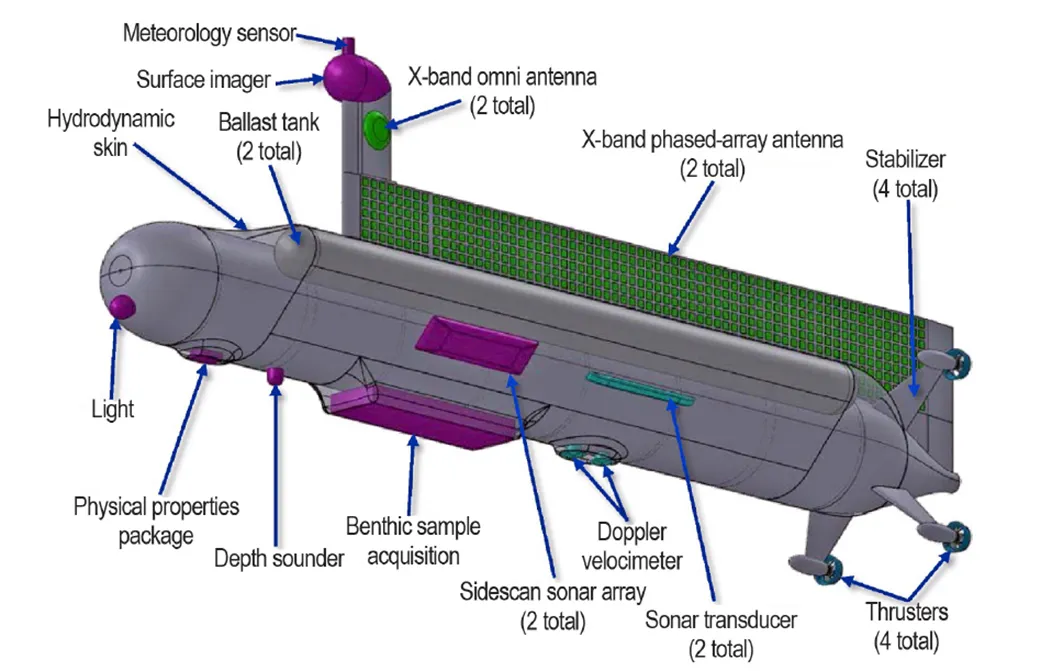
NASA Titan submarine concepts are early-stage mission studies for a robotic submarine that could explore Titan’s methane and ethane seas. One NASA concept focused on a submersible autonomous vehicle designed to explore Kraken Mare, Titan’s largest northern sea.
The proposed vehicle would not be a crewed submarine. It would be a robotic spacecraft. It would need to operate far from Earth, make decisions on its own, collect scientific data, and survive in a cold hydrocarbon sea. Because Titan is so far away, humans could not control the submarine in real time. The vehicle would need autonomous systems to navigate, avoid problems, manage power, and decide when to collect and transmit data.
NASA’s concept suggested that a Titan submarine could investigate chemical composition, surface currents, subsurface currents, mixing, layering, tides, wind, waves, bathymetry, and bottom features. Bathymetry means measuring the depth and shape of the seafloor. On Earth, oceanographers use similar methods to map the bottoms of oceans and lakes. On Titan, bathymetry would help scientists understand the hidden shape of an alien sea.
A Titan submarine would create a new type of exploration. Instead of rolling across a surface like a rover or flying through an atmosphere like a drone, it would travel through liquid on another world. This would make it one of the first serious concepts for extraterrestrial nautical exploration.
Confirmed Facts vs Future Possibilities
This topic must be explained carefully because a concept is not the same as an approved mission. NASA has studied Titan submarine ideas, but that does not mean a submarine mission has been officially selected.
| Topic | Status |
|---|---|
| Cassini observations of Titan’s lakes and seas | Confirmed |
| Titan’s lakes and seas made mostly of methane and ethane | Confirmed |
| Kraken Mare as Titan’s largest sea | Confirmed |
| NASA Dragonfly mission to Titan | Confirmed future mission |
| NASA Titan submarine design studies | Concept study |
| Titan submarine launch date | Not officially confirmed |
| Titan submarine landing in Kraken Mare | Future possibility |
| Submarine exploration of Titan’s seafloor | Future possibility |
The confirmed NASA mission to Titan is Dragonfly. Dragonfly is a rotorcraft mission planned to launch in July 2028 and arrive at Titan in 2034. It will fly to multiple locations on Titan and study prebiotic chemistry, geology, and habitability. However, Dragonfly is not a submarine.
A Titan submarine remains a future concept. It is scientifically exciting, but it should not be described as an officially selected NASA mission unless NASA announces that in the future.
Why Kraken Mare Is a Major Target
Kraken Mare is Titan’s largest known sea and one of the most interesting possible targets for a future submarine. It is located near Titan’s north polar region, where many of Titan’s major lakes and seas are found. NASA’s submarine concept focused on Kraken Mare because of its large size, scientific value, and potential for detailed oceanographic study.
Kraken Mare is not a small pond. It is a vast sea of liquid hydrocarbons. NASA’s Titan submarine concept described Kraken Mare as roughly comparable in scale to the Great Lakes, with estimated depths around 300 meters in some areas. This makes it one of the most important liquid environments outside Earth.
A future mission to Kraken Mare could answer questions that cannot be fully answered from orbit. How deep is the sea? Does its composition change with depth? Are there tides? Are there currents? Are there waves? What does the seafloor look like? Are there sediments, dissolved gases, or chemical layers?
These questions make Kraken Mare one of the most exciting possible exploration targets in the outer solar system.
How a Titan Submarine Could Work
A Titan submarine would need to work very differently from a submarine on Earth. On Earth, submarines operate in water, communicate with support systems, and can eventually return to humans for repair. A Titan submarine would operate alone on a moon of Saturn, more than a billion kilometers from Earth.
First, the spacecraft would need to launch from Earth and travel to the Saturn system. This journey would take many years. After reaching Titan, the spacecraft would need to enter Titan’s atmosphere, survive descent, and land safely in or near a sea such as Kraken Mare.
Titan’s thick atmosphere could help slow the spacecraft during descent, but landing in a hydrocarbon sea would still be extremely difficult. The mission would need to survive entry heating, atmospheric descent, sea impact, floating or diving operations, and long-term exposure to extremely cold liquid methane and ethane.
Once in the sea, the submarine would begin autonomous operations. It could travel through the liquid, measure temperature and pressure, analyze chemical composition, study currents, map depth, and possibly image the seafloor.
Communication would be one of the biggest challenges. A submerged submarine could not easily communicate directly with Earth. NASA’s concept noted that the vehicle would need to surface regularly to transmit scientific data. This means the mission would likely follow a cycle: dive, collect data, surface, transmit data, then dive again.
What Instruments Could a Titan Submarine Carry?
A Titan submarine would need scientific instruments designed for one of the coldest and most unusual environments ever explored.
A chemical analyzer could measure the composition of the liquid. It could detect methane, ethane, nitrogen, dissolved gases, and complex organic compounds. These measurements would help scientists understand Titan’s hydrocarbon chemistry.
A sonar or acoustic mapping system could measure depth and map the seafloor. On Earth, submarines use sonar to study underwater environments. On Titan, a similar system could help scientists build the first detailed maps of an alien sea floor.
Temperature and pressure sensors could measure how conditions change with depth. These readings would help scientists understand whether the sea is well mixed or divided into layers.
Current meters could measure how the liquid moves. Titan’s seas may have currents caused by wind, tides, temperature differences, or chemical density differences.
Wave and wind sensors could study how Titan’s atmosphere interacts with the sea surface. Even small waves would be important because they would reveal how energy moves between the atmosphere and the liquid surface.
Imaging systems could possibly study the surface, shoreline, and maybe underwater features, depending on visibility. Titan’s seas may be dark and chemically complex, so imaging would be challenging, but even limited visual data could be valuable.
A meteorology package could measure atmospheric pressure, wind, humidity, and temperature while the submarine is floating on the surface. This would connect sea measurements with Titan’s weather system.
What Scientists Could Learn from Titan’s Alien Seas
A Titan submarine could help scientists answer many important questions.
One major question is sea composition. Scientists know Titan’s seas contain methane and ethane, but the exact mixture may vary between seas, locations, and depths. Direct measurements would help scientists understand how Titan’s liquid reservoirs work.
Another question is sea depth. Cassini provided important radar data, but a submarine could measure depth directly. This would help scientists understand the shape of Kraken Mare and the structure of its basin.
A third question is weather and climate. Titan’s methane cycle is similar in structure to Earth’s water cycle, but it operates in a much colder environment. A submarine could study evaporation, wind, waves, and sea-atmosphere interaction.
A fourth question is organic chemistry. Titan’s atmosphere produces many organic molecules. These materials may fall onto the surface and enter lakes and seas. A submarine could study how organic compounds behave in liquid methane and ethane.
A fifth question is geology. The shape of Titan’s seafloor could reveal how its sea basins formed. Scientists could investigate whether the basins formed through erosion, crustal movement, collapse, chemical dissolution, or other processes.
A sixth question is oceanography beyond Earth. On Earth, oceanography studies water oceans. On Titan, scientists could study a completely different kind of sea. This would expand the meaning of ocean science beyond Earth.
How Titan Submarine Concepts Connect to NASA Dragonfly
NASA’s Dragonfly mission is not a submarine, but it is very important for Titan exploration. Dragonfly is a rotorcraft mission designed to fly through Titan’s atmosphere and land at different surface locations. It will study Titan’s chemistry, geology, and habitability.
Dragonfly will explore solid surface regions, not Titan’s seas. It will fly like a large drone in Titan’s dense atmosphere and visit multiple locations. This makes it very different from a submarine, but both mission types are connected by the same larger scientific goal: understanding Titan as a complex organic world.
Dragonfly may help scientists understand Titan’s surface chemistry and prebiotic processes. A future submarine could later study Titan’s liquid environments directly. Together, these mission types could provide a much deeper understanding of Titan’s atmosphere, surface, seas, and chemistry.
For more NASA mission explainers, visit our NASA category.
Why Titan Is Important for Astrobiology
Astrobiology is the study of life in the universe and the conditions that may support life or life-related chemistry. Titan is important for astrobiology because it contains complex organic molecules.
Organic molecules are carbon-based compounds. On Earth, carbon chemistry is closely connected to life. Titan’s atmosphere produces many organic compounds, and some of these materials settle onto the surface. This makes Titan a natural laboratory for studying prebiotic chemistry.
However, Titan should not be described as Earth-like in a simple way. Its surface is extremely cold. Its lakes and seas are made of methane and ethane, not water. Its water is mostly frozen solid at the surface. This means Titan is familiar in some ways and completely alien in others.
NASA’s Dragonfly mission will study Titan’s chemistry and habitability. It is not a mission to find animals or plants. It is designed to investigate chemical processes that may resemble those on the early Earth before life developed.
A future submarine could expand this science by studying Titan’s liquid reservoirs directly. It could examine how organic compounds behave in alien seas and whether interesting chemistry happens where liquid, atmosphere, and solid materials interact.
Major Engineering Challenges
A Titan submarine mission would face extreme engineering challenges.
The first challenge is distance. Titan orbits Saturn, which is far from Earth. A spacecraft would need many years to reach the Saturn system. It would also need to survive deep space, radiation, cold temperatures, and long periods without repair.
The second challenge is landing. The spacecraft would need to enter Titan’s thick atmosphere and land safely in a sea. A sea landing may sound easier than landing on hard ground, but it would still require careful engineering. The vehicle would need to remain stable, avoid damage, and begin operations in a liquid hydrocarbon environment.
The third challenge is temperature. Titan’s surface is extremely cold. Electronics, batteries, instruments, seals, moving parts, and communication systems would need to work in conditions far colder than almost anywhere on Earth.
The fourth challenge is power. Solar power is not practical for a long-duration submarine mission at Saturn because sunlight is weak. A Titan submarine would likely need a radioisotope power system or another long-lasting power source suitable for the outer solar system.
The fifth challenge is communication. A submerged submarine cannot easily send data directly to Earth. The craft would need to surface regularly, point its communication system properly, and transmit stored data across a huge distance.
The sixth challenge is autonomy. Because of communication delays, the submarine could not be controlled like a remote-control vehicle. It would need onboard intelligence to protect itself, make decisions, and continue science operations even when Earth is not actively communicating with it.
The seventh challenge is buoyancy. Titan’s seas are not water. They are methane and ethane mixtures with different density and physical properties. Engineers would need to design a craft that can float, dive, move, and resurface properly in those liquids.
These challenges explain why a Titan submarine remains a concept rather than an active mission today.
What People Often Get Wrong About Titan Submarine Missions
Many people think NASA has already approved a Titan submarine mission. That is not correct. NASA has studied Titan submarine concepts, but a Titan submarine has not been selected as an official mission.
Another misunderstanding is that Titan’s seas are made of water. They are not. Titan’s surface seas are mostly made of liquid methane and ethane. Water on Titan’s surface is frozen hard because the moon is extremely cold.
Some people think a Titan submarine would search for fish-like life. That is not realistic. A Titan submarine would mainly study chemistry, physics, depth, currents, waves, and environmental conditions.
Another mistake is confusing Dragonfly with a submarine. Dragonfly is a rotorcraft mission. It will fly through Titan’s atmosphere and land on solid surface locations. A Titan submarine would explore liquid seas. Both are exciting, but they are different mission types.
A final misunderstanding is that Titan matters only because of life-related questions. Titan is important even without life because it helps scientists understand organic chemistry, atmospheric cycles, planetary evolution, and liquid systems in extreme environments.
Why Future Missions Could Change Our View of Titan
Future Titan missions could completely change how scientists understand the outer solar system. Cassini gave scientists a global view of Titan from orbit and flybys. Huygens landed on Titan’s surface in 2005 and gave humanity the first direct surface data from this moon. Dragonfly will explore Titan’s land regions in the future. A submarine could eventually open a new chapter by exploring Titan’s seas.
Each type of mission studies Titan differently. An orbiter can map the surface from above. A lander can study one location directly. A rotorcraft can visit many surface locations. A submarine could enter a sea and study the liquid environment from within.
This layered approach is how planetary science grows. Scientists first observe a world from far away, then send flybys, orbiters, landers, and eventually more specialized vehicles. Titan is one of the few places where such specialized exploration makes sense because it has an atmosphere, surface liquids, organic chemistry, and complex weather.
To understand Saturn’s environment better, read our guide on why planets have rings.
Could Titan’s Seas Help Us Understand Earth?
Titan is not Earth, but studying Titan can still help scientists think about Earth in new ways. Earth and Titan are the only known worlds in the solar system with stable surface liquids. That comparison is powerful because it allows scientists to study how liquids shape landscapes under very different conditions.
On Earth, water shapes rivers, lakes, coastlines, and oceans. On Titan, methane and ethane may shape channels, shorelines, basins, and seas. By comparing the two worlds, scientists can ask deeper questions about how liquids behave on planetary surfaces.
Titan also helps scientists understand atmospheric cycles. Earth has a water cycle, while Titan has a methane cycle. Comparing them may help scientists understand climate, weather, evaporation, precipitation, and surface erosion in a broader planetary context.
This is why Titan is not just a strange moon. It is a natural experiment in how planets and moons can develop complex surface systems.
Frequently Asked Questions
What are NASA Titan submarine concepts?
NASA Titan submarine concepts are proposed robotic mission ideas for exploring Titan’s methane and ethane seas. These concepts imagine an autonomous submarine that could study sea chemistry, depth, currents, waves, tides, and seafloor features.
Has NASA approved a Titan submarine mission?
No. NASA has studied Titan submarine concepts, but a Titan submarine has not been officially selected as an active mission. NASA’s confirmed future mission to Titan is Dragonfly.
Which sea could a Titan submarine explore?
Many concepts focus on Kraken Mare, Titan’s largest known sea. Kraken Mare is scientifically important because of its size, possible depth, and location in Titan’s northern polar region.
Are Titan’s seas made of water?
No. Titan’s surface seas are mostly made of liquid methane and ethane. Water on Titan’s surface is frozen because the moon is extremely cold.
Why is Titan important to NASA?
Titan is important because it has a thick atmosphere, organic chemistry, weather, rivers, lakes, and seas. It is one of the best places to study complex chemistry and planetary processes beyond Earth.
What is NASA Dragonfly?
Dragonfly is NASA’s confirmed future rotorcraft mission to Titan. It is planned to launch in July 2028 and arrive at Titan in 2034. It will fly to different locations on Titan to study chemistry, geology, and habitability.
Could a Titan submarine find life?
A Titan submarine would not be designed to look for large life forms. Its main purpose would be to study chemistry, sea composition, currents, depth, waves, and environmental conditions. Its astrobiology value would come from helping scientists understand Titan’s organic chemistry.
Conclusion
NASA Titan submarine concepts represent one of the boldest ideas in future planetary exploration. Titan is not just another moon. It is a world with a thick atmosphere, complex organic chemistry, methane rain, rivers, lakes, and vast hydrocarbon seas. It is both familiar and alien: familiar because it has weather and surface liquids, alien because those liquids are methane and ethane instead of water.
A future Titan submarine could explore Kraken Mare, measure the chemical composition of alien seas, study currents and waves, map the seafloor, and reveal how Titan’s methane cycle works. Such a mission would open a new category of exploration: extraterrestrial oceanography.
However, it is important to describe this topic accurately. NASA has studied Titan submarine concepts, but no Titan submarine mission has been officially selected. The confirmed future NASA mission to Titan is Dragonfly, a rotorcraft planned to explore Titan’s surface and chemistry after arriving in the 2030s.
For readers, the simplest way to understand this topic is this: Titan’s seas are real, NASA has studied how a submarine could explore them, and future missions may one day dive into the first alien sea ever explored beyond Earth.
Sources and Further Reading
NASA: Titan Submarine — Exploring the Depths of Kraken
NASA: Exploring the Depths of Titan’s Seas
NASA: Dragonfly Rotorcraft Mission to Saturn’s Moon Titan Confirmed
JPL: Cassini’s Final View of Titan’s Northern Lakes and Seas
About the Author
Shahzaib Ali
Shahzaib Ali is the founder and editor of Sanceen, a science, space, NASA, and future technology educational website. He writes beginner-friendly articles about space missions, astronomy, scientific discoveries, and emerging technology.