Science is full of facts that sound impossible at first. Some are so strange that they feel like myths, jokes, or science fiction. Bananas are slightly radioactive. A day on Venus is longer than a year. Octopuses have blue blood. Lightning can be hotter than the surface of the Sun. Tiny animals called tardigrades can survive exposure to outer space.
These facts sound fake because they do not match everyday experience. Most people do not think of fruit as radioactive, oceans as oxygen factories, or time as something that can change depending on speed and gravity. But science often becomes most interesting when reality feels stranger than imagination.
The key is evidence. A surprising claim should not be accepted just because it sounds exciting. It should be checked against reliable sources, experiments, observations, and expert explanations.
In this article, we will explore 10 science facts that sound fake but are true. Each fact is explained in simple language, with examples, scientific context, and trusted sources so you can understand why it is real.
For more science mystery content, you can also read Is Time Travel Possible? What Scientists Really Think and The Bermuda Triangle: Science or Supernatural?.
Editorial Note
This article is written for educational and informational purposes. The title uses the phrase “100% true” in a popular science sense, but the explanations below include important scientific context. Some facts are directly measured, while others require careful wording because the details matter.
The goal is to make strange science easy to understand without exaggerating or turning real facts into misleading claims.
Key Facts at a Glance
| # | Science Fact | Why It Sounds Fake | Why It Is True |
|---|---|---|---|
| 1 | Bananas are slightly radioactive | Fruit does not seem radioactive | Bananas contain potassium, and a small fraction of potassium is naturally radioactive |
| 2 | A day on Venus is longer than a year | A day usually feels shorter than a year | Venus rotates extremely slowly |
| 3 | Lightning can be hotter than the Sun’s surface | The Sun sounds hotter than everything | Lightning heats surrounding air to extreme temperatures |
| 4 | Octopuses have three hearts and blue blood | It sounds like fantasy biology | Their blood uses copper-based hemocyanin |
| 5 | Roughly half of Earth’s oxygen production comes from the ocean | People usually think forests produce most oxygen | Ocean plankton photosynthesize on a massive scale |
| 6 | A teaspoon of neutron star matter would weigh about a billion tons | A teaspoon seems tiny | Neutron stars are incredibly dense collapsed stellar cores |
| 7 | Tardigrades can survive exposure to outer space | Most life dies quickly in space | Some tardigrades survive by entering a dried, low-metabolism state |
| 8 | Sharks are older than trees | Trees seem ancient | Shark ancestors appear in the fossil record hundreds of millions of years ago |
| 9 | You are made of star stuff | It sounds poetic, not literal | Many elements in your body formed inside stars or stellar explosions |
| 10 | Space is mostly silent | Space battles in movies are loud | Sound needs a medium, and most of space is a near-vacuum |
1. Bananas Are Slightly Radioactive
This sounds fake because most people do not connect food with radiation. But bananas really are slightly radioactive.
The reason is potassium. Bananas contain potassium, and a small fraction of all natural potassium is radioactive potassium-40. The U.S. Environmental Protection Agency explains that bananas and Brazil nuts are well-known examples of foods with naturally occurring radionuclides. EPA also notes that eating one banana gives a very small radiation dose. (epa.gov)
This does not mean bananas are dangerous. The amount is tiny. Your body also regulates potassium, so eating bananas does not make you dangerously radioactive.
Example: the phrase “banana equivalent dose” is sometimes used as an educational comparison for very small amounts of radiation. It helps people understand that radiation is not always artificial or dangerous at every level.
The important lesson is that radiation exists naturally in the world. Rocks, soil, air, water, food, and even the human body contain small amounts of naturally occurring radioactive material.
2. A Day on Venus Is Longer Than a Year
On Earth, one day is much shorter than one year. That makes the Venus fact sound impossible.
But Venus rotates extremely slowly. NASA explains that a day on Venus is 243 Earth days long, while a Venus year is 225 Earth days. That means Venus takes longer to spin once on its axis than it takes to complete one orbit around the Sun. (science.nasa.gov)
In simple words, a year on Venus finishes before a full Venus day finishes.
Venus is also unusual because it rotates in the opposite direction from Earth and most other planets. If you could safely stand on Venus, which you cannot because of extreme heat and crushing pressure, the Sun would appear to rise in the west and set in the east.
Example: imagine celebrating New Year on Venus before the planet even completes one full day-night rotation. That is how strange Venus is compared with Earth.
For more space science content, read Why Do Planets Have Rings?.
3. Lightning Can Be Hotter Than the Surface of the Sun
This fact sounds fake because the Sun is the symbol of heat. But lightning can heat the air around it to temperatures far hotter than the Sun’s visible surface.
The National Weather Service says lightning can heat the air it passes through to around 50,000 degrees Fahrenheit, about five times hotter than the surface of the Sun. (weather.gov)
This does not mean lightning is more powerful than the Sun overall. The Sun is enormous and continuously produces energy. Lightning is extremely hot for a very short time and in a narrow path.
That short burst of heat explains thunder. When lightning heats the air suddenly, the air expands explosively. That rapid expansion creates the shock wave we hear as thunder.
Example: when lightning strikes a tree, the heat can vaporize water inside the tree, causing bark to explode outward. That is why lightning damage can look so violent.
4. Octopuses Have Three Hearts and Blue Blood
Octopuses already look unusual, but their internal biology is even stranger.
Smithsonian Magazine explains that octopuses have blue blood because they use a copper-containing protein called hemocyanin to carry oxygen. Human blood uses iron-based hemoglobin, which appears red when oxygenated. Octopus blood appears blue because of copper chemistry. (smithsonianmag.com)
Octopuses also have three hearts. Two hearts pump blood through the gills, while the third pumps blood through the rest of the body.
This system helps octopuses survive in ocean environments where oxygen can be limited and temperatures can be cold.
Example: when an octopus swims, the heart that pumps blood to the body can temporarily stop beating, which is one reason crawling can be less tiring for many octopuses than swimming.
This fact sounds like fantasy biology, but it is real marine science.
5. Roughly Half of Earth’s Oxygen Production Comes From the Ocean
Many people believe most of Earth’s oxygen comes from forests. Forests are important, but the ocean plays a huge role too.
NOAA explains that scientists estimate roughly half of the oxygen production on Earth comes from the ocean, mostly from oceanic plankton such as drifting plants, algae, and photosynthetic bacteria. (oceanservice.noaa.gov)
These tiny organisms photosynthesize. They use sunlight, carbon dioxide, and water to produce food and release oxygen.
One especially important organism is Prochlorococcus, a tiny photosynthetic bacterium. NOAA notes that it produces up to 20% of the oxygen in the biosphere. (oceanservice.noaa.gov)
Example: every time you breathe, some of the oxygen entering your lungs may trace back to microscopic life floating in sunlit ocean waters.
This fact is powerful because it reminds us that tiny organisms can shape the whole planet.
6. A Teaspoon of Neutron Star Matter Would Weigh About a Billion Tons
A teaspoon seems small, so this fact sounds impossible. But neutron stars are not ordinary objects.
A neutron star forms when a massive star collapses after a supernova. NASA describes a neutron star as an ultra-dense sphere about the size of a city but containing up to twice the mass of the Sun. NASA also says one teaspoon of neutron star matter would weigh a billion tons on Earth. (nasa.gov)
That density is hard to imagine. It means matter has been crushed into an extreme state by gravity.
Example: if Mount Everest were compressed into a tiny sugar-cube-sized volume, it would begin to give a sense of the density scientists are talking about, though neutron star matter is even more extreme.
Neutron stars show how strange the universe becomes when gravity wins against normal matter.
For more extreme space science, read What Happens If You Fall Into a Black Hole?.
7. Tardigrades Can Survive Exposure to Outer Space
Tardigrades, also called water bears, are microscopic animals famous for surviving extreme environments.
This sounds fake because outer space is deadly. It has vacuum, radiation, extreme temperature changes, and no liquid water. Most life would die quickly.
But NASA’s “Water Bears in Space” discussion explains that tardigrades were exposed to the vacuum of space for about ten days in low Earth orbit and were shown to be viable after that exposure. (nasa.gov)
Smithsonian also describes a 2007 experiment in which dehydrated tardigrades were exposed to space vacuum and solar radiation for 10 days; many protected from radiation survived after returning to Earth and being rehydrated. (smithsonianmag.com)
The key is that tardigrades can enter a state called cryptobiosis. They dry out, slow their metabolism dramatically, and become highly resistant to environmental stress.
Example: a tardigrade is not walking around happily in space like an astronaut. It survives by shutting down into a nearly lifeless state and reactivating when conditions improve.
That makes the fact real, but the details matter.
8. Sharks Are Older Than Trees
This fact sounds fake because trees feel ancient. Forests seem like one of Earth’s oldest features. But shark ancestors appeared earlier in the fossil record than true forests.
The Natural History Museum explains that the earliest fossil evidence for sharks or their ancestors includes scales dating to about 450 million years ago. (nhm.ac.uk)
The same museum explains that some of the oldest known fossil forests date back around 390 million years. (nhm.ac.uk)
That means shark-like animals were swimming in ancient seas long before forests became established on land.
Example: when the ancestors of sharks were already in the ocean, Earth did not yet have the kind of forests we know today. Land ecosystems were still developing.
This does not mean modern sharks are unchanged fossils. Sharks have evolved over time. But their lineage is incredibly ancient.
9. You Are Made of Star Stuff
This sounds poetic, but it is literally true in a scientific sense.
NASA explains that most elements beyond hydrogen and helium were formed through the life cycles of stars, where lighter elements fuse into heavier ones, and the heaviest elements are created in supernova explosions. (astrobiology.nasa.gov)
NASA also says that being made of star stuff is not just an analogy; it is literally true. (nasa.gov)
The carbon in your body, the oxygen you breathe, the calcium in your bones, and the iron in your blood are connected to cosmic processes that happened before Earth existed.
Example: the iron in your blood did not simply appear on Earth from nowhere. Elements like iron were produced in earlier generations of stars and stellar explosions, then became part of the material that formed the solar system.
So in a real scientific sense, every person carries a piece of cosmic history.
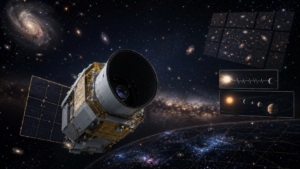
For more universe-related reading, visit NASA Roman Space Telescope 2026.
10. Space Is Mostly Silent
Movies often show loud explosions, roaring engines, and dramatic battle sounds in space. In reality, most of space is nearly silent.
Sound needs a medium, such as air, water, or solid material, to travel. Most of space is a near-vacuum, meaning it does not have enough particles to carry ordinary sound waves the way air does on Earth.
NASA has explained that most space is a vacuum, providing no way for sound waves to travel. However, some regions of space contain gas, and scientists can convert data into sound through sonification. (nasa.gov)
This is why the phrase “in space, no one can hear you scream” is mostly accurate for empty space.
Example: if an explosion happened in deep space, you would not hear it the way you would hear an explosion on Earth. There is no air to carry the sound to your ears. But instruments could still detect light, radiation, particles, or vibrations if the conditions were right.
Space is not boring, but it is mostly quiet in the ordinary sound-wave sense.
Bonus Fact: Water Can Exist as Ice, Liquid, and Vapor at the Same Time
This is not one of the main 10, but it is too interesting to ignore.
Under a precise temperature and pressure condition called the triple point, water can exist as solid ice, liquid water, and water vapor at the same time in equilibrium. The triple point of water is an important concept in thermodynamics and scientific calibration. NIST has published research related to water’s triple point vapor pressure, showing its importance in precise measurement science. (nist.gov)
This does not happen under normal kitchen conditions. It requires carefully controlled pressure and temperature.
Example: in a laboratory demonstration, water under the right conditions can appear to boil and freeze as its phases shift around the triple point.
This fact sounds like a magic trick, but it is thermodynamics.
What These Facts Teach Us About Science
The most important lesson is that science is not always intuitive.
Everyday experience is limited. We live on one planet, under one atmosphere, at one range of temperatures and pressures, with one type of gravity. The universe is much bigger and stranger than the conditions we experience daily.
That is why facts about Venus, neutron stars, octopuses, tardigrades, and lightning can sound fake at first. They do not match our normal environment.
Science helps by testing claims, collecting evidence, and building explanations that can be checked.
That is the difference between a real strange fact and a false viral claim.
How to Tell If a Strange Science Fact Is Reliable
A strange science fact is more trustworthy when:
It comes from a scientific organization, university, museum, or official agency.
It includes a clear explanation, not just a shocking sentence.
It can be checked through multiple sources.
It does not rely only on social media posts.
It uses careful wording.
It explains limits and context.
Example: “bananas are radioactive” is true, but “bananas are dangerous because they are radioactive” is misleading. The first is a scientific fact. The second exaggerates the risk.
Good science communication does not only tell people surprising facts. It explains what those facts really mean.
What People Often Get Wrong
Many people think “radioactive” always means dangerous. In reality, radiation exists naturally, and dose matters.
Another mistake is thinking “hotter than the Sun” means lightning is more powerful than the Sun. Lightning can briefly heat air to a higher temperature than the Sun’s surface, but the Sun produces vastly more total energy.
A third mistake is thinking “space is silent” means nothing happens in space. Space is full of radiation, plasma, particles, gravity waves, magnetic fields, and signals, but ordinary sound needs a medium.
A fourth mistake is thinking “tardigrades survive space” means they can live normally in space. They survive in a dormant state under certain conditions; they do not thrive there.
A fifth mistake is thinking “made of star stuff” is only poetry. It is poetic, but it is also rooted in stellar nucleosynthesis.
Practical Reader Takeaway
The strangest science facts are often true because nature is not limited by human intuition.
Bananas can be slightly radioactive. Venus can have a day longer than its year. Lightning can briefly heat air hotter than the Sun’s surface. The ocean can produce roughly half of Earth’s oxygen. Tiny tardigrades can survive extreme space exposure. Your body contains elements formed by ancient stars.
These facts are not just trivia. They show how connected biology, physics, astronomy, chemistry, and Earth science really are.
The universe is stranger than fiction, but the best strange facts are still supported by evidence.
Frequently Asked Questions
Are bananas really radioactive?
Yes. Bananas contain potassium, and a small fraction of natural potassium is radioactive potassium-40. The amount is very small and not dangerous under normal eating conditions. (epa.gov)
Is a day on Venus really longer than a year?
Yes. NASA explains that Venus takes 243 Earth days to rotate once and 225 Earth days to orbit the Sun, making its day longer than its year. (science.nasa.gov)
Is lightning really hotter than the Sun?
Lightning can heat the air around it to about 50,000 degrees Fahrenheit, which is hotter than the Sun’s visible surface. However, lightning is brief and localized, while the Sun is enormous and continuously energetic. (weather.gov)
Do octopuses really have blue blood?
Yes. Octopus blood appears blue because it uses copper-containing hemocyanin to carry oxygen instead of iron-based hemoglobin like human blood. (smithsonianmag.com)
Does the ocean really produce oxygen?
Yes. NOAA says scientists estimate roughly half of Earth’s oxygen production comes from the ocean, mainly from photosynthetic plankton. (oceanservice.noaa.gov)
Can tardigrades really survive space?
Some tardigrades have survived exposure to space conditions, especially when dehydrated and protected from intense radiation. They do this by entering a dormant survival state, not by living normally in space. (nasa.gov)
Are sharks really older than trees?
Yes, shark ancestors appear in the fossil record hundreds of millions of years ago. The Natural History Museum says the earliest shark or shark-like fossil evidence dates to about 450 million years ago, while some of the oldest fossil forests date to around 390 million years ago. (nhm.ac.uk)
Are humans really made of stardust?
Yes. Many elements in the human body were formed in stars or supernova explosions before becoming part of the material that formed Earth and life. NASA describes this as literally true. (nasa.gov)
Is space completely silent?
Most of space is a near-vacuum, so ordinary sound waves cannot travel the way they do in air. However, scientists can convert astronomical data into sound through sonification.
Why do fake-sounding science facts go viral?
They go viral because they surprise people. But a viral science fact should still be checked against reliable sources before being believed or shared.
Conclusion
Science facts can sound fake when they challenge everyday experience. But that is exactly what makes science fascinating.
A banana can be slightly radioactive. A day on Venus can last longer than a year. Lightning can briefly heat air hotter than the Sun’s surface. Octopuses can have three hearts and blue blood. The ocean can produce roughly half of Earth’s oxygen. A teaspoon of neutron star matter can weigh about a billion tons. Tardigrades can survive exposure to space. Sharks can be older than trees. Human bodies can contain elements forged in stars. Space can be mostly silent.
These facts remind us that reality is not always ordinary. The natural world is full of strange, beautiful, and surprising truths.
The best part is that these facts do not need exaggeration. They are already amazing when explained accurately.
Sources and Further Reading
EPA: Natural Radioactivity in Food
National Weather Service: How Hot Is Lightning?
Smithsonian Magazine: Octopus Facts
NOAA: How Much Oxygen Comes From the Ocean?
Smithsonian: How Tardigrades Survive Outer Space
Natural History Museum: Shark Evolution Timeline
Natural History Museum: How Trees Changed the World
NASA Astrobiology: Are We Really Made of Star Stuff?
NASA: How Are We Made of Star Stuff?