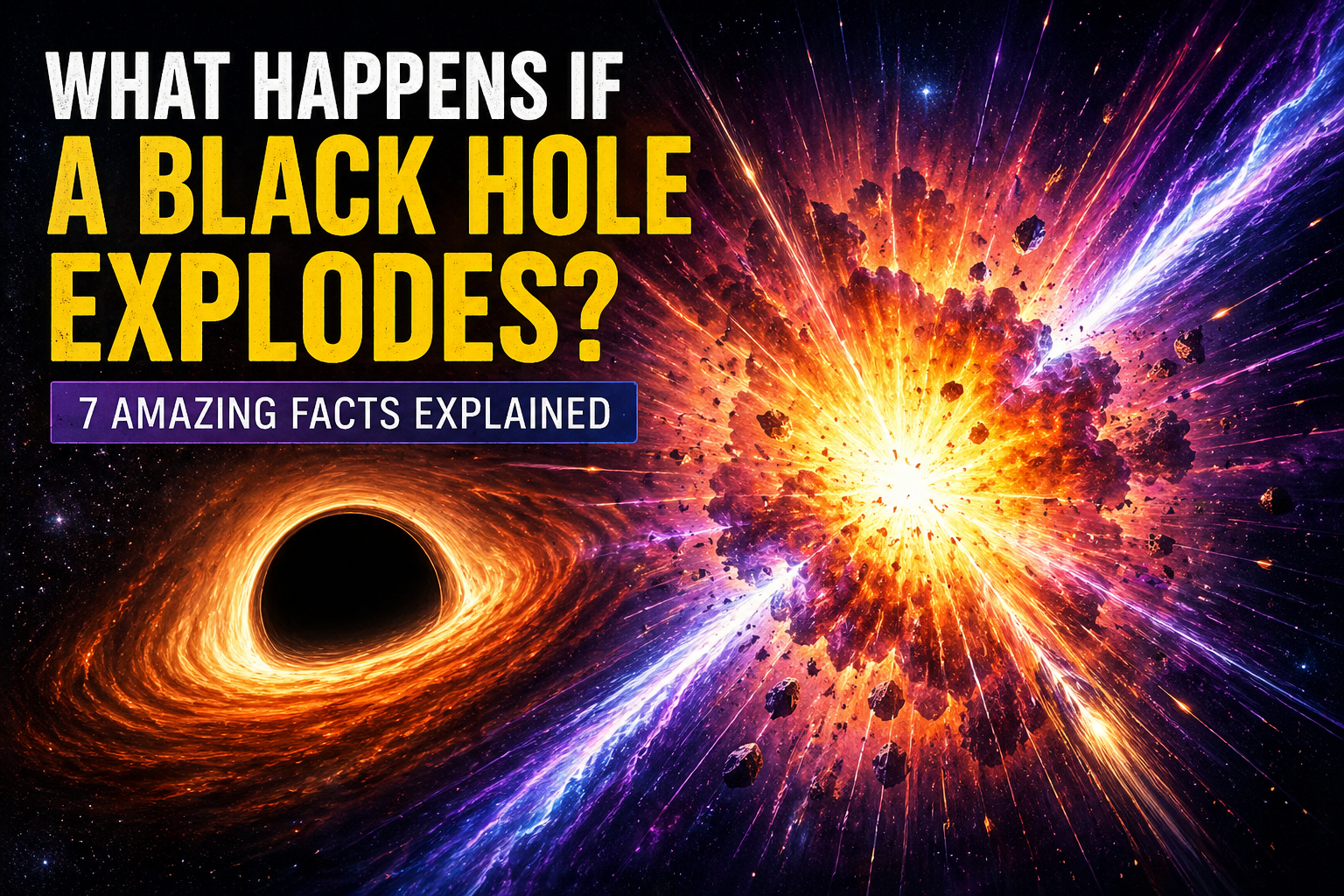
What Happens If a Black Hole Explodes? 7 Amazing Facts Explained
What happens if a black hole explodes? This question sounds like science fiction, but it is actually connected to one of the most fascinating ideas in modern astrophysics. Black holes are usually known as objects with gravity so strong that nothing, not even light, can escape once it crosses the event horizon. NASA explains that a black hole’s event horizon is the boundary where escape would require moving faster than light, which is impossible according to modern physics.
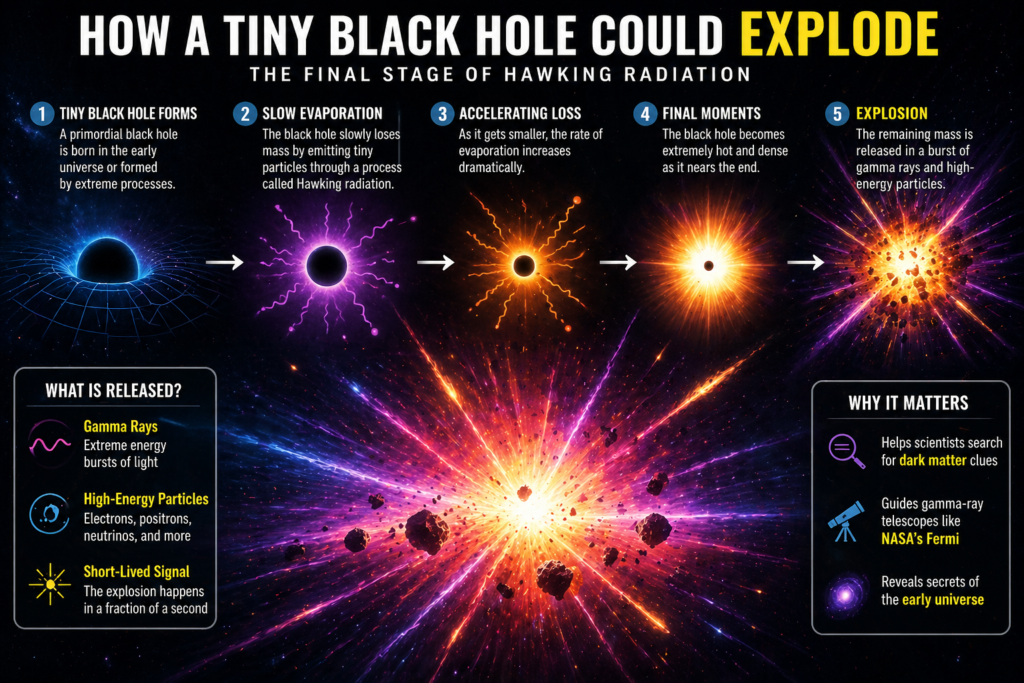
But there is a twist. Some theories suggest that very tiny black holes, especially hypothetical primordial black holes, may slowly lose energy through a process called Hawking radiation. If such a small black hole reached the final stage of evaporation, it could release a burst of high-energy particles and gamma rays. NASA-related Fermi material describes this final stage as a possible runaway explosion into gamma rays and other particles.
1. Understanding What Happens If a Black Hole Explodes
What Is a Black Hole?
A black hole is an extremely dense object where gravity is so powerful that nothing can escape from inside its event horizon. Black holes can form when massive stars collapse, and they can also grow by consuming matter or merging with other black holes. NASA notes that black holes may be surrounded by bright rings of gas and dust called accretion disks, which can glow strongly in X-rays and other wavelengths.
In simple words, a black hole is not empty space. It is a region where matter has been compressed so strongly that gravity dominates everything nearby.
Can a Black Hole Really Explode?
A normal stellar-mass black hole does not explode like a supernova. It does not suddenly burst outward like a star. Instead, it usually grows by pulling in matter or by merging with other black holes. NASA explains that black holes grow through accretion, the process of consuming surrounding matter.
However, tiny theoretical black holes are different. According to Hawking radiation theory, a very small black hole could slowly evaporate. Near the end of that process, the evaporation could become extremely rapid, creating what scientists describe as a burst of radiation.
2. Why Black Holes Usually Do Not Explode Like Stars
Black holes are very different from stars. A star can explode when its internal fuel runs out and its structure collapses violently. A black hole, however, is already an end-state object with an event horizon. It does not have a normal surface like a planet or star.
2.1 Event Horizon
The event horizon is the point of no return around a black hole. Once matter or light crosses it, it cannot escape back into normal space. NASA describes it as the boundary where the escape velocity becomes greater than the speed of light.
This is why the idea of a black hole “exploding” is not simple. Anything inside the event horizon cannot just burst outward in the normal way.
2.2 Accretion Disk
Many black holes are surrounded by an accretion disk. This disk is made of hot gas and dust spiraling around the black hole before falling in. NASA describes the accretion disk as the main light source around many black holes because the material becomes extremely hot before crossing the event horizon.
So when people see bright energy near a black hole, they are often seeing the surrounding matter, not the black hole itself.
2.3 Jets and High-Energy Radiation
Some black holes can launch powerful jets from regions near their poles. These jets do not come from inside the event horizon. Instead, they are connected to the extreme environment around the black hole, including magnetic fields and fast-moving matter. NASA explains that hot material around black holes can emit X-rays and other forms of energy.
This can look explosive, but it is not the same as the black hole itself exploding.
3. The Role of Hawking Radiation
The idea that black holes can slowly lose energy comes from physicist Stephen Hawking. This theoretical process is known as Hawking radiation. It suggests that black holes are not completely black forever. Over extremely long periods, they may emit tiny amounts of radiation and lose mass.
For large black holes, this process is incredibly slow. NASA’s Fermi science material explains that Hawking radiation is unobservable from stellar-mass black holes because the evaporation rate is much smaller for massive black holes.
But for tiny black holes, the situation changes. The smaller the black hole becomes, the faster it can lose mass. Near the end, the process could speed up dramatically.
4. Primordial Black Holes and the Explosion Theory
Primordial black holes are hypothetical black holes that may have formed in the first second after the birth of the universe. NASA says scientists theorize that these black holes could have formed from dense pockets of hot material in the early universe, with possible masses ranging from extremely tiny to much larger than the Sun.
This is where the black hole explosion idea becomes important. A tiny primordial black hole could, in theory, evaporate over cosmic time. If it reached its final stage today, it might release a short burst of high-energy radiation. NASA’s Fermi material says theoretical predictions suggest final-stage primordial black hole evaporation could produce gamma-ray bursts at very high energies.
Scientists have not confirmed such an event yet, but they continue to search for signs of primordial black hole evaporation. NASA says Fermi data is used to search for primordial black hole evaporation as part of dark matter research.
5. What Would a Black Hole Explosion Release?
If a tiny black hole reached its final evaporation stage, it would not explode like a fireball in a movie. Instead, it would likely release high-energy particles and gamma rays. NASA’s Fermi science guide describes the final stage of tiny black hole evaporation as a runaway process producing gamma rays and other particles.
The possible release could include:
Gamma Rays:
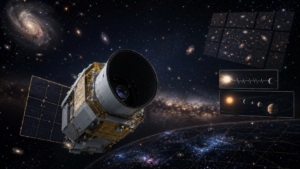
These are extremely energetic forms of light that telescopes like NASA’s Fermi Gamma-ray Space Telescope are designed to study.
High-Energy Particles:
The final stage could produce a shower of particles as the black hole loses mass rapidly.
Short-Lived Signal:
The event would likely be brief, meaning scientists would need sensitive instruments to detect it.
This is why black hole explosion searches are connected to high-energy astronomy.
6. Could Scientists Detect a Black Hole Explosion?
Yes, in theory, scientists could detect a black hole explosion if it produced a strong enough gamma-ray signal. NASA’s Fermi mission and other gamma-ray observatories are important because they observe some of the most energetic events in the universe. Fermi-related research has searched for gamma-ray signatures from evaporating primordial black holes, but non-observation has also been used to place limits on how common such events may be.
This means that even not finding a black hole explosion is useful. It helps scientists narrow down how many primordial black holes may exist and whether they could make up part of dark matter.
7. What People Get Wrong About Black Hole Explosions
Many people imagine a black hole explosion as a giant cosmic bomb. That is not accurate for normal black holes. A stellar-mass black hole would not simply burst outward and destroy nearby space. Its gravity and event horizon make it very different from ordinary explosive objects.
Another mistake is thinking black holes actively “suck in” everything across the universe. A black hole’s gravity works like any other massive object’s gravity at long distances. It only becomes extreme very close to the event horizon.
A third misunderstanding is thinking that any bright black hole image shows the black hole itself. In reality, the light usually comes from hot material around the black hole, especially the accretion disk. NASA explains that accretion disks are often the main source of light around black holes.
8. Why This Mystery Matters for Dark Matter and the Early Universe
The black hole explosion idea matters because it may help scientists understand the early universe and dark matter. NASA explains that primordial black holes are hypothetical objects that may have formed shortly after the Big Bang. Some theories suggest they could be connected to dark matter, one of the biggest unsolved mysteries in science.
If scientists ever detect a clear signal from an evaporating primordial black hole, it would be a major discovery. It could provide evidence for Hawking radiation, reveal new information about quantum physics, and help explain whether primordial black holes exist in meaningful numbers.
9. Beginner-Friendly Steps to Understand Black Hole Explosions
1. Understand the event horizon first.
The event horizon is the boundary where nothing can escape once it crosses inside.
2. Remember that normal black holes do not explode like stars.
Large black holes usually grow by accretion or mergers, not by sudden outward explosions.
3. Learn the idea of Hawking radiation.
This theory says black holes may slowly lose energy over time.
4. Focus on tiny primordial black holes.
The explosion theory mostly applies to very small hypothetical black holes from the early universe.
5. Think of the explosion as radiation, not fire.
A final-stage black hole explosion would likely release gamma rays and particles, not flames.
10. Frequently Asked Questions
What happens if a black hole explodes?
If a tiny black hole exploded through final-stage evaporation, it would likely release high-energy particles and gamma rays. This idea is mostly connected to hypothetical primordial black holes, not ordinary stellar black holes.
Can a normal black hole explode?
A normal stellar-mass black hole is not expected to explode like a star. It usually grows by accreting matter or merging with other black holes.
What is Hawking radiation?
Hawking radiation is a theoretical process proposed by Stephen Hawking in which black holes slowly emit radiation and lose mass over time. For large black holes, this process is extremely slow.
What are primordial black holes?
Primordial black holes are hypothetical black holes that may have formed in the first second after the birth of the universe.
Has a black hole explosion ever been observed?
No confirmed black hole explosion has been observed. Scientists use instruments such as Fermi to search for possible gamma-ray signals from evaporating primordial black holes.
Would a black hole explosion destroy Earth?
There is no evidence that a nearby black hole explosion is a realistic threat to Earth. The black hole explosion theory mainly concerns rare, tiny primordial black holes and high-energy signals that scientists would detect from space.
Why are scientists interested in exploding black holes?
Scientists are interested because detecting one could help confirm Hawking radiation, reveal information about the early universe, and possibly improve understanding of dark matter.
11. Conclusion
What happens if a black hole explodes? The answer depends on what kind of black hole we are talking about. A normal stellar-mass black hole does not explode like a star. It is more likely to grow by pulling in matter or by merging with other black holes. But a tiny hypothetical primordial black hole could, in theory, evaporate through Hawking radiation and release a final burst of gamma rays and particles.
This makes black hole explosions one of the most exciting ideas in modern space science. They connect black holes, quantum physics, gamma-ray astronomy, dark matter, and the earliest moments of the universe. For beginners, the simple explanation is this: large black holes do not explode like bombs, but tiny primordial black holes might end their lives in a powerful burst of radiation.