Kuiper Belt exploration is one of the most fascinating parts of modern space science because it takes us far beyond the familiar planets and into the frozen outer edge of the solar system. The Kuiper Belt is a distant region beyond Neptune filled with icy worlds, dwarf planets, comet-like bodies, and ancient leftovers from the formation of the solar system. For scientists, it is not just a cold and empty region of space. It is a natural archive that may preserve clues from the earliest days of planetary history.
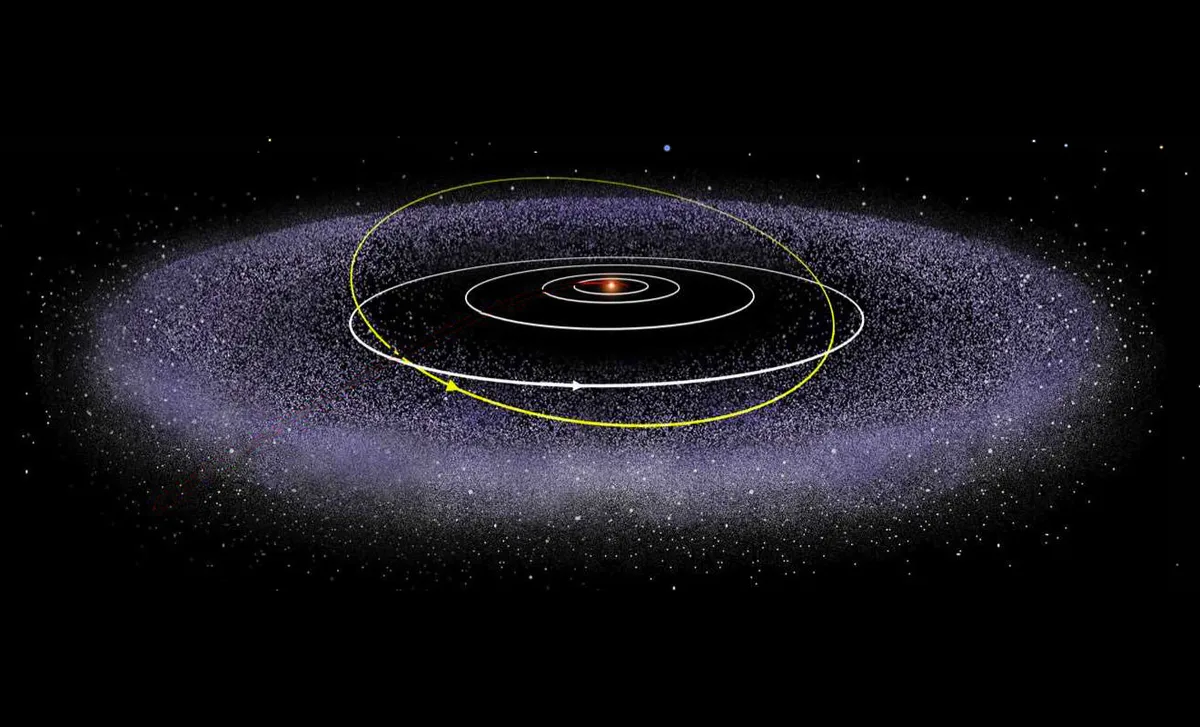
In simple words, the Kuiper Belt is a huge zone of icy objects beyond Neptune. It is home to Pluto, Arrokoth, many dwarf planets, and countless smaller bodies. NASA describes the Kuiper Belt as a doughnut-shaped region of icy objects beyond Neptune, containing Pluto, many known dwarf planets, and some comets. This makes it one of the most important regions for understanding how the outer solar system formed.
For many years, the Kuiper Belt was known mainly through telescope observations. Scientists could detect distant objects, estimate their orbits, and study their brightness, but they could not see their surfaces in detail. That changed when NASA’s New Horizons spacecraft flew past Pluto in 2015 and later visited Arrokoth in 2019. These flybys proved that Kuiper Belt objects are not boring frozen rocks. They can be complex, strange, ancient, and scientifically valuable.
This article explains what Kuiper Belt exploration means, what NASA has already achieved, what is confirmed, what remains only a future possibility, and why this distant region matters for the future of planetary science.
What Is the Kuiper Belt?
The Kuiper Belt is a wide region of the solar system located beyond the orbit of Neptune. It begins roughly around Neptune’s orbit and stretches outward into the distant solar system. NASA describes it as a region filled with icy bodies, dwarf planets, and small objects left over from the early formation of the solar system.
The Kuiper Belt is sometimes called the “third zone” of the solar system. The first zone includes the rocky inner planets such as Mercury, Venus, Earth, and Mars. The second zone includes the giant planets such as Jupiter, Saturn, Uranus, and Neptune. The third zone is the Kuiper Belt, where many icy bodies orbit far from the Sun.
Unlike the asteroid belt between Mars and Jupiter, which contains mostly rocky and metallic objects, the Kuiper Belt contains icy objects. These bodies may include frozen water, methane, ammonia, nitrogen, and other volatile materials. Because the Kuiper Belt is extremely far from the Sun, many of these materials can remain frozen for billions of years.
The most famous Kuiper Belt object is Pluto. Pluto was once known as the ninth planet, but it is now classified as a dwarf planet. However, its scientific importance has not decreased. Pluto remains one of the most studied and most interesting worlds in the Kuiper Belt. Other known Kuiper Belt-related dwarf planets include Haumea, Makemake, and Eris.
If you want to explore more space topics on Sanceen, visit our Space & Beyond section.
Why Kuiper Belt Exploration Matters
Kuiper Belt exploration matters because this region contains material from the early solar system. Scientists believe many Kuiper Belt objects are ancient planetesimals. Planetesimals are small bodies that formed during the early stages of planet formation. Some planetesimals collided and grew into planets, while others remained small and preserved their original characteristics.
This makes the Kuiper Belt a scientific time capsule. By studying objects in this region, researchers can learn about the ingredients that existed when the planets were forming. These icy bodies may reveal how planets grew, how the giant planets moved, and how water-rich and organic-rich material spread across the young solar system.
The Kuiper Belt also helps scientists understand comets. Some short-period comets are believed to come from the Kuiper Belt or related outer solar system populations. When these icy objects move closer to the Sun, heat causes their frozen material to vaporize, creating the glowing comas and tails we associate with comets.
In other words, exploring the Kuiper Belt helps answer deep scientific questions. Where did the planets come from? What were the original building blocks of the solar system like? How did small icy objects become comets? Why are some dwarf planets active and complex while others remain primitive and quiet?
These questions are not only about distant objects. They are also about the history of Earth and the entire solar system.
NASA’s Role in Kuiper Belt Exploration
NASA has played the most important role in direct Kuiper Belt exploration so far. The key mission is NASA’s New Horizons mission, which was launched in 2006. New Horizons was designed to study Pluto, its moons, and other objects in the Kuiper Belt.
Before New Horizons, Pluto was mostly a small blurry point in telescope images. Scientists knew it existed, knew it had moons, and could estimate some properties, but they had never seen its surface clearly. New Horizons changed that completely.
On July 14, 2015, New Horizons flew past Pluto and sent back the first close-up images of the dwarf planet. Those images revealed mountains, plains, glaciers, haze layers, craters, and complex surface patterns. Pluto turned out to be far more active and interesting than many people expected.
One of the most famous features discovered on Pluto is a bright heart-shaped region called Tombaugh Regio. Part of this region, known as Sputnik Planitia, appears to be a large plain of nitrogen ice. The discovery showed that Pluto has active geological processes, even though it is extremely far from the Sun.
This was a major lesson for planetary science. It showed that small icy worlds can be dynamic. Distance from the Sun does not automatically mean a world is geologically dead.
For more NASA-related space explainers, visit our NASA category.
New Horizons and the Pluto Flyby
The Pluto flyby was one of the most important moments in modern planetary exploration. New Horizons traveled for more than nine years before reaching Pluto. Because the spacecraft was moving very fast, it could not stop and enter orbit. Instead, it performed a high-speed flyby, collecting as much data as possible during a short encounter.
During the flyby, New Horizons studied Pluto’s surface, atmosphere, temperature, geology, and moons. It also studied Charon, Pluto’s largest moon. Charon surprised scientists with canyons, cliffs, and varied surface regions. The Pluto system turned out to be far more complex than a simple frozen dwarf planet and its moons.
The flyby helped scientists understand that Pluto has a thin atmosphere, icy mountains, large plains, and evidence of surface renewal. These findings made Pluto one of the most interesting worlds in the outer solar system.
This is why future Kuiper Belt exploration is so important. If Pluto could surprise scientists so much, then other distant icy worlds may also hold unexpected discoveries.
You can also read our related article on NASA Pluto flyby follow-up mission concepts, but remember that future mission ideas should be treated as concepts unless NASA officially selects them.
Arrokoth: A Primitive Kuiper Belt Object
After Pluto, New Horizons continued deeper into the Kuiper Belt. Its next major target was Arrokoth, previously known as 2014 MU69. On January 1, 2019, New Horizons flew past Arrokoth, making it the most distant object ever visited up close by a spacecraft at that time.
Arrokoth is important because it is very primitive. It has likely remained cold and relatively unchanged for billions of years. NASA describes Arrokoth as a Kuiper Belt object that may represent the building blocks of Pluto and other planet-like bodies.
The shape of Arrokoth is especially interesting. It looks like two connected lobes, almost like a flattened snowman. This suggests that it may have formed when two smaller objects gently came together rather than crashing violently. That gives scientists clues about how small bodies formed in the early solar system.
Arrokoth showed that Kuiper Belt objects can preserve ancient formation history. It also proved that close-up spacecraft exploration can reveal details that telescopes cannot provide. From Earth, Arrokoth was just a faint point of light. New Horizons turned it into a real world with shape, color, structure, and scientific meaning.
What Is Confirmed About NASA Kuiper Belt Exploration?
It is important to separate confirmed facts from future possibilities. This is especially important for AdSense approval because articles that make unsupported claims can look misleading or low-quality.
Here is what is confirmed:
NASA’s New Horizons mission successfully explored Pluto in 2015.
New Horizons successfully flew past Arrokoth in 2019.
New Horizons continues to travel through the outer solar system.
NASA announced that New Horizons operations would continue until the spacecraft exits the Kuiper Belt, expected around 2028 through 2029.
The Kuiper Belt remains an important scientific region for studying icy bodies, dwarf planets, comets, and early solar system material.
What is not confirmed is a specific new NASA “Kuiper Belt Explorer 2026” mission. Unless NASA officially announces and selects a mission, it should not be presented as confirmed. A safer and more accurate way to discuss the topic is to call it “NASA concepts and future mission possibilities.”
This wording protects your article from sounding misleading. It also improves trust because readers can clearly understand the difference between real missions and possible future ideas.
Future Mission Possibilities for Kuiper Belt Exploration
Future Kuiper Belt exploration could happen in several ways. One possibility is another flyby mission similar to New Horizons. A spacecraft could be launched toward a selected Kuiper Belt object, use gravity assists from planets, and fly past one or more distant targets. This type of mission would be scientifically valuable because it could reveal new worlds in close detail.
Another possibility is a Pluto orbiter. Unlike New Horizons, which flew past Pluto, an orbiter would slow down and remain around Pluto for a longer time. This would allow scientists to study Pluto’s surface, atmosphere, moons, and seasonal changes in much greater detail. However, a Pluto orbiter would be technically difficult because slowing down in the outer solar system requires a lot of energy.
A third possibility is a mission to another dwarf planet or large Kuiper Belt object. Scientists may want to compare Pluto with other icy worlds such as Makemake, Haumea, or Eris. Each of these objects could teach us something different about the outer solar system.
A fourth possibility is an interstellar probe that passes through the Kuiper Belt on its way beyond the solar system. Such a mission could study Kuiper Belt dust, plasma, icy bodies, and the environment where the Sun’s influence begins to weaken.
These future possibilities are exciting, but they should be described carefully. They are concepts, proposals, or scientific goals unless officially selected by NASA.
Why Kuiper Belt Missions Are So Difficult
Kuiper Belt missions are extremely difficult because the region is very far away. The distance creates several major challenges.
The first challenge is travel time. New Horizons took more than nine years to reach Pluto. A future spacecraft may also need many years or even decades to reach its target. This means the mission must be designed to operate reliably for a very long time.
The second challenge is power. Solar panels become less effective far from the Sun because sunlight is much weaker in the outer solar system. Spacecraft traveling to the Kuiper Belt often need radioisotope power systems, which generate electricity from heat produced by radioactive decay.
The third challenge is communication. Signals from spacecraft in the Kuiper Belt take hours to reach Earth. This means scientists cannot control the spacecraft instantly. The spacecraft must be able to follow commands, handle problems, and collect data with a high level of autonomy.
The fourth challenge is target selection. Kuiper Belt objects are usually small, dark, and far away. Finding a reachable object requires powerful telescopes and careful calculations. Even after a spacecraft is launched, scientists may need to search for possible targets along its path.
The fifth challenge is cost. Outer solar system missions require advanced technology, long mission timelines, strong engineering, and specialized power systems. This makes them expensive and difficult to approve compared with simpler missions closer to Earth.
What Scientists Could Learn from Future Kuiper Belt Missions
Future Kuiper Belt missions could help scientists understand many important topics.
One major topic is surface composition. Scientists want to know what materials exist on Kuiper Belt objects. Are they rich in water ice, methane ice, nitrogen ice, ammonia, or organic compounds? Surface materials can reveal where an object formed and how it changed over time.
Another topic is geology. Pluto showed signs of active geology, including icy plains and possible surface renewal. A future mission could help determine whether Pluto is unusual or whether other Kuiper Belt objects are also geologically active.
Another important topic is impact history. Craters can reveal how often objects in the outer solar system collide. By studying craters on Kuiper Belt objects, scientists can learn about the population of smaller bodies in the region.
Future missions could also study moons and rings. Many Kuiper Belt objects may have moons. Some may even have ring systems or unusual debris around them. These features can help scientists understand how small outer solar system bodies interact gravitationally.
The Kuiper Belt may also contain clues about planetary migration. Scientists believe the giant planets may have moved from their original positions early in solar system history. This movement could have scattered many icy bodies into different orbits. Studying Kuiper Belt objects helps test these ideas.
For a related explanation of how gravity shapes objects in space, read our article on why planets have rings.
The Role of Telescopes in Kuiper Belt Exploration
Spacecraft missions are powerful, but telescopes are also essential for Kuiper Belt exploration. Telescopes help scientists discover new Kuiper Belt objects, track their orbits, estimate their sizes, and select possible spacecraft targets.
Ground-based observatories and space telescopes can observe distant icy bodies even before a mission is planned. They can measure brightness, color, motion, and sometimes surface composition. This information helps scientists decide which objects are most interesting.
Telescopes can also observe stellar occultations. A stellar occultation happens when a Kuiper Belt object passes in front of a distant star. By measuring how the star’s light dims, scientists can estimate the size, shape, atmosphere, or rings of the object.
Without telescope surveys, missions like New Horizons would be much harder to plan. The Arrokoth target was identified after careful searches. This shows that telescope work and spacecraft exploration are connected. Telescopes find the targets, and spacecraft reveal them in detail.
NASA also uses advanced mapping and imaging methods in other planetary missions. You can read more in our article on how NASA maps the surface of Mars.
What People Often Get Wrong About the Kuiper Belt
Many people think the Kuiper Belt is empty space. This is wrong. The region contains many icy bodies, dwarf planets, and smaller objects. It is not densely packed like a science-fiction asteroid field, but it is scientifically rich.
Another common misunderstanding is that Pluto is the only important object in the Kuiper Belt. Pluto is important, but it is only one member of a much larger population. Arrokoth showed that even small objects can teach scientists something valuable.
A third mistake is thinking every NASA-related future space idea is already confirmed. This is not true. NASA studies many concepts, but only some become selected missions. Articles should make this difference clear.
Another mistake is assuming cold worlds are inactive. Pluto proved that even distant icy worlds can have complex surfaces and surprising activity. Future Kuiper Belt exploration may reveal more unexpected processes.
Finally, some people confuse the Kuiper Belt with the Oort Cloud. The Kuiper Belt is beyond Neptune but still much closer than the Oort Cloud. The Oort Cloud is a much more distant theoretical region believed to contain many icy bodies surrounding the solar system.
Why the Kuiper Belt Matters for the Future of Space Science
The Kuiper Belt matters because it connects many areas of space science. It helps explain planet formation, comet origins, dwarf planets, icy geology, and the structure of the outer solar system. It also helps scientists understand how our solar system compares with other planetary systems around other stars.
Many stars have distant debris disks made of dust and icy material. By studying the Kuiper Belt, scientists can better understand those distant systems. Our own Kuiper Belt acts like a nearby example of the kind of outer debris disk that may exist around other stars.
Kuiper Belt exploration also expands human knowledge of the solar system. For centuries, people studied the planets visible to the naked eye. Later, telescopes revealed Uranus, Neptune, Pluto, and many smaller worlds. Now spacecraft allow us to explore these places directly.
Each mission changes our understanding. New Horizons showed that Pluto is complex. Arrokoth showed that small primitive bodies can preserve ancient formation clues. Future missions may reveal even more about the frozen frontier beyond Neptune.
Frequently Asked Questions
What is Kuiper Belt exploration?
Kuiper Belt exploration is the study of icy objects beyond Neptune. It includes telescope observations, spacecraft flybys, mission concepts, and scientific research focused on Pluto, Arrokoth, dwarf planets, comets, and other distant bodies.
Has NASA explored the Kuiper Belt?
Yes. NASA’s New Horizons mission explored Pluto in 2015 and Arrokoth in 2019. It remains the most important spacecraft mission connected to Kuiper Belt exploration.
Is there a confirmed NASA Kuiper Belt Explorer mission for 2026?
No confirmed dedicated NASA Kuiper Belt Explorer 2026 mission should be presented as fact unless NASA officially announces it. The accurate wording is “NASA concepts and future mission possibilities.”
Why is Pluto important for Kuiper Belt exploration?
Pluto is one of the largest and most famous Kuiper Belt objects. NASA’s New Horizons flyby showed that Pluto has mountains, plains, glaciers, haze layers, and complex surface features.
Why is Arrokoth important?
Arrokoth is important because it is a primitive Kuiper Belt object that may preserve clues from the early solar system. Its two-lobed shape suggests a gentle formation process.
Why is the Kuiper Belt hard to explore?
The Kuiper Belt is difficult to explore because it is extremely far away. Spacecraft need long travel times, reliable power systems, strong communication systems, and carefully planned trajectories.
What could future Kuiper Belt missions study?
Future missions could study surface composition, geology, craters, moons, rings, dwarf planets, comet origins, and the early building blocks of the solar system.
Conclusion
Kuiper Belt exploration is one of the most important frontiers in planetary science. This distant region beyond Neptune contains Pluto, Arrokoth, dwarf planets, icy bodies, comet-like objects, and ancient material from the birth of the solar system. It is not just a frozen outer zone. It is a scientific archive that can help explain how planets formed and how the solar system evolved.
NASA’s New Horizons mission gave humanity its first close-up look at Pluto and Arrokoth. These discoveries changed the way scientists think about the outer solar system. Pluto turned out to be active and complex, while Arrokoth revealed clues about gentle planetesimal formation.
The future of Kuiper Belt exploration may include new flyby missions, Pluto orbiter concepts, dwarf planet missions, telescope surveys, and even interstellar probes that study the Kuiper Belt on their way beyond the solar system. However, it is important to describe these ideas accurately. Unless NASA officially selects a mission, they should be called concepts, proposals, or future possibilities.
For readers, the simplest way to understand the topic is this: the Kuiper Belt is where the solar system keeps many of its oldest frozen clues. Exploring it helps scientists understand where planets came from, how icy worlds formed, and what lies near the edge of the Sun’s influence.