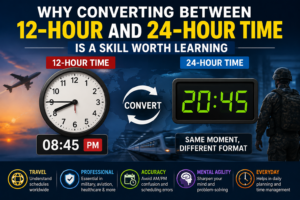
Most people are familiar with the traditional 12-hour clock, dividing the day into AM and PM. While this system works well for everyday life, it can sometimes create confusion—especially when accuracy and clear communication are essential. Is 7:00 in the morning or the evening? Was the meeting scheduled for 8:00 AM or 8:00 PM? In many situations, these small misunderstandings can have significant consequences.
This is one of the main reasons why military time, also known as the 24-hour clock, is used by armed forces, emergency services, healthcare professionals, aviation, transportation, and organizations around the world.
Although the term “military time” may sound intimidating, the system itself is surprisingly simple. Once you understand its basic principles, reading and converting military time becomes second nature. More importantly, learning this format can improve communication, reduce errors, and make international travel and professional interactions much easier.
Whether you’re a student, traveler, healthcare worker, emergency responder, or simply someone interested in expanding practical life skills, understanding military time is an investment that pays off in many ways.
What Is Military Time?
Military time is a method of telling time using a 24-hour clock rather than dividing the day into AM and PM.
Instead of restarting the clock after noon, the hours continue increasing until midnight.
For example:
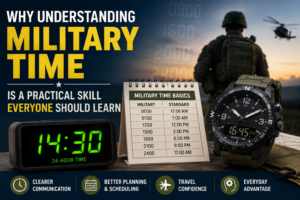
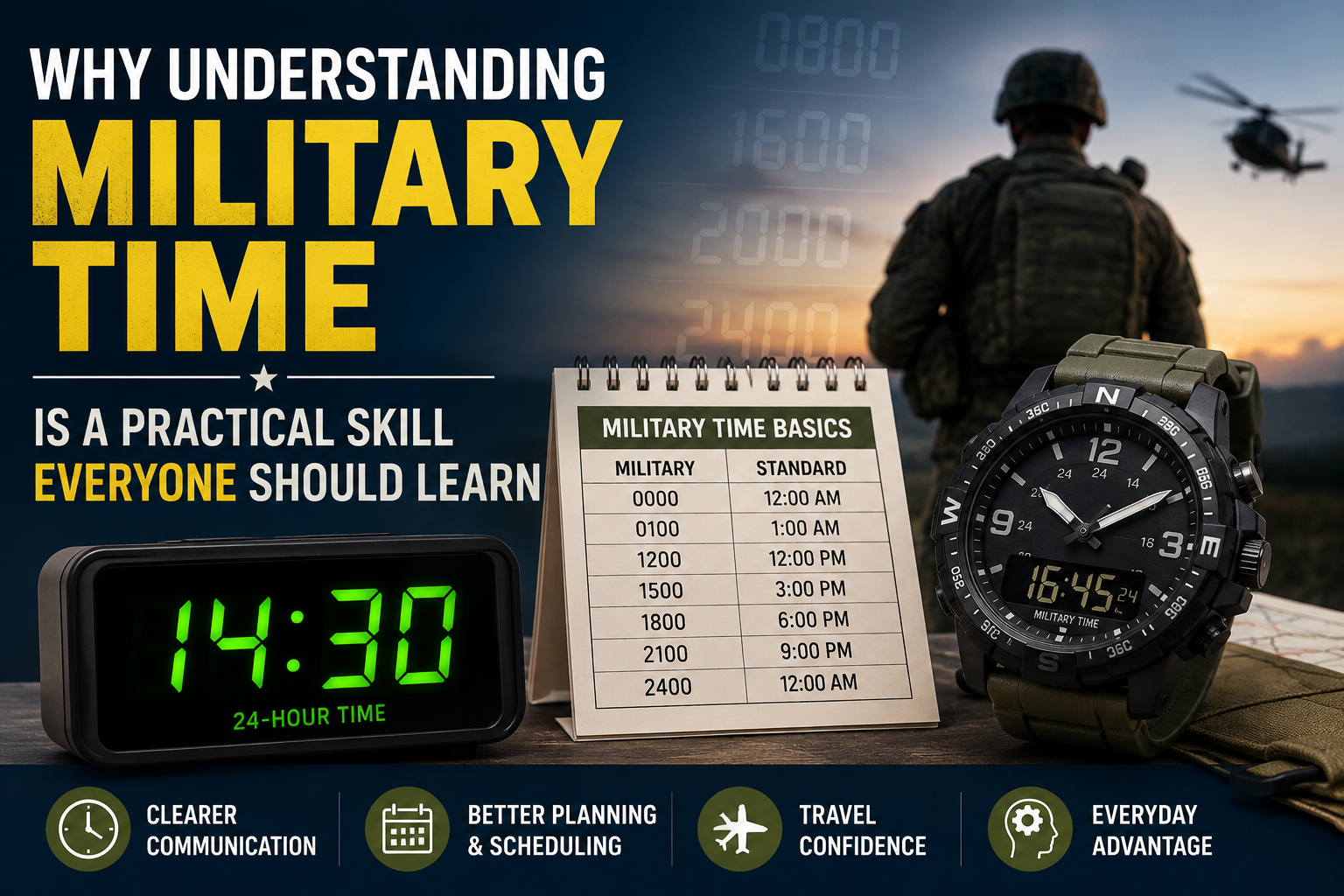
- 12:00 AM becomes 0000
- 6:00 AM becomes 0600
- 12:00 PM remains 1200
- 3:00 PM becomes 1500
- 7:00 PM becomes 1900
- 11:00 PM becomes 2300
Midnight marks the beginning of a new day, returning to 0000.
Because every hour has a unique number, there is no possibility of confusing morning with evening.
This straightforward approach is why military time has become the preferred system in professions where precision matters.
Why the 24-Hour Clock Reduces Confusion
Imagine receiving the following instruction:
“Meet at 8:00.”
Without additional context, it’s impossible to know whether that refers to morning or evening.
Now compare it with:
“Meet at 2000.”
There is no ambiguity.
Everyone understands that the meeting begins at 8:00 PM.
This clarity becomes especially important in environments where even minor misunderstandings can create serious problems.
Hospitals schedule surgeries.
Pilots coordinate flights.
Railway operators manage departures.
Emergency responders organize rescue efforts.
Military units coordinate operations.
In all of these situations, accurate communication saves time—and sometimes lives.
Industries That Depend on Military Time
Although commonly associated with armed forces, military time is used across numerous professions.
Healthcare
Doctors, nurses, pharmacists, and hospital administrators often record patient information using the 24-hour clock.
Medication schedules, surgery times, and emergency procedures all require exact timing.
Using military time prevents accidental confusion between morning and evening treatments.
Aviation
Pilots and air traffic controllers work across multiple time zones every day.
Using standardized time formats reduces misunderstandings between airports and flight crews.
Accuracy is critical for flight planning and safety.
Emergency Services
Police officers, firefighters, and paramedics frequently document incidents using military time.
Dispatch records, emergency calls, and incident reports all rely on precise timestamps.
Transportation
Railways, shipping companies, logistics providers, and public transportation systems often schedule operations using the 24-hour format.
Passengers traveling internationally frequently encounter departure boards displaying military time.
International Business
Companies operating across multiple countries often adopt the 24-hour clock for scheduling meetings and managing global teams.
This creates consistency regardless of regional differences.
Everyday Benefits of Learning Military Time
Even if your career doesn’t require military time, understanding it offers several practical advantages.
Easier International Travel
Many countries use the 24-hour clock for:
- Train schedules
- Flight information
- Hotel bookings
- Public transportation
- Event tickets
Travelers who understand military time can read schedules more confidently.
Better Time Management
Some people find the 24-hour format more organized because every hour has a unique identifier.
Planning calendars and digital schedules often becomes simpler.
Reduced Scheduling Errors
Using military time removes uncertainty from appointments, reminders, and work schedules.
There’s no need to specify AM or PM because the number already provides that information.
Common Misconceptions About Military Time
Many beginners assume military time is difficult to learn.
In reality, only a few simple rules are required.
Myth 1: You Need to Memorize Everything
Most people naturally remember common conversions after only a few days.
For example:
- 1300 = 1 PM
- 1500 = 3 PM
- 1800 = 6 PM
- 2100 = 9 PM
Regular exposure quickly builds familiarity.
Myth 2: Only Soldiers Use It
While military organizations popularized the system, millions of civilians use the 24-hour clock every day.
Healthcare, aviation, transportation, manufacturing, law enforcement, and many international businesses all rely on it.
Myth 3: It’s Too Complicated
Once you understand that afternoon hours simply continue counting beyond 12, the system becomes remarkably logical.
Simple Tips for Learning Military Time
Learning military time doesn’t require hours of study.
Here are a few practical strategies.
Practice Daily
Whenever you look at your phone or computer, mentally convert the displayed time into the 24-hour format.
Use Real-Life Examples
Think about your daily routine.
Breakfast at 0800.
Lunch at 1200.
Dinner at 1900.
Bedtime at 2200.
Connecting numbers to familiar activities speeds learning.
Learn Common Afternoon Conversions
Many people memorize these first:
1300 = 1 PM
1400 = 2 PM
1500 = 3 PM
1600 = 4 PM
1700 = 5 PM
1800 = 6 PM
After mastering these, the remaining hours become much easier.
Helpful Resources for Beginners
While many people learn military time through repetition, visual references can make the process much faster.
If you’re just getting started, referring to a Military time chart is an easy way to understand how standard 12-hour times correspond to the 24-hour clock used in military operations, healthcare, aviation, emergency services, and many other professional settings. A simple chart provides a quick reference that helps reinforce conversions until they become second nature.
Why Children Can Benefit Too
Teaching children the 24-hour clock introduces them to an internationally recognized time system while strengthening mathematical thinking.
Many educational programs introduce military time during primary or middle school because it develops:
- Logical reasoning
- Pattern recognition
- Number confidence
- Time management skills
Understanding both clock formats prepares students for future travel, education, and careers.
Technology Has Made Military Time More Common
Modern smartphones, computers, smartwatches, and digital calendars allow users to switch between 12-hour and 24-hour formats instantly.
Many people accidentally encounter military time after changing device settings or traveling abroad.
Rather than viewing it as confusing, becoming familiar with the system allows users to adapt more quickly to different technologies and environments.
Looking Ahead
As workplaces become increasingly global, standardized communication becomes even more valuable.
The 24-hour clock removes unnecessary ambiguity and creates consistency across industries, countries, and cultures.
Whether you’re coordinating an international meeting, catching a train overseas, reading a medical report, or simply organizing your personal schedule, understanding military time is a practical skill that enhances everyday communication.
Final Thoughts
Military time is much more than a system used by the armed forces. It is an internationally recognized method of expressing time with greater precision and clarity. By eliminating the need for AM and PM, it reduces misunderstandings and supports accurate communication in healthcare, transportation, aviation, emergency services, business, and countless other fields.
Fortunately, learning military time is far easier than many people expect. With a little daily practice and the help of clear visual references, anyone can become comfortable reading and using the 24-hour clock.
As our world becomes increasingly connected, practical skills like understanding military time continue to grow in value. Whether for work, travel, education, or everyday organization, it’s a simple skill that can make communication clearer and scheduling more reliable.