Time is one of the few things every person relies on every single day. We schedule meetings, catch flights, attend appointments, plan meals, and organize our routines around the clock. Yet despite how familiar timekeeping seems, many people still become confused when switching between the traditional 12-hour clock and the 24-hour format.
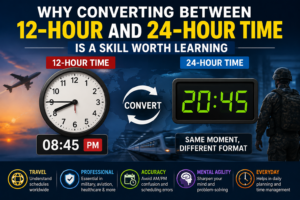
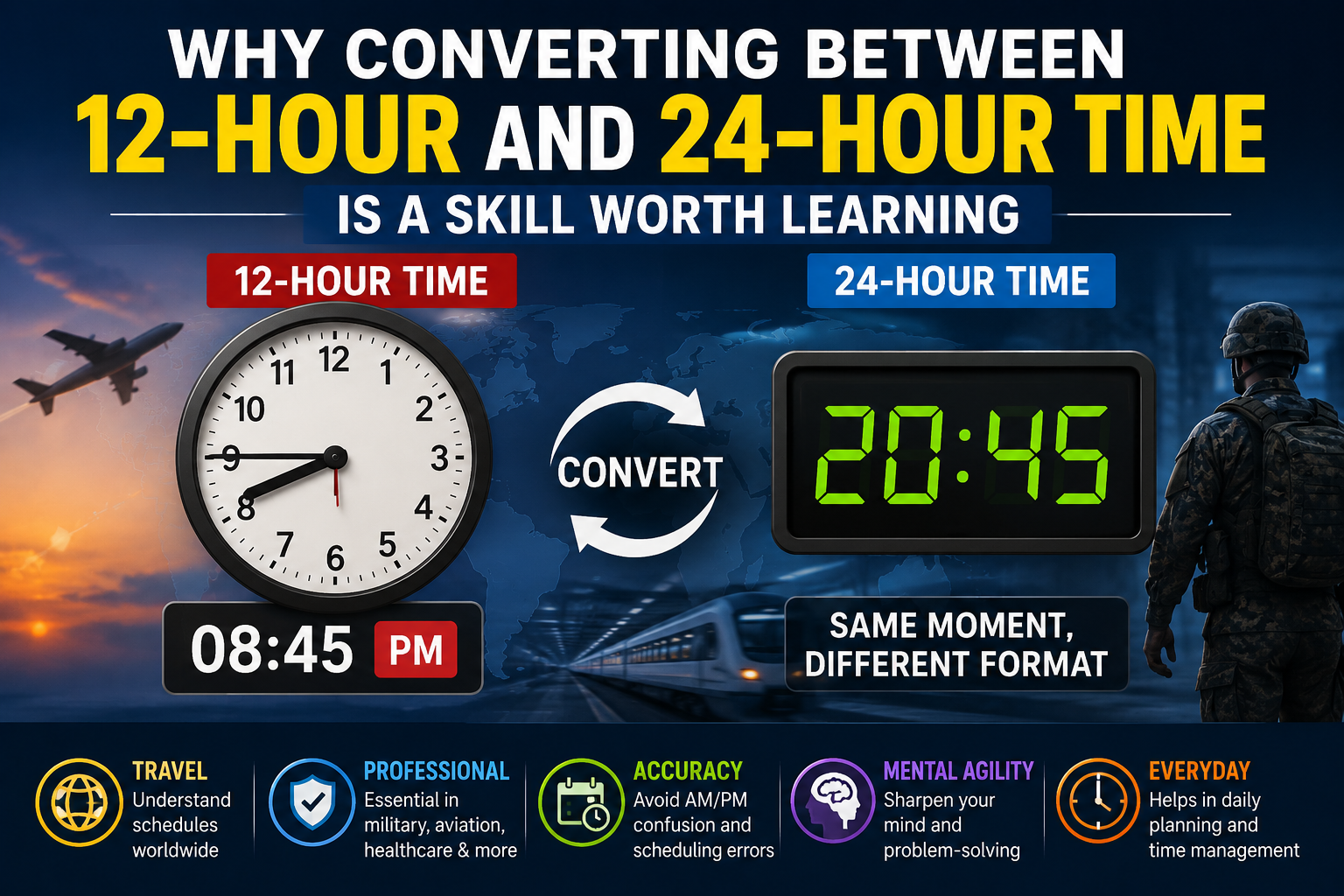
This confusion usually appears while traveling internationally, reading transportation schedules, working in healthcare, communicating with military personnel, or using digital devices configured to display military time. A simple misunderstanding between 7:00 AM and 7:00 PM may seem minor, but in professional settings it can lead to missed appointments, delayed travel, or costly mistakes.
Fortunately, converting between the two systems is much easier than many people imagine. Once you understand a few simple rules, changing between standard time and military time becomes almost automatic.
Whether you’re a student, traveler, healthcare worker, business professional, or simply someone who enjoys learning practical skills, understanding how to convert between these two time formats can improve both confidence and everyday efficiency.
Understanding the Two Time Systems
The world primarily uses two methods of displaying time.
The first is the 12-hour clock, which divides the day into AM (morning) and PM (afternoon and evening). This is the format commonly used in countries such as the United States, Canada, Australia, and several others.
The second is the 24-hour clock, often referred to as military time. Instead of restarting the clock after noon, the hours continue counting upward until midnight.
For example:
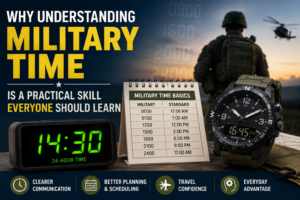
- 1:00 PM becomes 1300
- 2:00 PM becomes 1400
- 5:00 PM becomes 1700
- 8:00 PM becomes 2000
- 11:00 PM becomes 2300
Because every hour has a unique number, there is no need to specify AM or PM.
Why Accurate Time Conversion Matters
Most people rarely think about time conversion until they encounter a situation where accuracy matters.
Imagine arriving at an airport twelve hours early because you misunderstood a departure time. Or taking medication at the wrong hour because you misread a hospital schedule. While these examples may sound extreme, similar mistakes happen every day.
Professionals working in healthcare, aviation, emergency response, logistics, and international business rely on accurate time conversion because even small misunderstandings can disrupt operations.
Learning the basics of both systems eliminates unnecessary confusion.
Common Situations Where You’ll Encounter Military Time
Even if your job doesn’t require military time, you’ll probably encounter it more often than you expect.
International Travel
Many countries display train schedules, airline departures, hotel reservations, and public transportation timetables using the 24-hour clock.
Understanding these schedules helps travelers avoid mistakes.
Healthcare
Hospitals commonly document patient records, medication schedules, laboratory reports, and surgical procedures using military time.
This minimizes ambiguity.
Aviation
Pilots, flight dispatchers, and airport staff coordinate thousands of flights every day using standardized time formats.
Manufacturing and Logistics
Factories, warehouses, and transportation companies frequently operate around the clock.
Military time creates consistent scheduling across multiple work shifts.
Digital Technology
Many smartphones, smartwatches, computers, and fitness devices allow users to switch between 12-hour and 24-hour displays.
Understanding both formats makes using these devices much easier.
The Basic Conversion Rules
Fortunately, conversion follows predictable patterns.
Morning Hours
Midnight through 11:59 AM remain almost identical.
Examples include:
- 6:30 AM → 0630
- 9:45 AM → 0945
- 11:15 AM → 1115
Afternoon and Evening
After noon, simply add 12 to the hour.
Examples:
- 1:00 PM → 1300
- 4:20 PM → 1620
- 7:45 PM → 1945
- 10:30 PM → 2230
These simple rules cover nearly every conversion.
Common Mistakes Beginners Make
Many people accidentally add 12 to noon.
Remember:
12:00 PM remains 1200, not 2400.
Likewise, midnight becomes 0000, marking the beginning of a new day.
Another common mistake is forgetting leading zeros.
For example:
6:00 AM should be written as 0600, not simply 600.
Paying attention to these small details improves accuracy.
Tips for Learning Faster
Like any new skill, regular exposure builds confidence.
Try changing your phone to the 24-hour clock for one week.
After a few days, you’ll begin recognizing common afternoon times without needing to calculate them.
Another helpful exercise is mentally converting appointment times throughout the day.
If lunch is scheduled for 1:00 PM, think of it as 1300.
If dinner begins at 7:00 PM, think of it as 1900.
Small daily exercises reinforce learning naturally.
Helpful Tools Can Speed Up the Process
Although many people quickly learn the conversion rules, there are situations where a quick reference can save time and reduce uncertainty.
Using a military time converter is especially helpful for students, travelers, healthcare workers, and anyone who occasionally needs to switch between the 12-hour and 24-hour clock. It provides an easy way to verify conversions while building familiarity with both systems.
Over time, most users find themselves relying on these tools less as the conversion process becomes second nature.
Why Learning Both Systems Matters
Global communication continues to grow.
Businesses operate across multiple countries.
Students study abroad.
Families travel internationally.
Healthcare systems collaborate worldwide.
Understanding both time formats improves communication regardless of location.
Rather than viewing military time as something used only by the armed forces, it is better understood as a universal language for accurate scheduling.
Final Thoughts
Converting between standard time and military time is a simple but valuable skill that supports clearer communication in everyday life. Whether you’re reading travel itineraries, managing work schedules, using digital devices, or collaborating with people in different countries, understanding both formats reduces confusion and improves confidence.
The good news is that mastering time conversion doesn’t require advanced mathematics or extensive memorization. With a few basic rules, regular practice, and occasional use of reliable reference tools, anyone can become comfortable moving between the 12-hour and 24-hour clock.
As our lives become increasingly connected through travel, technology, and international communication, knowing how to convert time accurately is a practical ability that will continue to serve people well for years to come.